
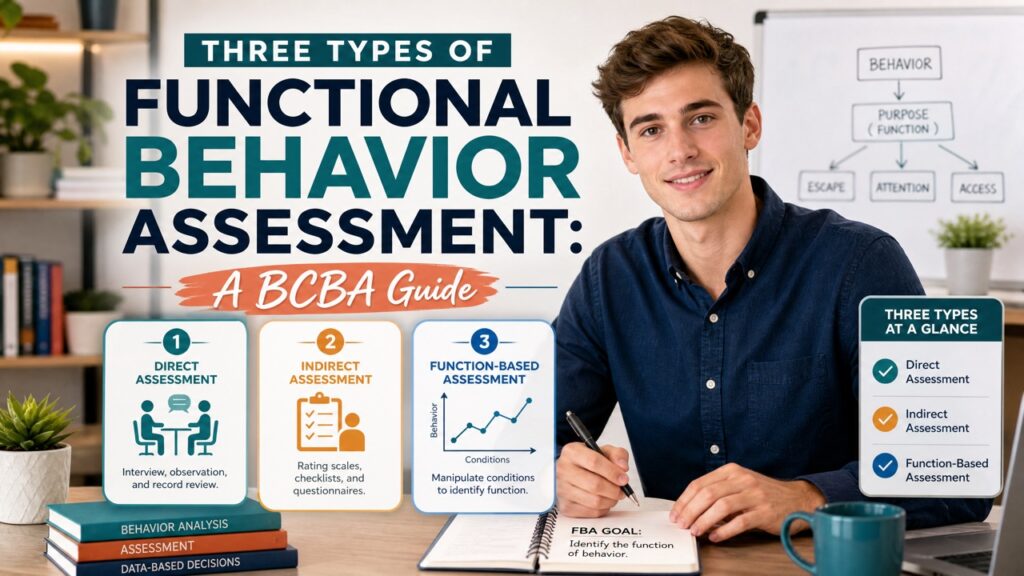
When preparing for the BCBA exam, few topics are as central as functional behavior assessment (FBA). You will encounter FBA concepts across multiple sections of the task list, from assessment to intervention. Understanding the three types of functional behavior assessment is not just about passing a test—it is about making ethical, effective decisions for the clients you serve. This article breaks down each type, gives you practical examples, and highlights common pitfalls so you can approach exam questions with confidence.
Table of Contents
- What Is Functional Behavior Assessment?
- The Three Types of Functional Behavior Assessment
- Works Examples: Putting the Three FBA Types into Action
- Exam Relevance and Common Traps
- Quick Checklist for FBA Mastery
- Summary and Next Steps
- Quick Review Checklist
- Take the Free BCBA Mock Exam
- References
What Is Functional Behavior Assessment?
At its core, functional behavior assessment is the process of identifying the environmental variables that maintain problem behavior. The goal is to determine the function—the reason a behavior occurs—so that interventions can be designed to make the behavior irrelevant, inefficient, and ineffective. FBA is not a single method; rather, it is a family of procedures that range from low-tech interviews to rigorous experimental manipulations.
Why is this so important for your exam prep? Because the BCBA task list emphasizes assessment as the foundation for intervention. Questions often ask you to identify which type of assessment is being used, to interpret data from an FBA, or to select the next step in the assessment process. A solid grasp of the three types will help you answer these items quickly and accurately.
Why FBA Matters for BCBA Exam Prep: FBA is not merely a topic on the exam; it is a cornerstone of ethical practice. The Behavior Analyst Certification Board (BACB) Ethics Code requires behavior analysts to conduct functional assessments before implementing interventions that may restrict rights or use punishment. On the exam, you will see questions that test your ability to choose the most appropriate assessment based on the situation. For example, a question might describe a client who engages in self-injury and ask which type of assessment provides the most conclusive evidence of function. Knowing the strengths and limitations of each type is key.
The Three Types of Functional Behavior Assessment
Behavior analysts recognize three main categories of FBA: indirect, descriptive, and experimental (often called functional analysis, or FA). Each type differs in the level of objectivity, the amount of control, and the strength of the conclusions it can support. In the following sections, we explore each type in detail, including their typical methods, advantages, and drawbacks.
Indirect Functional Behavior Assessment: Indirect assessment involves gathering information about the behavior without directly observing it. Common methods include interviews, questionnaires, rating scales, and record reviews. For example, you might interview a parent about when their child’s tantrums occur, or have a teacher complete a behavior rating scale such as the Functional Assessment Screening Tool (FAST). Indirect methods are quick, inexpensive, and can generate hypotheses about the function of behavior.
However, indirect assessments are subjective because they rely on the memory and perception of the informant. People may forget details, misinterpret events, or unintentionally distort the picture. Therefore, indirect assessment should never be used as the sole basis for a conclusive function. On the exam, you might be asked to identify which method is most likely to produce biased data—indirect assessment would be the correct answer because it does not involve direct observation.
Example: A BCBA interviews a preschool teacher about a student’s hitting behavior. The teacher reports that hitting occurs most often during circle time when the student is asked to sit. This suggests an escape function, but the BCBA knows that the teacher’s perception may be incomplete. The next step would be to confirm this hypothesis with direct observation.
Descriptive Functional Behavior Assessment: Descriptive assessment involves direct observation of the behavior in the natural environment. The clinician systematically records antecedents, behaviors, and consequences (the ABC model) to identify patterns. Additional tools include scatterplots to determine times of day when behavior is most likely, and conditional probabilities to see if certain events reliably precede or follow the behavior.
Descriptive assessment is more objective than indirect methods because it relies on direct data rather than recollection. However, it only shows correlation, not causation. Just because a behavior frequently follows a particular antecedent does not prove that the antecedent causes the behavior. For instance, a student may hit others whenever the teacher is working with another student, but the hitting might be maintained by access to toys, not attention. Descriptive data can suggest a function, but they cannot rule out other possibilities.
Example: A BCBA conducts a descriptive assessment by observing a student during math class. The data show that the student engages in off-task behavior when given a difficult worksheet, and the teacher responds by removing the worksheet. This pattern suggests an escape function. The BCBA notes that while this is a strong hypothesis, an experimental analysis would be needed to confirm causation.
Experimental Functional Behavior Assessment (Functional Analysis): The experimental method, or functional analysis (FA), is the most rigorous type of FBA. It involves systematically manipulating environmental variables to demonstrate a cause-and-effect relationship between those variables and the behavior. The clinician creates analog conditions—typically including alone, attention, demand, and tangible conditions—and compares the rate of behavior across conditions. The condition in which the behavior occurs most frequently is presumed to indicate its function.
The classic example is the seminal study by Iwata et al. (1982/1994), which demonstrated how FA could identify the functions of self-injurious behavior. In an FA, the therapist might test whether self-injury is maintained by attention, escape from demands, access to tangibles, or by automatic reinforcement (sensory stimulation). FA provides the most conclusive evidence of function, but it is also the most time-consuming and requires expertise to avoid harm—for example, by including safety precautions.
Example: A BCBA conducts a brief FA in a clinic to determine why a child engages in aggression. During the attention condition, the therapist provides a mild reprimand whenever the child hits. The rate of hitting is much higher in the attention condition than in the alone condition, suggesting that the behavior is socially mediated by attention. This result guides the intervention to use attention extinction and differential reinforcement of alternative behavior.
Works Examples: Putting the Three FBA Types into Action
To truly understand the differences among the three types, it helps to see them applied in realistic scenarios. Below are three examples that illustrate how an indirect, descriptive, and experimental FBA might be conducted, along with the kind of data they produce.
Example 1: Indirect FBA in a Clinic: Imagine a 7-year-old boy named Leo who engages in disruptive vocalizations during therapy. The BCBA starts with an indirect assessment: she interviews Leo’s parents and his clinic therapist using a structured questionnaire. Both report that the vocalizations often occur when Leo is asked to complete a non-preferred task. This leads to a hypothesis of escape-maintained behavior. The BCBA constructs an ABC model: Antecedent – task demand; Behavior – vocalization; Consequence – task removed. While helpful, the BCBA recognizes that this is only a hypothesis and plans to verify it with observation.
Example 2: Descriptive FBA in a Classroom: In a classroom, a student named Mia frequently leaves her seat during group instruction. The BCBA conducts a descriptive FBA by observing Mia for several sessions and recording ABC data. The data show a consistent pattern: the teacher is standing near the whiteboard, and Mia leaves her seat immediately after the teacher says “Everyone open your book.” The consequence is that a peer or the teacher often tells her to sit down, which provides attention. The BCBA notes that the behavior appears to be maintained by attention, but she also notices that sometimes Mia leaves her seat when she is given a difficult assignment, which suggests a possible escape function as well. The descriptive data show two potential functions, demonstrating that correlation does not always indicate a single clear cause.
Example 3: Experimental FBA (Functional Analysis) in a Home: A teenager named Sam engages in self-biting that appears to occur across many settings. To confirm the function, the BCBA conducts a brief FA at Sam’s home, with the family’s consent. The conditions include: alone (no social consequences), attention (therapist provides verbal reprimand), demand (therapist requires a task), and tangible (access to preferred item). The results show that Sam’s biting is highest in the alone condition, indicating that the behavior is likely maintained by automatic reinforcement (sensory stimulation). This finding leads to a treatment plan that focuses on providing alternative sensory stimulation and not relying on social consequences.
Exam Relevance and Common Traps
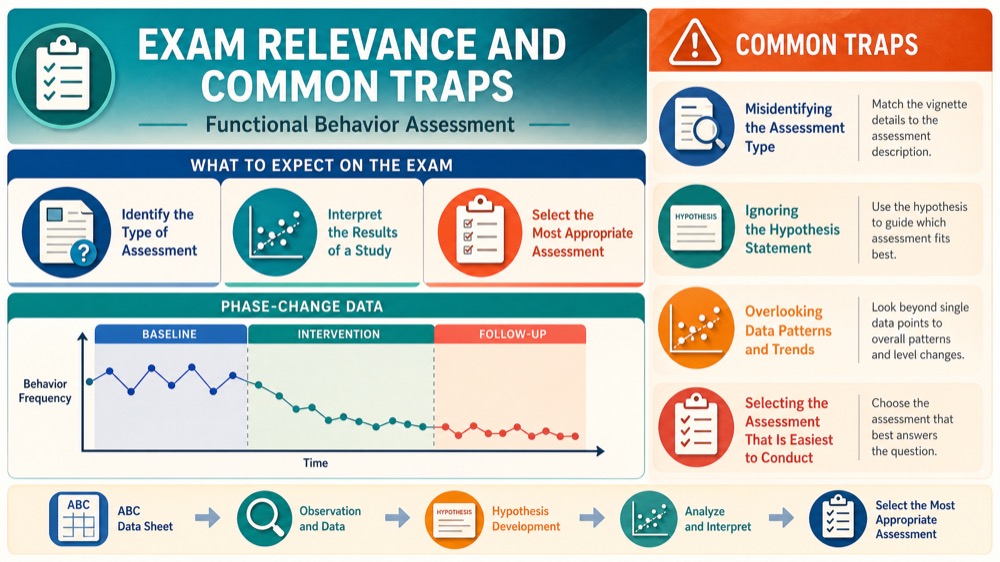
The BCBA exam tests your ability to apply FBA concepts in various contexts. You may be asked to identify which type of assessment is described in a vignette, to interpret the results of a study, or to select the most appropriate assessment given the circumstances. Understanding the differences among the three types is critical because each has distinct assumptions and limitations.
What to Expect on the Exam: Exam questions often present a scenario and ask you to determine the most likely function based on the data provided. For example, a question might describe an FA where the behavior is high in the attention condition but low in the alone condition, and ask what function is indicated. Alternatively, you might be asked to identify the type of assessment (indirect, descriptive, experimental) based on the methods described. In other items, you may need to recognize the ethical and practical considerations, such as the importance of obtaining informed consent before conducting an FA.
- Identification items: Recognize whether a described procedure is indirect (interview), descriptive (observation), or experimental (manipulation).
- Interpretation items: Analyze graphs or data summaries from an FA and identify the function(s).
- Selection items: Choose the most appropriate assessment method for a given situation (e.g., when time is limited, when behavior is dangerous, etc.).
Common Traps to Avoid: Trap 1: Confusing descriptive with experimental. Descriptive assessment shows correlation, not causation. Only experimental analysis (FA) can demonstrate cause-and-effect. Exam questions may try to trick you into thinking that ABC observation data are sufficient to conclude a function. Remember: descriptive data provide a hypothesis, but FA confirms it.
Trap 2: Thinking indirect assessment is enough. Some practitioners rely heavily on interviews and questionnaires to decide on a function, but this is rarely conclusive. The exam will likely test your understanding that indirect methods are useful for generating hypotheses, not for confirming them. A comprehensive FBA should include descriptive or experimental methods whenever possible.
Trap 3: Ignoring extinction bursts in FA. In a functional analysis, when you alter contingencies—for example, by ignoring behavior during an attention condition—you may see a temporary increase in behavior (extinction burst). This can be misinterpreted as the behavior being maintained by something else. Be aware that extinction bursts are a normal part of the process, and they do not necessarily indicate that the function is different.
Quick Checklist for FBA Mastery
Use this checklist to review the essential points before your exam:
- Define FBA and explain its purpose in identifying the function of behavior.
- List the three types: indirect, descriptive, and experimental.
- Describe typical methods for each type (interviews, ABC observation, FA conditions).
- Identify the strengths and limitations of each type (e.g., indirect is quick but subjective; descriptive is objective but correlational; FA is conclusive but time-intensive).
- Explain the conditions used in a functional analysis: alone, attention, demand, tangible.
- Recognize the possible functions of behavior: social positive reinforcement (attention, tangible), social negative reinforcement (escape), and automatic reinforcement.
- Understand when it is appropriate to use each type and the ethical considerations.
- Practice interpreting ABC data and FA graphs.
Summary and Next Steps
Functional behavior assessment is a systematic process that helps behavior analysts understand why problem behavior occurs. The three types—indirect, descriptive, and experimental—each have their place in the assessment process. Indirect methods are useful for generating hypotheses, descriptive methods for collecting direct data, and experimental methods for establishing causal relationships. For the BCBA exam, you need to be able to differentiate these types and know when to use them.
Now that you have reviewed this guide, put your knowledge into practice. Try to identify the type of FBA in various scenarios, and work through practice questions that require you to interpret FA data. You can also explore our other resources on functional behavior assessment and functional analysis to deepen your understanding. Good luck with your preparation!
For a broader perspective on assessment, you might also review the assessment in ABA guide, which covers other types of assessments you will need for the exam. Remember, mastering FBA is not just about passing—it is about becoming a competent and ethical behavior analyst.
Quick Review Checklist
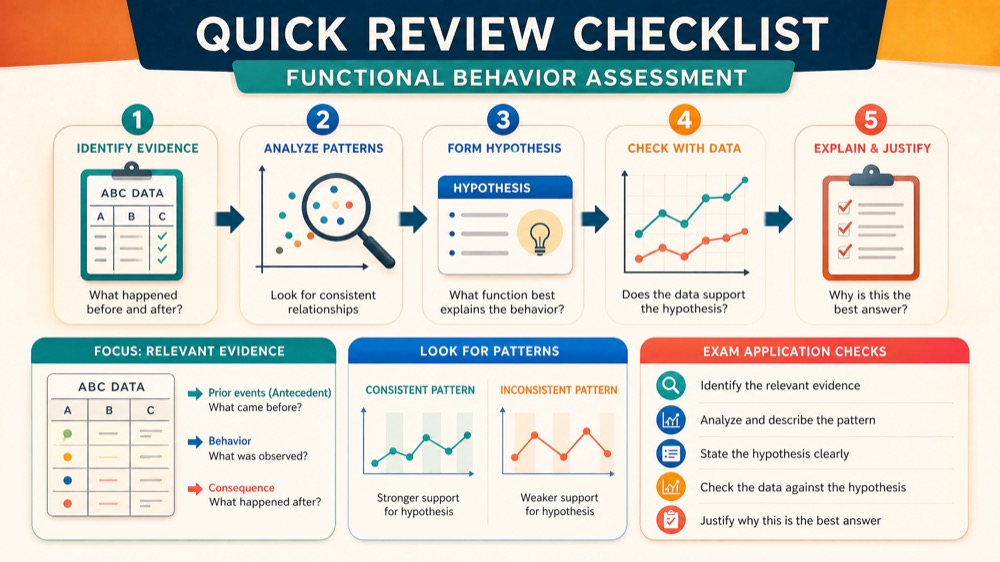
Use this final checklist to turn functional behavior assessment into exam-ready reasoning. The goal is not to memorize a label in isolation; it is to identify the relevant evidence and explain why the best answer fits the scenario. Key ideas to review:
- State the central definition or decision point for functional behavior assessment in your own words.
- Identify the detail that makes functional behavior assessment different from its closest related ABA term.
- Separate the observable facts in a scenario from assumptions that are not supported by the facts.
- Write one example and one nonexample so you can recognize the concept in a new setting.
Exam application checks:
- Ask what the question is actually requesting before comparing the answer choices.
- Mark the antecedent, response, consequence, or other evidence that supports the selected answer.
- Look for a distractor that describes a related process but does not answer the specific question.
Final self-check:
- Explain how you would verify the interpretation with clear observations or data.
- Change one detail in the scenario and decide whether your answer should change.
- Give a one-sentence rationale that a supervisor or study partner could evaluate.
Take the Free BCBA Mock Exam
Ready for more practice? Use the free mock exam to keep testing your accuracy with realistic BCBA-style items. Take the Free BCBA Mock Exam



