

Introduction: What is a CMO-R in Applied Behavior Analysis?
In the field of Applied Behavior Analysis (ABA), understanding the variables that influence behavior is crucial for effective assessment and intervention. One such variable is the motivating operation, a concept that describes how environmental events temporarily alter the value of reinforcers or punishers and thereby change the frequency of behaviors related to those consequences. Among the types of motivating operations, the reflexive motivating operation, or CMO-R, stands out for its role in how we respond to aversive stimuli. This article will break down what a CMO-R is, how it works, and why it is a critical topic for BCBA® exam candidates.
Table of Contents
- Introduction: What is a CMO-R in Applied Behavior Analysis?
- Breaking Down the Definition: Reflexive Motivating Operations
- How CMO-R Works: A Step-by-Step Analysis with ABA Examples
- Distinguishing CMO-R from Other CMOs (CMO-T and CMO-S)
- Why CMO-R Matters for BCBA® Exam Prep: Common Traps and How to Avoid Them
- Quick Checklist: Identifying a CMO-R in Exam Scenarios
- Practice Prompts for BCBA® Exam Candidates
- Conclusion: Mastering CMO-R for the Exam and Beyond
- Quick Review Checklist
- Take the Free BCBA Mock Exam
- References
Whether you are studying for the exam or refining your clinical skills, understanding CMO-R helps you identify why certain behaviors occur in specific situations. For example, a sudden loud noise might make a quiet environment more valuable, leading to escape or avoidance behaviors. By grasping this concept, you can better analyze behavior-environment relations and design more effective interventions. Let’s explore the definition, examples, and exam relevance of CMO-R in depth.
Why CMO-R Matters for BCBA® Exam Candidates: On the BCBA® exam, you’ll encounter questions that require you to identify and distinguish among different types of motivating operations. A solid grasp of CMO-R is essential because it frequently appears in vignettes about escape and avoidance behaviors. Misidentifying it as a discriminative stimulus or another type of MO is a common error. This article will equip you with the tools to recognize CMO-R in scenarios and avoid exam traps.
Breaking Down the Definition: Reflexive Motivating Operations
The technical definition of a reflexive motivating operation is: an environmental event that establishes its own presence (or absence) as a form of reinforcement or punishment. In simpler terms, a CMO-R is a stimulus change that alters the value of itself. If the event is aversive, its termination becomes reinforcing; if it is appetitive, its continuation becomes reinforcing. This self-referential nature is what makes it ‘reflexive.’
Let’s dissect this further. According to Michael (1993), a motivating operation has two effects: a value-altering effect and a behavior-altering effect. In the case of a CMO-R, the value-altering effect involves the stimulus itself becoming more or less valuable. For instance, a headache (aversive stimulus) makes the removal of the headache more reinforcing. The behavior-altering effect is that behaviors that have previously terminated the stimulus are more likely to occur. So, a person may take medication or lie down to alleviate the headache.
What Makes It 'Reflexive'?: The term ‘reflexive’ in CMO-R does not refer to respondent conditioning, but rather to the fact that the motivating operation is the stimulus itself. In other words, the MO and the consequence it establishes are the same event. This contrasts with other CMOs, where the MO is a separate event that alters the value of a different stimulus. For example, a transitive MO (CMO-T) involves an event that makes another stimulus valuable as a means to obtain a reinforcer, whereas a CMO-R directly alters its own value.
How CMO-R Fits into the Motivating Operations Framework: To fully appreciate CMO-R, it’s helpful to place it within the broader framework of motivating operations. There are two main categories: unconditioned motivating operations (UMOs) and conditioned motivating operations (CMOs). UMOs are unlearned and include states like food deprivation, sleep deprivation, and painful stimulation. CMOs are learned and are further divided into three types: transitive (CMO-T), surrogate (CMO-S), and reflexive (CMO-R).
While UMOs affect the value of primary reinforcers, CMOs affect the value of conditioned reinforcers. CMO-R is unique because the value it alters is that of an event that signals either a worsening or improvement in conditions. It’s a key concept for understanding how individuals respond to warnings and safety signals. For exam purposes, you must be able to differentiate CMO-R from CMO-T and CMO-S, which we’ll cover later.
How CMO-R Works: A Step-by-Step Analysis with ABA Examples
To solidify your understanding, let’s walk through three practical examples where a CMO-R is at play. Each example will include an ABC analysis (Antecedent-Behavior-Consequence) and a hypothesized function. Example 1: The Startle Response and Avoidance: Imagine you are walking in a quiet neighborhood at night. Suddenly, a car backfires loudly. The abrupt loud noise is a CMO-R because it establishes the termination of that noise as a reinforcer. In your body, a startle response occurs, but you may also engage in behaviors to avoid or escape the noise source, such as covering your ears or moving away.
ABC Analysis: The antecedent is the loud noise (CMO-R). The behavior is covering ears or stepping back. The consequence is the reduction in the noise’s impact, which reinforces those escape behaviors. The hypothesized function is negative reinforcement in the form of escape from an aversive stimulus.
This example illustrates how a CMO-R can evoke behavior that removes or avoids an aversive event. In practice, you might see similar dynamics in clients who are sensitive to certain sounds, leading to disruptive behaviors.
Example 2: Medical Procedure and Client Distress: Consider a child with autism who has had several painful injections in the past. Now, the sight of a syringe (neutral before but conditioned as an aversive stimulus) becomes a CMO-R. The presence of the syringe temporarily makes the upcoming injection more aversive, and it also evokes behaviors that have previously delayed or avoided the injection, such as crying, hitting, or running away.
ABC Analysis: The antecedent is the sight of the syringe (CMO-R). The behavior is avoidance behaviors. The consequence is the postponement of the injection, which negatively reinforces those behaviors. The function is avoidance or escape. Here, the CMO-R is a conditioned aversive stimulus that signals an upcoming aversive event. By understanding this, a behavior analyst can design interventions such as desensitization or providing a competing reinforcer.
Example 3: Academic Setting and Peer Rejection: In a classroom, a student has a history of being rejected by peers. A negative social cue, such as a peer frowning or turning away, can act as a CMO-R. This cue establishes social isolation as more aversive, making social acceptance more reinforcing. As a result, the student may increase their attempts to gain peer attention, such as making jokes or interrupting.
ABC Analysis: The antecedent is the peer’s frown (CMO-R). The behavior is increased social bids. The consequence is possibly receiving some form of social acknowledgment, which reinforces the behavior. The function could be access to social interaction, but the aversive cue makes that access more valuable. This example demonstrates that CMO-R can be subtle, involving social cues. For exam purposes, recognizing such nuances is key to answering scenario-based questions.
Distinguishing CMO-R from Other CMOs (CMO-T and CMO-S)
A common source of confusion in the exam is differentiating between the three types of conditioned motivating operations. Let’s clarify each briefly and then contrast them with CMO-R. CMO-T (Transitive): A CMO-T is an environmental event that establishes another stimulus as a reinforcer due to its relation to a different reinforcer. For example, if you are locked out of your car, the presence of the locked car (MO) makes a key (conditioned reinforcer) more valuable because it allows you to open the car. The key is not the MO itself; the MO is the state of being locked out.
CMO-S (Surrogate): A CMO-S acquires its MO properties by being paired with a UMO or another CMO. For instance, if a particular song is repeatedly played during a stressful event, the song itself might later function as a CMO-S, evoking similar escape behaviors even without the original stressor. It resembles classical conditioning.
Now, to distinguish from CMO-R: CMO-R is a stimulus that directly creates its own value as a reinforcer or punisher. Unlike CMO-T, it does not require a separate reinforcer; the stimulus’s own change in value is the critical effect. Unlike CMO-S, CMO-R is not a neutral stimulus that acquires MO properties through pairing; instead, it is an event that is inherently or conditionally aversive and thus establishes its own termination as reinforcing. To remember, think: Reflexive = itself; Transitive = involves a chain; Surrogate = borrowed power.
- CMO-R: The stimulus itself becomes valuable to remove or terminate (e.g., a loud sound that you want to stop).
- CMO-T: A stimulus makes another stimulus valuable as a means to achieve a goal (e.g., needing a tool to finish a project).
- CMO-S: A neutral stimulus acquires MO properties through pairing with another MO (e.g., a cue that signals a shock).
Why CMO-R Matters for BCBA® Exam Prep: Common Traps and How to Avoid Them
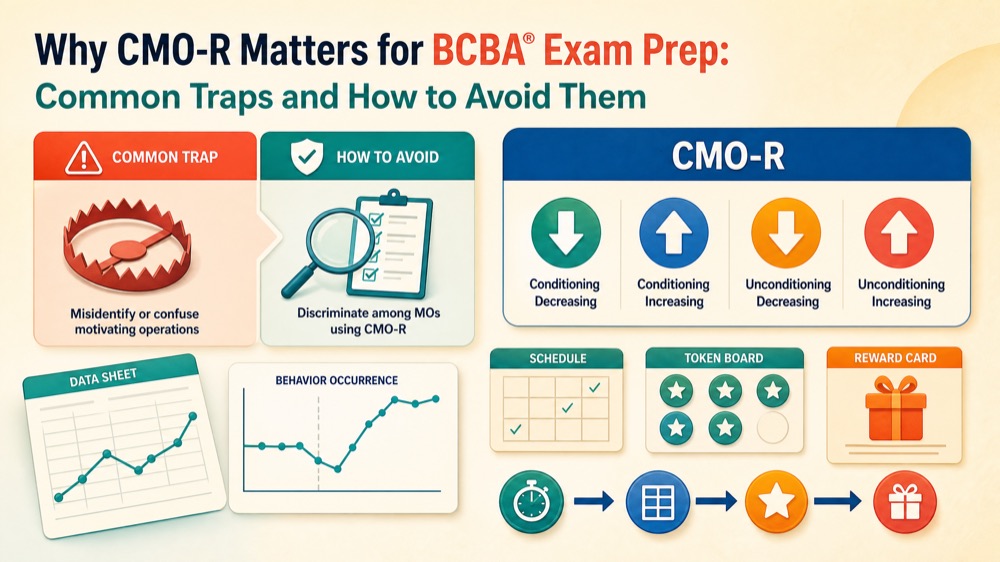
On the BCBA® exam, motivating operations are a developing topic, and CMO-R often appears in questions that test your ability to discriminate among MOs. Understanding the common traps can make a significant difference in your score. Let’s highlight typical misconceptions and provide strategies for tackling these questions effectively.
Common Exam Traps: Confusing CMO-R with UMOs or Reflexes: One frequent error is confusing a CMO-R with an unconditioned motivating operation (UMO). UMOs are related to biological needs, such as food deprivation or pain. While pain is a UMO, a specific painful stimulus that signals more pain is a CMO-R. For example, a toothache is a UMO (pain), but the sight of a dentist’s drill may be a CMO-R that signals potential further pain.
Another trap is confusing CMO-R with a reflex (respondent behavior). A reflex is a specific stimulus-response relation, like a knee jerk, whereas a CMO-R alters the value of a consequence and thus affects operant behavior. It’s crucial to identify whether the behavior is elicited or emitted under the control of consequences.
Additionally, watch out for scenarios where a stimulus is described as a discriminative stimulus (SD). An SD signals the availability of reinforcement based on a prior learning history, whereas a CMO-R alters the value of a consequence and does not signal a specific contingency. For instance, a red light is an SD for pressing the brake, but a sudden loud horn blast might be a CMO-R that makes escaping the sound reinforcing.
How to Spot CMO-R in a Scenario Question: When reading a vignette, ask yourself: Is there an environmental event that seems to make its own removal or termination reinforcing? If so, it’s likely a CMO-R. Look for keywords such as ‘aversive’, ‘unpleasant’, ‘startling’, or ‘frightening’. Also, consider the function of the behavior: if the behavior serves to escape or avoid a specific stimulus, and that stimulus is the MO, then CMO-R is a good answer.
Use a systematic approach: First, identify the antecedent event. Second, determine if the event itself is the reinforcer (as in removal). Third, consider whether the behavior is under operant control. This will help you differentiate from SD and UMO.
Quick Checklist: Identifying a CMO-R in Exam Scenarios
To help you quickly analyze scenario questions, here’s a practical checklist to run through:
- Presence of an aversive (or appetitive) stimulus: Is there a stimulus change that is unpleasant or pleasant?
- Alteration of its own value: Does the stimulus make its own removal more reinforcing (if aversive) or continuation more reinforcing (if appetitive)?
- Evokes behavior: Does the stimulus evoke behavior that has previously led to escape or avoidance of that stimulus?
- Not a signal for reinforcement: Is the stimulus not just signaling the availability of a reinforcer but actually altering the value of the reinforcer?
- No direct biological need: Is the effect learned rather than a UMO like food deprivation?
If all or most of these points apply, you can confidently identify the event as a CMO-R. This checklist is also useful in practice for writing functional behavior assessments.
Practice Prompts for BCBA® Exam Candidates
Applying your knowledge through practice questions is one of the best ways to prepare for the exam. Here are two prompts to test your understanding of CMO-R. Prompt 1: Identify the CMO-R: Scenario: A student often disrupts the class when the teacher announces a pop quiz. The student has a history of failing quizzes. The announcement itself now evokes escape behaviors like asking to go to the bathroom. Question: What is the CMO-R in this scenario?
Answer: The announcement of the pop quiz is the CMO-R because it establishes the quiz-taking situation as aversive, making escape behaviors more reinforcing. The behavior (asking to use the restroom) is negatively reinforced by escaping the quiz. Prompt 2: Function-Based Intervention: Scenario: A client with a developmental disability displays aggression when a specific alarm sounds. The alarm has been paired with unpleasant transitions in the past. Question: How would you use your understanding of CMO-R to design an intervention?
Answer: You might implement extinction by preventing escape from the alarm, or you might create a competing reinforcer. Alternatively, you could change the alarm sound (remove the CMO-R) to reduce aggression. Additionally, pair the alarm with preferred activities to decrease its aversive value over time.
Conclusion: Mastering CMO-R for the Exam and Beyond
In summary, a CMO-R is a conditioned motivating operation in which a stimulus alters its own value as a reinforcer or punisher. It is crucial for understanding behaviors that are maintained by escape or avoidance. By now, you should be able to define CMO-R, distinguish it from other MOs, and identify it in scenario questions. This knowledge not only helps you pass the BCBA® exam but also enhances your clinical judgment in creating effective behavior plans.
Remember, practice is key. Use the checklist provided, work through sample questions, and consult reliable resources like the BACB’s task list and seminal articles by Michael (1993). For more in-depth reviews of ABA concepts, check out our complete guide to motivating operations or our articles on reinforcement schedules. As you continue your studies, always ask yourself: ‘What is the motivating operation here?’ This question will sharpen your analysis and boost your exam performance. Good luck!
Quick Review Checklist
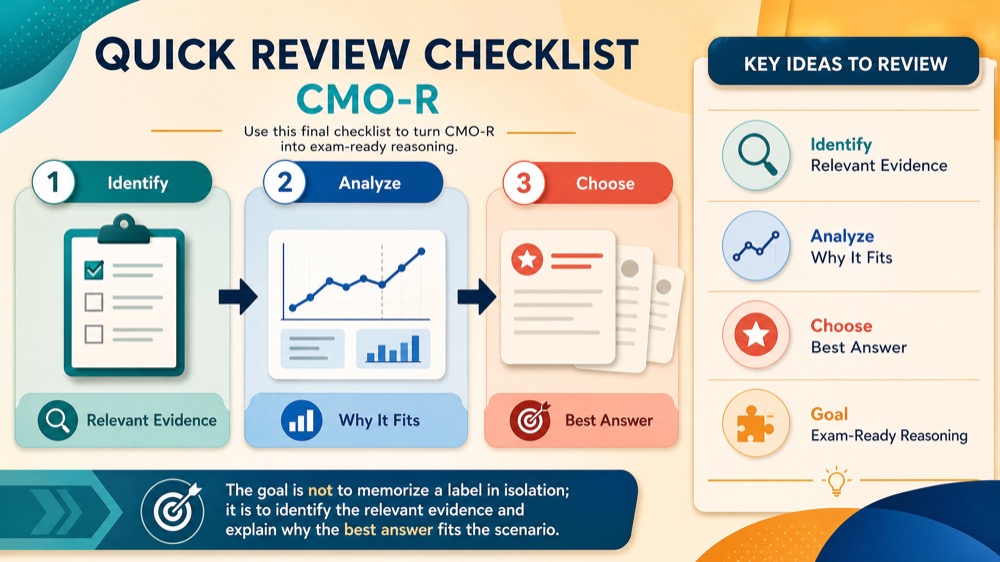
Use this final checklist to turn CMO-R into exam-ready reasoning. The goal is not to memorize a label in isolation; it is to identify the relevant evidence and explain why the best answer fits the scenario. Key ideas to review:
- State the central definition or decision point for CMO-R in your own words.
- Identify the detail that makes CMO-R different from its closest related ABA term.
- Separate the observable facts in a scenario from assumptions that are not supported by the facts.
- Write one example and one nonexample so you can recognize the concept in a new setting.
Exam application checks:
- Ask what the question is actually requesting before comparing the answer choices.
- Mark the antecedent, response, consequence, or other evidence that supports the selected answer.
- Look for a distractor that describes a related process but does not answer the specific question.
Final self-check:
- Explain how you would verify the interpretation with clear observations or data.
- Change one detail in the scenario and decide whether your answer should change.
- Give a one-sentence rationale that a supervisor or study partner could evaluate.
Take the Free BCBA Mock Exam
Ready for more practice? Use the free mock exam to keep testing your accuracy with realistic BCBA-style items. Take the Free BCBA Mock Exam
References
Next step for BCBA exam prep
Turn this topic into exam-day practice
Use this topic as a focused review, then test it in exam-style conditions with a free mock before deciding whether five full-length mocks are the right next step.
Start the Free BCBA Mock ExamContinue with Five Full-Length Mocks — $99
Review the included materials and access details before ordering. No pass guarantee is implied.



