
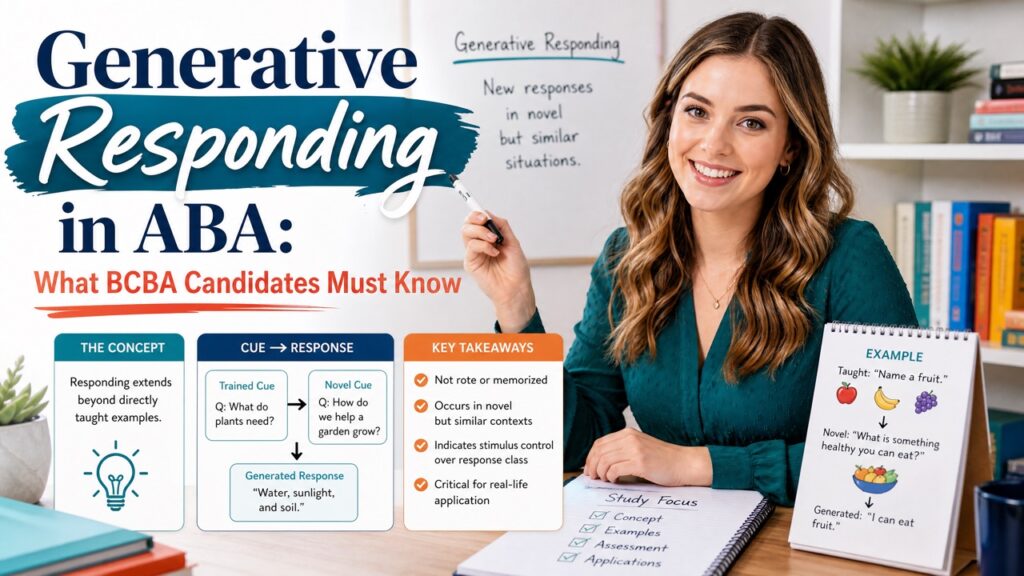
Introduction: The Power of Novel Responses in ABA
Think about a time when a learner did something you never directly taught them—using a newly acquired word in a different setting, or solving a problem with an unexpected combination of skills. This phenomenon, often called generative responding aba, is a cornerstone of efficient and meaningful behavior change. For BCBA candidates, understanding this concept isn’t just an academic exercise; it’s essential for designing interventions that produce durable, generalized outcomes.
Table of Contents
- Introduction: The Power of Novel Responses in ABA
- Definition and Core Principle
- Key Concepts Related to Generative Responding
- Real-World ABA Examples of Generative Responding
- Exam Relevance and Common Traps
- Quick Checklist for Studying Generative Responding
- Summary and Final Tips
- Quick Review Checklist
- Take the Free BCBA Mock Exam
- References
Generative responding refers to behavior that emerges in novel situations without a direct reinforcement history for that specific response. Instead, the behavior is a product of learned repertoires combining in new ways. In applied behavior analysis, this is what separates rote memorization from true skill mastery. When a learner can generate new responses, they are not merely repeating what was taught—they are applying their learning flexibly across environments, which is a core goal of many behavior change programs.
In this guide, we’ll break down the definition, related concepts, real-world examples, and exam-related pitfalls. By the end, you’ll have a clearer picture of how generative responding appears in both practice and the BCBA exam, and you’ll be better prepared to identify it in scenarios and apply it in your future work.
Definition and Core Principle
Generative responding is a type of behavior that is not directly trained but occurs as a result of other learned skills. It often involves combining existing response components in novel ways to meet new environmental demands. The core principle is that learning is not just about acquiring isolated behaviors but about building repertoires that can be recombined flexibly.
This concept is closely related to response generalization, where a learner emits a variation of a trained response under similar stimulus conditions. However, generative responding goes a step further: it emphasizes the production of entirely new response forms or sequences that serve the same or similar function. For example, a child who has learned to request items using single words might suddenly combine words into a novel two-word phrase like “more juice” without being explicitly taught that exact combination.
The importance of generative responding in ABA cannot be overstated. It increases the efficiency of interventions because it means that teaching one skill can lead to many untaught skills. This is particularly valuable in settings where time and resources are limited. Furthermore, it aligns with the goal of promoting independence, as learners who can generate novel responses are better equipped to navigate unpredictable environments.
For BCBA candidates, recognizing generative responding is crucial for designing curricula that promote it. Techniques such as teaching sufficient response examples, varying training stimuli, and ensuring that instruction includes multiple exemplars can all facilitate generative outcomes. Understanding these principles will help you evaluate whether an intervention is likely to produce generalized behavior change.
Key Concepts Related to Generative Responding
To grasp generative responding fully, it’s important to distinguish it from related but distinct concepts. Two common areas of confusion are response generalization versus stimulus generalization, and how generative responding differs from problem solving. Response Generalization vs. Stimulus Generalization: Response generalization occurs when a learner emits a variation of a trained behavior in response to the same or similar stimulus. For instance, if a child is taught to say “hello” when greeting someone, they might later say “hi” or “good morning” without explicit training. The response form varies, but the function and the controlling antecedent are similar.
On the other hand, stimulus generalization happens when a behavior trained in one context is emitted in a different context that shares similar features. For example, a child who learns to say “please” when asking for a toy at home might also say “please” at school or in a store, because those settings share discriminative stimuli (e.g., the presence of desirable items).
Generative responding is often considered a subset or an extension of response generalization, but with a stronger emphasis on the novelty of the response combination. While response generalization might involve minor variations (like synonyms), generative responding can involve entirely novel response sequences that have never been reinforced before. In the BCBA exam, you may be asked to identify whether a scenario demonstrates response generalization, stimulus generalization, or generative responding. A key distinction is whether the response is topographically different but functionally equivalent.
How Generative Responding Differs from Problem Solving: Problem solving in behavior analysis involves a series of behaviors that lead to a solution, often involving a discriminative stimulus that signals the need for a novel response. Problem solving can involve generative responding, but it’s not synonymous. Problem solving often requires a chain of behaviors with intermediate steps, whereas generative responding can be a single, novel response.
For example, a student confronted with a math problem doesn’t have a pre-learned answer; they must combine arithmetic skills in a novel sequence to find a solution. That solution is a generative response, but the overall process of problem solving includes multiple steps, self-corrections, and perhaps trial-and-error.
Generative responding, by contrast, can occur instantly and without overt problem-solving steps. A child who sees a new dog and says “puppy” without ever being taught that specific word is engaging in generative responding—there was no explicit problem-solving chain. Understanding this distinction helps you analyze behavior more accurately, especially on the exam where scenarios might describe either process.
Real-World ABA Examples of Generative Responding
To solidify your understanding, it helps to look at concrete scenarios. These examples illustrate how generative responding manifests in typical ABA practice and how you might analyze them using an ABC (Antecedent-Behavior-Consequence) framework. Example 1: Teaching a Child to Greet: Imagine you’re teaching a young child, Marcus, to greet others by saying “Hi” when someone waves. During teaching, you present the antecedent (a person waving) and reinforce Marcus’s response of saying “Hi” with praise and attention. After several sessions, Marcus reliably says “Hi” in response to your wave and your assistant’s wave.
One day, Marcus’s grandmother, whom he has never met, waves at him. Without any additional teaching, Marcus says “Hi” to her. This is a clear example of generative responding: Marcus produced a greeting response in a novel stimulus condition (new person) without direct reinforcement for that specific response. The behavior is topographically the same as trained, but the stimulus is novel. While this might be considered stimulus generalization, it also demonstrates a generative quality because the response was not explicitly taught with that person.
From an ABC analysis: Antecedent—grandmother waves; Behavior—Marcus says “Hi”; Consequence—grandmother says “Hello” and smiles, providing natural reinforcement. The hypothesized function of the greeting is social positive reinforcement in the form of attention or the start of an interaction. This example shows how generative responding can lead to positive social outcomes without extensive training for every possible variation.
Example 2: Using Synonyms in a Writing Task: Consider a classroom setting where a student, Lily, has been taught to use the word “happy” in her writing when describing characters. She practices writing sentences like “The character felt happy” and receives points for correct usage. After several lessons, Lily is assigned an essay about her weekend. In her essay, she writes, “I was glad when I saw my friend at the park.” She used a synonym, “glad,” that was never directly taught.
Lily’s behavior of using “glad” is a generative response because she produced a novel word that serves the same function (expressing happiness) without direct training on that specific word. This is more than just response generalization (where she might have said “happy” in a new context); she generated a new topographical response that she likely learned through incidental exposure or generalization of a semantic category.
ABC analysis: Antecedent—the essay prompt about her weekend; Behavior—writing “I was glad”; Consequence—teacher’s positive comment about her vocabulary. The likely function is access to praise or a good grade. This example illustrates how generative responding can enrich language and academic skills, making instruction more efficient and meaningful.
These examples highlight that generative responding can occur across various response modalities—verbal, motor, and more. On the BCBA exam, you might be given a similar scenario and asked to identify whether it represents generative responding or another process. Look for the key indicators: the response is novel, not directly taught, and serves the same function as previously taught behaviors.
Exam Relevance and Common Traps
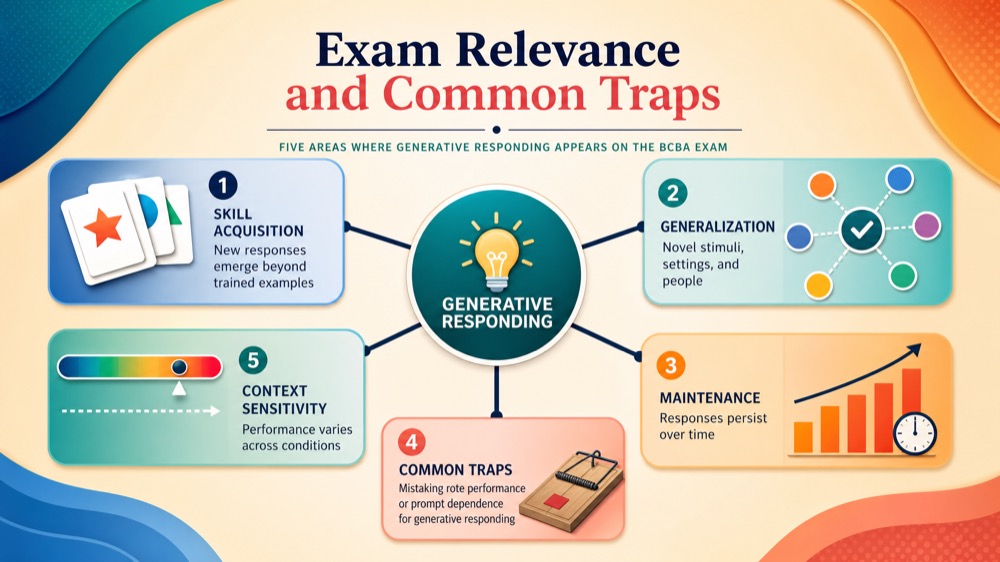
Understanding generative responding is not just theoretical; it’s a concept that appears frequently on the BCBA exam, often woven into questions about generalization, maintenance, and skill acquisition. Being able to identify generative responding in scenarios is crucial for selecting appropriate interventions and for answering scenario-based questions correctly.
How BCBA Questions Test Generative Responding: Typical exam questions might present a detailed scenario about a learner who demonstrates untaught skills. For example, a question might describe a child who was taught to request “cookie” using a picture card and then unexpectedly requests “cracker” using the same card without training. You might be asked to identify the behavior process (e.g., generative responding) or to select the best instructional strategy to promote such outcomes.
Questions may also test your ability to distinguish generative responding from other related concepts. For instance, a question might describe a child who says “car” in the presence of a car (stimulus generalization) versus a child who says “vehicle” in the presence of a bus (generative responding). The key is whether the response form is new (topographically different) but serves the same function.
Another common format is to ask how you would program for generative responding. You might be asked to identify which teaching approach (e.g., multiple exemplar training, training loosely, using sufficient response examples) is most likely to produce generative outcomes. Knowing these strategies is essential for both the exam and real-world practice.
Common Misconceptions and Traps: One of the biggest traps is confusing generative responding with stimulus generalization. Remember that stimulus generalization involves the same response occurring in new settings or with new stimuli, whereas generative responding involves a novel response form. For example, if a child says “dog” when seeing a new breed of dog, that’s stimulus generalization. If the child says “puppy” when seeing a small dog, that might be generative responding if the word “puppy” was never taught.
Another trap is thinking that every novel response is generative. Some novel responses might be a result of trial-and-error learning or problem-solving. Generative responding specifically implies that the response was not directly trained and emerges from the combination of existing skills. Additionally, be careful not to overgeneralize the term; not every untaught behavior is generative. It must serve a similar function and be influenced by the same environmental variables.
To avoid these traps, focus on the defining features: the response is novel (not previously reinforced), it serves a similar function to trained behaviors, and it occurs under appropriate antecedent conditions without direct instruction. On the exam, underline those elements in the scenario before answering.
Quick Checklist for Studying Generative Responding
Here’s a concise checklist to help you review the key points and prepare for exam questions. Use this as a quick refresher before the test.
- Define it: Generative responding is a novel behavior that emerges without direct reinforcement, often from combining existing repertoires.
- Distinguish it: It differs from response generalization (topographical variation) and stimulus generalization (same response, new context).
- Identify it: Look for responses that are not taught, serve the same function, and are appropriate to the situation.
- Program for it: Use strategies like multiple exemplar training, teaching sufficient response examples, and varying antecedent conditions.
- Analyze it: When you see a scenario, break it down into ABC to determine if the novel response is truly generative.
- Remember the function: Generative responding is often maintained by natural consequences, which is why it’s so valuable.
Summary and Final Tips
Generative responding is a fundamental concept that BCBA candidates must understand to design effective behavior change programs. It represents the pinnacle of learning efficiency—where learners go beyond rote skills to create new behaviors that are functional and adaptable. By mastering this concept, you’ll be better equipped to promote generalization and meaningful outcomes in your clients.
On the exam, remember to read scenarios carefully and ask yourself: Is this response novel? Was it explicitly taught? Does it serve the same function? If the answer is yes to all three, it’s likely generative responding. Also, be aware of the common traps, such as confusing it with stimulus generalization. Regular practice with scenario-based questions can help solidify your understanding. For more in-depth study, consider exploring related topics like emergent relations, which are closely tied to generative performance. You can also review skill maintenance to see how generative responding fits into long-term behavior stability.
We hope this guide has clarified the concept of generative responding in ABA. As you continue your BCBA exam preparation, keep an eye out for this topic in practice questions and supervision discussions. The more you engage with it, the more intuitive it becomes. Good luck with your studies!
Quick Review Checklist
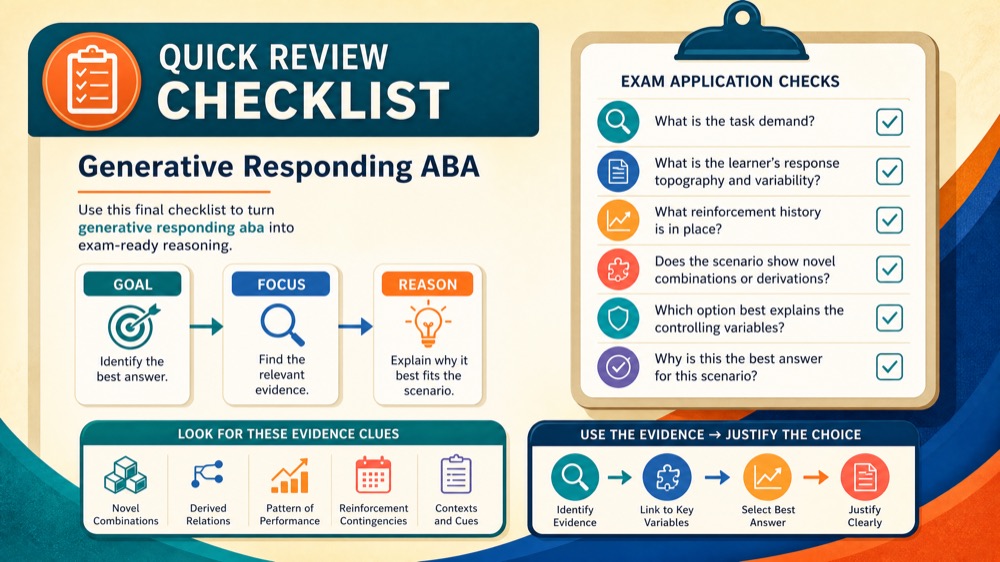
Use this final checklist to turn generative responding aba into exam-ready reasoning. The goal is not to memorize a label in isolation; it is to identify the relevant evidence and explain why the best answer fits the scenario. Key ideas to review:
- State the central definition or decision point for generative responding aba in your own words.
- Identify the detail that makes generative responding aba different from its closest related ABA term.
- Separate the observable facts in a scenario from assumptions that are not supported by the facts.
- Write one example and one nonexample so you can recognize the concept in a new setting.
Exam application checks:
- Ask what the question is actually requesting before comparing the answer choices.
- Mark the antecedent, response, consequence, or other evidence that supports the selected answer.
- Look for a distractor that describes a related process but does not answer the specific question.
Final self-check:
- Explain how you would verify the interpretation with clear observations or data.
- Change one detail in the scenario and decide whether your answer should change.
- Give a one-sentence rationale that a supervisor or study partner could evaluate.
Take the Free BCBA Mock Exam
Ready for more practice? Use the free mock exam to keep testing your accuracy with realistic BCBA-style items. Take the Free BCBA Mock Exam
References
Next step for BCBA exam prep
Turn this topic into exam-day practice
Use this topic as a focused review, then test it in exam-style conditions with a free mock before deciding whether five full-length mocks are the right next step.
Start the Free BCBA Mock ExamContinue with Five Full-Length Mocks — $99
Review the included materials and access details before ordering. No pass guarantee is implied.



