
Quick answer: The steps to access early ABA care usually begin with writing down your concerns, contacting the right early-intervention or health-plan entry point, requesting an evaluation, checking eligibility and coverage, comparing providers, and reviewing the proposed plan before services start. You do not have to solve every part of the process in one call. Start the next documented step while you gather the information needed for the following one.
Table of Contents
- What Does Early ABA Care Mean?
- Steps to Access Early ABA Care
- Do You Need an Autism Diagnosis to Start the Process?
- What Should You Prepare Before Calling?
- How Do You Compare Early ABA Providers?
- Questions to Ask at the First Call
- What If You Are on an ABA Waitlist?
- What Is the BCBA’s Role in Early Access?
- FAQ
- Quick Review Checklist
- Take the Free BCBA Mock Exam
The exact route depends on a child’s age, state, developmental needs, insurance, and the type of service being requested. A state early-intervention program may use a different eligibility process from private insurance-funded ABA. This guide is educational rather than medical, legal, or insurance advice. Use the current program and plan documents for your situation, and ask the provider or agency to explain any requirement you do not understand.
What Does Early ABA Care Mean?
Early ABA care is behavior-analytic support delivered during the early-childhood period or through an early-intervention pathway. It may address communication, learning, play, daily living, participation, or other goals that matter to the child and family. ABA can be one part of a broader service plan that may also include speech-language, occupational, educational, medical, or family supports.
“Early” does not mean that every child needs the same number of hours or the same program. A responsible plan starts with the child’s strengths, current needs, family priorities, safety, assent, and the environments where skills are useful. Starting a conversation early can reduce avoidable delays, but it should not pressure a family into a one-size-fits-all treatment package.
The CDC guide to accessing services for autism spectrum disorder explains that early-intervention systems can help young children with developmental delays and that a formal diagnosis or physician referral is not always required to request a developmental evaluation. Eligibility rules still vary by state and program, so confirm the local path rather than assuming that one national checklist applies everywhere.
Steps to Access Early ABA Care
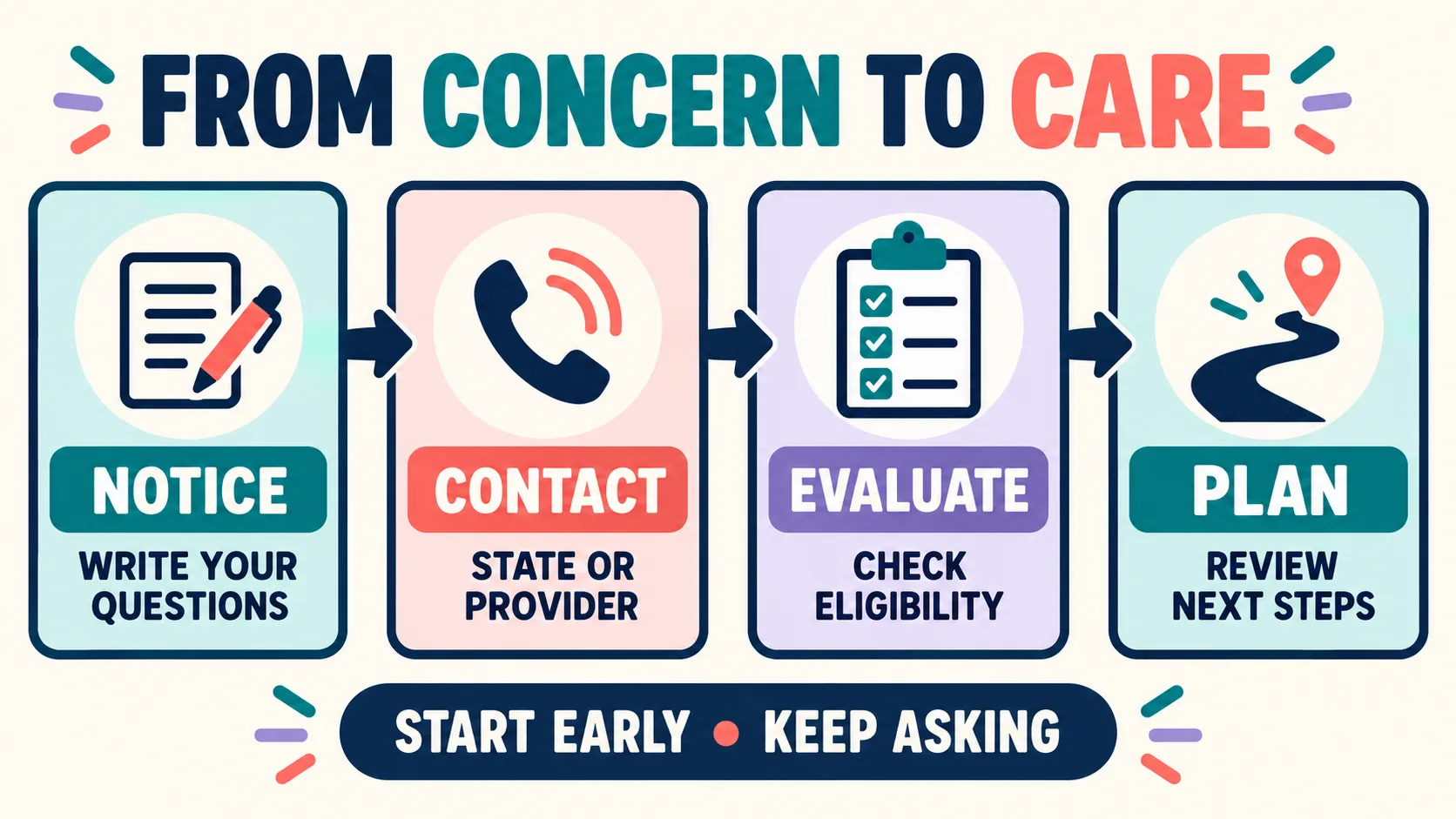
Use this sequence as a starting map. Some steps may happen in parallel, especially when waitlists are long:
- Write down the concern. Describe what you see, when it happens, what the child is trying to communicate or do, and what helps. Add dates, settings, examples, and questions instead of relying on a broad label such as “behind” or “behavior problem.”
- Identify the correct entry point. For a child younger than 3, contact the state or territory early-intervention program and ask about an evaluation. For a preschool or school-age child, ask the local education system about evaluation and also check health-plan options. A pediatrician or developmental provider can be helpful, but do not assume a referral is the only route.
- Request an evaluation. Ask who will evaluate, what areas will be considered, how long the process takes, and whether there is a cost. Keep the request and the agency’s response in writing when possible. If the child’s needs are urgent or safety-related, say so clearly and ask what immediate supports are available.
- Check the funding pathway. Call the insurer or public program using the number on the current card or official website. Ask whether a diagnosis, referral, treatment prescription, prior authorization, network provider, or medical-necessity document is required. Do not assume that a general behavioral health benefit and an ABA benefit use the same rules.
- Contact more than one qualified provider. Ask about age range, service settings, current capacity, waitlist length, supervision, caregiver involvement, and whether the provider accepts the relevant plan. A provider who cannot start soon may still offer a useful referral or interim resource.
- Prepare for the assessment. Bring reports, school or early-intervention records, medication and health information that the family chooses to share, insurance details, and a list of priorities. Describe routines that are going well as well as difficult situations. A balanced picture helps the team choose meaningful targets.
- Review the proposed plan. Ask what will be measured, how goals were selected, who will implement them, how caregivers will participate, and how progress will be communicated. Check that the plan addresses functional outcomes rather than only reducing behavior that adults find inconvenient.
- Confirm the first practical step. Before ending a call or meeting, write down the contact person, documents still needed, expected date, authorization status, and what to do if the timeline changes. A simple follow-up calendar can prevent a referral from disappearing between systems.
Do You Need an Autism Diagnosis to Start the Process?
Not always. The CDC states that families can request a developmental evaluation through early-intervention systems and that a doctor’s referral is not necessarily required. For children under 3, the state early-intervention program may evaluate developmental eligibility under its own rules. For children age 3 and older, the public-school system may have a Child Find or special-education evaluation route.
Private insurance-funded ABA can be different. A health plan may require an autism diagnosis, a prescription, a referral, specific testing, or prior authorization before it approves treatment. That requirement should come from the current plan and state rules, not from a generic online statement. You can ask whether developmental evaluation, speech services, parent coaching, or another support can begin while an ABA authorization is being reviewed.
What Should You Prepare Before Calling?
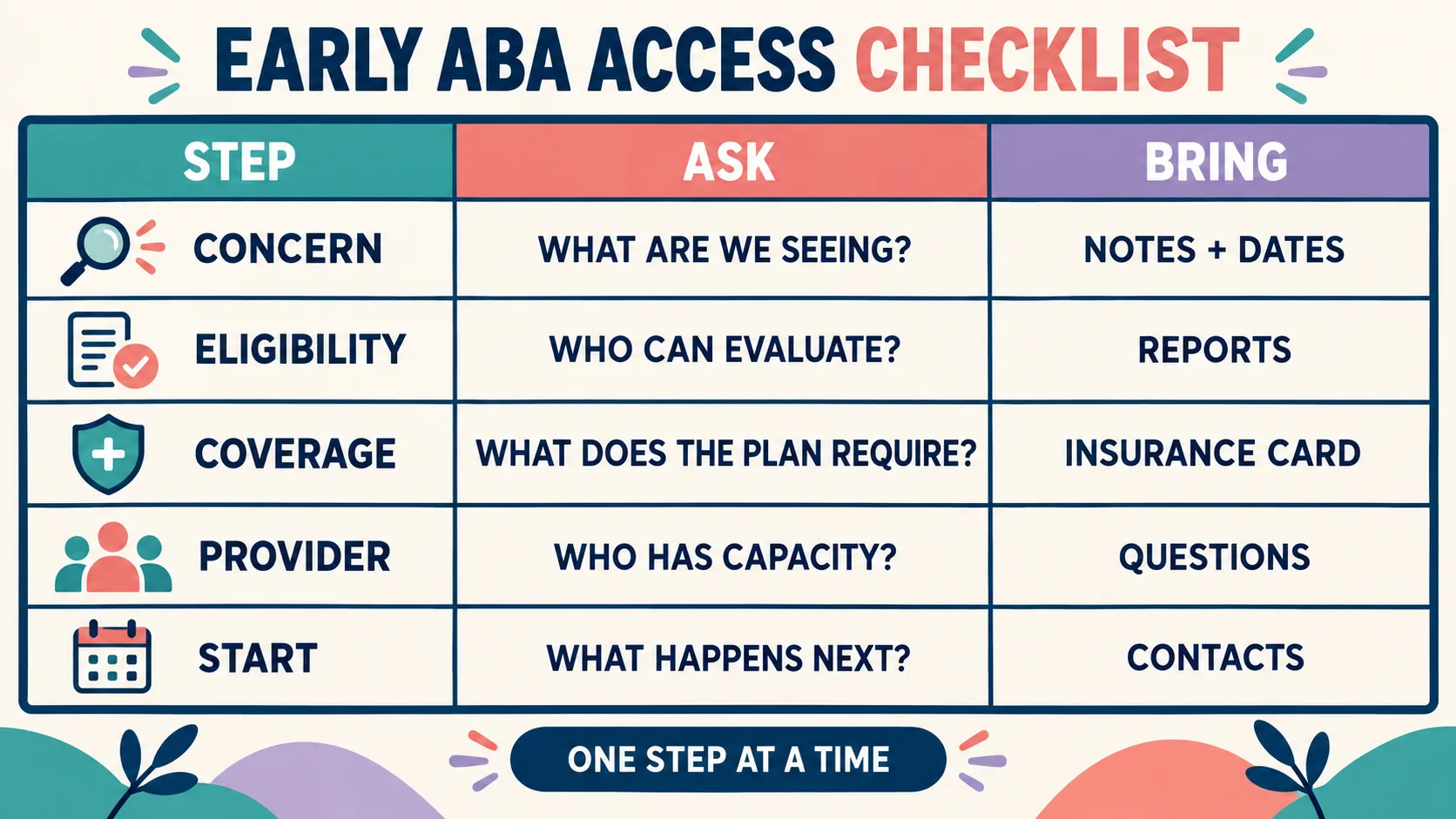
You do not need a perfect file before asking for help. A small, organized packet makes the next conversation easier:
| Item | What to collect | Why it helps |
|---|---|---|
| Concern notes | Examples, dates, settings, strengths, and family priorities. | Keeps the request specific and useful. |
| Existing reports | Developmental, medical, school, or therapy records you choose to share. | Reduces repeated history-taking. |
| Coverage details | Current card, member number, plan phone, and authorization questions. | Clarifies the funding route. |
| Contact log | Names, dates, promised follow-ups, and reference numbers. | Makes delays visible and follow-up easier. |
How Do You Compare Early ABA Providers?
Look beyond the first available opening. Ask how the provider defines useful goals, measures progress, trains and supervises staff, includes caregivers, protects privacy, handles assent and refusal, and responds when a plan is not helping. Ask whether services can occur in the settings where the child actually needs the skill, such as home, school, community, or telehealth when appropriate.
Capacity matters, but a short waitlist is not the only quality signal. Ask for the expected assessment timeline, who will be the responsible BCBA, how often the plan is reviewed, and what happens if staffing changes. If a provider promises a fixed outcome or identical schedule before evaluating the child, ask how the program will be individualized.
Questions to Ask at the First Call
- Do you serve this age range and the settings important to our family?
- What information do you need before the assessment, and who reviews it?
- How long is the current wait for an assessment and for a treatment opening?
- Which insurance or public-program requirements do you verify before recommending services?
- How are goals selected, measured, and explained to caregivers?
- How do you honor assent, communication, sensory needs, and the child’s dignity?
- What should we do while we are waiting, and who should we contact if a concern becomes urgent?
What If You Are on an ABA Waitlist?
Ask the provider to confirm your position, the next update date, and whether an earlier opening may occur in another setting or time block. Continue the state early-intervention, school, medical, speech, or family-support conversations that are available to you; joining an ABA waitlist does not require pausing every other appropriate support. Keep a record of calls and ask for written instructions when the process is confusing.
While waiting, focus on safe, functional opportunities: communication access, predictable routines, play, daily-living participation, and ways to let the child express “no” or request a break. Avoid copying an online intervention without an assessment or turning ordinary family routines into constant therapy. If there is an immediate safety concern, contact the appropriate local professional or emergency service rather than waiting for an ABA intake.
What Is the BCBA’s Role in Early Access?
A BCBA can help translate concerns into observable goals, select a measurement system, assess environmental variables, design function-based support, coach caregivers, and review whether the plan is producing meaningful change. The BCBA should collaborate with the family and other providers instead of treating access as a sales handoff. The role includes explaining uncertainty, documenting consent, and staying within competence.
For BCBA candidates, the access pathway is a useful exam scenario because it combines assessment, collaboration, ethics, and data-based decision-making. The correct answer is rarely “start the most intensive service immediately.” It is usually to clarify the concern, obtain the right evaluation, coordinate qualified supports, and use data to refine the plan.
FAQ
Can a parent contact early intervention without a doctor?: Often, yes. The CDC explains that a parent can contact a state or territory early-intervention program directly and request an evaluation, but local eligibility and intake rules vary. Use the official contact information for your state rather than relying on an outdated directory.
Does early intervention always mean ABA?: No. Early intervention is a service system that may include different supports. ABA may be appropriate for some goals and families, while speech, occupational, educational, medical, or other services may also be relevant. The evaluation and family priorities should guide the combination.
How long does it take to start early ABA care?: There is no universal timeline. Eligibility reviews, diagnosis or referral requirements, insurance authorization, provider capacity, staffing, and location can all affect the start date. Ask each organization for the next milestone and follow up on the date they give you.
Bottom line: The steps to access early ABA care are manageable when you separate the process into notice, contact, evaluation, coverage, provider choice, plan review, and follow-up. Start with the official state early-intervention contacts, keep your questions and records organized, and choose support that is individualized, measurable, respectful, and useful in daily life. For a broader overview, read the site’s ABA for toddlers guide or practice the BCBA decision-making side with the free BCBA mock exam. For targeted review, use our steps to access early aba care practice questions to apply the concept in exam-style scenarios.
Quick Review Checklist
Use this final checklist to turn steps to access early aba care into exam-ready reasoning. The goal is not to memorize a label in isolation; it is to identify the relevant evidence and explain why the best answer fits the scenario. Key ideas to review:
- State the central definition or decision point for steps to access early aba care in your own words.
- Identify the detail that makes steps to access early aba care different from its closest related ABA term.
- Separate the observable facts in a scenario from assumptions that are not supported by the facts.
- Write one example and one nonexample so you can recognize the concept in a new setting.
Exam application checks:
- Ask what the question is actually requesting before comparing the answer choices.
- Mark the antecedent, response, consequence, or other evidence that supports the selected answer.
- Look for a distractor that describes a related process but does not answer the specific question.
Final self-check:
- Explain how you would verify the interpretation with clear observations or data.
- Change one detail in the scenario and decide whether your answer should change.
- Give a one-sentence rationale that a supervisor or study partner could evaluate.
Take the Free BCBA Mock Exam
If you want a low-pressure way to check your recall, use the free practice resource below. Take the Free BCBA Mock Exam



