
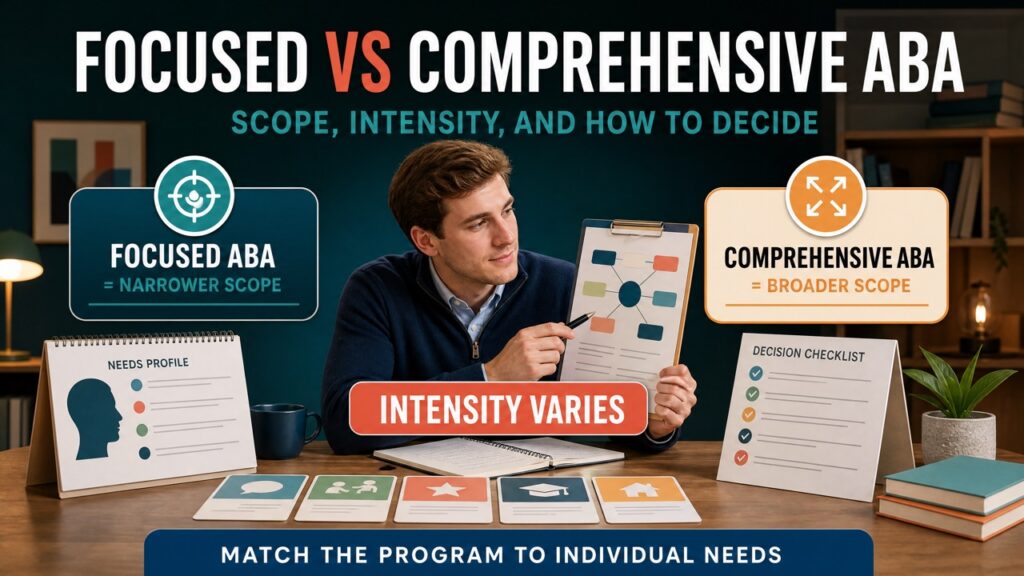
When planning applied behavior analysis (ABA) services, one of the first decisions is whether to design a focused behavior intervention or a comprehensive behavior intervention. The choice is not about one being inherently better; it is about matching the intervention to the client’s needs. This guide defines both approaches, compares their scope and intensity, and explains how a behavioral assessment informs the decision. You will also find practical examples and ethical considerations to guide your practice.
Table of Contents
- What Is Focused ABA?
- What Is Comprehensive ABA?
- Key Differences: Scope, Intensity, and Duration
- How to Decide: The Role of Behavioral Assessment
- Ethical Considerations
- Common Traps and Misconceptions
- Study Notes for BCBA Preparation
- Conclusion
- Reference
What Is Focused ABA?
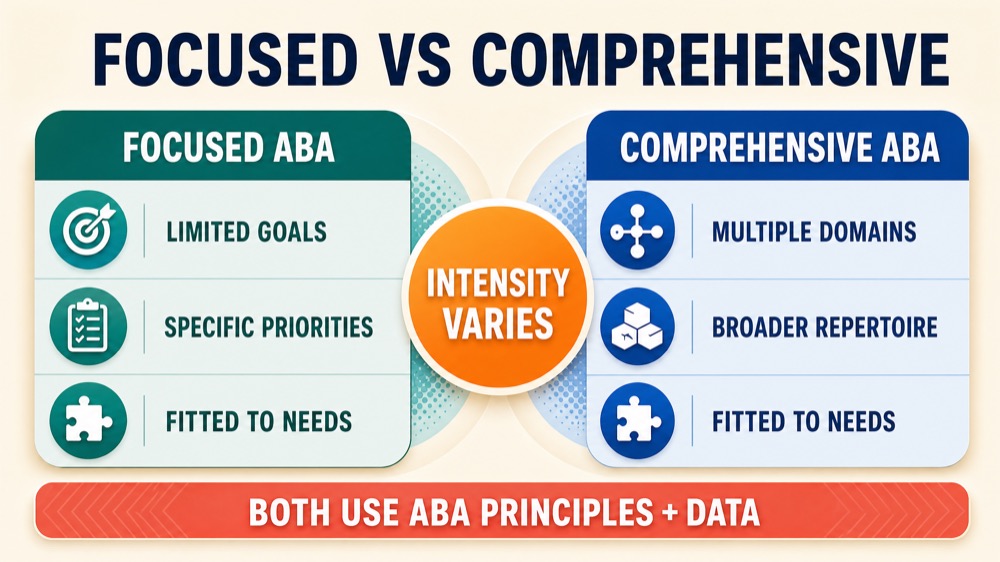
Focused ABA is a time-limited intervention that targets a limited set of behaviors or skill deficits. It is often used when a client has one or a few specific concerns, such as reducing aggressive behavior, increasing communication requests, or teaching daily living skills. The scope is narrow, but the intervention can still be intense. For example, a focused program might involve 10 hours per week of direct therapy, but those hours are dedicated to one or two priority goals.
In focused ABA, the behavior analyst conducts a behavioral assessment to identify the target behaviors and the variables maintaining them. The intervention plan is then designed to address those specific behaviors. The emphasis is on efficiency and rapid progress on a defined set of objectives. Focused ABA is not always less intense than comprehensive ABA; intensity refers to the number of hours and the density of teaching trials, not the breadth of goals. For instance, a focused program for self-injury might be very intensive, with high staff training and frequent data collection, but it still targets a narrow range of behaviors. Common examples of focused ABA include:
- Reducing tantrums during transitions
- Teaching a child to request items using a picture exchange system
- Increasing on-task behavior during homework
- Toilet training
What Is Comprehensive ABA?
Comprehensive ABA is a broader intervention that addresses multiple domains of a client’s life, such as communication, social skills, academic skills, daily living, and behavior reduction. It is typically used when a client has significant delays or behavioral challenges across many areas. Comprehensive programs often involve more hours per week, but the key is the breadth of the curriculum, not just the hours. For example, a comprehensive program might include goals for requesting, labeling, social interaction, self-care, and following instructions.
In comprehensive ABA, the individualized program is designed based on a comprehensive behavioral assessment that evaluates skills across all relevant areas. The intervention plan is then implemented across natural environments, such as home, school, and community. The goal is to reduce gaps in development and improve overall functioning. Comprehensive ABA is not exclusively for children with autism; it can be used with anyone who has significant needs across multiple domains. However, it is common in early intensive behavioral intervention (EIBI) for young children with autism. Examples of comprehensive ABA include:
- Early intensive behavioral intervention for a young child with autism, targeting communication, play, social, and pre-academic skills
- A program for an adolescent with intellectual disability that includes vocational, daily living, and community skills
- Support for an adult with traumatic brain injury to rebuild independent living skills across many areas
Key Differences: Scope, Intensity, and Duration
The primary difference between focused and comprehensive ABA is the program breadth—the number of behaviors and skills targeted. Focused ABA addresses a limited set of behaviors; comprehensive ABA addresses many. Treatment intensity refers to the number of hours and the density of instruction, but it is not synonymous with breadth. A focused program can be intense if the target behaviors are severe or complex. Conversely, a comprehensive program might have lower intensity if the client is younger or has less severe needs.
Duration also differs. Focused programs are often shorter, lasting a few months to a year, while comprehensive programs may extend over years. However, duration is not the sole criterion. Some focused programs may be necessary for an extended period if the behavior is resistant to change. Ultimately, the decision is based on the client’s needs, as determined by the behavioral assessment.
| Aspect | Focused ABA | Comprehensive ABA |
|---|---|---|
| Scope (number of domains) | Limited; one to a few behavior clusters | Broad; multiple domains |
| Intensity (hours per week) | May vary; can be high or low | Often higher, but not always |
| Duration | Time-limited; often weeks to months | May extend for years |
| Goals | Focused on specific target behaviors | Across many skill areas |
| Typical settings | Clinic, home, school (specific contexts) | Multiple settings (home, school, community) |
For example, consider a child who throws tantrums only during transitions. A focused program might target that specific behavior, teaching the child to follow a transition routine. The program may involve 5-10 hours per week across home and school. In contrast, a child with autism who has significant language delays, social deficits, and self-stimulatory behaviors might receive a comprehensive program that includes goals for expressive and receptive language, social play, and replacement behaviors for stereotypy. That program might involve 20-40 hours per week, but the key is the breadth of the curriculum.
How to Decide: The Role of Behavioral Assessment
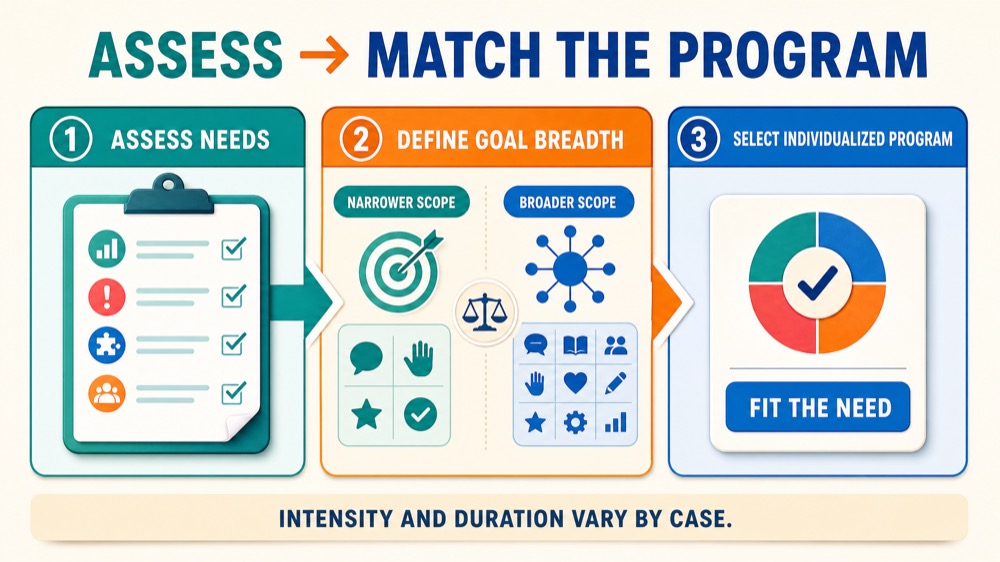
The choice between focused and comprehensive ABA should be made after a thorough behavioral assessment. This assessment is not just a list of problem behaviors; it includes functional assessments to understand the variables maintaining behavior, and skills assessments to identify strengths and deficits. The BACB Test Content Outline (6th ed.) emphasizes that behavior analysts must design interventions based on assessment results, not on a one-size-fits-all approach. During the assessment, the behavior analyst considers several factors:
- Number of behaviors: Are there many behaviors that need change, or just a few?
- Severity: How dangerous or impactful are the behaviors?
- Skill deficits: Are there significant delays across multiple areas?
- Resources: What is the family’s availability and capacity for intervention?
- Goals: What does the family want to prioritize?
The assessment then informs an individualized program that matches the client’s needs. For instance, if a client has only one disruptive behavior, a focused program may be the least restrictive and most efficient. If a client has multiple needs, comprehensive programming may be necessary to prevent future deficits. The BACB Ethics Code requires behavior analysts to select interventions that are least restrictive and most effective, which means choosing the approach that achieves significant outcomes with the least amount of unnecessary intrusion.
It is important to note that hours per week alone does not distinguish focused from comprehensive. A focused program may be intensive in terms of hours, but narrow in scope. For example, a client with severe self-injury might receive a highly focused, 20-hour-per-week program to implement a protective intervention and functional communication training, but that program is still considered focused because it targets a limited set of behaviors. Conversely, a comprehensive program might involve only 10 hours per week if the client is younger or has fewer needs, but the program addresses many domains.
Ethical Considerations
Behavior analysts must consider ethical principles when deciding between focused and comprehensive ABA. The BACB Ethics Code requires us to benefit others and to treat them with compassion and dignity. This means we must consider the client’s overall well-being, not just the immediate problem. For example, a comprehensive program might include social skills training even if the primary referral concern is only a behavior reduction, because social skills are essential for long-term success.
However, we must also respect the principle of least restrictive intervention. If a focused program can effectively address the concerns without the need for more extensive services, that is preferable. The code also emphasizes the importance of ongoing assessment and data-based decision-making. As the client progresses, the need for comprehensive vs focused services may change. A client might start with a comprehensive program and later transition to a focused program as skills are acquired.
Another ethical consideration is the involvement of the family and the client in decision-making. The BACB Ethics Code stresses that clients and stakeholders should be involved in the design and implementation of services. Therefore, the decision about focus vs comprehensiveness should be collaborative, taking into account the family’s goals and resources. For example, a family might prefer a focused program because they can manage the time commitment, even if a comprehensive program could theoretically address more areas. The behavior analyst should respect these preferences while providing professional guidance.
Common Traps and Misconceptions
There are several common traps when thinking about focused vs comprehensive ABA. One is assuming that focused ABA is always less intense than comprehensive ABA. As we have seen, intensity refers to hours and teaching density, not breadth. A focused program for a severe problem can be very intense. Another trap is thinking that comprehensive ABA is always superior. This is false; the best approach is the one that fits the client’s needs and produces meaningful outcomes. Other misconceptions include:
- Focused ABA only addresses one behavior – actually, it can target a limited set of behaviors, which may include multiple behaviors in a cluster.
- Comprehensive ABA is only for children with autism – it is used for various populations with multiple needs.
- Focused vs comprehensive ABA always works the same way – interventions are individualized, so they may differ in procedures and techniques.
- Focused vs comprehensive ABA is guaranteed on the BCBA exam – while the exam may cover intervention design, this specific label is not guaranteed.
Study Notes for BCBA Preparation
When studying for the BCBA exam, it is helpful to have a structured approach that includes both focused and comprehensive ABA concepts. Use this checklist to ensure you have covered all critical aspects:
- Understand the definitions of focused and comprehensive ABA and be able to identify which is appropriate given a client description.
- Know the key dimensions: scope, intensity, duration, and goals.
- Be able to explain how a behavioral assessment informs the decision between focused and comprehensive services.
- Describe the ethical principles that guide intervention selection, including least restrictive alternative.
- Recognize common misconceptions, such as thinking focused always means low intensity.
- Practice with real-world scenarios and BCBA practice questions.
To practice your skills, take the free BCBA mock exam. This exam provides realistic questions that cover intervention design, assessment, and ethics. Additionally, you can review our stimulus control in ABA and stimulus generalization in ABA guides to reinforce your understanding.
Conclusion
In summary, focused and comprehensive ABA differ in the breadth of goals and the scope of intervention, not necessarily in intensity. The decision between the two is guided by a thorough behavioral assessment, ethical principles, and collaborative input from the client and family. Focused ABA is time-limited and targets specific behaviors, while comprehensive ABA addresses multiple life domains. Understanding these differences is crucial for effective practice and for passing the BCBA exam. Always remember to base your intervention choices on data and the individual needs of the client. For continued preparation, access our free BCBA mock exam and other resources to enhance your study plan.



