

What Is Chaining in ABA? A Foundational Definition
Chaining in ABA is a teaching procedure used to develop complex behaviors by linking together smaller, discrete steps into a sequence. Each step serves as a cue for the next, and the chain is taught systematically using a task analysis. For BCBA candidates, understanding chaining is essential because it appears frequently on the task list and in exam scenarios.
Table of Contents
- What Is Chaining in ABA? A Foundational Definition
- Types of Chaining: Forward, Backward, and Total Task
- Worked ABA Examples: Applying Chaining with ABC Data
- Exam Relevance: Common Traps and How to Avoid Them
- Quick Checklist: Chaining for the BCBA Exam
Chaining is particularly useful for teaching daily living skills, academic routines, and vocational tasks. The three main types are forward chaining, backward chaining, and total task chaining. Each approach differs in how steps are introduced and reinforced.
Why Chaining Matters for BCBA Candidates
The BCBA exam tests your ability to select and implement the appropriate chaining procedure based on the learner’s skill level and the nature of the task. You must also be able to identify the components of a task analysis and understand how reinforcement is delivered across the chain. Mastery of chaining concepts will help you answer both definitional and application-based questions.
Types of Chaining: Forward, Backward, and Total Task
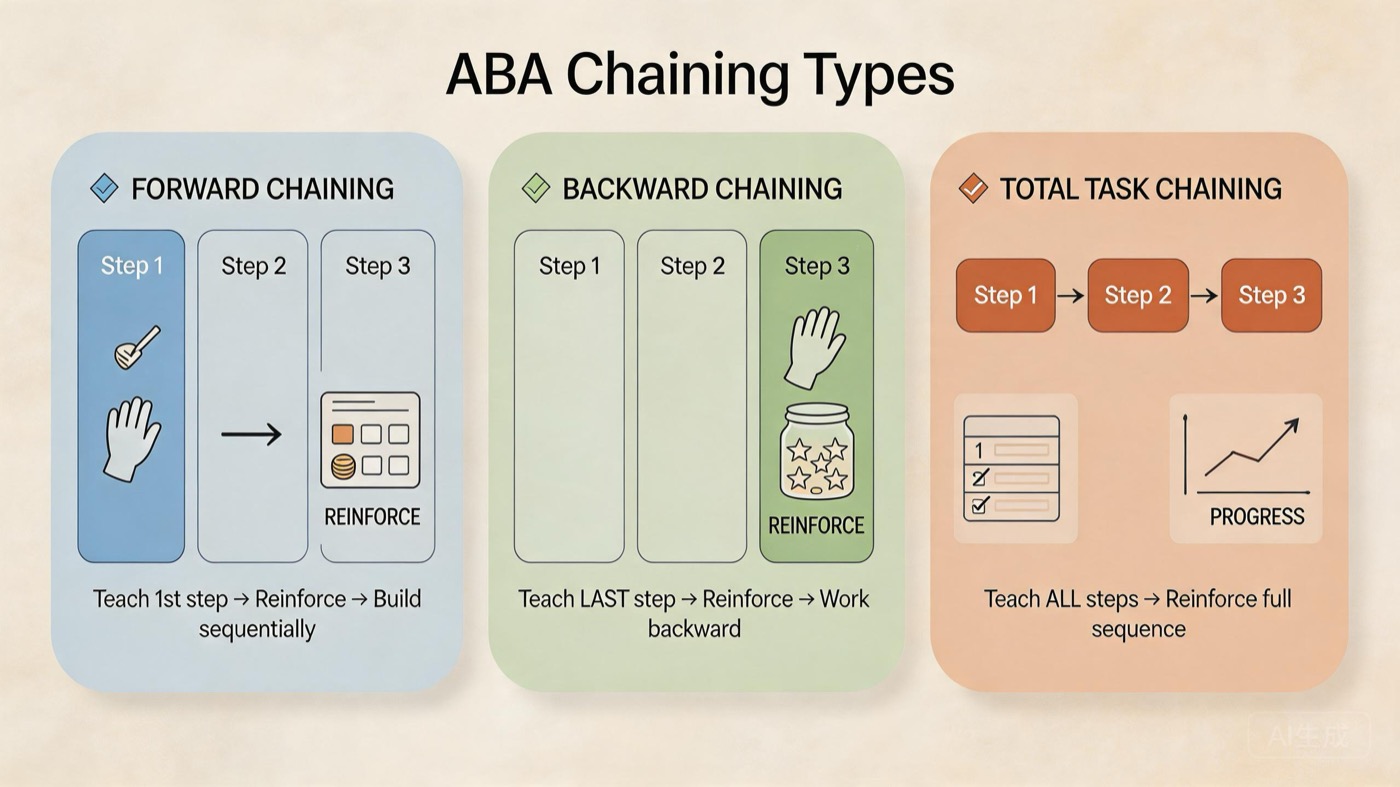
Each type of chaining has a distinct structure and is suited for different learners and goals. Below we define each method and provide practical examples.
Forward Chaining
In forward chaining, you teach the first step of the sequence first. The learner completes that step, receives reinforcement, and then you prompt or guide them through the remaining steps. Over time, you gradually increase the number of steps the learner completes independently before reinforcement. For example, teaching hand washing: start with turning on the water. Once the learner does that step independently, you add the next step (soap) and so on. Reinforcement occurs after the first completed step is mastered.
Backward Chaining
Backward chaining begins with the last step in the chain. The trainer completes all steps except the final one, and the learner performs that final step to receive reinforcement. Once mastered, you add the previous step. This method ensures the learner always experiences the natural reinforcer at the end of the task. A classic example is teaching a child to tie shoes: you do all the steps except pulling the loops tight. The child completes that final motion and gets reinforced (e.g., access to recess). Gradually, you fade prompts and shift more steps to the child.
Total Task Chaining
With total task chaining, the learner attempts every step in the sequence during each trial. The trainer provides prompting as needed, and reinforcement is delivered after the entire chain is completed (with or without prompts). This method works best for learners who already have some of the prerequisite skills. For example, brushing teeth: the child completes the full routine (pick up brush, apply toothpaste, brush, rinse) with prompts fading over time. Reinforcement might be a sticker or praise after the whole sequence.
Video Study: Task Analysis / Chaining
Watch: Task Analysis and Task Chaining: Forward, Backward, and Total Task | 6th ed. | BCBA Exam Prep
Use this lesson as a visual companion to the chaining definitions and examples below, then compare the steps with the exam distinctions in this guide.
Prefer a second pass? Open this lesson on YouTube.
Worked ABA Examples: Applying Chaining with ABC Data
To excel on the BCBA exam, you need to analyze real-world scenarios using the ABC (antecedent-behavior-consequence) framework and identify the hypothesized function. Below are three examples using different chaining types.
Example 1: Teaching a Child to Brush Teeth (Forward Chaining)
Antecedent: Parent says ‘brush teeth’ and presents the toothbrush. Behavior: Child picks up the toothbrush (Step 1). Consequence: Parent provides praise and a small token. Hypothesized function: Positive reinforcement (attention). Over trials, the parent expects the child to initiate step 1 independently before adding step 2 (applying toothpaste).
Example 2: Teaching a Student to Tie Shoes (Backward Chaining)
Antecedent: Teacher presents an untied shoe. Behavior: Student pulls the loops tight (final step). Consequence: Teacher says ‘Great!’ and allows access to recess. Hypothesized function: Tangible reinforcement (access to preferred activity). The teacher then fades assistance, eventually having the student complete the previous step (making loops) as well.
Example 3: Packing School Bag Using Total Task Chaining
Antecedent: Verbal cue ‘Pack your bag.’ Behavior: Student completes the full sequence (gather books, place in bag, zip) with prompted assistance as needed. Consequence: Student earns a sticker on a chart. Hypothesized function: Conditioned reinforcement (tokens). Prompts are faded over time as the student gains independence.
Exam Relevance: Common Traps and How to Avoid Them
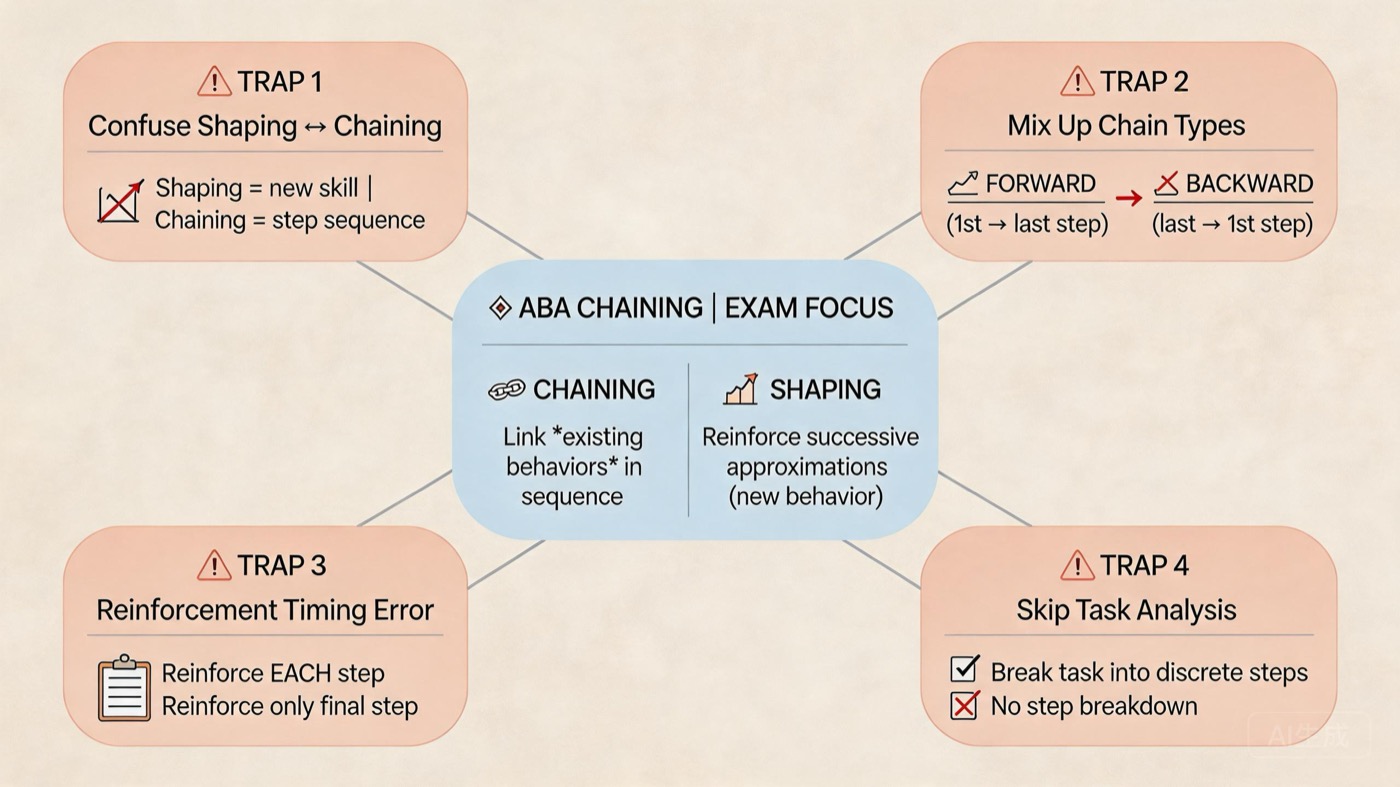
Many BCBA candidates stumble on chaining questions due to subtle distinctions. Here are four common exam traps to watch out for.
Trap 1: Confusing Chaining with Shaping
Shaping reinforces successive approximations to a final behavior (e.g., teaching a child to say ‘ball’ by reinforcing closer and closer vocalizations). Chaining involves linking discrete behaviors already in the learner’s repertoire into a sequence. On the exam, if the scenario describes reinforcing closer approximations to a single behavior, it’s shaping; if it describes a sequence of distinct steps, it’s chaining.
Trap 2: Forgetting to Include a Task Analysis
Chaining always requires a validated task analysis—a list of all steps in the sequence. Exam questions often ask candidates to identify the steps or to recognize that a task analysis was omitted. Always check whether the steps are clearly defined before selecting a chaining procedure.
Trap 3: Misidentifying the Last Step in Backward Chaining
When using backward chaining, you must identify the true terminal step that produces the natural reinforcer. For example, in putting on a shirt, the last step is pulling the shirt down into place, not buttoning. Confusing the order can lead to selecting an inappropriate chaining method.
Trap 4: Overlooking Reinforcement of Individual Steps
In forward chaining, each mastered step is reinforced. In backward chaining, only the terminal step is reinforced initially, with earlier steps receiving reinforcement indirectly through the chain. The exam may test your understanding of how reinforcement is scheduled differently across types.
Quick Checklist: Chaining for the BCBA Exam
Use this concise list to review key points before the test. Read more about chaining on our detailed guide.
- Identify the task analysis: Break the behavior into teachable steps.
- Choose the chaining type: Forward (first step first), backward (last step first), or total task (all steps with prompting).
- Remember reinforcement rules: Forward reinforces each step; backward reinforces the last step; total task reinforces the chain.
- Watch for common errors: Don’t confuse with shaping; ensure steps are in correct order.
- Practice with ABC data: Analyze antecedent, behavior, consequence, and hypothesized function.
For additional exam prep resources, visit our BCBA exam prep page. To dive deeper into related concepts, see the BACB’s official website for the task list.
Mastering chaining in ABA will not only help you pass the exam but also equip you to teach meaningful skills to your clients. Practice with scenarios, memorize the key differences, and you’ll be ready.
Complete BCBA Exam Prep
Turn this topic into exam-day practice
Practice concepts in context with five full-length 6th Edition mock exams, two bonus practice exams, a 6th Edition study guide, and key-term flashcards—all in one $120 USD package.
Get the $120 All-in-One Prep Pack
Review everything included on the product page before ordering. No pass guarantee is implied.



