
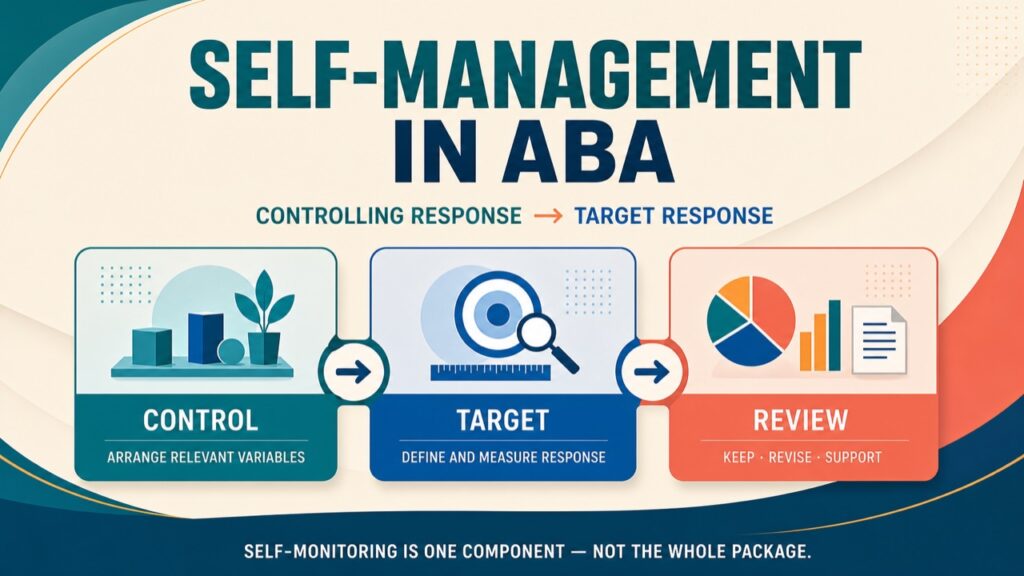
Self management ABA refers to behavior a person uses to change variables that affect another, separately defined behavior of their own. It is broader than recording behavior on a form. A well-specified plan identifies the controlling response, the target response, relevant environmental variables, measurement, and a rule for reviewing results. This guide separates the components, examines two small studies, and shows how to design examples without treating self-management as willpower.
Table of Contents
- What Is Self-Management in ABA?
- Self-Management vs. Self-Monitoring and Self-Control
- Components of a Self-Management Package
- What Two Component Studies Show
- Two Original Self-Management Examples
- A Data-Based Design Checklist
- Common Conceptual Errors
- Study Connection and Next Step
What Is Self-Management in ABA?
Behaviorally defined, self-management is a repertoire in which a person emits a controlling response that changes an antecedent, consequence, measurement arrangement, or other variable affecting a separate target response. Placing a work file on the computer desktop tonight can alter the conditions under which opening that file occurs tomorrow. Setting a reminder, preparing a checklist, arranging a quiet location, or requesting a scheduled check-in can also be controlling responses when they affect the target under the conditions measured.
The label does not identify an inner manager or a store of willpower. Both the controlling and target responses have environmental histories and current contexts. Nor must a person invent every component alone. A plan can be collaboratively selected, taught, prompted, and checked while the learner gradually performs meaningful controlling responses. If another person arranges every antecedent and consequence and the learner performs none of the controlling repertoire, that plan is externally managed rather than learner self-management.
Self-Management vs. Self-Monitoring and Self-Control
Self-monitoring means observing and recording one’s own behavior. It may serve as measurement, as part of an intervention package, or both. The existing guide to self-monitoring in ABA focuses on recording accuracy and reactivity. Self-management is the broader category: a package can contain self-monitoring plus other controlling responses.
Self-control is used in behavior analysis for relations in which a person’s controlling behavior alters the probability of another response. Choice between a smaller-sooner and larger-later outcome is one commonly studied arrangement, but it is not the only self-control situation. Self-management is the practical programming framework that may include commitment responses, delay arrangements, environmental changes, or other self-control strategies.
Self-instruction and self-evaluation are also components rather than synonyms. Self-instruction arranges verbal prompts for later action. Self-evaluation compares measured performance with a defined criterion. Neither term tells us whether the overall package changed the target response; that conclusion comes from data.
Components of a Self-Management Package
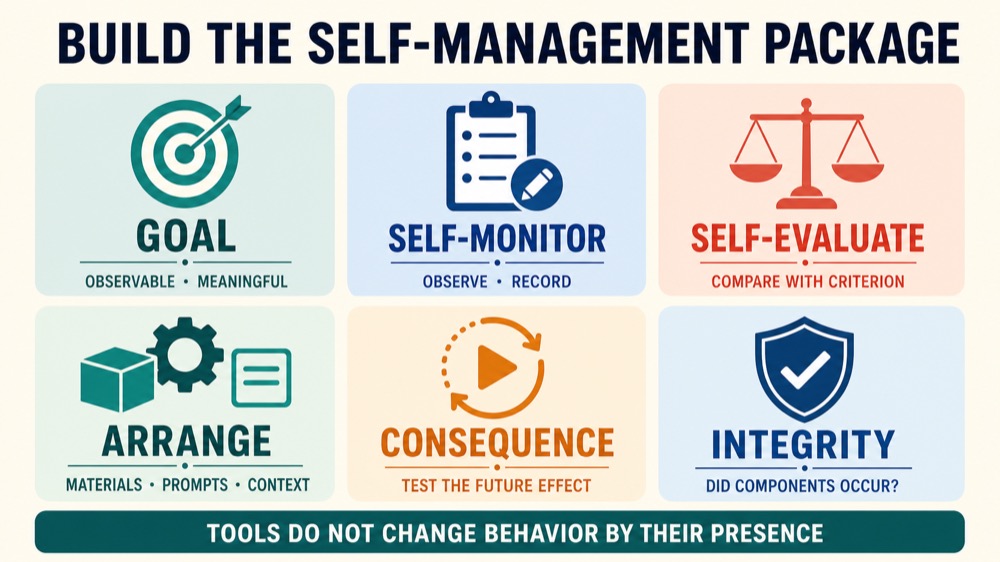
A package can combine several elements. The appropriate combination depends on the target, the person’s skills and preferences, the context, and observed effects.
- Goal setting: collaboratively define a meaningful, observable performance aim and time frame.
- Self-monitoring: observe and record the target or an important precursor with a feasible system.
- Self-evaluation: compare the record with an explicit, revisable criterion.
- Environmental arrangement: add, remove, or reposition materials and cues relevant to the target.
- Self-instruction: prepare a brief prompt, sequence, or implementation statement for the relevant moment.
- Behavioral contract: document the target, roles, measurement, criterion, consequences, and review process.
- Programmed consequence: arrange an outcome after the defined performance and verify its effect.
The phrase self-reinforcement requires functional care. A self-delivered preferred event is a programmed consequence; it is a reinforcer only if contingent delivery increases the relevant future response. Self-delivery does not detach behavior from environmental contingencies or learning history. Access rules also need integrity checks, because an event available regardless of performance cannot be assumed to support the specified contingency.
What Two Component Studies Show
A 2026 component analysis evaluated task engagement for five people with intellectual and developmental disabilities. In that arrangement, self-monitoring alone did not increase task engagement. Differential reinforcement for accurate self-monitoring improved monitoring accuracy for all five participants but increased engagement for only two. Reinforcement for both accurate monitoring and task engagement was needed for the remaining participants before engagement increased. Read the open-access JABA article for the full procedures and individual results.
A 2005 study evaluated a package for social initiations with three students. The students first acquired initiations while reinforcement was externally determined. The researchers then shifted to a self-management system and faded prompts while initiations were maintained. The open-access study illustrates transfer of package components after acquisition. It does not isolate one necessary component, show that support can be removed in every case, or establish outcomes for other learners and targets.
Together, the studies support component-level measurement. A change in recording accuracy is not automatically a change in task engagement, and a multicomponent package cannot reveal which element mattered unless the design evaluates components. Small samples call for individualized replication, not a universal package.
Two Original Self-Management Examples
Example 1: beginning an assigned reading block. The target response is reading the assigned text during a learner-selected study period. The controlling responses are placing the text and data card on the desk, starting a timer, and moving entertainment notifications to a chosen focus mode. The learner records independent starts and reading duration. A collaboratively selected leisure activity is available after the individualized criterion, and the team checks whether contingent access actually increases starts. An integrity check records whether the materials, timer, and consequence rule were used. The decision rule compares several observations and revises one component when data do not improve.
Example 2: submitting a weekly work report. The target response is uploading a complete report by the agreed deadline. The employee creates a calendar prompt, breaks the report into visible steps, checks completed steps, and asks a colleague for a scheduled accuracy review. Submission time and missing sections are measured. The consequence rule and review interval are selected with the employee, not imposed as a generic prescription. If performance changes only when the colleague prompts each step, the data show continued external prompt control and guide the next revision.
A nonexample is a teacher selecting the target, keeping the only record, delivering every consequence, and changing the plan while the student performs none of those controlling responses. Another nonexample is downloading an app and calling it self-management without defining what the person will do, when they will do it, and how results will be measured.
A Data-Based Design Checklist
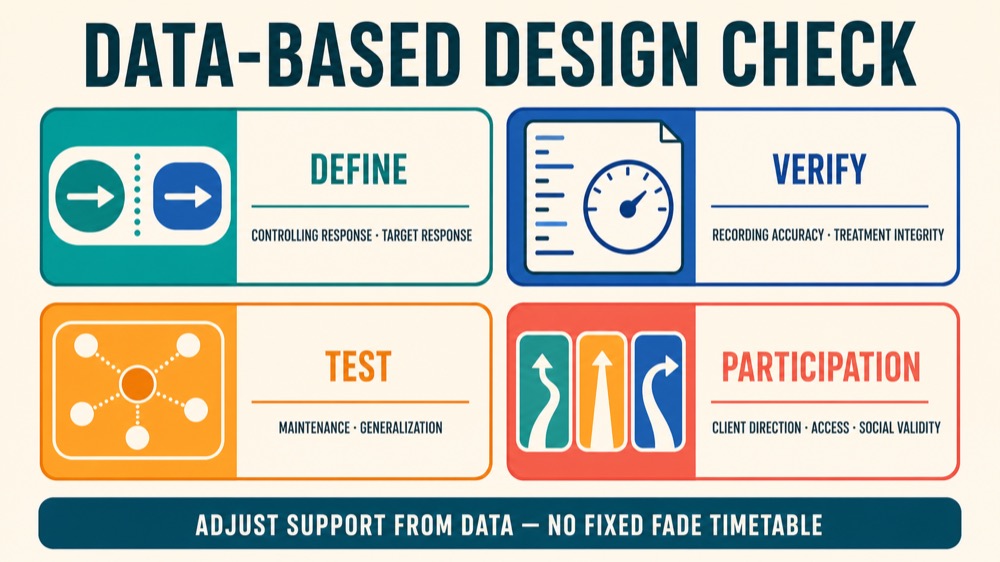
- Define two responses: state the controlling response and target response separately.
- Measure a baseline: describe current performance before attributing change to the package.
- Check recording accuracy: compare self-records with another feasible measure on planned samples.
- Measure treatment integrity: record which components occurred as designed.
- Separate independence and prompts: do not combine prompted and independent performance.
- Match assessment to the question: behavior reduction may warrant functional assessment of relevant variables; a formal functional analysis is not a prerequisite for every benign organizational goal.
- Plan maintenance and generalization: measure later performance and relevant settings rather than inferring them from acquisition.
- Protect privacy and accessibility: use records, technology, language, and response modes the person can access without unnecessary disclosure.
- Include client direction: select meaningful goals and review consent, assent, refusal, and withdrawal processes appropriate to the person and context.
- Review social validity: ask whether the goals, procedures, effort, and outcomes remain acceptable and useful.
Support should be adjusted from performance, integrity, safety, and participation data. Fading is not a default timetable. Some external prompts or checks may remain useful, while other components can transfer to the learner.
When a package contains several new elements, record their introduction and any later changes. If a reminder, self-recording form, colleague check, and consequence rule all begin on the same day, improved performance supports the package but does not identify one active ingredient. A planned component analysis may be appropriate when the question matters and the design is feasible; in ordinary service delivery, cautious sequential changes can still improve interpretability. Document competing changes such as a new deadline, workload, schedule, or access to materials so the graph is not read as stronger evidence than the arrangement permits.
Common Conceptual Errors
- Equating self-management with self-monitoring: recording is one possible component, not the entire package.
- Calling a tool the intervention: a checklist, graph, app, goal, or contract has no guaranteed effect by its presence.
- Labeling preference as reinforcement: verify an increase in the relevant future behavior.
- Ignoring external variables: “self” describes who emits controlling responses, not freedom from environmental influence.
- Using diagnosis as a predictor: assess repertoires, context, accessibility, preference, and observed performance.
- Assigning stimulus function by appearance: a book on a pillow is not automatically an SD; that function depends on a relevant differential reinforcement history.
- Mislabeling environmental arrangement: moving a phone changes availability and context; it should not be described as “removing an S-delta that cues checking.”
These distinctions connect self-management to stimulus control without turning ordinary objects into permanent SDs or S-deltas. State the history and measure the response pattern before assigning a functional label.
Study Connection and Next Step
The current BACB BCBA Test Content Outline, 6th edition is the official source for examination-content scope. It does not predict the concepts selected for a particular form. Study self-management by identifying the two responses, the arranged variables, the package components, and the data needed to evaluate effects.
Use the Free BCBA Mock Exam for broader practice and answer feedback. It is a study resource and does not promise an item on this exact topic.



