
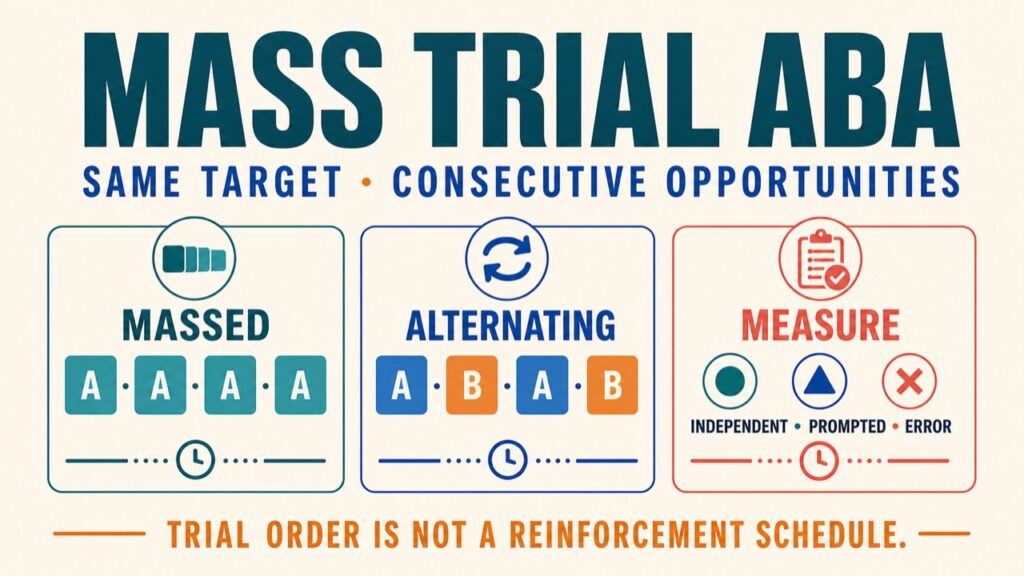
Mass trial ABA is an informal phrase for a way of ordering teaching opportunities. The more precise term is massed-trial teaching: several consecutive opportunities are arranged for the same current teaching target before another target is introduced. This guide explains what that sequence does and does not show, how it differs from alternating and interspersed trials, and how learner data should guide its use.
Table of Contents
- What Is Mass Trial ABA?
- Four Ways to Order Teaching Trials
- Worked Example: What Massed Data Can Show
- What Comparative Research Found
- A Data-Based Sequencing Decision
- Moving From Concentrated to Varied Practice
- Common Study Errors
- Mass Trial ABA Study Checklist
What Is Mass Trial ABA?
Massed-trial teaching is a sequencing arrangement. Repeated learning opportunities for one current target are grouped together. If the target relation is selecting a cat picture when asked “Point to cat,” a massed block might contain several consecutive opportunities for that relation. The cards can change position between trials when position is not the relevant feature.
The sequence should not be confused with the anatomy of a trial. In discrete trial teaching, a programmed opportunity may include a relevant antecedent or instruction, a prompt when indicated by the plan, the learner response, a programmed consequence, an inter-trial interval, and data recording. Massed-trial teaching describes how several such opportunities are ordered. It is not a prompting hierarchy, an error-correction procedure, or a reinforcement schedule.
The singular phrase “mass trial” appears in study materials and program conversations, but authors do not use every label consistently. A replicable teaching plan should therefore state the target relation, trial order, materials, prompt and consequence rules, interval between trials, and the outcome measured. The operational definition matters more than the shorthand label.
Four Ways to Order Teaching Trials
Trial-order labels overlap across programs, so the examples below are arrangements to define rather than universal templates.
- Massed-trial teaching: opportunities for target A occur consecutively, such as A–A–A–A.
- Alternating-trial sequencing: two relations alternate in a specified order, such as A–B–A–B.
- Interspersed trials: other acquisition or maintenance tasks occur between opportunities for A, such as A–mastered task–B–mastered task–A.
- Random rotation: several defined targets are presented in a varied order that is not predictable from a fixed alternation.
These arrangements can answer different instructional questions. Consecutive practice can produce many opportunities with one relation in a short period. Mixed arrangements can sample control by more than one instruction or target and reduce the chance that the immediately preceding trial alone predicts the next response. Neither arrangement, by its name alone, establishes acquisition, fluency, discrimination, maintenance, or generalization.
Worked Example: What Massed Data Can Show
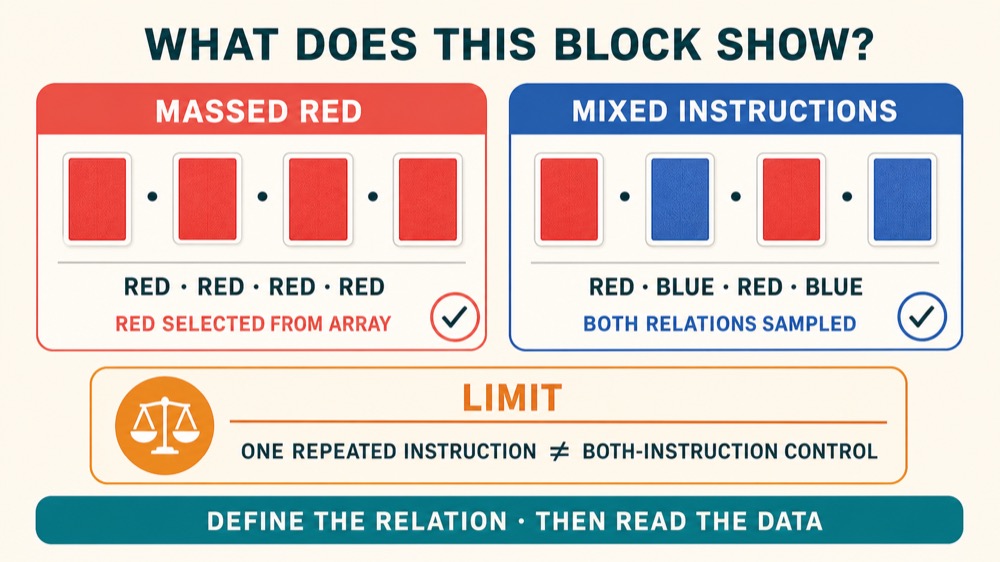
Suppose the teaching target is selecting red from a two-card array after the instruction “Show me red.” The practitioner shuffles the positions of the red and blue cards between opportunities. A massed sequence contains five consecutive red trials. The plan specifies a gestural prompt when needed, praise and a brief preferred activity for a correct response, a three-second inter-trial interval, and separate data for independent and prompted responses.
This block can show whether the learner selects red in the presence of blue under those conditions. It does not by itself show that responding is under conditional control of both “red” and “blue” instructions, because “Show me blue” was not presented. A comparison block might mix red and blue instructions while keeping the array, prompting rules, consequences, and measurement constant. Accurate responding to both instructions across varied positions provides stronger evidence for that specific discrimination.
A nonexample is running several unrelated targets and calling the session “massed” merely because trials occurred quickly. Trial density and trial sequence are separate dimensions. Another nonexample is repeating an instruction after errors without a defined teaching or error-correction plan; repetition alone is not massed-trial programming.
What Comparative Research Found
Comparative evidence is useful but limited. Henrickson, Rapp, and Ashbeck compared massed-trial and interspersed-trial teaching across three programs for three autistic participants. Acquisition rate was higher in the massed condition for all three participants, and problem behavior was similar across conditions. Maintenance results were mixed; interspersed teaching appeared advantageous at some follow-up probes for two participants, and neither arrangement produced consistently high correct responding at every follow-up. The 2015 research article supports evaluating outcomes, not declaring one sequence best across learners, targets, and contexts.
Ross and colleagues studied choice between massed and alternating sequencing in a computerized matching-to-sample arrangement with two autistic children. Both selected the alternating arrangement more often in that study. The 2017 open-access article supports measuring learner preference under defined conditions. Two participants’ choices do not establish what another learner will select, and preference for an arrangement is distinct from its acquisition or maintenance effect.
Read both studies at the level of their participants, targets, procedures, and measured outcomes. Small comparative studies can inform hypotheses and individualized tests. They cannot supply a universal trial count or a guaranteed progression.
A Data-Based Sequencing Decision
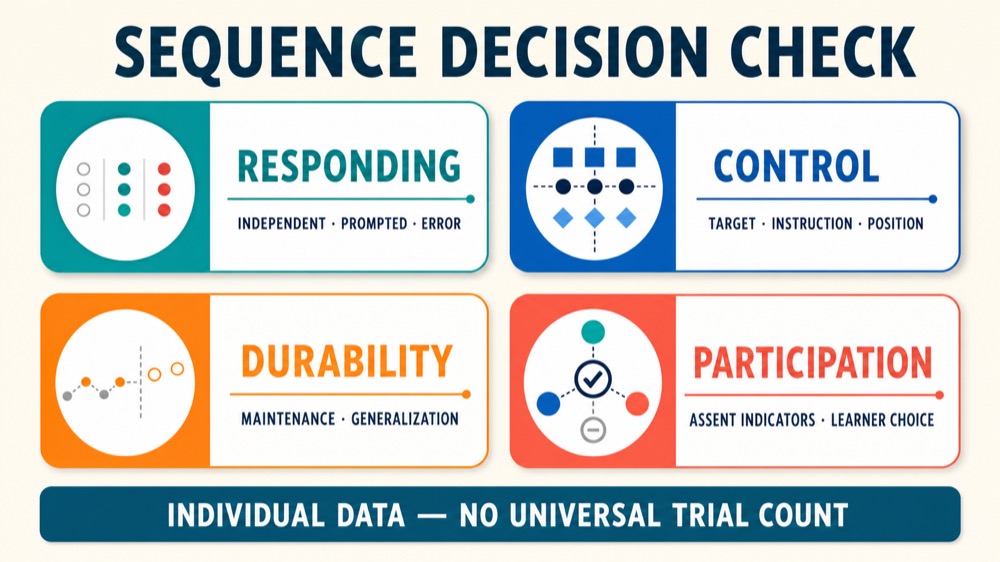
Selecting and changing a sequence is a data-based programming decision. Before comparing arrangements, define them so differences in prompting, reinforcement, materials, and trial duration do not accidentally become the explanation for an outcome.
- Independent responding: score performance by target rather than combining prompted and independent correct responses.
- Errors and prompts: examine error type, position patterns, prompt level, and whether prompt control is decreasing.
- Efficiency: compare opportunities, time, sessions, and trials to the individualized learning criterion.
- Discrimination: include relevant comparison stimuli or instructions when the goal requires differential responding.
- Maintenance and generalization: arrange separate probes after time has passed and across relevant people, materials, or settings.
- Social validity: obtain client and stakeholder input about goals, procedures, and meaningful outcomes.
- Assent and participation: define context-specific approach, engagement, pause, refusal, or withdrawal indicators and honor the applicable plan rather than assigning one meaning to crying, looking away, or leaving.
- Preference: when appropriate, offer clearly defined choices and record selections instead of inferring preference from impression alone.
The number of consecutive opportunities should follow the learner’s data and the program’s purpose. A percentage from one block can be misleading when targets, prompts, or opportunities differ, so retain the numerator, denominator, and response category.
For example, “four of five independent responses to red in a massed block” is more informative than “80% correct” alone. Pair that result with performance when red and blue instructions are mixed, with a later probe, and with the prompt history. If more than one person collects data, define each response category and check observer agreement on a sample when feasible. These details help the team decide whether to continue the sequence, modify teaching variables, or test a different arrangement without treating one favorable block as a mastery decision.
Moving From Concentrated to Varied Practice
A practitioner may use concentrated practice during acquisition and then introduce other arrangements, but no fixed ladder applies to every program. One learner may benefit from early alternating trials; another may show more independent responding when a new relation is first concentrated. The useful question is which arrangement produces meaningful learning while remaining acceptable and feasible.
Possible programming changes include inserting a well-maintained task, alternating two acquisition targets, varying exemplars, testing a discrimination, or arranging natural opportunities outside structured teaching. Change one clearly defined feature when possible, then inspect independent responding, errors, prompts, maintenance, generalization, and participation. If performance changes, verify that the result is related to the sequence rather than an unplanned change in reinforcement or prompting.
Varied practice can create opportunities to assess broader stimulus control, but random rotation does not automatically produce generalization. Generalization must be planned and measured across the relevant conditions. Maintenance likewise requires later observation, not an assumption based on acquisition data.
Common Study Errors
- Calling massed trials a reinforcement schedule: trial order and the response–reinforcer contingency describe different variables.
- Treating prompted correct as independent acquisition: report prompt level so apparent accuracy does not hide prompt dependence.
- Claiming discrimination from one repeated instruction: specify which stimulus relation was sampled and arrange the relevant comparison.
- Equating acquisition with fluency or durability: rate, accuracy, maintenance, and generalization are separate outcomes.
- Using “blocked” as an exact synonym everywhere: definitions differ across clinical and research traditions.
- Assuming disengagement or preference: define observable indicators, examine context, and collect choice or participation data.
The current BACB BCBA Test Content Outline, 6th edition is the official source for examination content scope. It does not predict the concepts selected for a particular examination form. Study massed-trial teaching as an application of skill-acquisition, stimulus-control, measurement, and data-based decision principles rather than relying on claims about question frequency.
Mass Trial ABA Study Checklist
- Define massed-trial teaching by the order of opportunities.
- Separate trial sequencing from prompting, error correction, and reinforcement schedules.
- Distinguish massed, alternating, interspersed, and random-rotation arrangements operationally.
- State exactly which discrimination a set of trials can and cannot demonstrate.
- Interpret the 2015 and 2017 findings within their small samples and procedures.
- Use independent responding, errors, prompt level, maintenance, generalization, social validity, participation, and learner preference to guide decisions.
For related foundations, review stimulus control in ABA and stimulus generalization. Then use the Free BCBA Mock Exam for practice and feedback across the broader content area. The mock exam is a study resource and does not promise an item on this exact concept.
Next step for BCBA exam prep
Turn this topic into exam-day practice
Use this topic as a focused review, then test it in exam-style conditions with a free mock before deciding whether five full-length mocks are the right next step.
Start the Free BCBA Mock ExamContinue with Five Full-Length Mocks — $99
Review the included materials and access details before ordering. No pass guarantee is implied.



