
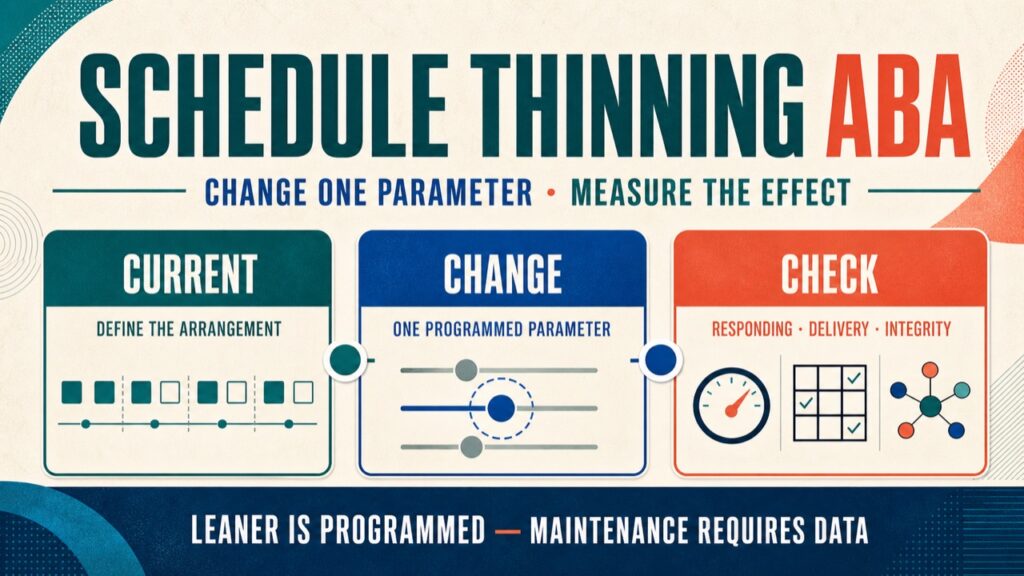
Schedule thinning ABA describes a planned change from a dense reinforcement or reinforcer-delivery arrangement toward a leaner, more practical one. The change is usually systematic and progressive, but the label does not promise a successful result. Practitioners must measure whether useful responding, safety, feasibility, and client participation remain acceptable after each change. This guide separates four common arrangements, explains what parameter changes in each, and shows why the decision cannot be reduced to one universal sequence.
Table of Contents
- What Schedule Thinning Changes
- Four Common Schedule-Thinning Arrangements
- Worked Examples: Change One Parameter
- FCT, Multiple Schedules, and Stimulus Control
- Token Economy: Two Schedules, Not One
- Data-Based Decisions and Ratio Strain
- Study Boundaries and Official Source
- Practice the Analysis
What Schedule Thinning Changes
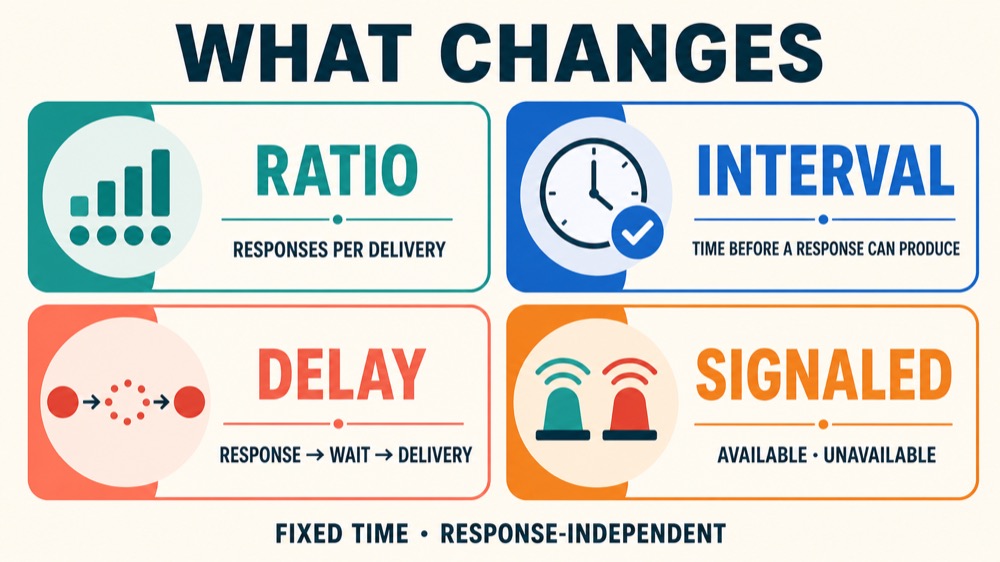
A schedule-thinning program alters one or more programmed parameters across observations. It may increase a response requirement, lengthen an interval, add a delay to reinforcement, reduce the relative duration of signaled reinforcer availability, or lengthen a response-independent delivery interval. A terminal arrangement is a documented goal judged feasible in the relevant setting, not a number that applies across learners. Maintenance is therefore a measured outcome of the program rather than a feature built into the definition.
The first analytic question is whether delivery is response dependent. Under a reinforcement schedule such as fixed ratio or fixed interval, a specified response remains necessary for the consequence. Under fixed time delivery, passage of time schedules the event independently of the target response. The literature often calls the latter noncontingent reinforcement, but practitioners should still state the actual contingency and verify the event’s behavioral function instead of classifying it from preference or appearance.
Schedule thinning also differs from withdrawing a previously reinforcing consequence for a response. Some multiple-schedule applications include a signaled component in which a functional communication response does not contact its usual consequence. That component may operate as extinction for that response, yet the complete package alternates availability and unavailability. Precise writing identifies the response, consequence, component, and signal instead of assigning one loose label to the entire program.
Four Common Schedule-Thinning Arrangements
The title’s four “types” are best understood as common arrangements, not an exhaustive taxonomy. Each row in a plan should identify the current arrangement, the single parameter selected for change, what remains constant, and the measures used to judge the effect.
- Ratio requirement: A fixed ratio schedule changes the number of defined responses required for delivery. For example, one independently completed work unit may initially produce a token; a later step may require two units. The unit definition, consequence, and exchange rule can remain constant while the response count changes.
- Contingent interval: Under a fixed interval schedule, the first defined response after the programmed interval produces the consequence. Lengthening the interval changes when reinforcement becomes available, but time alone does not produce delivery. A variable-interval arrangement changes the distribution around an average rather than creating a fixed wait.
- Delay after a response: A response still produces its programmed consequence, but delivery occurs after a specified delay. The delay value changes while the response requirement can remain constant. Waiting behavior, problem behavior when relevant, and actual delivery must be measured separately.
- Signaled components: A multiple schedule alternates two or more schedules with distinct correlated stimuli. A chained schedule also has signaled components, but completing the requirement in one component produces access to the next, with the terminal consequence delivered after the chain. Thinning may change component durations or requirements without making these arrangements interchangeable.
Moving directly from continuous reinforcement to FR 10 is still a move to a leaner schedule. It is poorly graduated if no intermediate steps or decision rules are planned, but abruptness does not create a different behavioral operation. Whether responding becomes disrupted, previously reduced behavior returns, or no important change occurs is an empirical question. Those patterns should be documented rather than predicted from the size of the numerical jump alone.
Worked Examples: Change One Parameter
The numbers below are invented to demonstrate analysis, not to prescribe treatment. A real program requires individualized assessment, competence, consent or assent processes, and supervision appropriate to the setting.
- Positive-reinforcement ratio example: During a packaging task, each correctly sealed box currently produces one token under continuous reinforcement. A planned comparison changes only token production to FR 2. Staff record correct boxes, errors, pauses, tokens delivered, and the obtained reinforcer rate. If accuracy or participation changes materially, the analyst holds or revises the step instead of advancing by calendar date.
- Contingent-interval example: During independent study, the first completed practice item after three minutes currently produces brief access to a selected activity. A later observation uses five minutes while the response definition and consequence remain unchanged. Staff record items completed, latency after availability, actual deliveries, integrity, and client feedback. This is not fixed time because completion is still required.
- Delay example: After an appropriately assessed attention request, a teacher signals a brief programmed delay before responding. The next comparison lengthens only that delay. Data include appropriate requests, waiting duration, attention delivered, competing classroom demands, and any relevant problem behavior. A request should not be assumed to tolerate the new delay merely because it was acquired under immediate delivery.
- Negative-reinforcement chain example: In a qualified, function-based program, one signal marks a short instructional component and a second signal marks when a break request can produce removal of demands. A planned step changes the instructional requirement while the break duration and communication response remain constant. Data on task completion, communication, problem behavior, assent or withdrawal indicators, and integrity determine whether to continue.
- Response-independent example: A fixed time arrangement delivers access to a functionally relevant event every three minutes regardless of the target response. A comparison lengthens the interdelivery interval to four minutes while the event and observation period remain constant. Analysts report the response-independent arrangement, target behavior, deliveries obtained, and contextual changes rather than describing the target behavior as earning the event.
FCT, Multiple Schedules, and Stimulus Control
Functional communication training often begins with dense access to a functionally equivalent consequence, which can be difficult to sustain in everyday settings. A multiple schedule can correlate one signal with availability and another with unavailability so that the communication response comes under stimulus control. Thinning may then alter the relative component durations. A chained schedule can instead require completion of an identified component before the terminal consequence becomes available. The functional assessment and treatment context matter; these descriptions are educational, not stand-alone clinical instructions.
A three-participant FCT study by Hanley, Iwata, and Thompson began with FR 1 delivery for alternative communication. In the studied applications, increasing delays and a graduated fixed-interval arrangement produced important limitations, while discriminative stimuli in multiple schedules facilitated thinning for participants exposed to those comparisons. The findings describe a small set of single-case applications and do not rank every possible procedure for every client.
A 2022 study of three participants compared chained and multiple schedules after FCT for escape-maintained problem behavior. Both arrangements reduced problem behavior in those applications, and compliance increased under both; relative compliance and preference results differed across participants. Those differences support measuring performance and preference rather than choosing a schedule from a generalized rule.
Multiple-schedule methods have also been examined with response-independent delivery. A primary study of noncontingent-reinforcement schedule thinning evaluated brief exposure to signaled availability and nonavailability followed by rapid thinning. It reported that establishing control across signaled components facilitated the evaluated procedure. This does not erase the distinction between a contingent communication response and an event delivered according to time.
Token Economy: Two Schedules, Not One
A token economy contains at least two decisions that are easy to blur. The token-production schedule specifies what behavior produces tokens. The exchange schedule specifies when or how accumulated tokens can be exchanged for backup reinforcers. Backup-reinforcer availability is another relevant variable. Increasing responses per token changes production; increasing tokens required for exchange changes a different relation. A valid plan names the parameter instead of saying only that “the token schedule” became thinner.
Tokens and backup items should be evaluated functionally. Calling an item preferred does not establish that contingent delivery increases the relevant future response. Likewise, changing production and exchange simultaneously makes it harder to interpret which change affected performance. When feasible, alter one planned parameter, measure both programmed and obtained delivery, and document deviations through treatment integrity data.
Data-Based Decisions and Ratio Strain
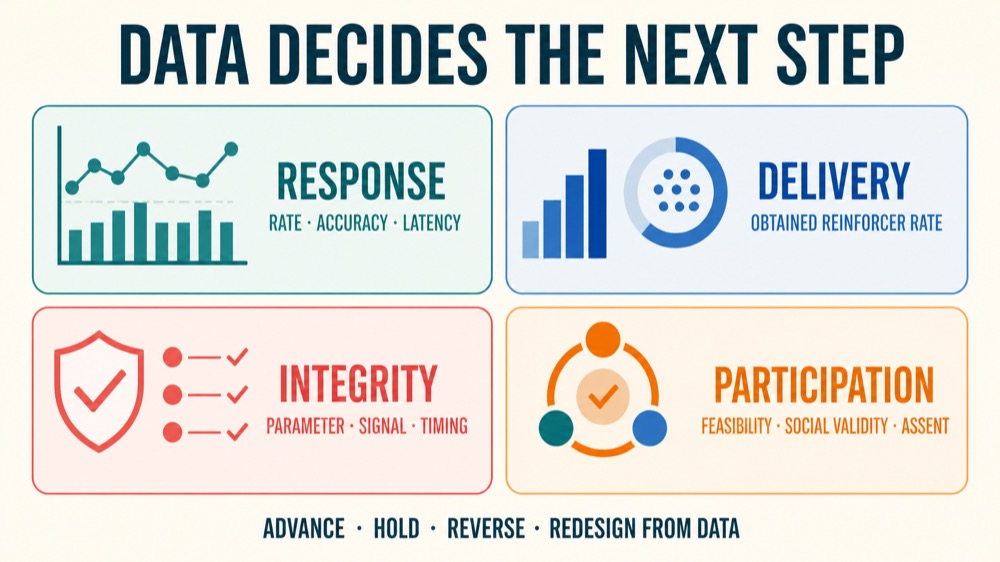
Schedule values alone cannot show whether a step worked. The obtained reinforcer rate may differ from the programmed maximum because response rate, missed opportunities, competing events, or implementation errors change. A step that looks leaner on paper may have little effect, while a smaller numerical change may coincide with disruption. The detailed ratio strain guide covers disruption patterns; here the central rule is to define them and inspect data rather than infer them from a ratio label.
- Measure the target response and functional communication response separately when both are relevant.
- Track problem behavior only with an operational definition and appropriate safety plan.
- Record latency, duration, or distribution across components when those dimensions answer the decision question.
- Calculate actual deliveries or obtained reinforcer rate, not just the programmed schedule value.
- Check treatment integrity for signals, timing, response requirements, and consequence delivery.
- Document feasibility, social validity, client preference, and observable assent or withdrawal indicators.
- State in advance what pattern will lead to advancing, holding, reversing, or redesigning a step.
- Probe maintenance, generalization, and relapse separately from performance during acquisition.
Resistance to extinction is a theoretical concept about persistence under disrupted reinforcement conditions, not an outcome conferred by thinning. Durable performance should be tested with measures suited to the goal and context. The same caution applies to natural reinforcement: a thinner programmed schedule can approximate some everyday conditions, but transfer to naturally occurring contingencies must be demonstrated rather than assumed.
Study Boundaries and Official Source
The BCBA Test Content Outline, 6th edition names schedule thinning in task G.16, alongside transferring behavior change to naturally occurring reinforcers. It also separately includes simple and compound schedules, time-based schedules, token economies, maintenance, measurement, and data-based intervention decisions. The outline establishes the official content domain; it does not specify which arrangement will appear on an individual examination form.
- Identify whether delivery depends on a response or on elapsed time.
- Name the exact parameter that changes and the features held constant.
- Distinguish ratio, interval, delay, multiple, and chained arrangements.
- Separate a programmed schedule value from the obtained reinforcer rate.
- Evaluate maintenance and resistance to extinction with data, not labels.
- Keep token production, exchange, and backup-reinforcer availability distinct.
Practice the Analysis
Use the Free BCBA Mock Exam to practice identifying contingencies, comparing schedule arrangements, and using feedback to find study gaps. The practice resource is a preparation tool and does not claim to reproduce a particular live exam form or include this exact topic.
Next step for BCBA exam prep
Turn this topic into exam-day practice
Use this topic as a focused review, then test it in exam-style conditions with a free mock before deciding whether five full-length mocks are the right next step.
Start the Free BCBA Mock ExamContinue with Five Full-Length Mocks — $99
Review the included materials and access details before ordering. No pass guarantee is implied.



