
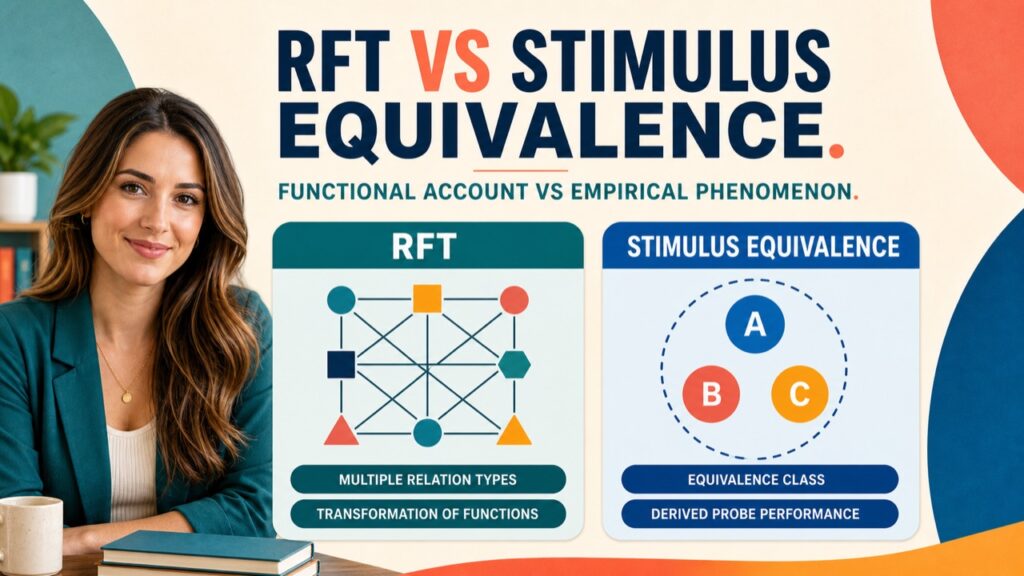
In applied behavior analysis (ABA), two closely related but distinct accounts of derived relations often challenge students and practitioners: stimulus equivalence and relational frame theory (RFT). Understanding the difference between these two approaches is essential for mastering verbal behavior and equivalence content. This article provides a side-by-side comparison, clarifies conceptual overlap without conflating the two accounts, and offers practical examples to solidify your understanding. It draws on authoritative sources such as the BCBA Test Content Outline (6th ed.), the contextual science website, and a peer-reviewed article in the Psychological Record.
Table of Contents
- Defining Stimulus Equivalence
- Defining Relational Frame Theory (RFT)
- Key Differences Between RFT and Stimulus Equivalence
- Conceptual Overlap and Distinctions
- Matched Example: Equivalence Class vs. Relational Frame
- Practical Implications for ABA Practitioners
- Common Traps and Study Checklist
- Further Reading and Test Prep
Defining Stimulus Equivalence
Stimulus equivalence is an empirically demonstrated pattern of derived relations, evaluated with probes appropriate to the baseline arrangement. In a common A→B and B→C arrangement, the taught conditional discriminations are the baseline relations. Subsequent unreinforced probes can assess reflexivity (for example, A→A), symmetry (B→A and C→B), transitivity (A→C), and a combined symmetry-plus-transitivity relation (C→A). The exact probes depend on which relations were taught, so a test relation should never be relabeled as trained—or vice versa. For example, a learner might be taught to select a picture of a cat (B) after hearing “cat” (A), then select the printed word CAT (C) when shown the picture. Accurate responding on carefully arranged, unreinforced reverse and cross-modal probes would provide evidence that the stimuli participate in an equivalence class. Correct performance on the baseline conditional discriminations by itself establishes only those taught relations. Stimulus equivalence therefore names an observed outcome and a research tradition; matching-to-sample is one procedure researchers may use to establish baselines and test for that outcome.
Defining Relational Frame Theory (RFT)
Relational frame theory is a broader functional-analytic account of arbitrarily applicable relational responding (AARR). “Arbitrarily applicable” means that the relevant relation need not follow from the formal properties of the stimuli; a learned contextual cue can specify how they are related. Across a history of multiple-exemplar training and differential reinforcement, cues such as “same,” “opposite,” “more than,” or “before” may come to control patterns of mutual and combinatorial entailment. RFT also emphasizes the transformation of stimulus functions: a stimulus function may change in a relation-consistent way even without direct conditioning of every network member. For example, the ACBS account notes that if A has a conditioned reinforcing function and a learner derives that B is opposite to A, B may acquire an aversive function. The direction and size of any change must still be measured; the relational label does not guarantee a particular effect. RFT uses this vocabulary across coordination, opposition, comparison, hierarchy, temporality, and other relations, making it a theory or functional account of language and cognition rather than merely the name of a single test performance.
Key Differences Between RFT and Stimulus Equivalence
The following table summarizes the main distinctions across several dimensions. Understanding these differences helps avoid conceptual confusion.
| Dimension | Stimulus Equivalence | Relational Frame Theory |
|---|---|---|
| Scope | Equivalence-class performances assessed through reflexivity, symmetry, transitivity, and combined probes | Multiple relation types, including coordination, opposition, comparison, hierarchy, and temporality |
| Analytic status | An empirical phenomenon and research tradition describing observed derived performance | A functional-analytic theory intended to account for equivalence and other relational responding |
| Learning history and test logic | Baseline conditional discriminations are taught; separately arranged probes evaluate emergent relations | Multiple-exemplar histories and contextual control are analyzed as foundations for AARR |
| Stimulus functions | Transfer of function among class members can be studied after class formation is demonstrated | Relation-specific transformation of functions is a central analytic feature |
| Role of context | Baseline contingencies, samples, comparisons, and test conditions are relevant | Relational contextual cues and cues that alter stimulus functions receive explicit emphasis |
| Primary analytic language | Equivalence class and the particular trained or derived relation | Mutual entailment, combinatorial entailment, and transformation of stimulus functions |
| Language focus | Provides a precise way to describe an important form of emergent performance | Extends the analysis across relational networks relevant to language and cognition |
Conceptual Overlap and Distinctions
The two bodies of work overlap because both examine performance that emerges without direct teaching of every tested relation, but they answer different analytic questions. Stimulus-equivalence research specifies baseline and probe arrangements and describes whether an equivalence-class outcome is demonstrated. In RFT terminology, equivalence is usually analyzed as coordination, while the same functional vocabulary can also address opposition, comparison, hierarchy, temporality, and other patterns. This framing is a theoretical account, not a reason to discard the empirical equivalence literature. It is also important to keep four levels separate: the instructional or experimental procedure, the specific relations directly taught, the derived performance observed on probes, and the theoretical account offered for that performance. A matching response is evidence only in relation to the learner’s baseline history and the exact probe being presented. Likewise, classifying a response as relational or verbal requires analysis of contextual control and learning history; the mere fact that the response was not directly trained is not enough.
Matched Example: Equivalence Class vs. Relational Frame
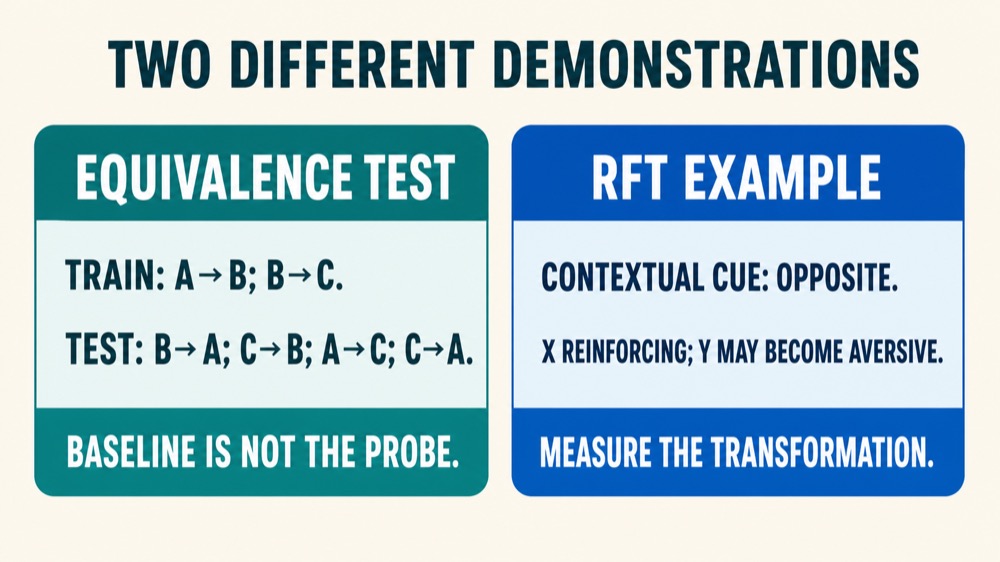
Use two deliberately different arrangements to see what each analysis establishes. The labels A, B, and C below identify stimuli; arrows identify the direction of a conditional relation. This makes it possible to audit which performances received feedback and which appeared only during unreinforced probes.
- Equivalence-class arrangement: Teach A→B and B→C with feedback. Then test B→A and C→B for symmetry, A→C for transitivity, and C→A for the combined relation. If the learner meets the study’s criteria across the required probes, the observed pattern supports an A-B-C equivalence class. The procedure establishes the baseline; performance on the derived probes supplies the evidence.
- Relational-frame arrangement: Across many exemplars, reinforce responding to contextual cues for SAME and OPPOSITE. With novel arbitrary tokens X and Y, establish that X is opposite to Y, then give X a conditioned reinforcing function. A change in Y toward an aversive function would be a relation-consistent transformation, provided the change is actually measured. RFT analyzes the history that brings the OPPOSITE cue under contextual control, the mutually entailed relation, and the transformed functions.
Both arrangements can yield responses that were not directly reinforced in their final form, but the demonstrations are not interchangeable. The first asks whether a specified equivalence pattern emerges from a defined baseline; the second analyzes generalized relational responding and how the type of relation changes stimulus functions.
Practical Implications for ABA Practitioners
In practice, equivalence-based instruction may be useful when a goal involves related spoken words, pictures, printed words, symbols, or categories. A teacher could directly teach selected conditional relations among a spoken name, a picture, and a printed word, then assess untaught relations with planned probes. An RFT-informed program may instead target generalized responding to relational cues such as “bigger than,” “before,” or “I versus you” across varied exemplars. In either case, the practitioner should distinguish the teaching procedure from the learner’s observed performance: matching-to-sample is a procedure; presenting a sample and comparisons defines features of that procedure; baseline accuracy documents taught relations; and accurate unreinforced probes may document a derived relation. A theory is the account used to interpret these findings, not the finding itself. Goals, prompts, reinforcement, mastery criteria, and generalization checks should be individualized, implemented within competence, and evaluated with data rather than inferred from the name of the instructional package.
Stimulus control plays a role in both frameworks. In equivalence, the sample and comparison stimuli control responding through conditional discrimination. In RFT, contextual cues (e.g., “same” vs. “opposite”) exert additional control over which relational frame is applied. Understanding these nuances allows for more precise analysis in clinical settings. For example, when teaching emotions, one might use an equivalence procedure to teach that a happy face, the word “happy,” and a thumbs-up are in the same class. Alternatively, an RFT approach could teach comparative frames like “happier than” or “less sad than,” which go beyond equivalence.
These analyses also depend on careful stimulus-control terminology. For a focused review of how antecedent variables and learning histories affect responding, continue with our guides to stimulus control in ABA and stimulus generalization, then return to the baseline-versus-probe distinction used here.
Common Traps and Study Checklist
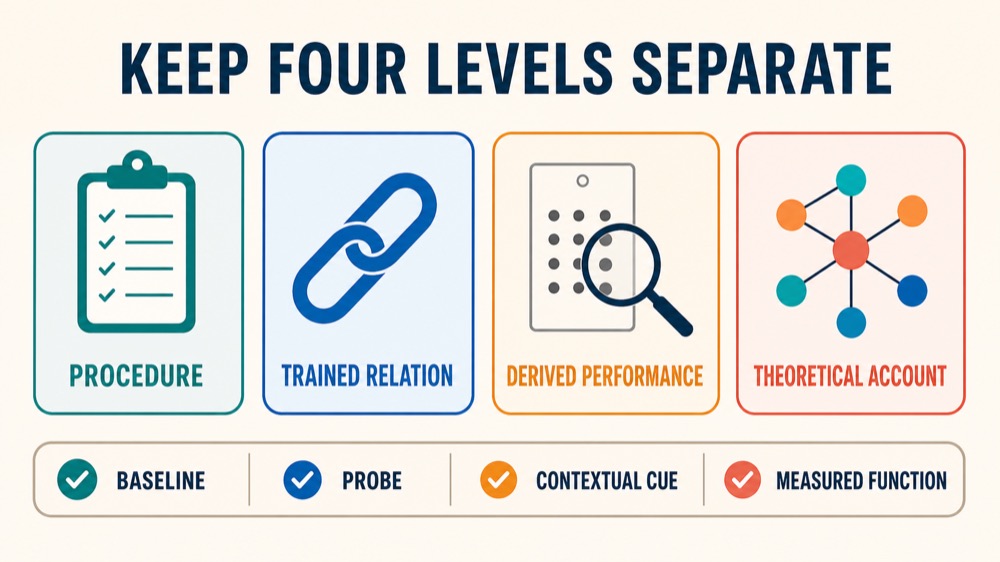
Most errors on this topic come from changing the level of analysis mid-explanation. Use the following contrasts to keep the phenomenon, procedure, observed performance, and theoretical account distinct while you study:
- Vocabulary check: Use equivalence terms for the relevant sameness relations and RFT’s broader vocabulary when the relation is opposition, comparison, hierarchy, or another non-equivalence pattern.
- Evidence check: Identify the baseline first, then name the unreinforced probe and the performance criterion. A correct response has meaning only within that arrangement.
- Status check: Describe an equivalence-class result as an empirical outcome and RFT as a functional account that also addresses other relation types.
- Context check: Specify which cues select the relation and which contextual features may alter stimulus functions.
- Inference check: Do not classify an emergent response from novelty alone; examine the relevant learning history and sources of contextual control.
Before considering the distinction mastered, work through the checklist below using a new example rather than memorizing the fruit, coin, or letter arrangements commonly used in study materials. You should be able to justify every label from the training and test conditions:
- Can you define reflexivity, symmetry, and transitivity with an example?
- Can you explain arbitrarily applicable relational responding in your own words?
- Can you describe transformation of stimulus functions and give a non-equivalence example?
- Can you list three frame types besides sameness/coordination?
- Can you identify whether a given procedure tests equivalence, an RFT frame, or both?
Further Reading and Test Prep
For authoritative treatment of these topics, refer to the BCBA Test Content Outline (6th ed.), the ACBS resource on how RFT differs from stimulus equivalence, and an article in the Psychological Record that discusses naming, stimulus equivalence, and RFT. For more background, explore our guides on stimulus control and stimulus generalization.
Ready to test your knowledge? Try our Free BCBA Mock Exam for practice questions and feedback. Note that our mock exam does not guarantee inclusion of this specific topic, but it provides a valuable way to assess your overall understanding.
Next step for BCBA exam prep
Turn this topic into exam-day practice
Use this topic as a focused review, then test it in exam-style conditions with a free mock before deciding whether five full-length mocks are the right next step.
Start the Free BCBA Mock ExamContinue with Five Full-Length Mocks — $99
Review the included materials and access details before ordering. No pass guarantee is implied.



