
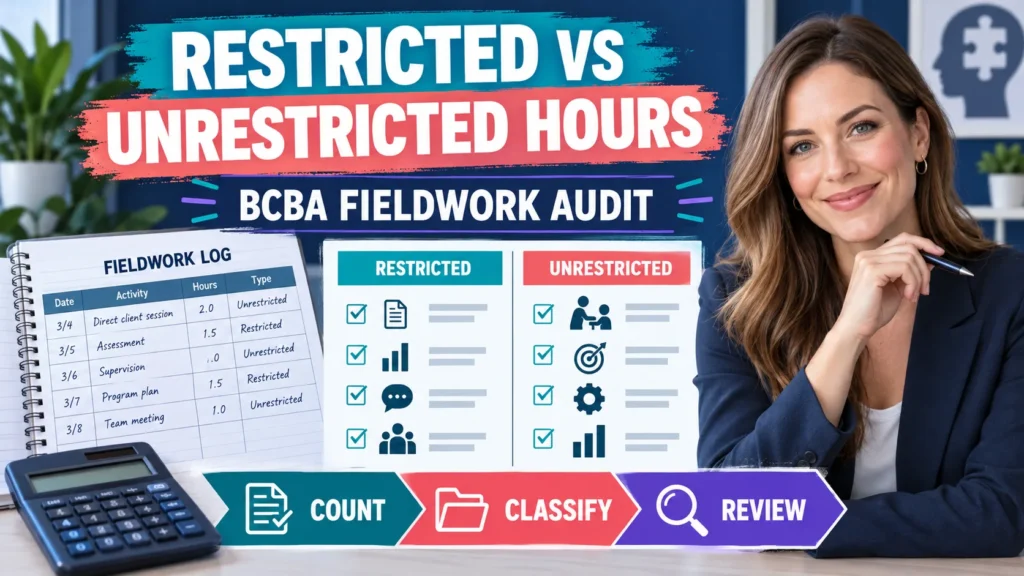
A practical BCBA fieldwork audit for classifying restricted and unrestricted activities, checking the cumulative mix, and reviewing ambiguous rows with a supervisor. Restricted vs unrestricted hours BCBA is not only a vocabulary question. It is a documentation question. The same activity name can be classified differently depending on why it was performed, how it supported a client, and whether it represented the work of a behavior analyst who designs, evaluates, and oversees programs. A reliable fieldwork log therefore records the context of each activity instead of relying on a job title or a copy-and-paste label.
Table of Contents
- Restricted vs Unrestricted Hours BCBA: What the Labels Mean
- Why Context Changes the Classification
- How to Audit the Cumulative Mix
- Build a Fieldwork Log That Can Be Reviewed
- What to Recheck for the 2027 Requirements
- Common Classification Traps
- Frequently Asked Questions
- Quick Review Checklist
- Take the Free BCBA Mock Exam
Under the current BCBA Handbook, unrestricted activities must make up at least 60% of total supervised fieldwork hours. Restricted activities may make up no more than 40%, and there is no minimum restricted-hour requirement. Those percentages are cumulative requirements; they do not have to be met separately in every supervisory period. The current handbook and the 2027 BCBA requirements page control the details for your pathway and application date.
Important scope note: This is an educational record-keeping guide, not an eligibility determination. Your supervisor is responsible for reviewing whether activities fit the applicable BACB requirements, client needs, supervision arrangement, and your professional goals. Keep current forms and official handbooks as the source of truth.
Restricted vs Unrestricted Hours BCBA: What the Labels Mean
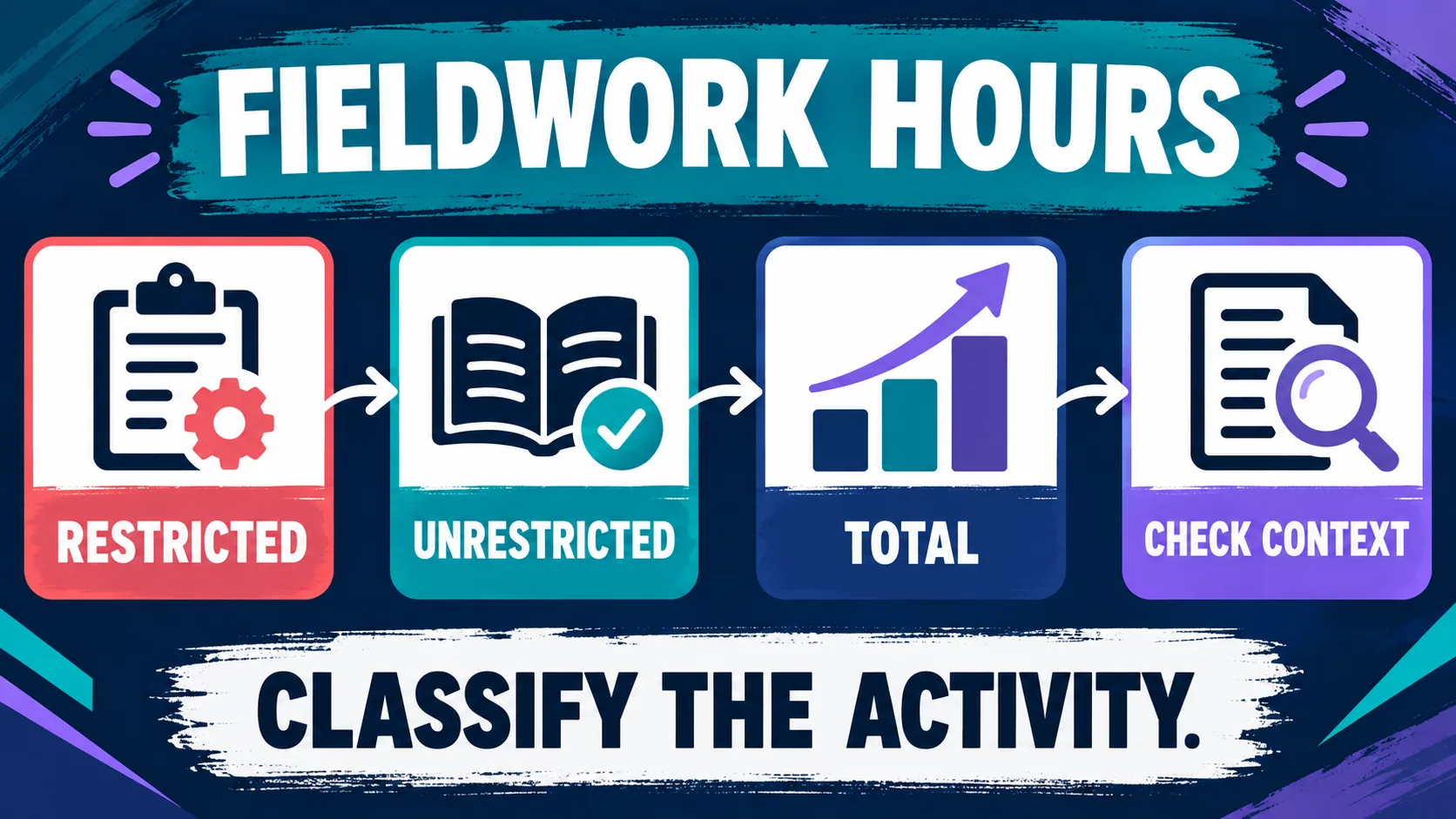
The BACB describes unrestricted activities as activities most likely to be performed by a BCBA. Examples include observing and collecting data, training staff or caregivers on behavior-analytic programs, conducting assessments related to the need for intervention, meeting with clients about programming, analyzing data, researching literature relevant to a current client’s programming, and writing or revising behavior-analytic programs.
Restricted activities involve the delivery of therapeutic or instructional procedures directly to clients. The restriction exists so that trainees have enough fieldwork exposure to develop the broader skills expected of a BCBA. Restricted hours are not “bad” hours, and unrestricted hours are not automatically better in every moment. The issue is whether the accumulated experience is balanced and meets the applicable requirement.
| Label | Working meaning | Record it with |
|---|---|---|
| Restricted | Direct delivery of therapeutic or instructional procedures to a client. | The client-related procedure, setting, and supervision context. |
| Unrestricted | Work that best represents what a BCBA does when designing, evaluating, and overseeing behavior-analytic services. | The specific client-related assessment, analysis, training, program, or decision made. |
| Unacceptable | Work that is not behavior-analytic, not client-specific, or outside the applicable fieldwork requirements. | Mark it for supervisor review; do not count it just because it occurred at an ABA employer. |
The label is not a reward for effort. It is a description of the activity in context. A trainee may spend a long time with a client and still be performing a restricted procedure. A short data-review meeting may be unrestricted if it involves client-specific analysis and programming decisions. The record needs enough detail for another person to understand what actually happened.
Why Context Changes the Classification
The BACB’s fieldwork FAQs use data collection as a useful example: data collection can be restricted when it is solely part of a client’s treatment program, but it can be unrestricted when it is part of a functional assessment used to identify future programming needs. The activity name is the same; the purpose and context are different.
| Activity name | Context that may support unrestricted classification | Question to ask |
|---|---|---|
| Data collection | You are collecting and interpreting information for a functional assessment or a programming decision. | What decision did the data help the team make? |
| Staff training | You train staff or caregivers on a behavior-analytic program or content and evaluate performance. | What behavior-analytic skill or program was taught and checked? |
| Program writing | You write or revise a client-specific behavior-analytic program under supervision. | Which client need, assessment, or data pattern drove the revision? |
| Meeting | The meeting addresses client-specific behavior-analytic programming or services. | Can the behavior-analytic content and client decision be described? |
Do not force an ambiguous row into the category that helps your percentage. Mark it as “needs supervisor review” and preserve the facts. A transparent uncertain row is safer than a confident but unsupported label that has to be reconstructed later.
How to Audit the Cumulative Mix
Use the cumulative total rather than trying to hit a separate percentage every month. For example, if the log contains 100 total supervised fieldwork hours, the current BCBA requirement means at least 60 of those hours need to be unrestricted, while restricted activities may account for no more than 40. This is an illustration of the ratio, not a replacement for the current handbook or your actual fieldwork plan.
| Audit field | Calculation | Interpretation |
|---|---|---|
| Total hours | Restricted + unrestricted + any rows awaiting review | Do not hide uncertain rows outside the total. |
| Unrestricted share | Unrestricted hours divided by total hours | Compare the cumulative result with the current BCBA requirement. |
| Restricted share | Restricted hours divided by total hours | There is no required minimum restricted share; monitor the maximum. |
| Review queue | Rows whose classification depends on purpose or client context | Ask the supervisor before submitting or finalizing forms. |
Recalculate after every supervisory period, but do not panic when one month is high in restricted work. The official handbook says the percentage does not need to be met during each supervisory period. The trend matters because a late discovery that the cumulative mix is off can be harder to correct than a small adjustment made early.
Build a Fieldwork Log That Can Be Reviewed
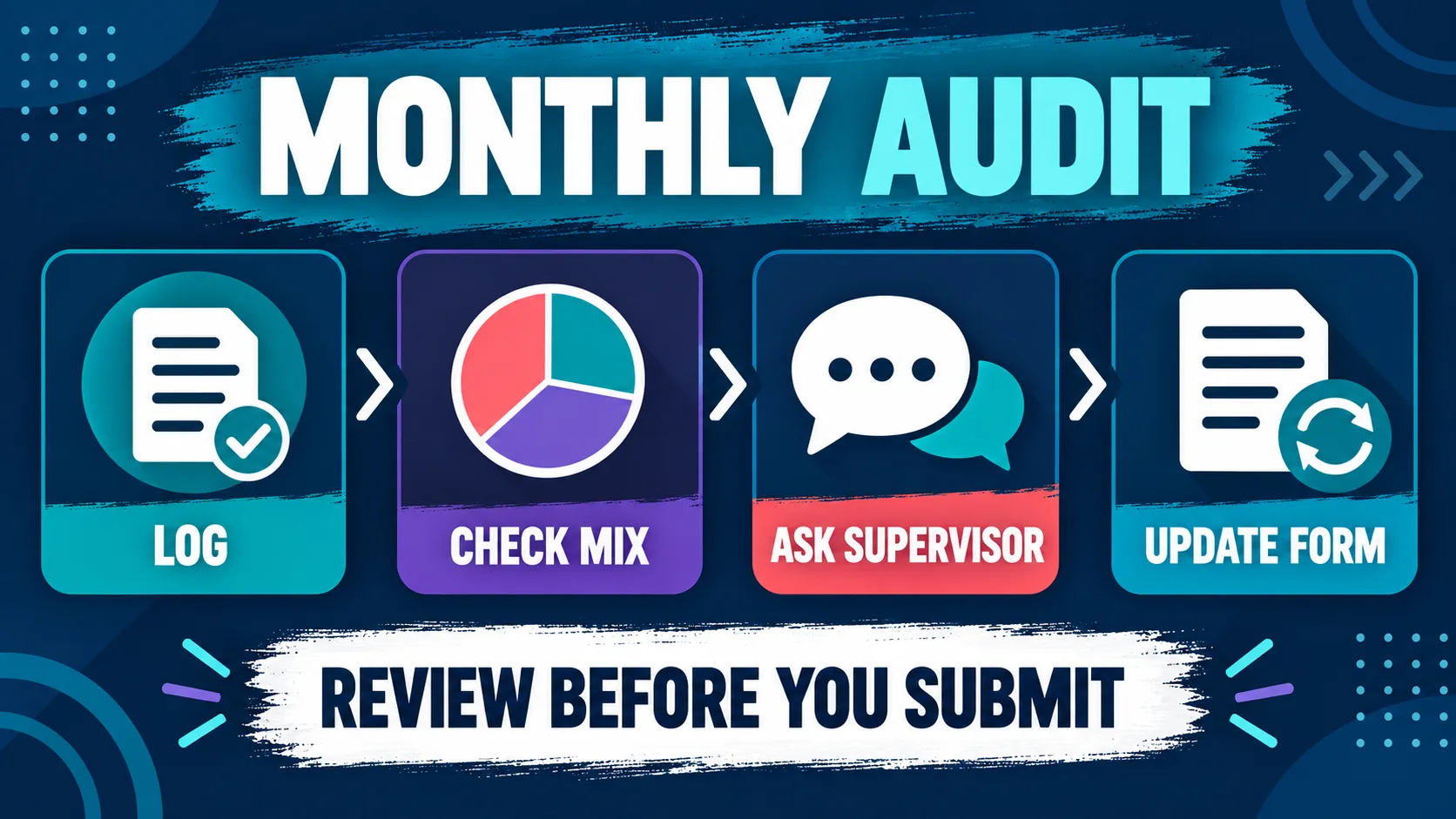
A useful log makes the classification visible without turning every entry into an essay. At minimum, record the date, client or project identifier, activity, purpose, category, hours, supervisor review status, and the evidence or decision created. Protect privacy: use the organization’s approved identifiers and never place unnecessary protected information in a public study file.
| Log column | Example of a useful note | Why it prevents rework |
|---|---|---|
| Activity | Observed assessment session and graphed client data | “Worked with client” is too vague to review. |
| Purpose | Compared patterns to guide the next programming decision | Purpose helps distinguish direct implementation from assessment or analysis. |
| Category | Unrestricted—pending supervisor confirmation | Uncertainty stays visible instead of becoming a silent assumption. |
| Evidence | Graph, assessment summary, feedback note, or program revision | The entry shows what skill or decision the hour developed. |
At the end of each week, flag rows using words such as “paperwork,” “meeting,” “session,” or “data” without a purpose. Those words are not automatically wrong, but they are prompts to add context. At the end of each supervisory period, send the cumulative summary and the flagged rows to the supervisor rather than waiting until the final form.
What to Recheck for the 2027 Requirements
The BACB’s 2027 BCBA Requirements page lists at least 60% unrestricted activities in the overview of fieldwork requirements. It also distinguishes supervised fieldwork and concentrated supervised fieldwork and identifies different total-hour, supervision, observation, and form requirements. The page says applicants after January 1, 2027 will need to use the 2027 Monthly and Final Fieldwork Verification Forms.
That does not mean you should edit an old log by guessing what the new forms will require. Instead, create a transition checkpoint: identify your intended application date, read the current BCBA Handbook, save the official 2027 transition resources, and ask your supervisor or program contact which forms and requirements govern your records.
Requirements can change while your fieldwork is in progress. A good audit system records the source version and the date it was checked. This protects your planning without pretending that a blog post can replace a current official document.
Common Classification Traps
Trap 1: classifying by job title. Being called a technician, therapist, analyst, or coordinator does not determine the category of a specific activity. Record what you did and why. Trap 2: assuming all data collection is unrestricted. Context matters. Ask whether the data were collected solely to implement an existing treatment procedure or to support assessment and programming decisions. Trap 3: counting didactic study as fieldwork. University coursework, readings, quizzes, podcasts, and unrelated workshops are not automatically client-specific fieldwork activities. Trap 4: counting every meeting. Meetings with little or no behavior-analytic content may not count. Describe the client-specific programming, analysis, training, or feedback that occurred. Trap 5: waiting until the final month. A monthly or supervisory-period review catches classification questions while the context is still easy to reconstruct.
For a focused concept check after you organize your log, use the Free BCBA Mock Exam. Treat practice results as a study signal; they do not determine whether a fieldwork activity qualifies or guarantee an exam outcome.
Frequently Asked Questions
What is the difference between restricted and unrestricted BCBA hours?: Restricted activities involve direct delivery of therapeutic or instructional procedures to clients. Unrestricted activities are more representative of the work a BCBA performs when assessing, analyzing, designing, training, and overseeing behavior-analytic services. The current BCBA Handbook sets the cumulative mix requirements.
Do I need a certain number of restricted hours?: The current BCBA Handbook states that restricted activities may make up no more than 40% of total fieldwork hours and that there is no minimum restricted-hour requirement. Check the handbook that applies to your pathway and application date.
Does the 60% unrestricted requirement apply every month?: No. The handbook explains that the percentage is a cumulative total and does not need to be met during each supervisory period. Review the trend regularly so the cumulative record remains workable.
Can data collection be unrestricted?: It can depend on the context. Data collection solely as part of a client’s treatment program may be restricted, while data collection connected to a functional assessment or future programming decision may be unrestricted. Document the purpose and ask the supervisor to confirm.
Who decides whether an activity counts?: Your supervisor should review the activity against the current BACB requirements, client needs, supervision arrangement, and your professional goals. BACB FAQs explain that the Board cannot decide every individual activity without knowing those situational details.
Bottom line: Restricted vs unrestricted hours BCBA is a cumulative, context-based documentation problem. Describe the activity, purpose, client connection, and evidence; audit the mix regularly; keep ambiguous rows visible; and review them with your supervisor against the current BACB handbook.
Quick Review Checklist
Use this final checklist to turn restricted vs unrestricted hours bcba into exam-ready reasoning. The goal is not to memorize a label in isolation; it is to identify the relevant evidence and explain why the best answer fits the scenario. Key ideas to review:
- State the central definition or decision point for restricted vs unrestricted hours bcba in your own words.
- Identify the detail that makes restricted vs unrestricted hours bcba different from its closest related ABA term.
- Separate the observable facts in a scenario from assumptions that are not supported by the facts.
- Write one example and one nonexample so you can recognize the concept in a new setting.
Exam application checks:
- Ask what the question is actually requesting before comparing the answer choices.
- Mark the antecedent, response, consequence, or other evidence that supports the selected answer.
- Look for a distractor that describes a related process but does not answer the specific question.
Final self-check:
- Explain how you would verify the interpretation with clear observations or data.
- Change one detail in the scenario and decide whether your answer should change.
- Give a one-sentence rationale that a supervisor or study partner could evaluate.
Take the Free BCBA Mock Exam
When you are ready to apply the idea, use the free practice resource below for additional feedback. Take the Free BCBA Mock Exam



