

A practical BCBA exam decision framework for matching a measurement procedure to the behavior dimension, observation constraints, and data-quality goal. Continuous vs discontinuous measurement ABA is not a question of which method is universally “better.” The defensible choice depends on what must be measured, how the behavior is defined, how much observation is feasible, and what decision the data will support. Continuous measurement records each occurrence or the relevant temporal feature. Discontinuous measurement samples behavior across intervals or moments.
Table of Contents
- Continuous vs Discontinuous Measurement ABA: Start With the Question
- Use the Critical Dimension Before the Method Name
- When Continuous Measurement Fits the Scenario
- When Discontinuous Measurement Fits the Scenario
- Run a Data-Quality Check Before You Commit
- BCBA Exam Traps to Eliminate
- Frequently Asked Questions
- Quick Review Checklist
- Take the Free BCBA Mock Exam
On a BCBA exam, the best answer usually comes from the scenario rather than from memorizing a slogan. Start with the critical dimension of the behavior. Then ask whether the observer can capture it accurately in the setting. Finally, check whether the selected procedure could produce data that are valid, reliable, and useful for the next clinical decision.
Scope note: This is an exam-preparation guide, not a substitute for the current BACB Test Content Outline, BCBA Handbook, supervision guidance, or your training program. The BACB’s current outline includes distinguishing continuous and discontinuous procedures, designing discontinuous procedures, evaluating validity and reliability, and selecting a procedure that accounts for the critical dimension and environmental constraints.
Continuous vs Discontinuous Measurement ABA: Start With the Question
Continuous measurement is designed to capture every occurrence of the defined response, or the full temporal feature that matters. Frequency, rate, duration, latency, and interresponse time are common examples. The strength is detail: when the observer can capture the behavior consistently, the record can represent the behavior with relatively little sampling distortion.
Discontinuous measurement records behavior during selected intervals or observation moments rather than during every second of the observation period. Partial-interval recording, whole-interval recording, and momentary time sampling are common examples. The strength is feasibility when continuous observation would be unrealistic, but the sampling rule can change how the data represent the behavior.
| If the stem emphasizes | First question | Likely direction |
|---|---|---|
| Every response matters | Can the observer reliably capture each defined response? | Consider a continuous procedure. |
| Behavior lasts or starts after a cue | Is duration or latency the critical dimension? | Choose a procedure that preserves that temporal feature. |
| Many clients or rapid events | Would full observation create missed responses or poor observer performance? | Consider a planned discontinuous sample. |
| Intervention decision depends on trend | Will the sampling rule systematically overestimate or underestimate behavior? | Select and interpret the method with that bias in mind. |
The phrase “continuous vs discontinuous” describes a family-level distinction. It does not by itself answer whether frequency, rate, duration, partial interval, whole interval, or momentary time sampling is correct. The rest of the decision comes from the behavior and the purpose of the measurement.
Use the Critical Dimension Before the Method Name
The first technical question is: what feature of the behavior must the data preserve? A behavior can occur often, last a long time, begin quickly or slowly, or occur with a particular spacing between responses. If the measurement does not match the feature that matters, a clean-looking graph can still answer the wrong question.
| Critical dimension | Procedure family to consider | Scenario cue |
|---|---|---|
| Occurrence | Count, frequency, or rate | The question asks how often the response occurs during a defined observation period. |
| Duration | Continuous duration recording | The clinical concern is how long the behavior continues, not only how many times it begins. |
| Latency | Continuous latency recording | The key question is the time between an instruction or event and the response. |
| Occurrence across time windows | Partial interval, whole interval, or momentary time sampling | The observer needs a planned sample because full recording is not feasible. |
Also define the response before selecting the procedure. “Off task,” “aggressive,” or “appropriate behavior” is too vague unless the operational definition identifies what an observer can see or hear. A precise definition improves both continuous and discontinuous measurement because the observer is applying a rule to observable events rather than making a global judgment.
When Continuous Measurement Fits the Scenario
Continuous measurement is a strong candidate when the behavior is discrete enough to detect, the observer can attend to the relevant events, and losing an occurrence would materially change the decision. It is also useful when the target dimension is inherently temporal, such as duration or latency.
For example, if a stem asks for the time from a teacher’s instruction to a learner’s independent response, latency is the critical dimension. Counting whether a response happened would discard the information the question cares about. If a stem asks how long a stereotypic behavior continues, duration is more informative than a simple count of episodes.
Continuous procedures are not automatically superior. They can be difficult when behavior is frequent, the observer has several responsibilities, or the environment changes quickly. A method that is theoretically detailed but routinely misses responses may have worse practical validity than a carefully planned sample. On an exam, look for the constraint that makes continuous recording realistic or unrealistic.
When Discontinuous Measurement Fits the Scenario
Discontinuous measurement can be appropriate when the observation period is long, the behavior is frequent, the observer cannot watch continuously, or the purpose is to estimate occurrence across a representative sample. The interval rule must be selected intentionally.
| Procedure | What counts | Key interpretation issue |
|---|---|---|
| Partial interval | The behavior occurred at any time during the interval. | It can overestimate how much of the interval the behavior occupied. |
| Whole interval | The behavior occurred for the entire interval. | It can underestimate behavior that is important but not continuous for the full interval. |
| Momentary time sampling | The behavior is occurring at the exact moment the interval ends. | A brief event between checks may be missed. |
The exam trap is choosing a discontinuous method only because it sounds efficient. Efficiency is relevant, but the question still has to be answered. If the goal is to increase sustained engagement, whole-interval recording may require behavior to persist across the full interval. If the goal is to detect whether a brief response ever happened, a whole-interval rule may be a poor fit. Use the target dimension and decision goal together.
Run a Data-Quality Check Before You Commit

Before finalizing a measurement choice, run a short data-quality check. The BCBA Test Content Outline specifically connects measurement selection with validity, reliability, the critical dimension, and environmental constraints. Those concepts turn a memorized definition into a defensible clinical or exam answer.
| Check | Ask yourself | If the answer is no |
|---|---|---|
| Definition | Could two trained observers identify the response from the definition? | Rewrite the operational definition before debating the method. |
| Dimension | Does the procedure preserve the feature tied to the decision? | Choose a different measure or clarify the clinical question. |
| Feasibility | Can the observer apply the rule accurately in this environment? | Adjust the observation plan or select a defensible sample. |
| Interpretation | Do you know how the method may overestimate, underestimate, or miss behavior? | State the limitation and avoid overclaiming from the graph. |
For an exam item, eliminate answer choices that solve a different problem. A rate measure does not answer a duration question. A momentary sample does not guarantee that a brief response was seen. A method that is impossible to implement reliably is not rescued by sounding more precise. The correct choice is the one that preserves the needed information under the stated conditions.
BCBA Exam Traps to Eliminate
Trap 1: treating continuous as “always best.” Continuous measurement can be detailed, but a method that produces missed or inconsistent observations may not be valid for the decision. Trap 2: confusing a measurement dimension with a procedure. Frequency, duration, and latency describe what is measured. Partial interval and momentary time sampling describe how observation is sampled. Read the stem for both. Trap 3: ignoring the operational definition. If the target is not observable and measurable, the choice between continuous and discontinuous procedures is premature.
Trap 4: forgetting sampling effects. Partial-interval, whole-interval, and momentary time sampling do not produce identical estimates. The correct answer often depends on whether the goal is to capture any occurrence, sustained occurrence, or occurrence at a moment. Trap 5: choosing the method before the decision. Ask what the team needs to know next. Measurement is useful when it supports a decision, not merely because the graph looks organized.
After you can explain the choice in one sentence—“I selected this because it preserves the critical dimension and is feasible in the stated setting”—use the Free BCBA Mock Exam to practice recognizing the same cues in timed scenarios. Practice performance is a study signal; it is not a guarantee of exam success.
Frequently Asked Questions
What is the main difference between continuous and discontinuous measurement in ABA?: Continuous measurement records each occurrence or the full relevant temporal feature during the observation period. Discontinuous measurement samples behavior during selected intervals or moments. The right choice depends on the critical dimension, the decision goal, and the observation conditions.
Is frequency a continuous measurement procedure?: Frequency is a dimension of occurrence typically obtained through continuous event recording when the observer records each defined response. A scenario may require a rate calculation when observation periods differ, so read whether the question asks for count, frequency, or rate.
When should I use partial-interval recording?: Partial-interval recording can be considered when the question is whether behavior occurred at any point during each interval and continuous observation is not feasible. Remember that it can overestimate the amount of time behavior occurred.
When should I use whole-interval recording?: Whole-interval recording can be considered when the behavior must occur throughout the entire interval to count. It may underestimate behavior that is clinically important but does not last for the complete interval.
What should I do if two measurement procedures seem possible?: Return to the operational definition, critical dimension, decision goal, and environmental constraint. Then compare validity and feasibility. On a real case, discuss the plan with the supervisor; on an exam, choose the option that best preserves the information the stem says matters.
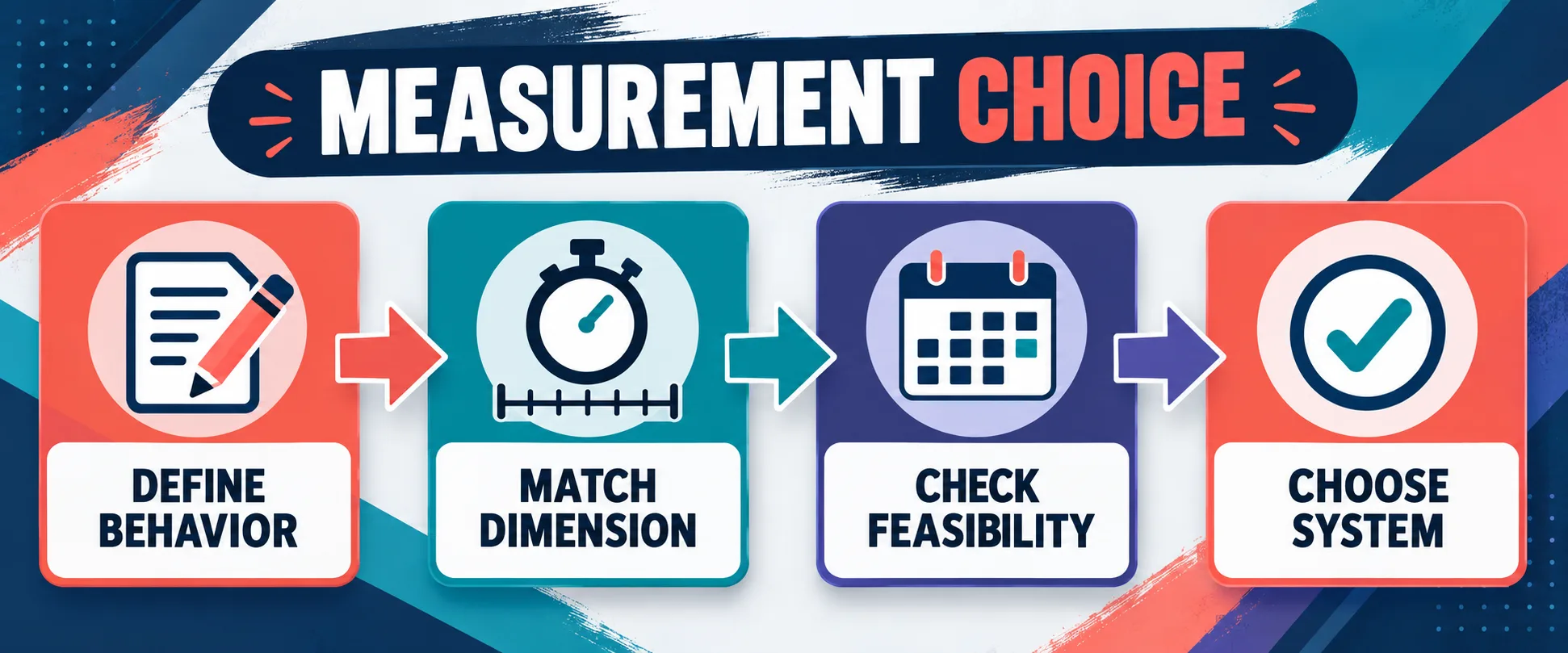
Bottom line: For continuous vs discontinuous measurement ABA questions, define the behavior, identify the critical dimension, match the procedure to the decision, check feasibility, and interpret the sampling tradeoff. That sequence is more reliable than memorizing a single “best” method.
Quick Review Checklist
Use this final checklist to turn continuous vs discontinuous measurement aba into exam-ready reasoning. The goal is not to memorize a label in isolation; it is to identify the relevant evidence and explain why the best answer fits the scenario. Key ideas to review:
- State the central definition or decision point for continuous vs discontinuous measurement aba in your own words.
- Identify the detail that makes continuous vs discontinuous measurement aba different from its closest related ABA term.
- Separate the observable facts in a scenario from assumptions that are not supported by the facts.
- Write one example and one nonexample so you can recognize the concept in a new setting.
Exam application checks:
- Ask what the question is actually requesting before comparing the answer choices.
- Mark the antecedent, response, consequence, or other evidence that supports the selected answer.
- Look for a distractor that describes a related process but does not answer the specific question.
Final self-check:
- Explain how you would verify the interpretation with clear observations or data.
- Change one detail in the scenario and decide whether your answer should change.
- Give a one-sentence rationale that a supervisor or study partner could evaluate.
Take the Free BCBA Mock Exam
When you are ready to apply the idea, use the free practice resource below for additional feedback. Take the Free BCBA Mock Exam



