
A psychology-focused guide to respondent behavior: what “elicited” means, how respondent conditioning changes a stimulus function, and why a respondent is not the same thing as a survey participant or an operant response. If you are searching for the respondent behavior definition psychology uses, begin with the stimulus-response relation. Respondent behavior is behavior that is elicited by an antecedent stimulus. The response may be an unconditioned reflex, such as blinking to a puff of air, or a conditioned response, such as fear elicited by a cue that has been paired with an aversive event. The definition is about what the stimulus does to the response, not about whether the response looks emotional or whether the person can describe it.
Table of Contents
- What Is the Respondent Behavior Definition Psychology Uses?
- What Features Make Behavior Respondent?
- What Are Examples of Respondent Behavior?
- How Does Respondent Conditioning Work?
- Respondent Behavior, Respondent Conditioning, and Classical Conditioning
- Respondent Behavior vs Operant Behavior
- How Psychology and ABA Use the Term
- Common Definition Mistakes
- How to Study the Definition
- Frequently Asked Questions
- Take the Free BCBA Mock Exam
Psychology uses the word respondent in more than one way. In research methods, a respondent may simply be a person who answers a survey. In behavioral psychology, respondent behavior refers to an elicited response. This page uses the behavioral meaning and then connects it to classical conditioning, respondent-versus-operant distinctions, and BCBA study language. For current certification boundaries, check the BACB Test Content Outline and do not treat a study definition as individualized clinical advice.
What Is the Respondent Behavior Definition Psychology Uses?
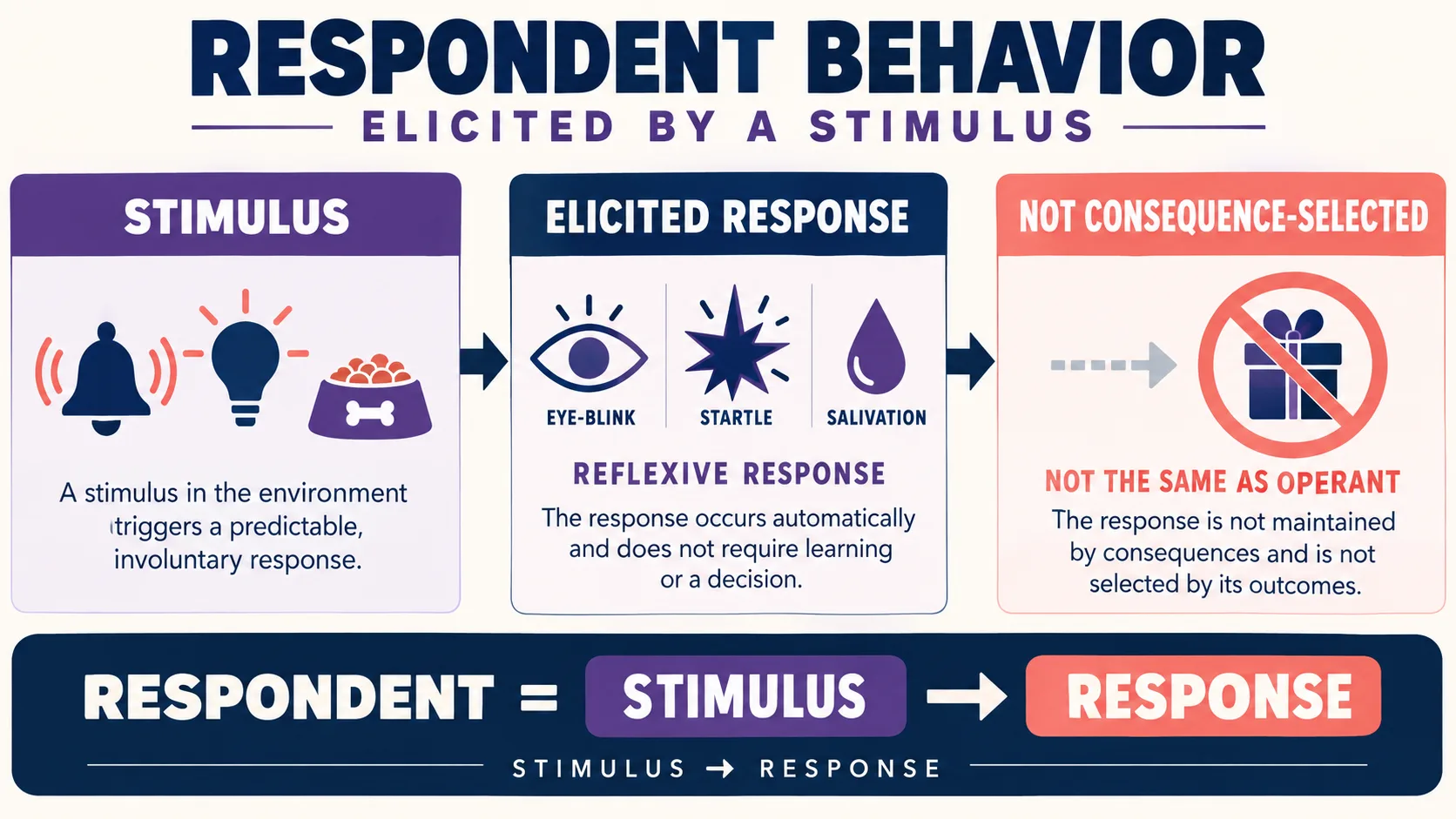
In behavioral psychology, respondent behavior is behavior elicited by an antecedent stimulus. “Elicited” describes a functional relation: a stimulus reliably brings about a response. A loud burst can elicit a startle, food in the mouth can elicit salivation, and a puff of air can elicit an eye blink. These examples are not defined by the response’s appearance alone. They are defined by the stimulus that precedes and evokes the response.
Respondent behavior is often discussed as reflexive or automatic behavior, but “automatic” should not become a vague synonym for anything a person did quickly. A response can be fast and still be operant, and a conditioned respondent response can depend on a learning history. The useful question is: what stimulus is currently eliciting the response?
The term also does not mean that the individual is a passive object or that the response is unimportant. It is a technical description of one relation in a behavior system. A person may show respondent fear when entering a room associated with pain and then emit operant escape behavior to leave the room. One episode can contain both kinds of responding, so analyze each response and its controlling relation.
What Features Make Behavior Respondent?
A respondent classification is strongest when the observation or scenario identifies an eliciting stimulus and a response that follows it. The response may be unconditioned or conditioned. The stimulus may be biologically effective from the beginning, or it may acquire an eliciting function through stimulus-stimulus pairing.
- Stimulus control: an antecedent stimulus is described as eliciting, evoking, or reliably producing the response.
- Reflexive relation: the response is part of a stimulus-response relation rather than being defined by a consequence that selected future responding.
- Learning-history distinction: a conditioned respondent response may be learned, but learning through pairing does not make it operant.
- Observable description: the response can be described as blinking, salivating, tensing, startling, crying, or another measurable event instead of only as a feeling or trait.
- Context sensitivity: the same stimulus may not elicit the same response in every context, so the analyst should record the relevant conditions and history.
These features help prevent a common error: labeling a response respondent merely because it is involuntary in ordinary language. Psychology and behavior analysis need the actual relation. If the scenario says that a response produces attention and then becomes more frequent, the consequence may be the important clue even if the response also looks emotional.
What Are Examples of Respondent Behavior?
Examples are easiest to classify when the stimulus and response are written as a pair. The following examples illustrate the definition without claiming that every similar-looking event has the same function:
- Eye blink: a puff of air directed toward the eye elicits blinking.
- Salivation: food in the mouth elicits salivation through an unconditioned relation.
- Startle: a sudden loud sound elicits a startle response.
- Conditioned fear: a clinic cue that has repeatedly preceded a painful procedure may later elicit fear or tension.
- Physiological arousal: a learned cue associated with an emotionally significant event may elicit changes in heart rate or sweating.
These examples are not diagnoses. A behavioral description does not by itself establish why a person is distressed, whether a situation is safe, or what intervention is appropriate. In applied or clinical contexts, use qualified assessment, consent, communication access, and current professional guidance rather than inferring a private experience from a single visible response.
How Does Respondent Conditioning Work?
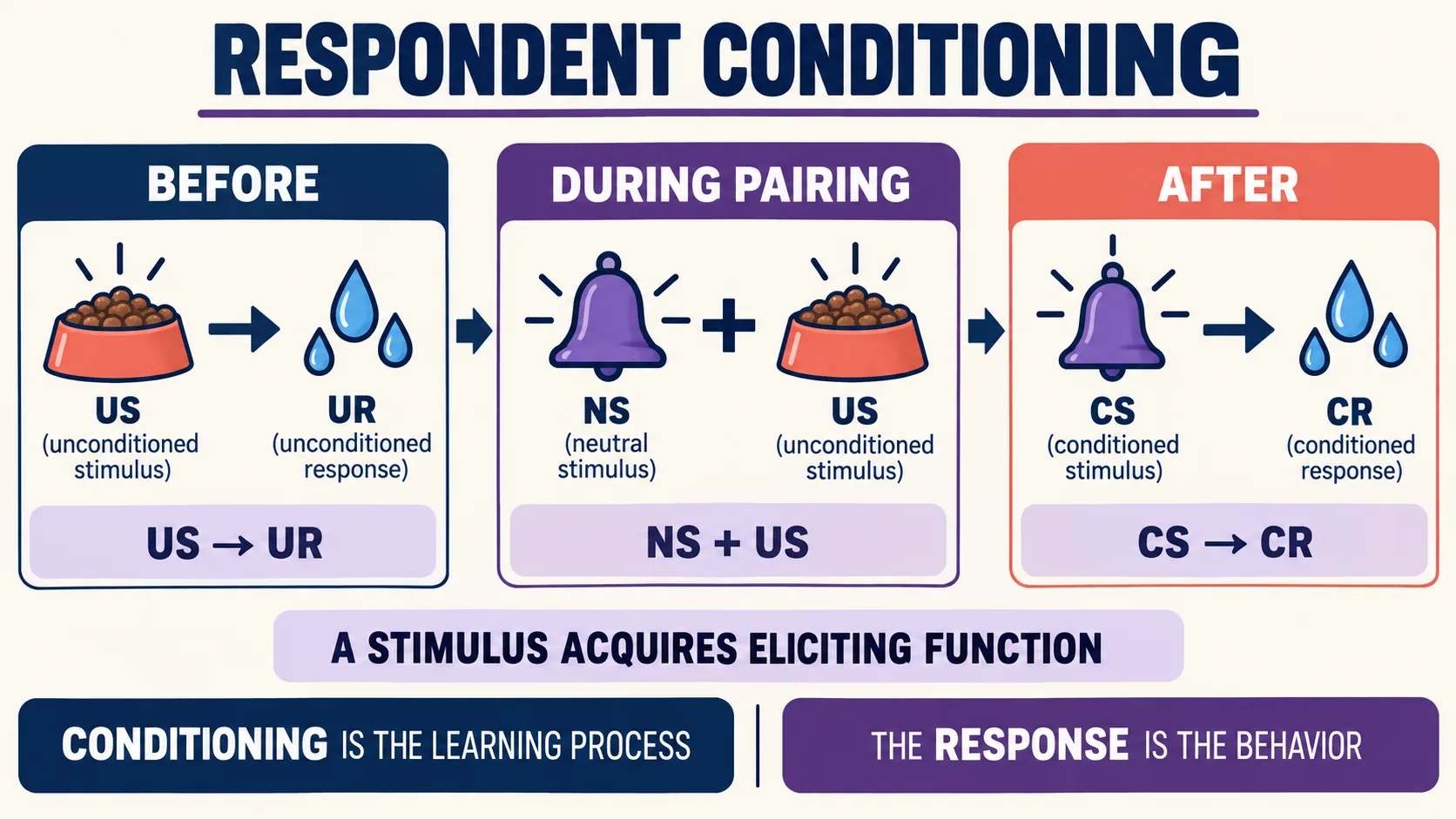
Respondent conditioning is the learning process through which a previously neutral stimulus acquires the ability to elicit a response after being paired with another stimulus. Classical conditioning and Pavlovian conditioning are common names for this type of stimulus-stimulus learning. The process changes the stimulus function; it does not redefine the response as an operant.
Use the standard notation as a map rather than as a replacement for observing events. Before conditioning, an unconditioned stimulus (US) elicits an unconditioned response (UR). A neutral stimulus (NS) does not reliably elicit the target response. During acquisition, the NS is paired with the US. After sufficient pairing, the former NS becomes a conditioned stimulus (CS) and can elicit a conditioned response (CR).
| Stage | Stimulus relation | What to identify |
|---|---|---|
| Before | US → UR; NS does not reliably elicit the target response. | Which stimulus has an unconditioned eliciting function? |
| During pairing | NS + US occur in a repeated temporal relation. | What two stimuli are being paired, and in what order? |
| After acquisition | CS → CR; the learned stimulus now elicits the response. | What stimulus function changed, and what response is now elicited? |
Extinction, generalization, and discrimination describe additional changes in respondent stimulus control. For example, repeated presentations of a CS without the US may reduce the CR, while similar stimuli may also begin to elicit responding. The exact pattern depends on the learning history and the conditions in which the stimuli are presented.
Respondent Behavior, Respondent Conditioning, and Classical Conditioning
These terms are related but not interchangeable:
- Respondent behavior: the elicited response itself, such as a blink, startle, salivation, or conditioned fear response.
- Respondent conditioning: the learning process in which stimulus pairing changes what a stimulus elicits.
- Classical conditioning: a common psychology label for respondent conditioning, especially in general psychology and learning-theory texts.
- Conditioned stimulus: the stimulus that acquired an eliciting function after pairing.
- Conditioned response: the response elicited by that learned stimulus.
If a question asks for the “behavior,” it may want the response. If it asks how the response was learned, it may want respondent conditioning. If it asks what changed, the answer may be the neutral stimulus’s function. Match the level of the answer to the wording of the question.
Respondent Behavior vs Operant Behavior
The most useful contrast is not “automatic versus voluntary.” It is stimulus-elicited versus consequence-selected. Respondent behavior is elicited by an antecedent stimulus. Operant behavior is shaped and maintained by its consequences, even though antecedents can signal when a consequence is available.
| Question | Respondent | Operant |
|---|---|---|
| Primary relation | Stimulus elicits response. | Consequence changes future response probability. |
| Learning history | Unconditioned relation or stimulus pairing. | Reinforcement, punishment, or extinction contingency. |
| Exam clue | “Elicited by,” “reflex,” “paired with,” or “conditioned stimulus.” | “Followed by,” “increased,” “decreased,” or “produced access/escape.” |
A single event can include both. A tone may elicit a startle response, and the person may then press a button that turns the tone off. Classify the startle and the button press separately. Do not let the first response’s reflexive quality make you ignore the consequence controlling the second response.
How Psychology and ABA Use the Term
General psychology often introduces respondent behavior through reflexes, Pavlovian conditioning, and examples such as salivation or fear. ABA and BCBA coursework use the same basic stimulus-response distinction but place it beside operant conditioning, stimulus control, assessment, and intervention decision-making. The current BACB outline is the better authority for what a certification exam may emphasize; general psychology pages can provide accessible examples but may use less precise language.
In either field, avoid treating “respondent” as a synonym for “unconscious,” “emotional,” or “not changeable.” Conditioned respondent relations can change through new learning, extinction, discrimination, or exposure to different contexts. At the same time, a technical label does not authorize a person to expose someone to distressing stimuli or change treatment without appropriate competence, consent, and safeguards. The current BACB Ethics Code hub is a useful professional boundary resource.
Common Definition Mistakes
- Confusing respondent with survey respondent: check whether the context is research participation or behavioral conditioning.
- Calling every learned response operant: a conditioned response can be learned through stimulus pairing and remain respondent.
- Calling every quick response respondent: speed is not the defining relation; identify the stimulus and consequence evidence.
- Confusing the CS with the CR: the CS is the learned stimulus; the CR is the response it elicits.
- Calling the pairing itself behavior: conditioning is a learning process; respondent behavior is the elicited response.
- Ignoring context: the same cue may have different histories for different people or settings.
These errors are especially common when a multiple-choice item uses ordinary-language words such as “automatic,” “fear,” or “reaction.” Translate the scenario into stimulus, response, pairing history, and consequence before selecting a label.
How to Study the Definition
Use a four-step study routine. First, write the observable response. Second, identify the stimulus that immediately precedes and elicits it. Third, ask whether the stimulus was unconditioned or acquired its function through pairing. Fourth, look for a separate consequence that changes future responding. This routine keeps respondent behavior, respondent conditioning, and operant behavior in their proper places.
- Underline the response and avoid mentalistic wording.
- Circle the stimulus described as eliciting or evoking the response.
- Map US/UR, NS, CS/CR only when the stem provides pairing history.
- Check whether a consequence changes later behavior before calling the relation respondent.
For additional practice distinguishing stimulus functions and learning relations, use the site’s free BCBA mock exam. It is an independent study resource, not official BACB content, and practice performance does not guarantee certification.
Frequently Asked Questions
What is the respondent behavior definition in psychology?
Respondent behavior is behavior elicited by an antecedent stimulus. The response may be unconditioned or conditioned through respondent learning. Is respondent behavior the same as classical conditioning?
No. Respondent behavior is the elicited response. Classical or respondent conditioning is the stimulus-pairing process that can give a new cue the ability to elicit that response. Is respondent behavior always involuntary?
It is often described as reflexive or automatic, but classification should rest on the stimulus-response relation rather than the everyday word “involuntary.” What is the difference between a respondent and an operant?
A respondent is elicited by an antecedent stimulus. An operant is selected or maintained by its consequences. One episode can contain both relations. Does learned mean operant?
No. A conditioned respondent response is learned through stimulus pairing and is still respondent when the learned stimulus elicits it.
Bottom line: For a respondent behavior definition psychology question, identify the stimulus, the elicited response, and the learning history. Then separate the response from respondent conditioning and check whether a consequence instead points to an operant relation. For targeted review, use our respondent behavior definition psychology practice questions to apply the concept in exam-style scenarios.
Take the Free BCBA Mock Exam
When you are ready to apply the idea, use the free practice resource below for additional feedback. Take the Free BCBA Mock Exam



