
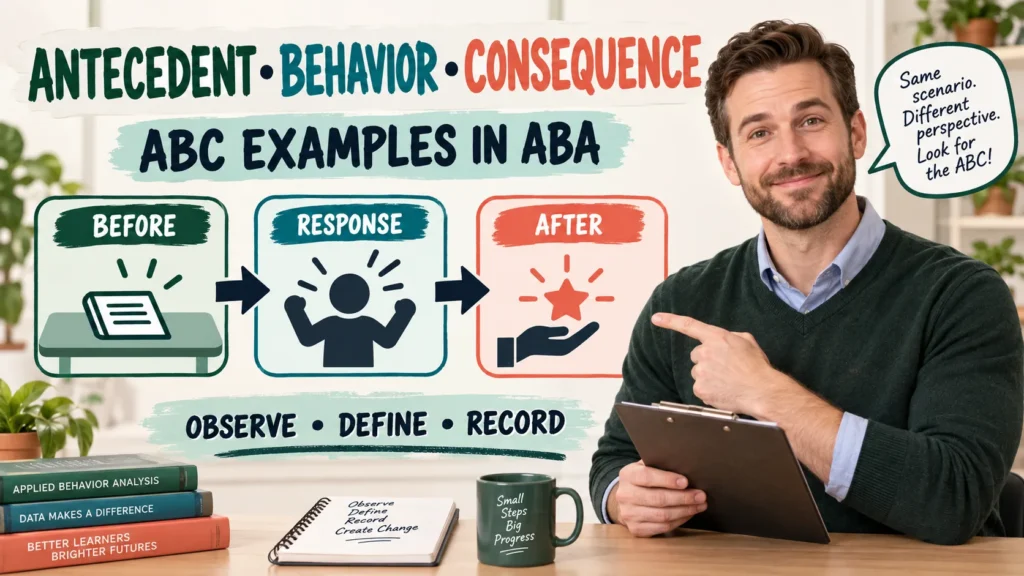
If you need an example of antecedent behavior and consequence, the fastest way to solve the question is to place one event in time: what happened immediately before, what did the person do that an observer could see or hear, and what happened immediately after? In ABA, those three parts are commonly abbreviated A-B-C.
Table of Contents
- Example of antecedent behavior and consequence: short answer
- Write the behavior as an observable event
- Example 1: a classroom task
- Example 2: a home transition
- Example 3: requesting help
- What the consequence means—and does not mean
- How to collect and review ABC data
- From ABC records to a cautious hypothesis
- Common mistakes
- Safety, dignity, and professional boundaries
- FAQ
- Sources for further study
- Quick Review Checklist
An ABC example is useful when it stays factual. “The student was defiant” is an interpretation or label; “after the worksheet was placed on the desk, the student pushed it to the floor and the teacher removed the worksheet” gives an antecedent, observable behavior, and consequence that another observer can review. The record can help a qualified team form a hypothesis, but it does not prove a behavioral function by itself.
The Vanderbilt IRIS ABC model resource and the University of Minnesota ABC chart resource both emphasize the before-behavior-after sequence. For BCBA study context, compare the current BACB BCBA Test Content Outline and the BACB Ethics Codes hub before applying any observation or intervention procedure with a real learner. Table of Contents
Example of antecedent behavior and consequence: short answer
An antecedent is an event or condition that occurs before a response. The behavior is the observable, measurable response itself. The consequence is what happens after that response. The terms describe the order of events; they do not automatically label the consequence as good, bad, reinforcement, or punishment.
| Part | Ask this question | Good wording | Avoid |
|---|---|---|---|
| Antecedent (A) | What was happening immediately before? | The teacher placed a math worksheet on the desk and said, “Start with number one.” | “The teacher triggered the behavior.” |
| Behavior (B) | What did the person do that could be observed? | The student pushed the worksheet to the floor and said, “No.” | “The student was defiant.” |
| Consequence (C) | What happened immediately after the response? | The teacher picked up the worksheet and gave a brief break. | “The student escaped because that was the function.” |
That is one descriptive observation. To interpret a pattern, collect more than one event, preserve the context, and involve a qualified behavior analyst when the data will guide assessment or treatment.
Write the behavior as an observable event
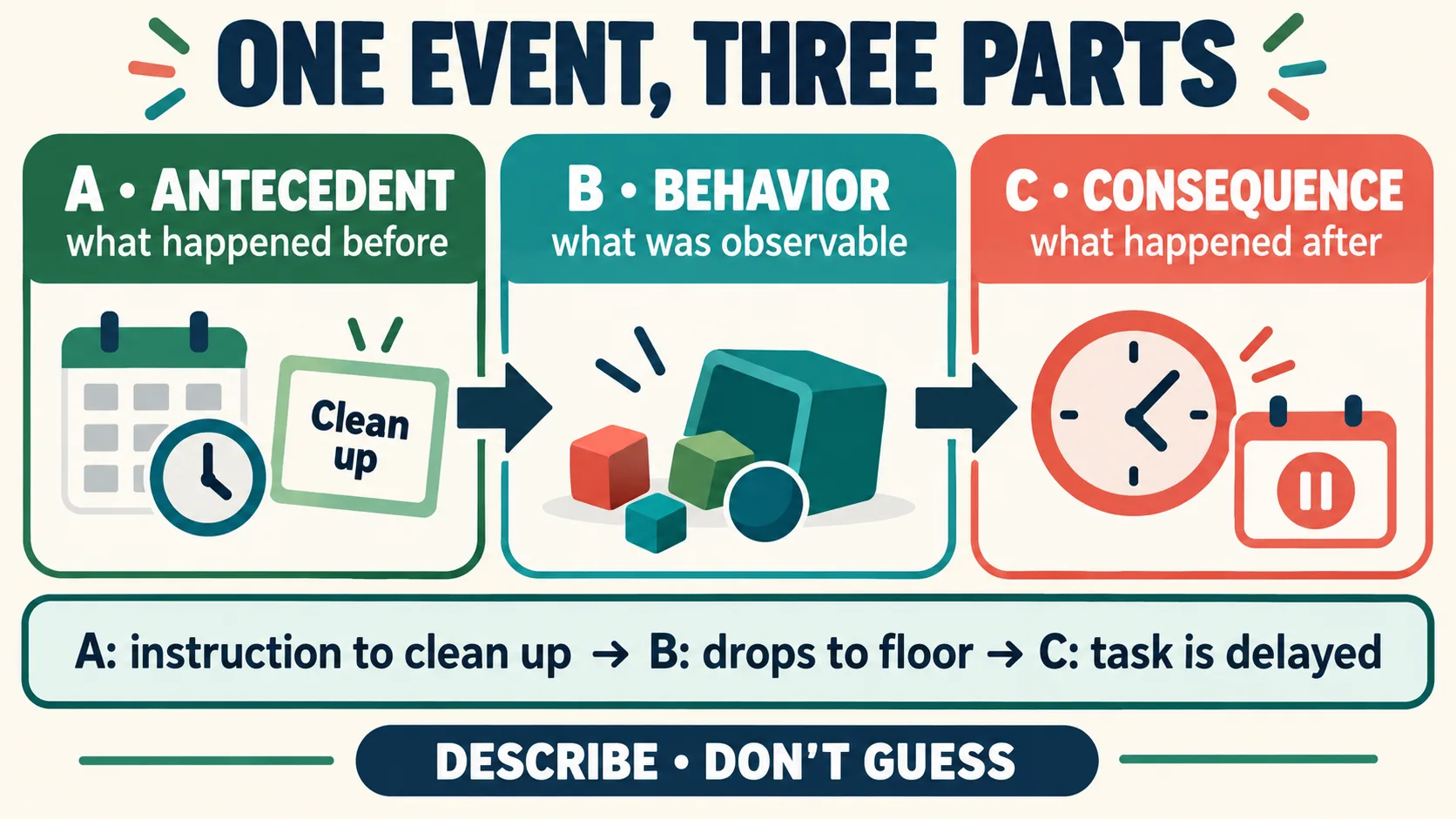
The behavior column is the center of a useful ABC record. Write what an observer could detect without guessing about thoughts, motives, feelings, or diagnosis. A strong definition often includes the topography, the setting, and a clear start or stop point.
For example, replace “meltdown” with “cried, dropped to the floor, and kicked the chair leg three times.” Replace “refused work” with “turned the worksheet face down, pushed the pencil away, and did not write for 30 seconds after the instruction.” If the response has an important threshold, state it before observation. Add an example and a nonexample when two observers might disagree.
Also separate setting events from the immediate antecedent. Poor sleep, a schedule change, pain, or a crowded room may matter, but the immediate antecedent is the event directly before the response in that episode. Recording both can improve context without putting every background variable into the A column.
Example 1: a classroom task
Suppose a teacher gives an independent worksheet. The student pushes the paper away, and the teacher moves the task to a later time. A factual ABC entry might look like this:
| A: before | B: observable response | C: after |
|---|---|---|
| Teacher says, “Complete the first five problems,” and places the worksheet in front of the student. | Student pushes the worksheet 20 cm away, puts their head on the desk, and does not write for 45 seconds. | Teacher removes the worksheet and says the student can try it later. |
This record supports a question about what tends to happen around task presentation. It does not establish why the response occurred. The team might need to review task difficulty, the learner’s communication, the availability of help, the timing, and other events across repeated observations.
Example 2: a home transition
Consider a screen-to-dinner transition. The antecedent is not “the child wanted the tablet”; that is an inference. The record should describe the cue and the observable response. The consequence should include what adults and peers actually did next.
| A: before | B: observable response | C: after |
|---|---|---|
| Caregiver says, “Tablet off; dinner is ready,” and reaches toward the device. | Child screams, drops to the floor, and kicks the cabinet for about two minutes. | Caregiver returns the tablet for five more minutes and delays dinner. |
After several observations, a team could write a tentative pattern statement such as: “When screen access is ended, screaming and dropping are sometimes followed by delayed dinner and renewed screen access.” That statement is still a hypothesis about a pattern, not proof that one variable causes the response. Safety, assent, communication, and the existing plan must guide any next step.
Example 3: requesting help
ABC recording is not only for challenging behavior. It can describe successful skill use. Suppose a learner is assembling a puzzle, encounters a difficult piece, points to a help card, and receives assistance.
| A: before | B: observable response | C: after |
|---|---|---|
| A puzzle piece does not fit after the learner tries it once. | Learner hands the help card to the instructor. | Instructor says, “Help,” and models how to rotate the piece. |
This example shows how an ABC record can track a replacement or communication response. Record whether the response was independent or prompted, what help was delivered, and whether the learner returned to the task. The goal is not simply to make an adult response happen; it is to support an accessible, meaningful way to communicate.
What the consequence means—and does not mean
In an ABC record, “consequence” means what followed the behavior. It is a time-order label, not a synonym for punishment. A consequence can be attention, access to an item, a break, a change in the task, peer behavior, no obvious response, or a naturally occurring result. Whether it functions as reinforcement or punishment depends on its effect on future behavior, not merely on what an adult intended.
Do not write “the consequence was escape” unless the record and the assessment support that conclusion. “The worksheet was removed for 60 seconds” is an observable consequence. “The student escaped the demand” is a functional interpretation that may be reasonable to test, but it belongs in a separate hypothesis or analysis field. The existing three-term contingency guide covers the broader conceptual foundation. The narrower task here is to classify and write examples cleanly before making a stronger claim.
How to collect and review ABC data
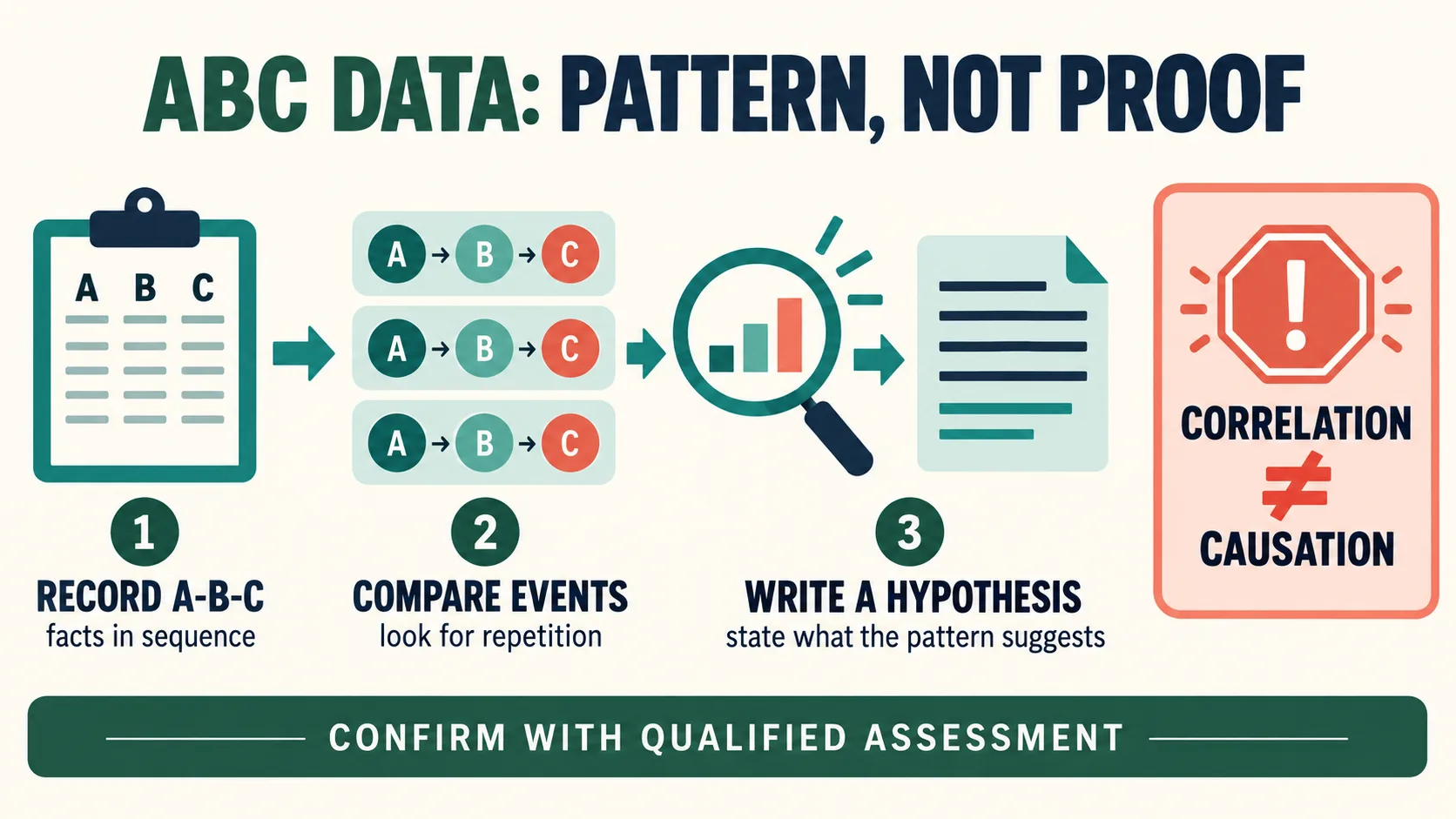
A useful ABC system is consistent enough to compare events and simple enough to use during the real routine. A descriptive ABC record commonly includes:
- Date, time, and setting: record where and when the event occurred.
- Antecedent: describe the immediate event, instruction, material, person, or transition.
- Behavior: write the observable response, including frequency, duration, intensity descriptor, or other measure if the plan specifies it.
- Consequence: record what happened directly afterward, including adult, peer, task, and access changes.
- Context notes: add relevant setting events without rewriting the episode as a conclusion.
- Review field: keep a separate space for a tentative pattern or question for the supervising team.
Review several entries together. Look for repeated A-B-C sequences, exceptions, differences across settings, and whether the same consequence follows every time. A table that has only one dramatic event can be useful for discussion, but it should not be treated as a stable pattern.
From ABC records to a cautious hypothesis
Descriptive ABC data can suggest what to examine next. For example, if task presentation repeatedly precedes dropping and the task is repeatedly removed afterward, a team might test whether task difficulty, communication support, break access, or other variables need review. A hypothesis should state the observed relation and the uncertainty: “When X occurs, Y is more likely, and Z often follows; collect more data or conduct the appropriate assessment to evaluate this pattern.”
ABC data show correlation in observed events. They do not, by themselves, demonstrate a functional relation. The StreamABA ABC data resource makes this descriptive-assessment boundary explicit. If an experimental functional analysis is clinically appropriate, it must be designed, supervised, and interpreted by a qualified professional with attention to safety and consent.
For a focused comparison of ABC recording and functional assessment, use the site’s ABC recording guide and functional assessment BCBA guide. They are supporting pages, not a reason to skip the exact A-B-C writing rules above.
Common mistakes
- Putting an inferred function in the behavior column: “attention seeking” is not an observable response.
- Writing a whole story instead of the immediate sequence: keep the A, B, and C linked to one episode.
- Calling an instruction a consequence: classify it by its position relative to the response being analyzed.
- Recording only adult actions: include peer, task, materials, and naturally occurring events when relevant.
- Assuming “nothing happened” is no consequence: record that no obvious change was observed, then review what the learner experienced.
- Using “meltdown,” “refusal,” or “aggression” without a definition: add observable examples and nonexamples.
- Treating one ABC entry as proof: compare repeated events and use appropriate assessment methods.
- Including identifiable information in a study example: use fictional names and de-identified details.
Safety, dignity, and professional boundaries
Do not provoke a behavior to obtain an ABC example, delay needed assistance, remove communication, or copy a crisis or punishment procedure from a generic article. If an event involves injury risk, medical concern, suspected abuse, severe escalation, or a change in medication or health, follow the responsible professional’s safety pathway and seek appropriate support.
Use assent- and dignity-aware observation. A learner’s communication, distress, refusal, or request for a break is part of the context to respect. Data should help the team make safer and more meaningful decisions, not turn a person into a problem label. The BACB Ethics Codes page is the current professional reference point; local law, payer rules, service agreements, and supervision requirements may add obligations.
FAQ
What is a simple example of antecedent, behavior, and consequence?: Antecedent: a teacher says, “Start the worksheet.” Behavior: the student pushes the worksheet away and says, “No.” Consequence: the teacher removes the worksheet for one minute. That is a descriptive A-B-C sequence; it does not by itself prove the function.
Is the consequence always a punishment?: No. In ABC recording, consequence simply means what happened after the behavior. Reinforcement or punishment are functional terms that depend on a later change in behavior, not on the label or intention alone.
Can ABC data prove why a behavior happens?: No. ABC data can reveal repeated correlations and support a hypothesis. Stronger causal claims require appropriate assessment, and an experimental functional analysis should be conducted or supervised by a qualified professional when indicated and safe.
How should I write “refusal” in an ABC example?: Describe the observable response, such as “turned away from the materials, pushed the pencil away, and did not begin writing within 30 seconds of the instruction.” Add clear examples and nonexamples if observers could score it differently.
When you are ready to practice classifying A, B, and C in new vignettes, use the Take the Free BCBA Mock Exam. It is a study resource, not an official BACB result or a substitute for supervision.
Sources for further study
- Vanderbilt IRIS: The ABC Model
- University of Minnesota Institute on Community Integration: ABC Chart
- StreamABA: ABC Data Sheet and descriptive-assessment limits
- OPEPP: Antecedent, Behavior, Consequence lesson
- Behavior Analyst Certification Board: BCBA Test Content Outline
- Behavior Analyst Certification Board: Ethics Codes
This article is for general education and BCBA exam-study context. It is not individualized clinical, medical, legal, or behavioral advice; it is not affiliated with or endorsed by the BACB; and it does not replace assessment, informed consent, assent, supervision, a written behavior plan, or emergency support.
Quick Review Checklist
Use this final checklist to turn example of antecedent behavior and consequence into exam-ready reasoning. The goal is not to memorize a label in isolation; it is to identify the relevant evidence and explain why the best answer fits the scenario. Key ideas to review:
- State the central definition or decision point for example of antecedent behavior and consequence in your own words.
- Identify the detail that makes example of antecedent behavior and consequence different from its closest related ABA term.
- Separate the observable facts in a scenario from assumptions that are not supported by the facts.
- Write one example and one nonexample so you can recognize the concept in a new setting.
Exam application checks:
- Ask what the question is actually requesting before comparing the answer choices.
- Mark the antecedent, response, consequence, or other evidence that supports the selected answer.
- Look for a distractor that describes a related process but does not answer the specific question.
Final self-check:
- Explain how you would verify the interpretation with clear observations or data.
- Change one detail in the scenario and decide whether your answer should change.
- Give a one-sentence rationale that a supervisor or study partner could evaluate.



