
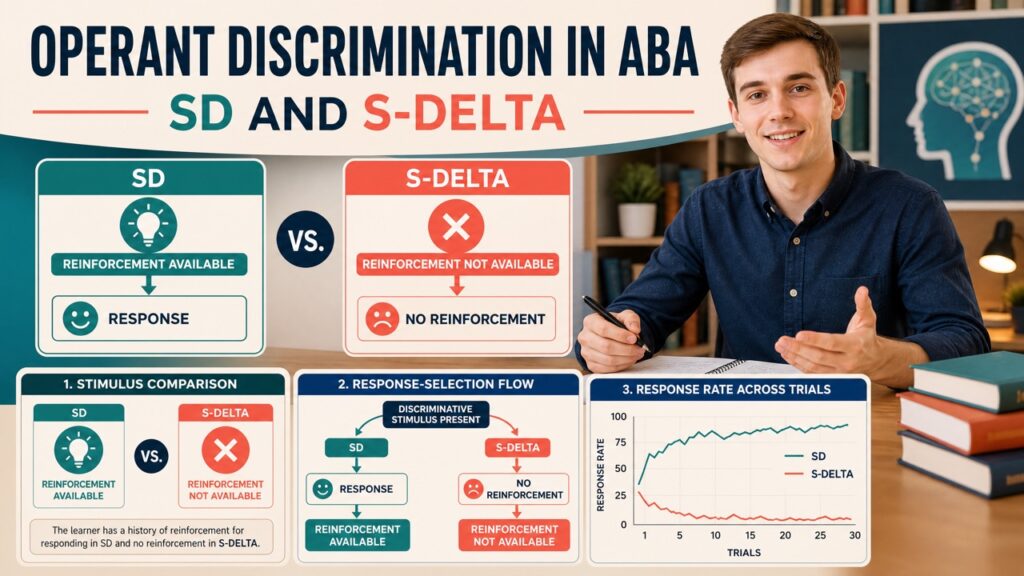
Operant discrimination is a core process in applied behavior analysis (ABA) that explains how behavior comes under the control of specific environmental cues. In everyday terms, it means learning when a behavior will “work” and when it will not. For BCBA candidates and practicing behavior analysts, mastering operant discrimination is essential because it underpins countless interventions, from teaching a child to request a break only when an adult is available, to helping a client respond to a therapist’s instruction rather than to background noise. This guide provides a precise definition, breaks down the discriminated operant, contrasts operant discrimination with stimulus control and respondent discrimination, and offers practical examples to solidify your understanding for the BCBA exam and real-world practice.
Table of Contents
- Defining Operant Discrimination
- The Discriminated Operant: A Three-Term Contingency
- Operant Discrimination vs. Stimulus Control
- How Discrimination Training Works
- Applied Examples and Evaluation
- Operant vs. Respondent Discrimination
- Common Traps and Study Checklist
- Reference
Defining Operant Discrimination
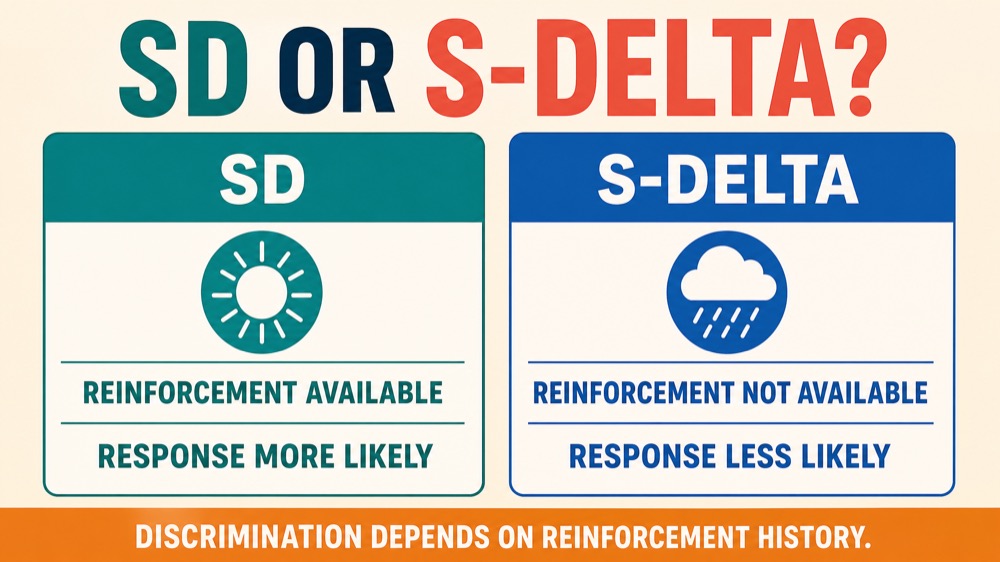
Operant discrimination is a behavioral process in which a behavior occurs more frequently in the presence of a particular antecedent stimulus because that stimulus has historically signaled that reinforcement is available. In contrast, the behavior is less likely to occur in the presence of a different stimulus that signals reinforcement is not available. The first stimulus is called a discriminative stimulus, or SD, and the second is called an S-delta (SΔ). The process of discrimination is demonstrated when a response is emitted reliably in the presence of the SD and withheld in the presence of the S-delta.
Consider a student in a classroom. When the teacher is facing the student and making eye contact (the SD), raising a hand has previously resulted in being called on by the teacher, which functioned as reinforcement. When the teacher is turned away, writing on the board (the S-delta), raising a hand has historically not resulted in being called on. Therefore, the student is more likely to raise a hand only when the teacher is looking. This original example illustrates the core of operant discrimination: the antecedent context alters the likelihood of a behavior because of its past correlation with reinforcement.
It is crucial to note that operant discrimination does not occur without reinforcement history. The differential reinforcement of responding in the presence of the SD, paired with extinction in the presence of the S-delta, establishes the stimulus control. The behavior is not controlled by the physical properties of the stimuli themselves but by their learned functions as signals for reinforcement availability.
The Discriminated Operant: A Three-Term Contingency
The discriminated operant is a unit of analysis in ABA that consists of three components: the antecedent stimulus (the SD), the behavior, and the consequence (reinforcement). This three-term contingency is often written as SD → R → Sr+. The SD sets the occasion for the response because in its presence, the response has historically produced reinforcement. The behavior is the operant response, and the consequence is the reinforcing outcome that strengthens the behavior under similar antecedent conditions.
For example, in the classroom scenario, the discriminated operant is: teacher looking (SD) → hand raise (behavior) → teacher calls on student (reinforcement). The S-delta (teacher turned away) is part of the discrimination training procedure but is not part of the discriminated operant itself; rather, it signals that the reinforcement contingency is not in effect, so the behavior is less likely to occur.
Understanding the discriminated operant is critical because it emphasizes that behavior is not random but is influenced by environmental events. Behavior analysts use this unit to analyze and modify behavior by manipulating the antecedents and consequences to create or change stimulus control. The discriminated operant is the building block of more complex behavioral repertoires, such as conditional discriminations and verbal behavior.
Operant Discrimination vs. Stimulus Control
Operant discrimination and stimulus control are closely related but not identical. Operant discrimination is the process of learning to respond differently to different stimuli based on their correlation with reinforcement. Stimulus control is the outcome or the degree to which behavior is influenced by the presence or absence of a specific antecedent stimulus. In other words, discrimination is the behavioral process; stimulus control is the measurable effect of that process on behavior.
When discrimination training is successful, we say that the behavior is under stimulus control of the SD. Stimulus control can be quantified by comparing response rates in the presence of the SD versus the S-delta. If a behavior occurs predominantly in the presence of the SD and rarely in the presence of the S-delta, stimulus control is strong. If the behavior occurs equally in both conditions, stimulus control is weak or absent.
For BCBA candidates, it is essential to use these terms precisely. Do not treat them as synonyms. Discrimination is the procedure or process; stimulus control is the effect. For example, a therapist might say, “We are conducting discrimination training to establish stimulus control over the client’s mand for a break.” This sentence correctly uses discrimination as the process and stimulus control as the outcome.
How Discrimination Training Works
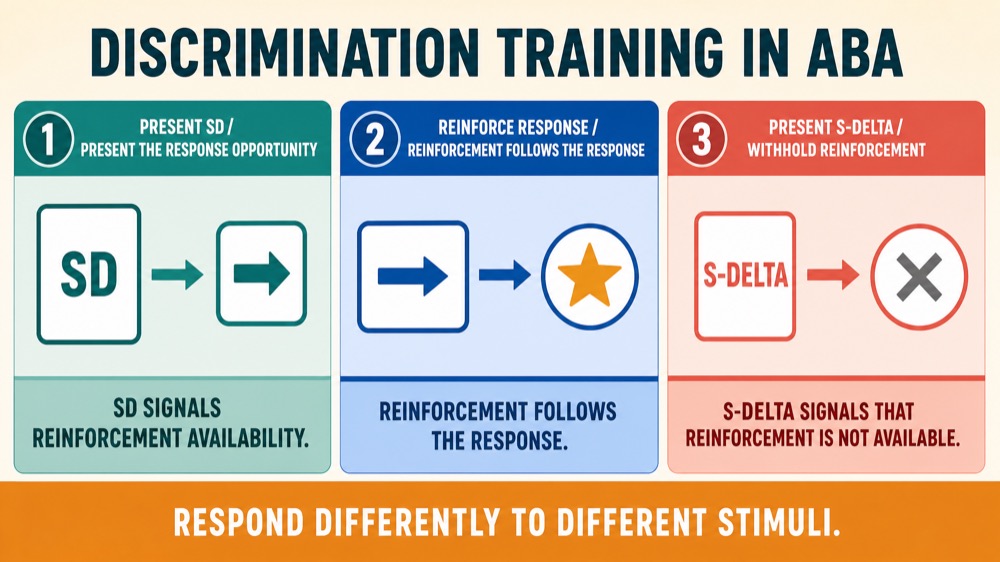
Discrimination training is a procedure that systematically arranges the environment to teach an individual to respond in the presence of the SD and not to respond in the presence of the S-delta. The essential components of discrimination training are:
- Present the SD and reinforce the response: When the SD is present, the target behavior is reinforced. This strengthens the response in the presence of that stimulus.
- Present the S-delta and withhold reinforcement: When the S-delta is present, the target behavior is not reinforced. This is an extinction procedure for that response in that context, which leads to a decrease in responding.
- Alternate presentations: The SD and S-delta are presented in a random or systematic sequence to ensure the individual learns to discriminate between them.
Consider a young child learning to request a snack. The therapist holds up a preferred snack (SD) and says, “What do you want?” When the child signs “cookie,” the therapist gives the cookie. When the therapist puts the snack away out of sight (S-delta) and asks the same question, the child’s sign is not followed by a cookie. Over repeated trials, the child learns to sign only when the snack is visible. This example shows how discrimination training uses differential reinforcement and extinction to establish stimulus control.
It is important to note that discrimination training does not require only reinforcing responses in the presence of the SD; it also requires withholding reinforcement in the presence of the S-delta. Without the extinction component, the behavior would remain strong in both conditions, and discrimination would not be established. Thus, the process always involves both reinforcement and extinction.
In practice, discrimination training can be made more efficient by using clear and distinct SD and S-delta stimuli. If the SD and S-delta are too similar, discrimination is harder to establish. Conversely, if they are very different, learning is faster. The goal is to achieve a discriminated operant where behavior reliably occurs in the presence of the SD and not in the S-delta.
Applied Examples and Evaluation
Conversely, if discrimination fails, overgeneralization may occur. Overgeneralization means that a behavior occurs in the presence of stimuli that resemble the SD but do not actually signal reinforcement. This can be problematic in social and academic settings. For instance, a student might raise a hand whenever any adult looks in their direction, even if the adult is not the teacher. Careful discrimination training helps prevent such overgeneralization.
To evaluate whether discrimination has been established, a behavior analyst measures the rate of the target behavior in the presence of the SD versus the S-delta across multiple contexts. A clear difference in responding provides a measurable outcome that indicates the strength of stimulus control. If the behavior occurs at similar rates in both conditions, the analyst may adjust the training by making the SD and S-delta more distinct or by ensuring consistent reinforcement and extinction. This systematic evaluation helps limit overgeneralization and ensures that the learner responds only when reinforcement is truly available.
Operant vs. Respondent Discrimination
It is important to distinguish operant discrimination from respondent (classical) discrimination. Respondent discrimination occurs when a conditioned response is elicited by one stimulus but not by another, due to the pairings of stimuli. For example, in respondent conditioning, a tone paired with food elicits salivation, but a different tone not paired with food does not. The process relies on stimulus-stimulus pairings and involves reflexive behaviors, not operant behavior that is controlled by consequences.
In operant discrimination, the behavior is emitted by the organism and is sensitive to reinforcement consequences. The learner actively engages in behavior to obtain reinforcement, rather than automatically responding to a conditioned stimulus. While both processes involve discrimination, they describe different behavioral mechanisms. In ABA, operant discrimination is the foundation for most skill-building interventions because it allows for flexible and goal-directed behavior.
Failing to make this distinction can lead to conceptual errors. For example, saying “operant discrimination is the same as respondent conditioning” would be incorrect. Instead, they are distinct processes, though they may interact in natural situations.
Common Traps and Study Checklist
- Confusing the SD and S-delta: The SD is the stimulus in the presence of which a response has been reinforced; the S-delta is the stimulus in the presence of which a response has not been reinforced. Do not label an SD based on physical appearance alone; you must consider reinforcement history.
- Thinking discrimination training is just reinforcement in the presence of SD: It also requires extinction in the presence of S-delta. The process involves both differential reinforcement and extinction.
- Equating stimulus control and discrimination: Discrimination is the process; stimulus control is the outcome. Use the terms correctly in your exam answers.
- Assuming operant discrimination occurs without reinforcement history: All operant learning requires a history of reinforcement. There is no innate discrimination in the operant sense.
- Overgeneralizing the concept: Operant discrimination does not always work the same way; the ease of discrimination depends on the similarity of stimuli and the schedule of reinforcement.
Use this checklist as you prepare for the BCBA exam to ensure you have a solid grasp of operant discrimination.
- Can you define operant discrimination in your own words, including the role of SD and S-delta?
- Can you identify the three-term contingency in a novel example?
- Can you differentiate operant discrimination from stimulus control?
- Can you explain the components of discrimination training (reinforcement in SD, extinction in S-delta)?
- Can you provide a unique example from education, home, or clinical settings?
- Can you distinguish operant from respondent discrimination?
- Can you explain potential negative outcomes if discrimination is not established (e.g., overgeneralization)?
If you are preparing for the BCBA exam, practice is essential. Take advantage of our free BCBA mock exam to test your knowledge across a variety of topics. The more you practice, the more confident you will be on exam day. Start your free practice today and receive valuable feedback on your performance.
Try the Free BCBA Mock Exam Now For further reading on related concepts, explore our guides on stimulus control in ABA and stimulus generalization.



