
What Is Discontinuous Measurement in A
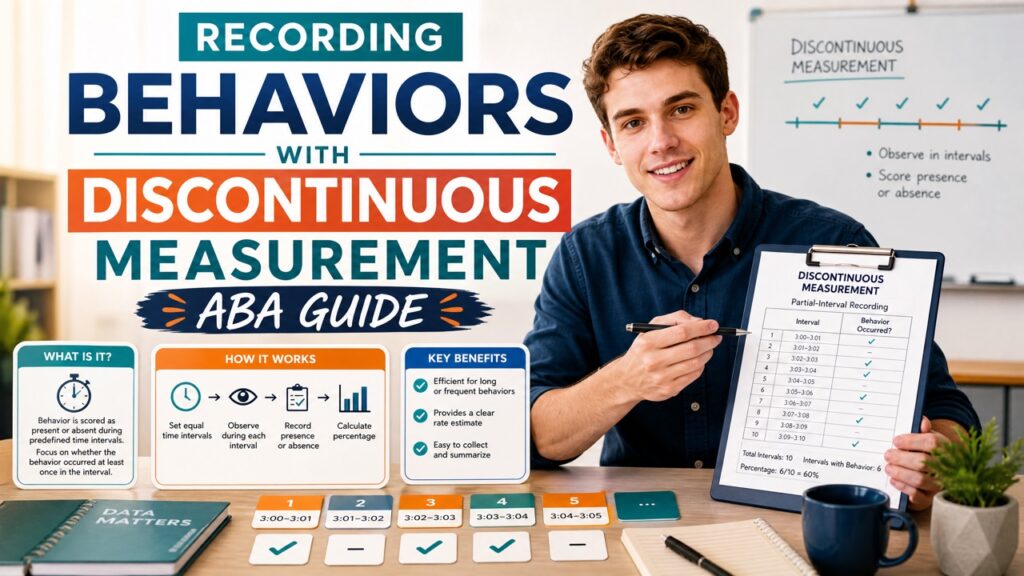
In applied behavior analysis, discontinuous measurement is a data collection approach in which an observation period is divided into equal intervals, and the observer records whether a target behavior occurred during each interval rather than capturing every instance. When using discontinuous measurement, behaviors are recorded as occurring or not occurring within each interval, based on a specific rule. This method produces an estimate of behavior, not an exact count, and is often used when continuous observation is impractical.
Table of Contents
- What Is Discontinuous Measurement in A
- Core Discontinuous Measurement Methods
- How Behaviors Are Recorded in Each Method
- Practical Examples of Discontinuous Measurement
- Comparing Discontinuous Measurement with Other Measurement Dimensions
- Selecting the Appropriate Discontinuous Measurement Method
- Common Misconceptions and Limitations
- Why Discontinuous Measurement Matters in ABA Practice
- How to Study Discontinuous Measurement
- Study Checklist for Discontinuous Measurement
- Further Resources
Behavior analysts select discontinuous measurement when they need to monitor behavior in natural settings such as classrooms, clinics, or homes, where constant one-on-one observation is not feasible. The choice of interval method depends on the behavior’s characteristics and the clinical question. Because the data are estimates, they must be interpreted with caution, especially when making treatment decisions. Understanding the strengths and limitations of each method is essential for accurate data-based decision-making.
Core Discontinuous Measurement Methods
There are three primary interval recording methods used in discontinuous measurement: partial interval recording, whole interval recording, and momentary time sampling. Each method has a distinct rule for recording behavior, and each yields different data patterns. The observer must be trained to follow the exact timing and recording rule to ensure reliable data.
Partial interval recording: The observer marks an interval as an occurrence if the behavior happens at any time during that interval. This method tends to overestimate the actual occurrence of behavior because even a brief instance counts as a full interval. It is often used for behaviors that are quick or sporadic, such as hand flapping or cursing.
Whole interval recording: The observer records an occurrence only if the behavior occurs throughout the entire interval. This method underestimates behavior because the behavior must be continuous for the whole interval to count. It is appropriate for behaviors that are ongoing, such as staying on-task or remaining seated.
Momentary time sampling: The observer records whether the behavior is occurring at the exact moment the interval ends. This method does not require continuous attention and is less likely to miss behaviors that occur briefly. It is useful when the observer has other responsibilities and provides a reasonable estimate for behaviors that are relatively stable.
How Behaviors Are Recorded in Each Method
When using discontinuous measurement, behaviors are recorded as a binary occurrence or non-occurrence, but the meaning of that binary depends on the method. In partial interval recording, a single brief instance of behavior marks the entire interval as an occurrence. In whole interval recording, the behavior must be present for the entire interval to be marked as an occurrence. In momentary time sampling, the behavior is recorded only if it is occurring at the precise moment the interval ends.
These differences affect the data pattern. Partial interval recording tends to overestimate the actual occurrence, whole interval recording tends to underestimate, and momentary time sampling provides a snapshot that may miss brief behaviors. Understanding these biases is critical for interpreting data and making clinical decisions. For example, if the goal is to reduce a behavior, an overestimating method may be acceptable; if the goal is to increase a behavior, underestimation may be safer.
Practical Examples of Discontinuous Measurement
Consider a teacher tracking a student’s on-task behavior during a 30-minute independent work session. Using whole interval recording with 5-minute intervals, the teacher would mark an occurrence only if the student was on-task for the entire 5 minutes. If the student looked away for a few seconds, that interval would be scored as non-occurrence.
For a self-injurious behavior like head-hitting, a therapist might use partial interval recording with 10-second intervals. If the student hits his head at any point during a 10-second interval, that interval is marked as an occurrence, regardless of how many times or for how long.
In a vocational setting, a job coach might use momentary time sampling to record whether a client is working at the end of each 2-minute interval. This allows the coach to also provide prompts or feedback without constant observation.
Comparing Discontinuous Measurement with Other Measurement Dimensions
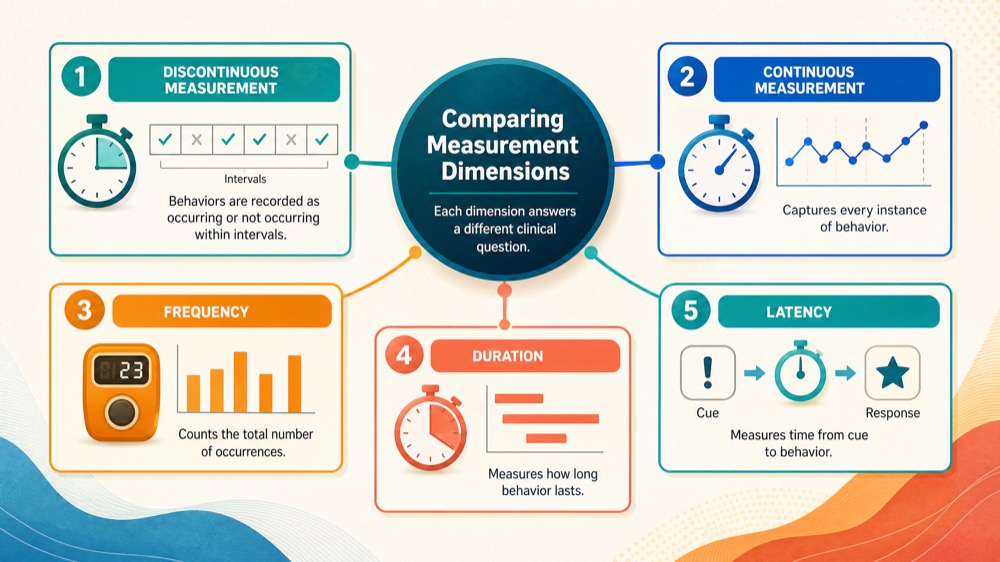
Discontinuous measurement is often contrasted with continuous measurement, which captures every instance of behavior. However, it is also important to distinguish interval-based recording from other measurement dimensions such as frequency, duration, and latency.
- Frequency is the count of behavior instances within a specified time period.
- Duration is the total time from the onset to the offset of a behavior.
- Latency is the time from a specified antecedent or instruction to the measured response.
- Interval-based recording (discontinuous measurement) records whether behavior occurred within intervals, not the exact count or duration.
Each dimension answers a different clinical question. Frequency is useful for discrete behaviors, duration for behaviors that last a long time, and latency for measuring the time to respond to an instruction. Discontinuous measurement provides an estimate of occurrence, which may be sufficient for many clinical decisions but not for all. The behavior analyst must choose the measurement approach that best matches the behavior and the purpose of assessment.
Selecting the Appropriate Discontinuous Measurement Method
The choice of method depends on the behavior’s frequency, duration, and the purpose of measurement. For behaviors that occur quickly and briefly, partial interval recording is often chosen. For behaviors that are expected to be continuous, whole interval recording may be more appropriate. For high-rate behaviors or when the observer has other duties, momentary time sampling is efficient.
- Partial interval recording: best for brief, discrete behaviors; overestimates occurrence.
- Whole interval recording: best for ongoing behaviors; underestimates occurrence.
- Momentary time sampling: best for stable behaviors or when attention is divided; provides a snapshot.
It is critical to consider the behavioral definition and the clinical goal. Always document the method used to interpret the data correctly. The interval length should be set based on the behavior’s rate; too long intervals may miss changes, and too short intervals may be impractical. The observer must be trained to follow the exact timing and recording rule to ensure reliable data.
Common Misconceptions and Limitations
One common misconception is that discontinuous measurement provides an exact count of behavior. In reality, it provides an estimate, and the accuracy depends on the method and interval length. Another misconception is that partial interval recording is always the most accurate method; however, its accuracy depends on the behavior and the clinical question. Similarly, whole interval recording is not appropriate for every behavior, and momentary time sampling does not capture every instance of behavior.
- Using partial interval recording for a behavior you want to increase may lead to false progress.
- Using whole interval recording for a behavior you want to decrease may miss important changes.
- Not using random interval starts can bias data.
- Recording during only part of the interval but marking occurrence is a procedural drift.
Another limitation is that momentary time sampling may miss brief behaviors that occur between observation moments, leading to underestimation. The observer must be trained and follow the exact timing. These limitations do not make discontinuous measurement invalid; rather, they require careful selection and interpretation.
Why Discontinuous Measurement Matters in ABA Practice
Discontinuous measurement is a core skill for behavior analysts because it allows data collection in natural environments without constant one-on-one observation. It is used in schools, clinics, and homes to monitor progress and guide interventions. By understanding the strengths and limitations of each method, practitioners can make informed decisions.
When using discontinuous measurement, behaviors are recorded as a binary occurrence or non-occurrence, but the meaning of that binary depends on the method. This data informs treatment efficacy and helps behavior analysts adjust strategies. Reliable and valid data are essential for ethical practice. The BACB’s current BCBA Test Content Outline includes measurement as a key area, and behavior analysts are expected to select and implement appropriate measurement procedures.
How to Study Discontinuous Measurement
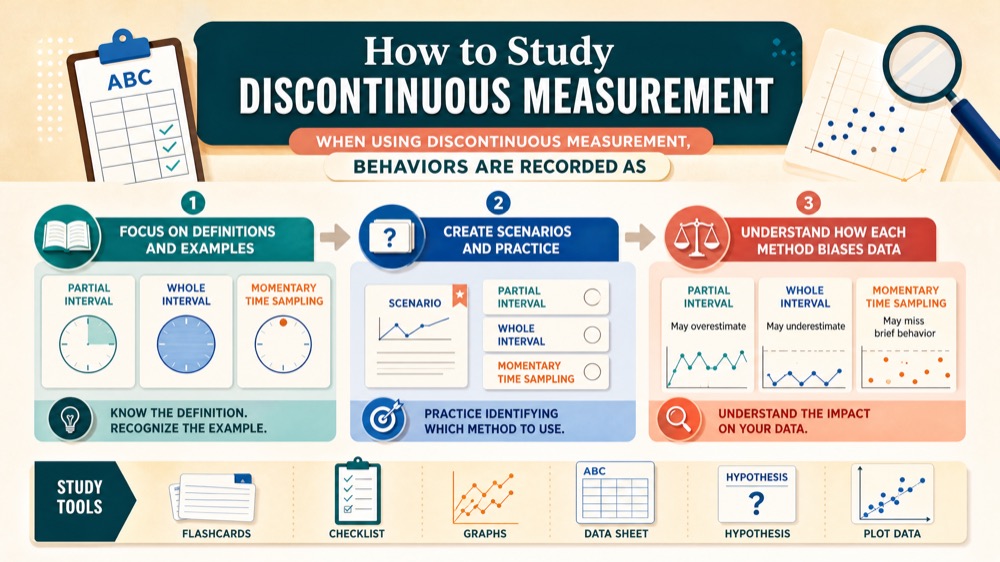
To master this topic, focus on the definitions and examples for each method. Create flashcards with scenarios and practice identifying which method to use. Understand how each method biases data. Also, learn to calculate percentages from interval data.
- Review the BACB 6th Edition Test Content Outline for measurement tasks.
- Practice with interval recording data sheets.
- Compare and contrast methods in a table.
- Use original scenarios to test your knowledge.
Remember, this topic is part of the measurement content area, but the exact emphasis may vary. Do not rely on a single source. Use official BACB resources and reputable textbooks. For additional practice and feedback across ABA topics, consider using the free BCBA mock exam.
Study Checklist for Discontinuous Measurement
- Define each method accurately.
- Identify which method is best for a given behavior.
- Explain overestimation and underestimation.
- Describe how to record data using interval recording.
- Recognize common procedural errors.
Further Resources
To deepen your understanding of related measurement and behavioral concepts, explore these articles:
- Stimulus Control in ABA
- Stimulus Generalisation in ABA
- Continuous vs. Discontinuous Measurement
- Discontinuous Measurement Guide
- Measurement Methods in ABA
- Measurement Systems in ABA
- Discontinuous Measurement Examples
- 4 Functions of Behavior
- Automatic Reinforcement
- Treatment Integrity and Social Validity
- BCBA Exam Study Framework
Additionally, refer to the BACB BCBA Test Content Outline (6th ed.) for official guidelines. Always rely on current behavior-analytic literature and the BACB Ethics Code. Continuous learning and accurate measurement are the foundation of quality behavior-analytic services.



