
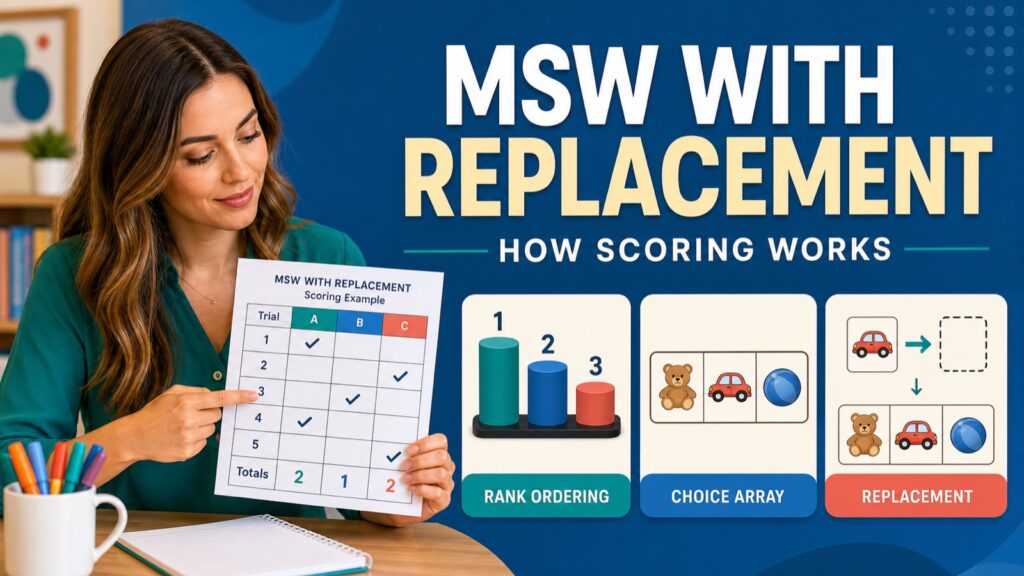
Multiple Stimulus With Replacement: How Scoring Works is written for BCBA candidates who need to apply multiple stimulus with replacement (MSWR) preference assessment to realistic ABA scenarios rather than memorize an isolated definition. The central question is always functional: what happened before the response, what happened immediately after it, and what pattern should be measured next?
Table of Contents
- How This Topic Appears on the BCBA Exam
- Core Definition and Key Distinction
- How to Solve a Scenario
- Visual Comparison Map
- Worked ABA Examples
- Measurement and Data
- Implementation and Generalization
- Second Decision Map
- Common BCBA Exam Traps
- Quick Review Checklist
- Frequently Asked Questions
- Take the Free BCBA Mock Exam
- References
This guide gives the concept a practical exam frame. It separates the target term from the closest alternatives, works through a representative scenario, identifies the data that support a defensible answer, and closes with a review checklist. The goal is not to make every case sound identical; it is to show how a behavior analyst reasons from the details in the stem. Use the current BACB materials for time-sensitive certification or ethics requirements, and treat every clinical example as a study model that still needs individualized assessment, consent, supervision, and data review.
How This Topic Appears on the BCBA Exam
Questions about multiple stimulus with replacement (MSWR) preference assessment usually embed the concept inside a short clinical, classroom, research, or measurement scenario. The stem may ask for the best classification, the next assessment step, the most defensible intervention, or the data pattern that supports the answer. A keyword in the question is a clue, not a substitute for analyzing the contingency.
Start by rewriting the stem in observable terms. Name the antecedent or contextual variable, define the response, identify the consequence, and note whether the response became more likely, less likely, faster, longer, or more generalized. Then ask which answer choice explains all of those facts without adding an unsupported private event or an unmentioned procedure.
- Identify the response and its measurable dimension.
- Separate an antecedent signal from a value-altering or contextual variable.
- Check whether the consequence was added, removed, delayed, or withheld.
- Look for the learning history that gives the stimulus or consequence its function.
- Decide what data would distinguish the best answer from the nearest distractor.
The safest exam habit is to delay the label until the sequence is clear. The key clues are several items, selection, replacement, and rank ordering. Do not describe MSWR as a reinforcer assessment that proves an item will increase behavior; it identifies relative preference under assessment conditions.
Core Definition and Key Distinction
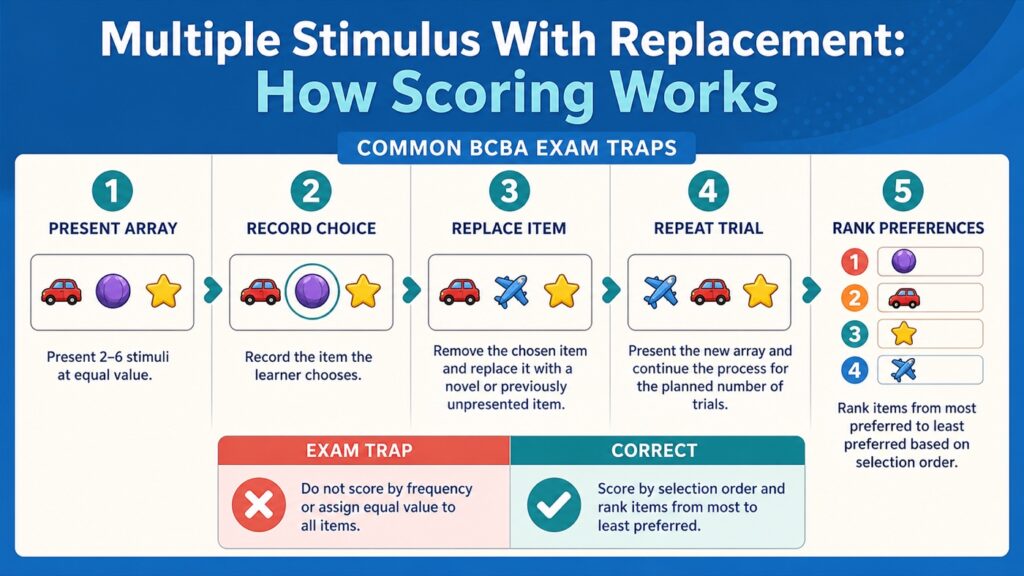
In a multiple-stimulus-with-replacement preference assessment, several items are presented, the learner selects one, the selected item is replaced, and the process continues. Items are scored by the order in which they are selected across trials, producing a rank ordering rather than a single paired comparison.
With replacement means the selected item returns to the array so it can be selected again. Without replacement removes the selected item. The scoring and interpretation differ, so the examiner may test whether the item returns and whether the outcome is a preference rank.
The term should be treated as a relation, process, or design feature, not as a personality description. If a scenario does not provide enough information to justify the label, the best answer may be to collect direct data, review the functional history, or consult the current standard that governs the decision.
- Ask what changed: stimulus, consequence, value, timing, response effort, or context.
- Ask what was learned: a response-consequence relation, a stimulus relation, or a respondent pairing.
- Ask what must be measured: the target response, the environmental variable, and the outcome trend.
- Ask what would falsify the first guess: a competing function, a fidelity problem, or a different measurement rule.
How to Solve a Scenario
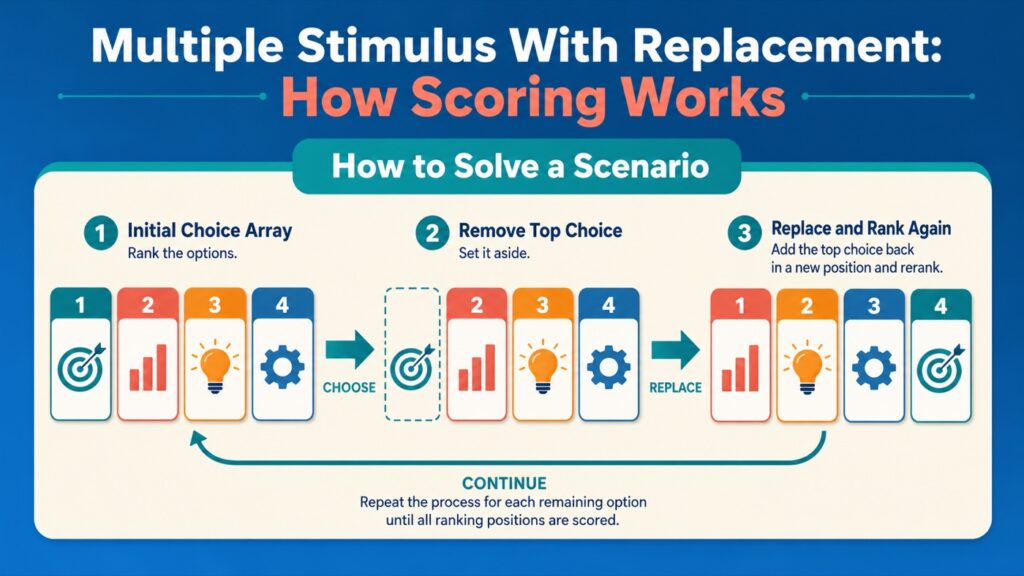
Read the scenario once for the story and a second time for the contingencies. On the second pass, circle the event that occurs before the response, underline the response itself, and box the immediate consequence. If the stem includes a change across sessions, write whether the behavior increased, decreased, or changed in quality. This prevents a familiar word from pulling the answer away from the actual data.
- Define the behavior: replace broad words such as compliance, motivation, or distress with an observable response.
- Locate the controlling relation: decide whether the stem emphasizes antecedent signaling, reinforcer value, consequence effect, respondent pairing, or experimental control.
- Check the time course: compare baseline, intervention, repeated trials, or phase changes.
- Reject overclaiming: do not infer a function, mastery, generalization, or ethical conclusion that the data do not support.
- Choose the smallest defensible answer: prefer the option that matches every stated detail with the fewest assumptions.
A learner chooses a ball from five items, the ball returns to the array, and the learner chooses again. Across repeated selections, the analyst records first, second, and later choices to calculate preference ranks while preserving access to each item.
A strong answer also identifies what would happen next. If the team cannot distinguish two plausible explanations, the next step is not to argue over terminology; it is to arrange a safe comparison or collect a more precise measure. That reasoning pattern transfers across measurement, assessment, teaching, behavior reduction, ethics, and experimental-design questions.
Visual Comparison Map
The first visual summarizes the distinction in a compact form. Use it after reading the definition, then return to the scenario and label each box with the exact event described in the stem. If a box cannot be filled from the scenario, that missing information is often the reason the question asks for assessment rather than a final conclusion.
- Context: what setting, history, or motivating condition is present?
- Signal or procedure: what is arranged before the response?
- Response: what does the learner do, and how is it measured?
- Consequence or outcome: what follows, and what changes later?
- Boundary: what nearby concept is the exam testing you not to confuse?
Worked ABA Examples
A learner chooses a ball from five items, the ball returns to the array, and the learner chooses again. Across repeated selections, the analyst records first, second, and later choices to calculate preference ranks while preserving access to each item.
In a second variation, the same target response occurs in a different setting or after a different consequence. That change matters because a label is only useful when it predicts the relation under examination. Compare the two cases by holding the response definition constant while changing one environmental feature at a time. If the behavior changes only when a particular stimulus or consequence is present, the functional interpretation becomes more specific.
In a third variation, the intervention appears to work but implementation is inconsistent. The analyst should inspect procedural integrity before deciding that the concept or treatment failed. A missed prompt, an extra consequence, a different interval rule, or an unplanned source of reinforcement can make a correct plan look ineffective.
- Case A: the expected relation is present and the response changes in the predicted direction.
- Case B: the same response occurs, but the relevant stimulus or consequence is absent.
- Case C: the outcome changes, but fidelity or competing reinforcement prevents a confident interpretation.
Measurement and Data
Record array composition, selection order, latency, refusals, and repeated selections. Summarize ranks across trials and validate the highest-ranked items in a subsequent reinforcer assessment when appropriate. Choose a measure that matches the decision. Frequency or rate may fit discrete responses; duration may fit sustained behavior; latency may fit response initiation; interval methods may fit repeated sampling; and phase-based graphs may fit experimental-design questions. The measure should be defined before the team begins interpreting the trend.
- Define the observation period and opportunities to respond.
- Record the exact consequence or condition that occurred after the response.
- Use independent observers when agreement or observer drift could affect the conclusion.
- Graph repeated observations so level, trend, variability, and immediacy are visible.
- Record replacement behavior and adverse effects, not only the problem response.
For an exam calculation, write the formula before substituting numbers. For an applied decision, write the operational definition before collecting data. Both habits reduce the chance that an attractive answer choice will quietly change the unit of measurement or the response being analyzed.
Implementation and Generalization
Use clear instructions, rotate positions, honor assent, avoid deprivation-based pressure, and account for item size, novelty, and competing variables. Reassess preference because it can change across time and contexts. Generalization should be planned rather than assumed. Vary people, materials, locations, examples, instructions, and reinforcement sources when the skill or behavior change is expected to matter beyond the teaching arrangement. At the same time, do not vary so many elements at once that the team cannot determine what produced the change.
- Use clear examples and nonexamples.
- Fade prompts and artificial supports according to data.
- Probe untrained materials, people, and settings.
- Preserve functional communication and learner choice.
- Review maintenance after reinforcement or intervention changes.
For a related review, see multiple-stimulus preference assessment, then test the distinction with the free BCBA mock exam. The related page is a starting point for internal study, not a replacement for the exact details in the current scenario.
Second Decision Map
The second visual turns the concept into an action sequence: define, arrange, measure, compare, and revise. When reviewing it, ask which step protects against the most tempting distractor in the question. In many BCBA items, the distractor is a familiar term that skips the measurement or the functional relation.
Use the map as a short verbal explanation: “I know the term because the stem shows this event, produces this response pattern, and rules out that competing relation.” If you cannot say that sentence, reread the stem before selecting an answer.
Common BCBA Exam Traps
Most errors come from answering the topic instead of the scenario. The following traps are especially relevant to multiple stimulus with replacement (MSWR) preference assessment:
- Confusing with replacement and without replacement.
- Treating preference rank as proof of reinforcement effect.
- Ignoring position bias.
- Using a single selection as a stable preference hierarchy.
- Choosing a procedure without checking whether the learner’s future behavior changed.
- Confusing an internal explanation with an observable functional description.
- Ignoring the difference between a direct observation and a hypothesis.
- Assuming a single successful trial proves mastery, generalization, or causation.
When two options remain, ask which one explains the exact environmental event and which one merely sounds related. The best answer usually uses the narrowest technical term supported by the data and identifies a practical next step.
Quick Review Checklist
Before submitting an answer about multiple stimulus with replacement (MSWR) preference assessment, run this checklist:
- Can I state the target response in observable terms?
- What happened immediately before the response?
- What consequence or outcome followed?
- Did the future response increase, decrease, persist, or generalize?
- What learning history gives the stimulus or consequence its function?
- What competing concept could the stem be testing?
- What direct measure would separate the competing explanations?
- Could implementation fidelity or another reinforcer explain the result?
- Are safety, dignity, consent, assent, and communication protected?
- What would I change or measure next if the data do not support my first answer?
The shortest rule is: reconstruct the relation, match the measure, and avoid claiming more than the data show. This approach is slower than keyword matching but faster and more reliable on difficult exam scenarios.
Frequently Asked Questions
Why does multiple stimulus with replacement (MSWR) preference assessment matter on the BCBA exam?: It matters because the exam often places the concept inside a scenario and asks you to distinguish it from a nearby term. The correct answer depends on the antecedent, response, consequence, measurement, and learning history.
What is the most common mistake with this topic?: The most common mistake is selecting a label from one familiar word while ignoring the rest of the contingency. Define the response, inspect the environmental change, and check the future behavior before deciding.
How should I study this topic?: Start with the definition, create one original example and one nonexample, solve a scenario without looking at the answer, and explain what data would change your conclusion. Then use the checklist and a full mock exam to test transfer.
What should I do when a scenario does not provide enough information?: Choose the answer that calls for appropriate assessment, direct measurement, consultation, or fidelity review rather than inventing a function or hidden cause. In clinical practice, document the uncertainty and collect the safest useful data.
Take the Free BCBA Mock Exam
Ready to apply multiple stimulus with replacement (MSWR) preference assessment to realistic questions? Take the free BCBA mock exam and review the rationale after each item. If you miss a question, return to the distinction map, rewrite the contingency, and identify the exact data that would support the corrected answer.
References
For current examination, certification, and practice standards, consult the official BACB resource. Time-sensitive requirements should be verified at the source before a candidate makes an application, supervision, or scheduling decision.



