
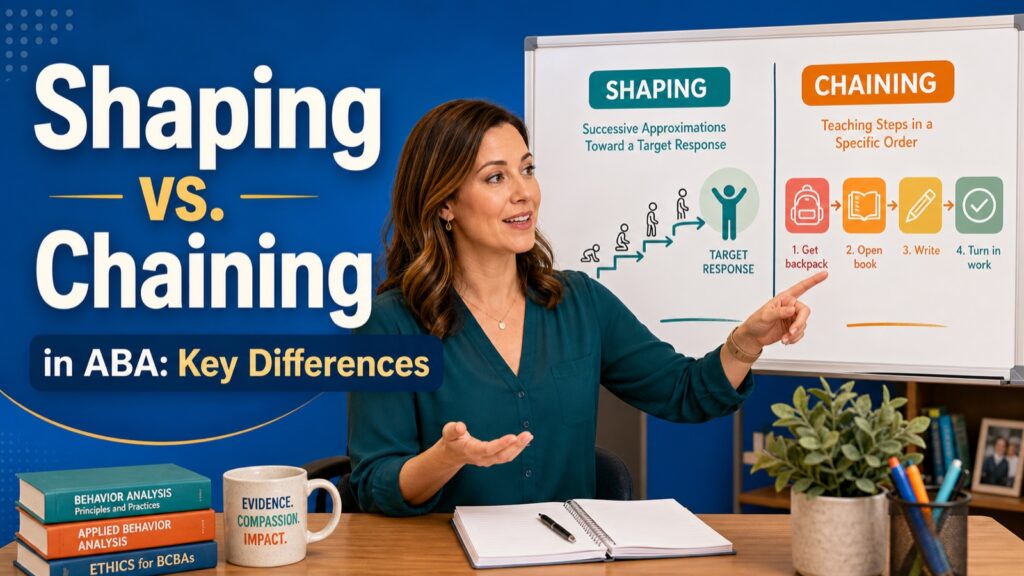
If you are asking what is the difference between shaping and chaining in ABA, begin with the response problem. Shaping changes a single response by differentially reinforcing successive approximations toward a target. Chaining teaches a response sequence by linking component behaviors that form a complex skill. Both procedures use reinforcement, but they solve different programming problems.
Table of Contents
- Direct Answer: Shaping vs. Chaining
- What Shaping Means in ABA
- What Chaining Means in ABA
- The Core Difference
- Shaping Example: A Spoon Response
- Chaining Example: Handwashing
- A Case That Is Often Confused
- Decision Guide: Which Procedure Fits?
- How to Program Successive Approximations
- How Task Analysis Supports Chaining
- Forward Chaining
- Backward Chaining
- Total-Task and Hybrid Options
- Measurement and Data Collection
- Reinforcement in Both Procedures
- Practical Troubleshooting
- BCBA Exam Traps
- Quick Comparison Checklist
- Frequently Asked Questions
- Take the Free BCBA Mock Exam
- Reference
Shaping is useful when the target response is not yet occurring in the needed form or quality. Chaining is useful when the learner can perform, or can be taught, component behaviors that must occur in a particular order. A learner who is gradually taught to grip and use a spoon may be receiving shaping; a learner who is taught the steps of handwashing through a task analysis is receiving chaining.
This guide compares the definitions, procedures, purposes, examples, measurement systems, forward and backward chaining, and common exam traps. The examples are original study illustrations, not recalled examination items. Use the learner’s assessment data, operational definitions, goals, and current BACB content framework when deciding which procedure fits.
Direct Answer: Shaping vs. Chaining
Shaping differentially reinforces successive approximations of one target response. The response form changes gradually as the learner moves from a current repertoire toward a terminal behavior. Chaining reinforces a sequence of distinct component responses so the learner completes a complex skill, such as dressing, preparing a snack, or washing hands.
| Question | Shaping | Chaining |
|---|---|---|
| Primary problem | The target response is not occurring in the required form or quality. | Component behaviors need to be linked into a response sequence. |
| Core unit | Successive approximations of one response. | Separate steps in a task analysis. |
| Reinforcement change | Criteria become closer to the terminal response. | Reinforcement is arranged across completed steps or the full task. |
| Example | Reinforce reaching, then grasping, then placing a spoon correctly. | Teach turn on water, wet hands, soap, scrub, rinse, and dry. |
| Main measurement | Criterion level, topography, or quality of the developing response. | Steps completed independently and accurately in the sequence. |
The shortest exam-ready rule is: use shaping when the response form is being built; use chaining when component responses are being sequenced. The procedures may appear together in a program. A learner may need shaping to acquire one difficult step and chaining to connect that step with other steps. Their possible combination does not make them the same procedure.
- Shaping: change the criterion for one response class through successive approximations.
- Chaining: arrange prompts and reinforcement so component responses form a functional sequence.
- Shared feature: both can use differential reinforcement and systematic prompting.
- Key distinction: shaping changes response topography or quality; chaining organizes response order.
What Shaping Means in ABA
Shaping is the differential reinforcement of successive approximations toward a terminal behavior. The analyst identifies a response that is closer to the goal than the current performance, reinforces that approximation, and then gradually raises the criterion. Responses that no longer meet the current criterion do not receive the shaping consequence, while the learner is supported toward the next attainable step.
The procedure begins with an assessment of the learner’s current repertoire and the dimensions of the target response. The analyst may shape force, duration, distance, accuracy, fluency, vocal form, or another observable feature. The approximation plan should be small enough that the learner contacts reinforcement while still moving toward a meaningful terminal response.
- Define the terminal response in observable and measurable terms.
- Identify the learner’s current response level or baseline observation.
- Select a first approximation that is likely to occur and can be reinforced.
- Deliver the programmed consequence contingent on the approximation.
- Raise the criterion gradually when performance is stable enough to progress.
- Adjust the step size if the learner stops contacting reinforcement or progresses too quickly.
Shaping is not simply praising any improvement. Differential reinforcement means that the consequence depends on the response meeting the current criterion. If the learner is being taught to produce a clearer vocal approximation, reinforcing every sound equally would not establish a systematic progression. The program should state what counts at each step and when the criterion changes.
What Chaining Means in ABA
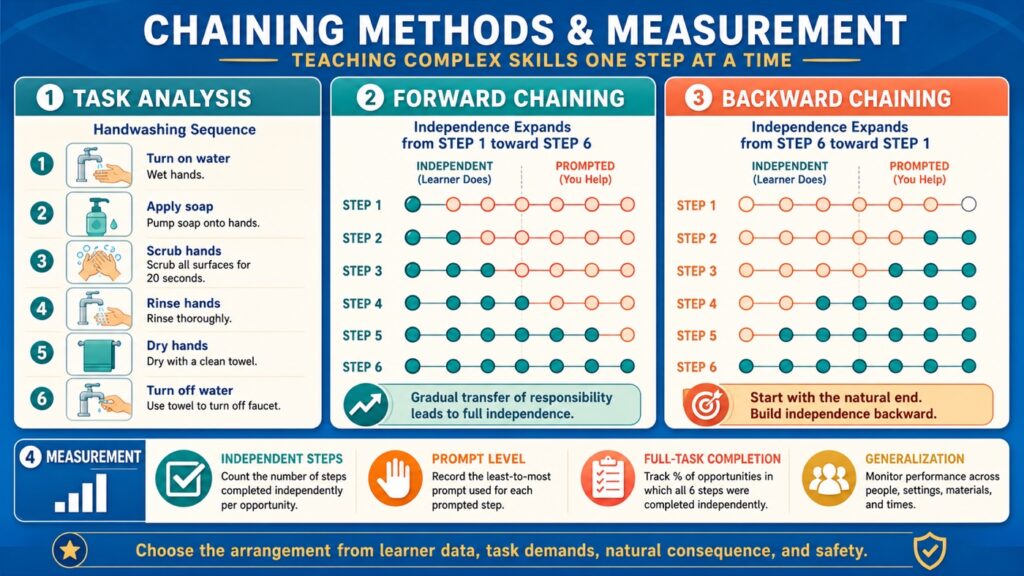
Chaining teaches a complex skill by linking component behaviors into a response sequence. The components are commonly identified through a task analysis, which breaks the skill into teachable steps. The learner may already perform some steps independently, or the analyst may need to teach individual components before connecting them. Reinforcement and prompts are arranged so the sequence becomes more independent and fluent.
Handwashing illustrates the logic. A task analysis may include walking to the sink, turning on the water, wetting hands, applying soap, rubbing hands, rinsing, turning off the water, and drying hands. The program can teach the steps in order, with the selected chaining arrangement determining which step is taught first and where the learner contacts the terminal reinforcer.
- Define the finished skill and the conditions under which it should occur.
- Conduct a task analysis that represents the actual response sequence.
- Check which component behaviors are already in the learner’s repertoire.
- Select forward chaining, backward chaining, total-task, or a justified hybrid.
- Use prompts and reinforcement that support independent completion and generalization.
- Measure step accuracy, independence, and completion of the sequence.
Chaining is not merely presenting a list of instructions. The response sequence must be practiced, the relation between steps must become functional, and prompts should be faded according to data. If the learner cannot perform a component at all, shaping, direct skill teaching, or another procedure may be needed before that component can function effectively in the chain.
The Core Difference
The core difference is the unit of change. Shaping changes the form, precision, intensity, duration, or another dimension of a single response by reinforcing closer approximations. Chaining changes how distinct component responses are connected and ordered. The learner may perform every component of a task separately but still need chaining to complete the sequence independently.
Consider two learners using a spoon. If one learner reaches toward the spoon but does not yet grasp it, the analyst may shape successive approximations: orienting, touching, grasping, lifting, and bringing the spoon to the mouth. If another learner can grasp, lift, and bring the spoon to the mouth but does not complete the meal routine in order, a task analysis and chaining procedure may be appropriate.
- Single response form: ask whether the target itself is gradually taking shape.
- Multiple components: ask whether existing or teachable steps must be linked.
- Criterion progression: shaping changes what qualifies; chaining changes which step follows.
- Prompting question: shaping prompts an approximation; chaining prompts a sequence component.
- Measurement question: shaping tracks closeness to the terminal response; chaining tracks independent steps.
Do not decide from the complexity of the final skill alone. A complex skill may contain one difficult response that needs shaping, several existing components that need chaining, or both. Analyze the learner’s current repertoire and the exact performance problem before selecting a procedure.
Shaping Example: A Spoon Response
Suppose the terminal target is: “The learner independently holds a spoon with a functional grip, scoops a small amount of food, and brings it to the mouth without dropping the food on four of five opportunities.” The learner currently touches the spoon but does not pick it up. The analyst might begin by reinforcing a stable reach and contact, then require a grasp, then a lift, then a scoop, and finally a controlled movement to the mouth.
| Approximation | Criterion | Possible data |
|---|---|---|
| 1 | Touches the spoon within five seconds of the cue. | Touches across opportunities. |
| 2 | Grasps and lifts the spoon two centimeters. | Successful lifts and duration. |
| 3 | Moves the spoon toward the bowl or food. | Distance and direction. |
| 4 | Scoops and keeps food in the spoon. | Successful scoops out of opportunities. |
| 5 | Brings the spoon to the mouth with a functional grip. | Independent terminal responses. |
This is shaping when the reinforcement criterion changes the form or quality of one developing spoon-use response. If the program separately teaches picking up the bowl, scooping, carrying the bowl to the table, sitting, eating, and cleaning up in a fixed order, those connected steps represent a chain. The presence of several actions in the final routine does not automatically make every teaching step chaining.
- Define each approximation before the session rather than changing the criterion arbitrarily.
- Reinforce the closest practical response that moves toward the terminal goal.
- Use baseline data to select a starting criterion and monitor progress.
- Raise the criterion only when the learner can contact reinforcement at the current level.
- Record prompts separately so prompted approximations are not mistaken for independence.
Chaining Example: Handwashing
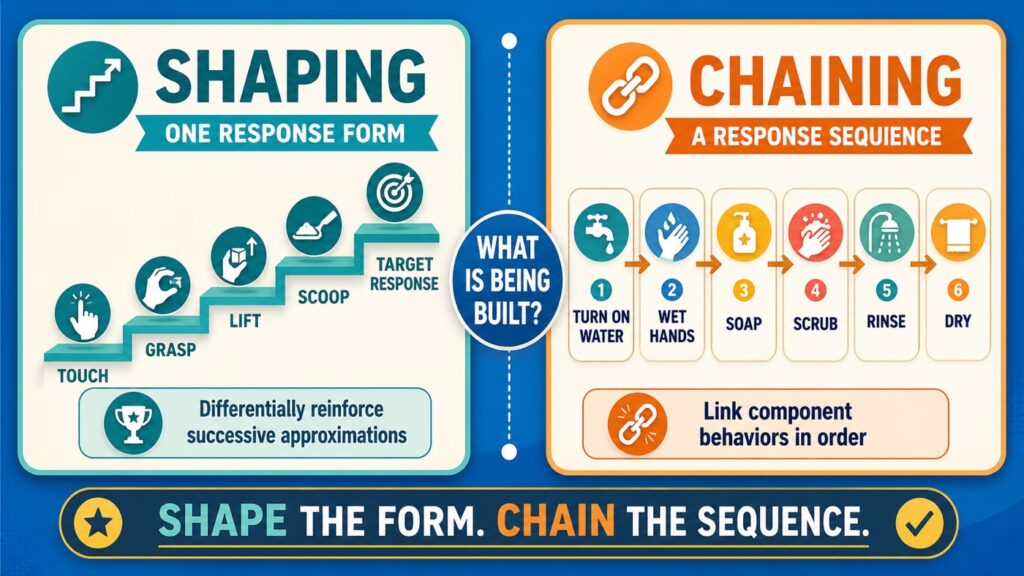
Suppose the target is independent handwashing after toileting. The analyst creates a task analysis that matches the setting: approach the sink, turn on water, wet hands, dispense soap, rub palms and fingers, rinse, turn off water, take a towel, dry hands, and discard the towel. Each step has observable boundaries and a scoring rule.
The analyst may use forward chaining by teaching the first step and prompting later steps, then adding the next independent step as data support progress. Or the analyst may use backward chaining by completing earlier steps with prompts and teaching the final step first, allowing the learner to contact the natural consequence of finishing the routine. Both are chaining because the programming problem is the sequence.
- Use the actual sink, materials, and routine when possible.
- Teach the steps in the planned sequence and record independent versus prompted performance.
- Use a prompt hierarchy and fade prompts based on performance data.
- Reinforce completion or the targeted step according to the intervention plan.
- Probe the full routine periodically to evaluate generalization and fluency.
A learner may need shaping for one component, such as gradually increasing the duration of scrubbing, but the handwashing program remains a chain when the broader objective is independent completion of ordered steps. Procedures can be nested; the classification depends on the teaching problem being described in the question.
A Case That Is Often Confused
Consider a program that says, “Teach handwashing by reinforcing each step: turn on water, wet hands, add soap, scrub, rinse, and dry.” This is chaining, not shaping, because the task analysis identifies a response sequence and reinforcement is arranged across components. The learner may need support with the form of a particular step, but the program’s central arrangement links the steps.
Now consider a program that says, “The learner does not yet produce a functional grip on a spoon. Reinforce touching the handle, then grasping it, then lifting it, and then maintaining the grip while moving the spoon.” This is shaping because the criterion for one response is gradually changed toward a terminal form. There is no requirement that a series of distinct routines be completed in an ordered chain.
- Look for successive approximations when the answer describes gradually closer response forms.
- Look for task analysis and response sequence when the answer describes linked steps.
- Do not call a task analysis shaping simply because reinforcement is delivered after steps.
- Do not call every gradual improvement chaining simply because the learner completes more than one movement.
- Identify whether the criterion changes within a response or across ordered components.
The closest distractor often uses a true statement about reinforcement but assigns it to the wrong procedure. Both procedures can include reinforcement, prompts, task-specific practice, and data collection. The differentiating feature is what is being constructed: response form or response sequence.
Decision Guide: Which Procedure Fits?
Use a decision sequence rather than choosing from one keyword. First define the performance problem. Then inspect the learner’s current repertoire, the target dimensions, and the number and order of component responses. Finally select the least complex procedure that addresses the actual barrier and can be monitored.
- Choose shaping when: the target response is absent or its current form is too far from the terminal response.
- Choose chaining when: component responses are present or teachable but must be linked into a functional sequence.
- Consider both when: a difficult component needs shaping and the completed components must then be sequenced.
- Reassess when: the learner cannot perform a component that the chain assumes is already available.
- Use data when: choosing the next approximation, adding a chain step, fading prompts, or changing reinforcement.
Avoid selecting shaping simply because the learner is making progress in small steps. Every teaching procedure has progress steps. The question is whether the steps are different response approximations or components that preserve an ordered routine. Likewise, do not choose chaining simply because the final goal has multiple words in its description.
How to Program Successive Approximations
A shaping plan should specify the terminal response, the current baseline, the sequence of approximation criteria, the reinforcer or consequence, and the rule for moving forward. The steps should be observable and close enough that the learner can contact reinforcement. If a criterion is too large, the learner may stop responding; if it is too small, progress may be inefficient or the response may drift without reaching the goal.
- Write the terminal response with a clear topography and performance criterion.
- Measure the current response so the first approximation is evidence-based.
- Choose a dimension to change, such as distance, duration, accuracy, or force.
- Deliver differential reinforcement for the approximation that meets the criterion.
- Use a mastery rule and a plan for returning to an easier step if performance falls.
- Plan for stimulus control, generalization, maintenance, and prompt fading.
Shaping should not become a series of unexplained demands. Tell the team what response earns the consequence and how the criterion changes. If the learner’s response changes because of prompts, record that information. Prompted performance can be part of a teaching arrangement, but it should not be reported as independent acquisition unless the measurement rule supports that conclusion.
How Task Analysis Supports Chaining
A task analysis breaks a complex skill into component behaviors that can be observed, taught, and measured. The analysis should reflect the learner’s actual environment and the sequence required for the task, not an abstract list copied without observation. Different learners may need different step sizes, materials, prompts, or response definitions.
- Observe a competent performance or consult reliable task information.
- List each component in the order needed for the routine.
- Define the start and completion of each step.
- Check that the learner can perform or can be taught the assumed components.
- Identify natural cues, prompts, and consequences in the routine.
- Revise the analysis when data show that a step is too broad, too narrow, or out of order.
Task analysis and chaining are related but not identical terms. A task analysis is the breakdown of the skill; chaining is the teaching arrangement that links or sequences the components. A question may ask for the analysis, the chain procedure, the prompt-fading plan, or the measurement method. Match the answer to the requested level.
Forward Chaining
In forward chaining, teaching begins with the first component of the sequence. The learner is taught to complete that step independently while later steps are prompted or completed by the instructor, according to the plan. As the first step becomes reliable, the learner is taught the next component, and the independent portion expands forward through the chain.
- Begin with the first step and establish its relation to the next step.
- Prompt later components so the routine can still be completed safely.
- Reinforce the targeted independent step or completed sequence as planned.
- Add the next step after the mastery criterion is met.
- Fade prompts and probe the sequence as independence increases.
Forward chaining may be useful when early steps are meaningful, when the learner benefits from building the routine from the beginning, or when the first step naturally sets the occasion for later steps. It is not automatically better than backward chaining. The choice depends on the learner, task, natural consequence, safety, and data.
Backward Chaining
In backward chaining, the instructor completes or prompts earlier components and teaches the learner to perform the final component first. This can allow the learner to contact the natural consequence of completing the task immediately after the taught step. As the final step becomes reliable, the learner is taught the step before it, and the independent portion expands backward through the chain.
- Complete or prompt the earlier steps according to the plan.
- Teach the learner the last component and its relation to task completion.
- Deliver the planned consequence after the learner completes the targeted final step.
- Add the preceding component when the current portion is sufficiently reliable.
- Fade prompts and evaluate whether the learner can complete the whole sequence.
Backward chaining may be useful when the final consequence is especially meaningful or when completing the final step gives the learner a clear outcome. As with forward chaining, it should be selected based on assessment and data rather than a universal claim that one direction is always more effective.
Total-Task and Hybrid Options
Total-task presentation teaches or prompts all components during each practice opportunity. The learner practices the whole sequence rather than completing only one independent step at a time. A hybrid arrangement may combine shaping for a difficult component, chaining for the routine, and natural-environment teaching for generalization. The label should match the actual programmed arrangement.
- Total task: practice the entire sequence on each opportunity with prompts as needed.
- Forward chain: build independence from the first component toward the last.
- Backward chain: build independence from the final component toward the first.
- Hybrid: combine methods when separate barriers require separate teaching solutions.
A question that asks for a chain procedure may include a learner who can perform some steps but not others. Do not assume that total-task practice is inappropriate simply because the learner needs prompts, or that forward chaining is required because the routine begins at the first step. Identify what the intervention actually arranges.
Measurement and Data Collection
Measurement differs because the targets differ. During shaping, measure progress toward the terminal response: the highest approximation met, percentage of opportunities meeting the current criterion, distance or duration achieved, response quality, or independent terminal responses. During chaining, measure the components: percentage of steps completed independently, prompted versus unprompted steps, total-task completion, errors, latency between steps, and generalization across settings.
- Shaping measure: current approximation criterion and distance from the terminal response.
- Chaining measure: independent completion of each task-analysis step.
- Prompt data: prompt level, prompt delay, and whether the prompt was faded.
- Fluency data: time to complete, errors, or pauses when these matter to the goal.
- Generalization data: performance with new people, materials, settings, or instructions.
Do not make a graph that combines unlike measures without clear labels. A shaping program may show a response dimension moving from touch to grasp to lift, while a chain program may show step-by-step independence. Both graphs can show improvement, but the data path has a different meaning. A correct answer identifies the measure that matches the procedure and decision.
Reinforcement in Both Procedures
Reinforcement can be part of shaping and chaining, but its role must be described precisely. In shaping, the consequence is delivered for the current approximation and the criterion changes over time. In chaining, reinforcement can be delivered after a component, after a portion of the chain, or after completion, depending on the programmed arrangement and natural consequences.
- Confirm that the consequence is contingent on the response being taught.
- Use a reinforcer assessment or ongoing data rather than assuming a preferred item will function as reinforcement.
- Thin or transfer reinforcement only when performance data support the change.
- Pair programmed reinforcement with natural consequences when appropriate.
- Keep reinforcement delivery consistent enough to make the contingency learnable.
The presence of reinforcement does not identify the procedure by itself. A distractor may say “reinforce each response” and appear plausible for both. Look at whether the responses are successive approximations of one form or components of a sequence. That discrimination is often the key to the item.
Practical Troubleshooting
If shaping stalls, check whether the approximation is too difficult, the reinforcer is effective, the response definition is observable, or the criterion is changing too quickly. If chaining stalls, check whether the task analysis is accurate, a component is missing from the repertoire, prompts are being faded too soon, or the learner is not contacting a meaningful consequence for completing the sequence.
- Stalled shaping: return to a smaller approximation and verify the consequence.
- Stalled chaining: analyze the difficult step and teach it directly if necessary.
- Prompt dependence: add planned prompt delays and collect prompt-level data.
- Poor generalization: vary materials, people, settings, and cues after the skill is stable.
- Low motivation: review access history, competing events, breaks, and the learner’s assent.
Do not fix a procedure by changing several variables at once and then claiming to know which change produced improvement. Make a reasoned adjustment, document it, and review the data. The teaching arrangement should remain aligned with the learner’s goals, safety, dignity, and actual performance.
BCBA Exam Traps
Comparison questions often include answer options that are true descriptions of one procedure but are assigned to the other. Read for the unit of change, the role of task analysis, and the pattern of reinforcement. Do not choose based on whether the learner improves gradually or whether reinforcement appears in the stem.
- Trap: saying shaping teaches sequences. Shaping differentially reinforces successive approximations of a target response.
- Trap: saying chaining changes response form. Chaining links components into a response sequence; a component may separately need shaping.
- Trap: calling handwashing shaping. A task analysis of handwashing and reinforcement across steps describes chaining.
- Trap: calling spoon grip chaining. Gradually reinforcing closer forms of one grip or spoon-use response describes shaping.
- Trap: assuming both require the same repertoire. Chaining depends on component responses being present or teachable; shaping begins from an approximation of one target.
- Trap: claiming forward chaining is always best. Select the arrangement based on learner, task, natural consequence, safety, and data.
- Trap: confusing task analysis with chaining. Task analysis is the breakdown; chaining is the teaching arrangement that links the steps.
- Trap: treating reinforcement as the deciding feature. Both procedures may use reinforcement; identify what is being constructed.
The best answer is usually the one that preserves the distinction between response topography and response order. If an option makes a universal claim, adds facts not in the scenario, or ignores the learner’s current repertoire, treat it cautiously.
Quick Comparison Checklist
- What is the terminal response or completed skill?
- Is the main barrier the form or quality of one response?
- Are several component behaviors already present or teachable?
- Does the plan describe successive approximations?
- Does the plan use a task analysis and response sequence?
- What response earns reinforcement at the current step?
- What data show progress: approximation criterion or independent chain steps?
- Is shaping needed for one component inside a broader chain?
- Would forward, backward, total-task, or hybrid teaching fit the context?
- Are prompts, prompt fading, generalization, and maintenance planned?
- Does the conclusion avoid saying either procedure is always more effective?
Use the short rule before answering: shape the response form; chain the response sequence. Then return to the scenario to confirm that the data, learner repertoire, and proposed procedure actually support that classification.
Frequently Asked Questions
What is the difference between shaping and chaining in ABA?: Shaping differentially reinforces successive approximations toward one target response. Chaining teaches a sequence of component behaviors that form a complex skill. Shaping changes response form or quality; chaining organizes response order.
Is handwashing shaping or chaining?: Teaching handwashing through a task analysis and linking steps such as wetting, soaping, scrubbing, rinsing, and drying is chaining. A particular handwashing component could separately require shaping if its response form is not yet in the learner’s repertoire.
What is an example of shaping?: Reinforcing a learner first for touching a spoon, then grasping it, then lifting it, and then bringing it toward the mouth can be shaping when the criteria represent successive approximations of one target response.
What is forward chaining?: Forward chaining teaches independence beginning with the first step of a task analysis and then adds later steps as performance meets the program’s criteria. Later steps may be prompted while the next independent component is taught. What is backward chaining?: Backward chaining teaches the final component first while earlier steps are completed or prompted. The independent portion then expands backward through the sequence as the learner masters additional components.
Take the Free BCBA Mock Exam
Ready to test your understanding of shaping, chaining, successive approximations, task analysis, forward chaining, backward chaining, differential reinforcement, and response sequence? Take the free BCBA mock exam for realistic practice across skill acquisition, behavior change, assessment, measurement, and ethics. For each item, identify whether the program changes one response form or links several components. For additional review, read our chaining in ABA guide after using this comparison page to identify the procedure that matches the scenario.
Reference
For examination content context, review the BACB BCBA Test Content Outline, 6th edition, including skill-acquisition and behavior-change content. Apply shaping and chaining decisions using current supervision, ethical, measurement, and learner-specific guidance.



