
In applied behavior analysis (ABA), a conditioned punisher is a neutral stimulus that acquires the ability to decrease behavior after being paired with an existing punisher. Unlike unconditioned punishers such as extreme heat or pain, conditioned punishers start out neutral and gain their punishing function through learning. This concept is central to understanding how consequences shape behavior in everyday practice. In this guide, you will learn the precise definition of a conditioned punisher, how it is established, and how it differs from unconditioned and generalized conditioned punishers. You will also see original examples, explore conditions that weaken its effectiveness, and review ethical considerations for intervention planning. Each section is designed to help you apply functional definitions correctly and avoid common pitfalls. As you study, keep in mind that preparation focuses on mastering concepts, not predicting specific test items.
Table of Contents
- What Is a Conditioned Punisher? Definition and Core Concepts
- How Is a Conditioned Punisher Established?
- Original Examples of Conditioned Punishers in ABA
- Key Distinctions: Unconditioned vs. Conditioned vs. Generalized Conditioned Punishers
- Punishment: Function vs. Procedure
- When Can a Conditioned Punisher Weaken?
- Contrast With Conditioned Reinforcers
- Ethical Considerations in Using Conditioned Punishers
- Common Misconceptions to Avoid
- Study Checklist for BCBA Exam Preparation
- Conclusion and Next Steps
- Reference
What Is a Conditioned Punisher? Definition and Core Concepts
A conditioned punisher is a previously neutral stimulus that acquires a punishing function through a behavioral history of pairing with an existing punisher. Its function must then be demonstrated: when the stimulus is presented contingently on a behavior, that response shows a reliable future behavior decrease. The label depends on measured effects, not on the stimulus looking unpleasant or on an implementer’s intent.
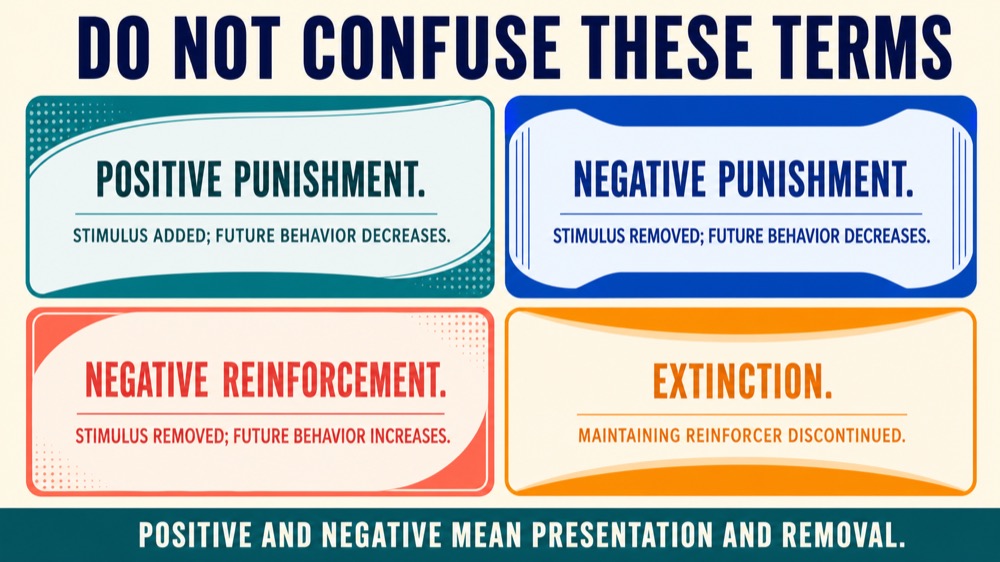
To fully understand this definition, you must distinguish three related terms: unconditioned punisher, conditioned punisher, and generalized conditioned punisher. An unconditioned punisher (e.g., electric shock, extreme heat, loud noise) has innate punishing properties that do not require learning. A generalized conditioned punisher is a conditioned punisher that has been paired with a variety of punishers, making it more likely to function across different situations. For example, the word “no” often signals many different punishing outcomes, so it can suppress behavior broadly. These distinctions are essential for analyzing behavior-environment relations in ABA.
How Is a Conditioned Punisher Established?
The establishment of a conditioned punisher follows a specific behavioral process. It begins with a neutral stimulus, such as a hand signal, a specific word, or a colored card. This neutral stimulus is repeatedly paired with an existing punisher—either an unconditioned punisher or a previously conditioned punisher. For example, a teacher might say “0” while delivering an unpleasant sound (an unconditioned punisher). Over several pairings, the word “0” alone may come to function as a punisher.
After this pairing history, the conditioned punisher must be presented contingently on a behavior to test its punishing effect. That is, the stimulus is delivered immediately after the behavior occurs, and the subsequent frequency of that behavior is observed. If the behavior decreases and this decrease is reliably reproduced, the stimulus is functioning as a punisher. This empirical demonstration is crucial: a stimulus is not labeled a punisher simply because it looks unpleasant or because the implementer intends to punish.
The behavioral process involved is respondent conditioning—the establishment of the punisher—while the application is operant: presenting the conditioned punisher contingently on behavior. Remember, the establishment is respondent, while the application is operant. This dual process is a common point of confusion; keep the two phases separate in your analysis.
Original Examples of Conditioned Punishers in ABA
Original examples help clarify the concept. Here are two applied scenarios:
- Hand signal paired with loud noise: In a vocational training setting, a supervisor uses a specific hand signal (e.g., raising two fingers) as a “stop” signal. Initially, this signal is neutral. The supervisor pairs it with a loud buzzer (an unconditioned punisher) that is presented whenever a worker engages in a safety violation. After repeated pairings, the hand signal alone acquires punishing function. The supervisor can then present the hand signal contingent on unsafe behavior, and the future frequency of that behavior is likely to decrease.
- Red card paired with loss of tokens: In a token economy, a red card is used as a “penalty” signal. At first, the red card has no meaning. It is paired with the removal of tokens (a punisher). Once the red card is consistently followed by token loss, it becomes a conditioned punisher. Presenting the red card after a behavior (e.g., talking out of turn) may reduce that behavior even if tokens are not removed immediately, because the red card has a history of being associated with token loss.
In both examples, the controlling history is the repeated pairing of the neutral stimulus with an existing punisher. The effect on behavior is a future behavior decrease—a reduction in the frequency of the behavior that preceded the conditioned punisher. This is the defining characteristic of any punisher, according to the functional definition. For more on how stimuli control behavior, see our guide on stimulus control in ABA.
Key Distinctions: Unconditioned vs. Conditioned vs. Generalized Conditioned Punishers
It is important to differentiate these three types of punishers:
- Unconditioned punisher: A stimulus that punishes behavior without prior learning. Examples: electric shock, extreme heat, loud noise, physical pain. These have biological or evolutionary significance.
- Conditioned punisher: A neutral stimulus that acquires punishing function via pairing with an unconditioned or conditioned punisher. Examples: a specific word (“no”), a gesture, a card.
- Generalized conditioned punisher: A conditioned punisher that has been paired with many different punishers. This makes it more likely to function as a punisher across varied situations. Example: the word “no” is often paired with many different punishing events.
This distinction matters because generalized conditioned punishers are more durable and less likely to lose their effectiveness when one specific pairing is weakened. A non-generalized conditioned punisher may lose its power if its pairing history is disrupted. Understanding these differences is essential for selecting interventions and for accurate behavioral analysis.
Punishment: Function vs. Procedure
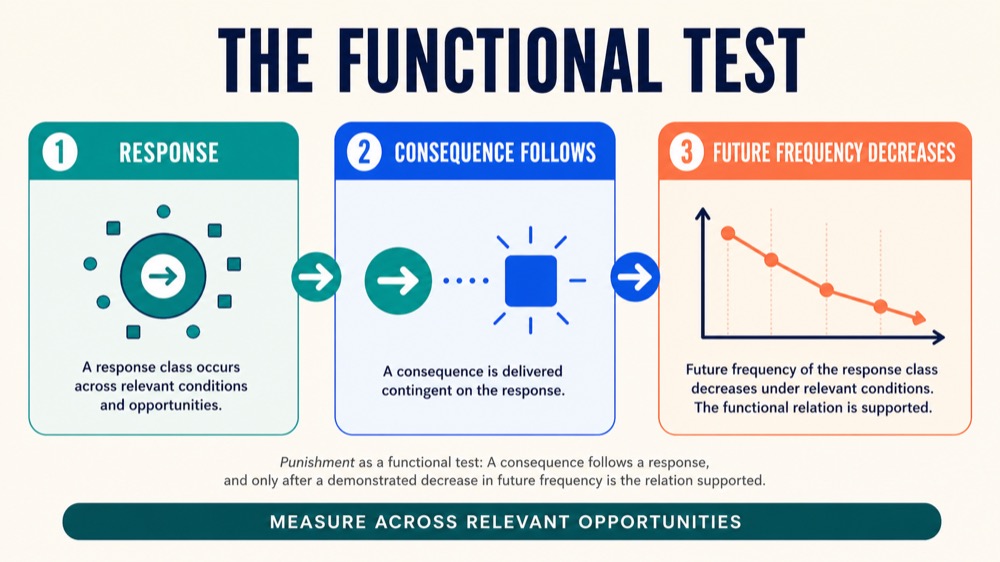
One of the most critical distinctions in ABA is between a stimulus function (punisher) and a behavioral operation (presentation or removal). Punishment is defined functionally: a behavior must decrease in the future because of the contingent presentation of a stimulus (positive punishment) or removal of a stimulus (negative punishment). The procedure may be identical, but the function depends on the effect on behavior.
For example, presenting a token might be a reinforcer for one person but a punisher for another, depending on the individual’s history. Similarly, removing a privilege (e.g., recess) is a specific technique; whether it functions as punishment depends on whether behavior decreases. A conditioned punisher is a type of stimulus that has acquired a punishing function, not a procedure in itself. This distinction is often tested in ABA coursework and certification preparation. You should be able to identify whether a stimulus is functioning as a punisher by looking at the data, not by its appearance or the implementer’s intent.
When Can a Conditioned Punisher Weaken?
The effect is not permanent or universal. It may weaken when the pairing history changes, when the stimulus is presented repeatedly without the consequence that established it, or when relevant motivating variables and contexts change. These possibilities must be evaluated with repeated data rather than assumed from a single response.
- Track the defined behavior before and after the consequence.
- Check whether the effect generalizes across people, settings, and responses instead of assuming it does.
- Reassess function and procedural integrity when the expected decrease is absent.
- Do not intensify or re-pair a punishment procedure merely to restore suppression; conduct ethical and clinical review first.
Contrast With Conditioned Reinforcers
It is easy to confuse conditioned punishers with conditioned reinforcers, as both involve stimulus pairing. A conditioned reinforcer is a neutral stimulus that acquires reinforcing function through pairing with existing reinforcers (e.g., a token paired with access to toys). Interestingly, a stimulus could have either function depending on its history. For example, a token might be paired with both reinforcing events (e.g., earning prizes) and punishing events (e.g., losing tokens). The key is the effect on behavior: if presentation of the stimulus increases behavior, it is a reinforcer; if it decreases behavior, it is a punisher.
This contrast is a common source of confusion. You must determine the function based on the observed behavior change, not on the assumed nature of the stimulus. For example, a time-out corner might be a punisher for one child but a reinforcer for another who wants to escape the classroom. Always rely on the data.
Ethical Considerations in Using Conditioned Punishers
Any punishment-based procedure requires careful ethical review. Before implementing a conditioned punisher, a behavior analyst must conduct a function-based assessment to understand why the behavior occurs. Reinforcement-based alternatives should be tried first, and the risk-benefit analysis must show that the benefits outweigh the risks. The practitioner must be competent in the procedure, obtain appropriate consent/assent where applicable, and continuously monitor the effects on behavior. Adherence to current governing requirements is also essential, including relevant ethical and professional standards. While a conditioned punisher may be part of an intervention, its use must be justified and systematically evaluated.
Common Misconceptions to Avoid
Here are some key points to remember:
- Procedure vs. function: The mere presentation of a supposedly aversive stimulus does not make it a punisher. The behavior must decrease.
- Conditioned punishers vs. unconditioned punishers: Unconditioned punishers do not require pairing history.
- Conditioned punishers vs. conditioned reinforcers: Both involve pairing, but they have opposite effects on behavior.
- Pairing history: If the pairing is disrupted, the conditioned punisher may weaken.
- Establishment process: The conditioned punisher is established through respondent conditioning, not operant conditioning.
These distinctions are important for accurate analysis and effective practice. Avoid assuming that a stimulus will have the same function across different behaviors or individuals.
Study Checklist for BCBA Exam Preparation
Use the following checklist to master this topic:
- Define conditioned punisher and provide an original example.
- Compare conditioned punishers with unconditioned punishers and generalized conditioned punishers.
- Explain how a neutral stimulus becomes a conditioned punisher through respondent conditioning.
- Identify conditions that weaken conditioned punisher effectiveness.
- Distinguish punishment as a function vs. punishment as a procedure.
- Describe how stimulus control relates to conditioned punishers.
- Practice with mock exam questions to apply the concept.
Review our stimulus generalization article for related concepts.
Conclusion and Next Steps
A conditioned punisher is identified by an acquired history and a demonstrated decrease in future responding—not by presumed aversiveness. Distinguish the establishment history from the later operant effect, and distinguish conditioned, unconditioned, and generalized conditioned punishers with data.
Now that you have a solid grasp, put your knowledge to the test. Take our free BCBA mock exam to get practice and feedback. This is an excellent way to identify areas for further study and to build confidence for the real exam. Good luck!



