

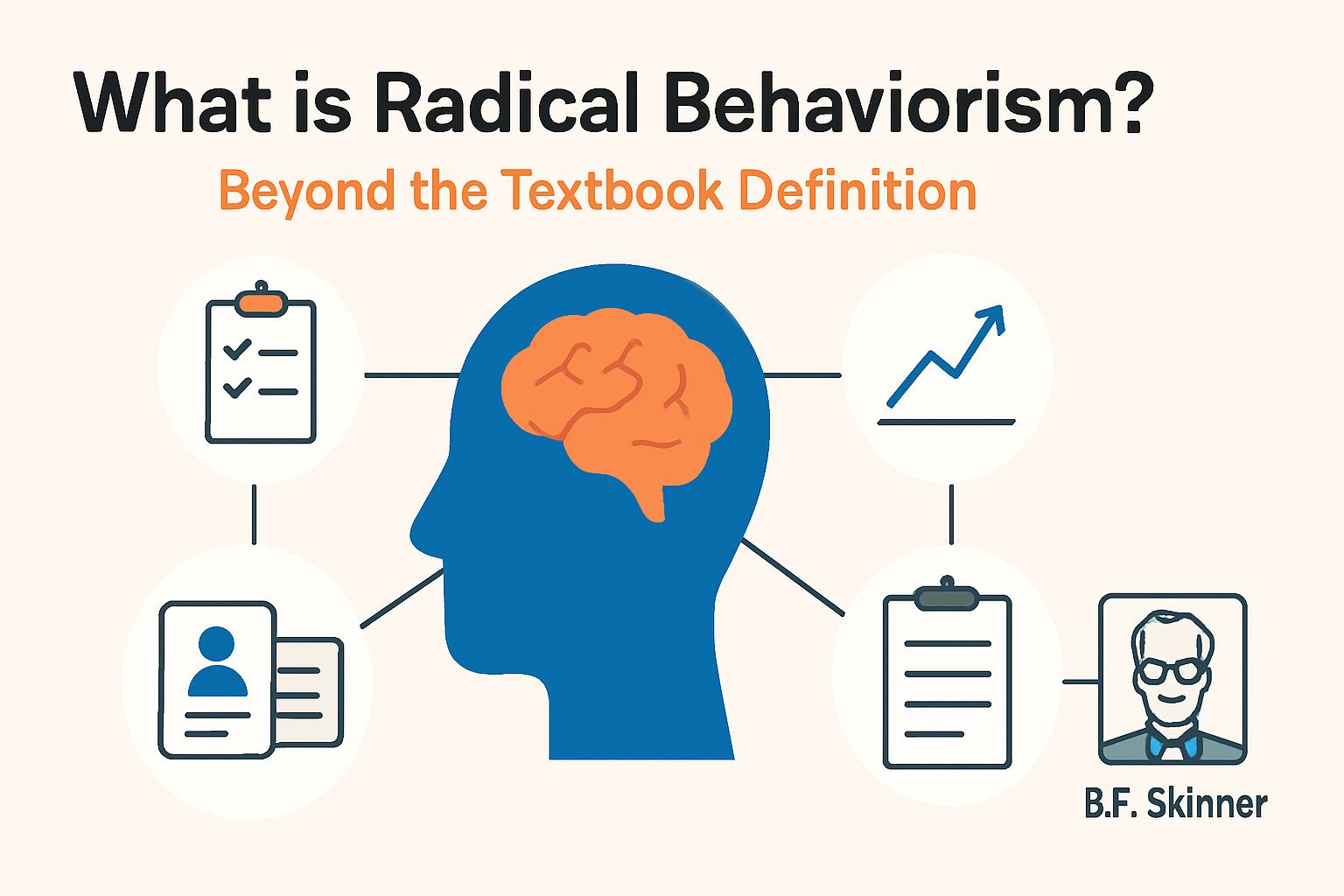
What is Radical Behaviorism? Beyond the Textbook Definition
Radical behaviorism represents the foundational philosophy underlying applied behavior analysis. Developed by B.F. Skinner, this approach extends behaviorist principles beyond observable actions to include internal experiences.
Table of Contents
- What is Radical Behaviorism? Beyond the Textbook Definition
- Radical Behaviorism in Action: Applied Examples for BCBAs
- Radical Behaviorism on the BCBA Exam: What to Know
- Quick-Review Checklist and Summary
Unlike earlier behaviorist schools, radical behaviorism acknowledges that private events—thoughts, feelings, and internal sensations—are legitimate subjects of scientific inquiry.
The Core Tenet: Behavior Includes Private Events
The ‘radical’ aspect refers to treating private events as behavior subject to the same environmental contingencies as public behavior. This means thoughts and feelings are not dismissed as irrelevant but analyzed as behavior influenced by reinforcement history.
Private events are considered covert behaviors that follow the same principles of operant conditioning as overt actions. They can be shaped, maintained, and modified through environmental interactions.
Radical vs. Methodological Behaviorism: The Critical Distinction
Understanding this distinction is crucial for BCBA candidates. Methodological behaviorism, associated with John B. Watson, restricts scientific study to observable behaviors only, rejecting private events as valid data.
In contrast, radical behaviorism includes private events while maintaining a natural science approach. This philosophical difference has profound implications for how BCBAs approach assessment and intervention.
Radical Behaviorism in Action: Applied Examples for BCBAs
Understanding the theory is essential, but applying it to real-world scenarios demonstrates its practical value. These examples show how radical behaviorism informs assessment and intervention decisions.
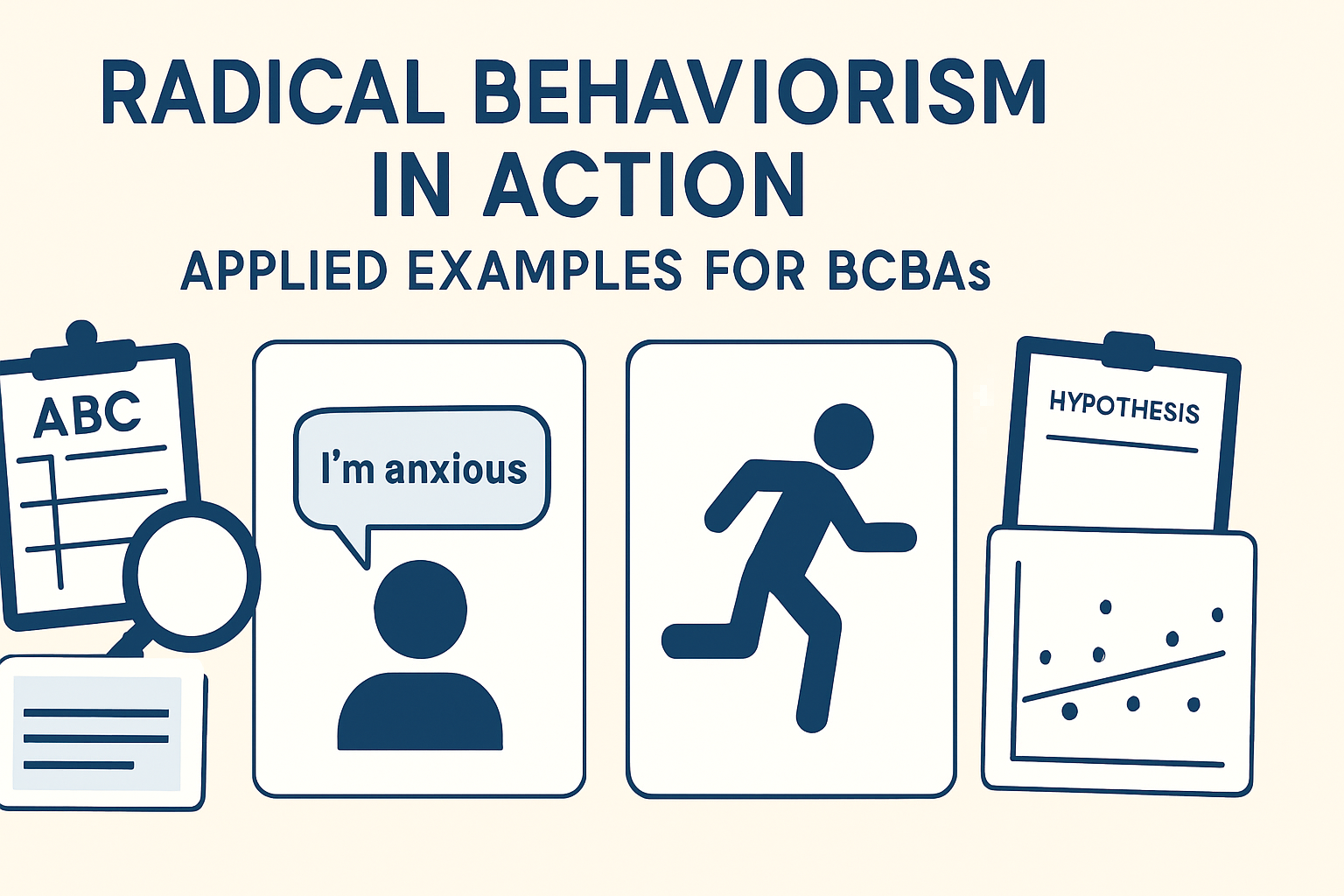
Example 1: Addressing ‘I’m Anxious’ as Verbal Behavior
Consider a client who says ‘I’m anxious’ before eloping from a difficult task. A radical behaviorist would analyze this statement as verbal behavior with potential escape function.
- Antecedent: Difficult academic demand presented
- Behavior: Client states ‘I’m anxious’ (private event report)
- Consequence: Task removed, escape achieved
The intervention would focus on teaching alternative communication for requesting breaks while building tolerance through systematic desensitization.
Example 2: A Client’s Self-Reported ‘Boredom’
When a client engages in off-task behavior and later reports feeling ‘bored,’ a radical behaviorist treats this as valuable data. ‘Boredom’ correlates with low reinforcement density in the current environment.
Rather than dismissing the report, the BCBA would assess the reinforcement schedule and modify the teaching environment to increase engagement opportunities. This approach aligns with understanding motivating operations that affect behavior.
Radical Behaviorism on the BCBA Exam: What to Know
This philosophical foundation appears throughout the exam, particularly in sections testing conceptual understanding. Recognizing how questions test this knowledge helps avoid common pitfalls.
Common Exam Traps and How to Avoid Them
Several recurring mistakes trip up candidates on radical behaviorism questions:
- Confusing radical with methodological behaviorism – Remember that radical includes private events
- Thinking it ignores cognition – It actually includes thoughts as behavior to be analyzed
- Assuming it justifies non-behavioral interventions – All interventions must still be behaviorally based
- Overlooking the environmental focus – Private events are still explained by environmental contingencies
When you see questions about philosophical assumptions or theoretical foundations, consider whether private events are being addressed appropriately.
Key Task List Connections
Radical behaviorism connects directly to several BACB Task List items that form the exam’s foundation:
- A-1: Philosophical Underpinnings – This section explicitly addresses behaviorism’s assumptions
- A-2: Behaviorism – Requires distinguishing between different behaviorist approaches
- B-14: Verbal Behavior – Private events often manifest as verbal behavior to be analyzed
- Concepts and Principles – Understanding how all behavior, including private events, follows established principles
For comprehensive coverage of philosophical assumptions, review our guide on philosophical assumptions in behavior analysis.
Quick-Review Checklist and Summary
Use this checklist to ensure you’ve mastered radical behaviorism concepts for the exam:
- Define radical behaviorism as including private events as behavior
- Distinguish radical from methodological behaviorism – the key difference is acceptance of private events
- Recognize private events as covert behavior subject to environmental contingencies
- Apply to assessment – treat reports of thoughts/feelings as verbal behavior with potential functions
- Maintain behavioral focus – all interventions must be based on behavioral principles
- Connect to Task List items – particularly A-1, A-2, and verbal behavior concepts
Radical behaviorism provides the philosophical foundation for modern applied behavior analysis. By understanding that private events are behavior influenced by the same environmental variables as observable actions, BCBAs can develop more comprehensive and effective interventions.
For further study on related concepts, explore our resource on radical vs methodological behaviorism differences and consult the BACB Ethics Code for guidance on ethical practice grounded in behavioral principles.
Complete BCBA Exam Prep
Turn this topic into exam-day practice
Practice concepts in context with five full-length 6th Edition mock exams, two bonus practice exams, a 6th Edition study guide, and key-term flashcards—all in one $120 USD package.
Get the $120 All-in-One Prep Pack
Review everything included on the product page before ordering. No pass guarantee is implied.



