
The BACB Ethics Code serves as the foundation for professional practice in applied behavior analysis. This essential document outlines the ethical obligations that guide behavior analysts in their clinical work, research, and professional relationships. For BCBA candidates, understanding this code isn’t just about memorization—it’s about developing the ethical decision-making skills needed for real-world practice and exam success.
Table of Contents
- Understanding the Structure of the BACB Ethics Code
- Applying the Ethics Code to Clinical Scenarios
- Navigating Ethics Questions on the BCBA Exam
- Your Ethics Code Study Checklist
Understanding the Structure of the BACB Ethics Code
The BACB Ethics Code is organized into ten core sections that address different aspects of professional responsibility. Each section contains specific standards that behavior analysts must follow in their practice.
Core Sections and Their Exam Relevance
Several sections appear frequently on the BCBA exam. Understanding these areas is crucial for exam preparation:
- Responsibility to Clients (Section 1): This section covers client welfare, informed consent, and treatment decisions. It’s heavily tested because it addresses fundamental ethical obligations in clinical practice.
- Behavior Analysts’ Responsibility to the Profession (Section 6): This includes maintaining professional competence and contributing to the field’s knowledge base. Exam questions often test your understanding of continuing education requirements and professional development.
- Supervision and Delegation (Section 5): This section outlines responsibilities when supervising RBTs or other staff. Questions frequently test supervisory competence and appropriate delegation practices.
- Research (Section 9): While less frequent, research ethics questions test understanding of informed consent in research contexts and protection of participant rights.
Key Definitions: From Principle to Practice
Several terms from the code appear regularly in exam questions. Understanding these definitions is essential:
- Client: The individual or entity receiving behavior-analytic services. This can include individuals, families, organizations, or groups.
- Stakeholder: Any person or entity affected by behavior-analytic services, including but not limited to the client.
- Multiple relationships: Situations where a behavior analyst is in a professional role with a person and simultaneously in another role with that same person.
- Exploitation: Taking unfair advantage of a professional relationship for personal gain.
- Informed consent: The process of obtaining permission before conducting assessment or treatment, with full disclosure of risks and benefits.
- Documentation: The systematic recording of professional activities, decisions, and client progress.
Applying the Ethics Code to Clinical Scenarios
The BCBA exam tests your ability to apply ethical principles to realistic clinical situations. These scenarios require more than just knowing the code—they demand ethical reasoning skills and practical application.
Scenario 1: Confidentiality and Data Sharing
A school district requests raw session data for a student receiving ABA services. The district claims they need this information for educational planning purposes.
Antecedent analysis: The request comes from an educational authority with legitimate interest in student progress. Behavior: Request for raw session data. Hypothesized function: Compliance with educational regulations and avoidance of potential conflict.
Applying the BACB Ethics Code:
- Section 2.06 (Maintaining Confidentiality) requires protecting client information
- Section 3.03 (Consultation) suggests consulting with the client or guardian
- Section 2.03 (Disclosures) allows sharing information only with proper authorization
The ethical response involves obtaining written authorization from the guardian, providing a summary rather than raw data when possible, and ensuring the information shared is minimally necessary for the stated purpose.
Scenario 2: Dual Relationships and Boundaries
A client’s parent offers you a significant gift after their child makes substantial progress in therapy. The gift is expensive and seems intended to ensure continued preferential treatment.
Antecedent analysis: Successful treatment outcomes leading to parental gratitude. Behavior: Offering an expensive gift. Hypothesized function: Positive reinforcement for the therapist and potential establishment of preferential treatment.
Applying the BACB Ethics Code:
- Section 1.06 (Multiple Relationships) prohibits relationships that could impair objectivity
- Section 1.07 (Exploitative Relationships) forbids taking unfair advantage of professional relationships
- Section 1.08 (Gifts and Favors) addresses appropriate handling of client gifts
The ethical response involves politely declining the gift while acknowledging the parent’s gratitude, explaining how accepting could create a dual relationship, and suggesting alternative ways to express appreciation that don’t compromise professional boundaries.
Navigating Ethics Questions on the BCBA Exam
Ethics questions on the BCBA exam often present complex scenarios with multiple plausible answers. Understanding common patterns and developing a systematic approach can significantly improve your performance.
Common Exam Traps and Distractor Answers
Exam writers create distractors that seem reasonable but violate ethical principles. Watch for these patterns:
- The ‘nice’ answer vs. the ethical answer: Choosing what feels kindest rather than what follows the code
- Confusing legal and ethical obligations: Something may be legal but still unethical
- Prioritizing efficiency over client welfare: Choosing the quickest solution rather than the most ethical
- Missing decision-making steps: Skipping consultation or documentation requirements
- Overlooking stakeholder perspectives: Focusing only on the primary client’s needs
A Decision-Making Framework for Exam Scenarios
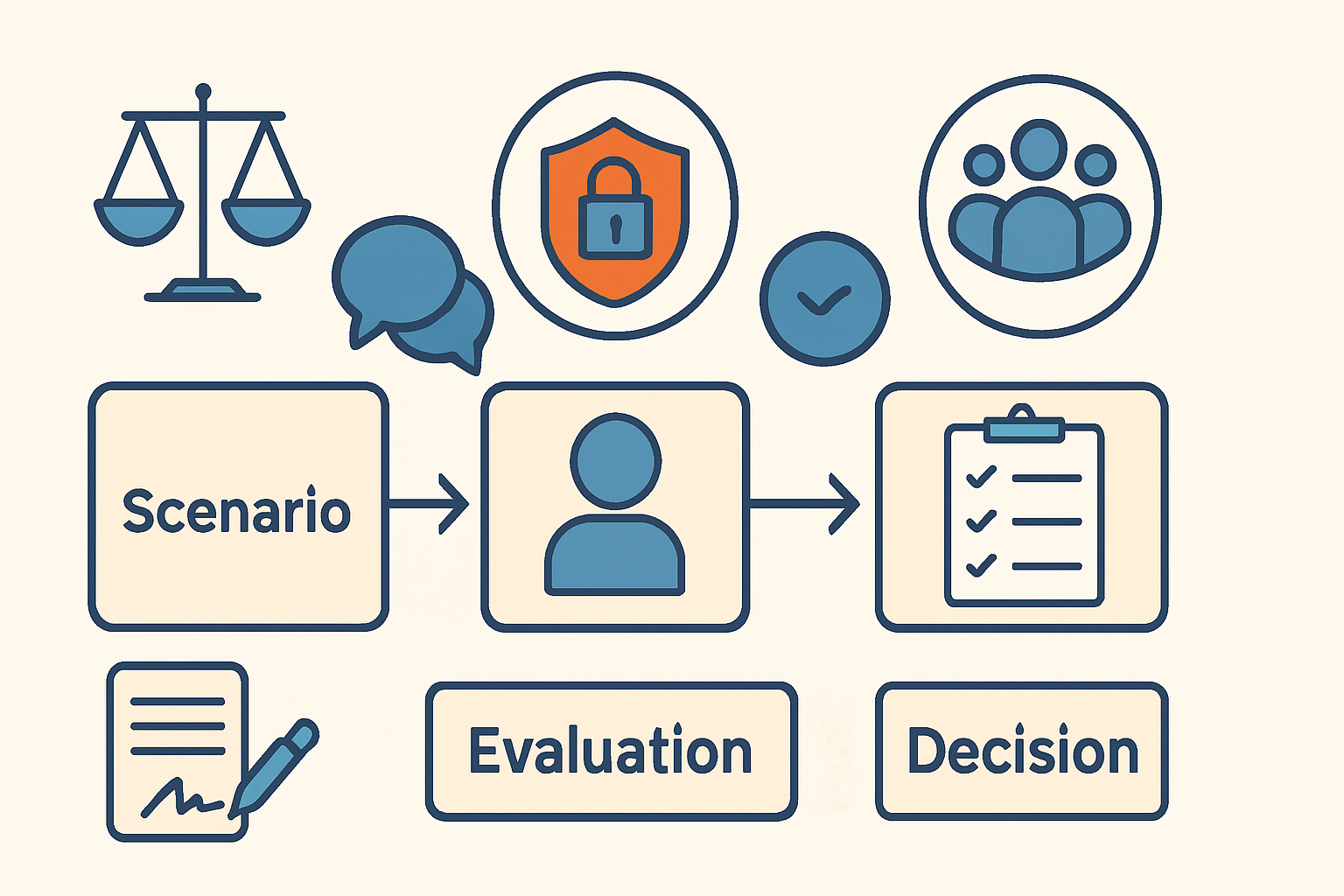
Use this four-step mental checklist when facing ethics questions:
- Identify primary stakeholders: Determine who is most affected and their rights
- Locate relevant code sections: Recall which ethical standards apply to the situation
- Eliminate violating answers: Remove options that clearly breach ethical principles
- Select client-welfare priority: Choose the action that best protects client interests
This systematic approach helps you avoid emotional reactions and apply the BACB Ethics Code consistently. For more on ethical decision-making in practice, see our guide on ethics in ABA practice.
Your Ethics Code Study Checklist
Use this actionable checklist to prepare for ethics questions on the BCBA exam:
- Memorize the ten sections of the BACB Ethics Code and their primary focus areas
- Practice applying ethical principles to clinical scenarios using the four-step framework
- Review key definitions like client, stakeholder, and multiple relationships
- Identify common exam traps and practice avoiding emotional decision-making
- Understand documentation requirements for informed consent and treatment decisions
- Study supervision ethics including competence requirements and delegation practices
- Review research ethics for scenarios involving data collection or publication
- Practice with scenario-based questions to build ethical reasoning skills
Remember that ethical practice extends beyond exam preparation. The BACB Ethics Code provides the foundation for maintaining professional standards throughout your career. For additional study resources, explore our BCBA exam prep guide and consider reviewing the official BACB Ethics Code document for the most current version.
Successful ethical practice requires both knowledge of the code and the ability to apply it in complex situations. By developing strong ethical decision-making skills, you’ll be prepared not only for the BCBA exam but for the real-world challenges of professional practice.
Complete BCBA Exam Prep
Turn this topic into exam-day practice
Practice concepts in context with five full-length 6th Edition mock exams, two bonus practice exams, a 6th Edition study guide, and key-term flashcards—all in one $120 USD package.
Get the $120 All-in-One Prep Pack
Review everything included on the product page before ordering. No pass guarantee is implied.



