

In applied behavior analysis, you constantly try to understand why behavior happens. When a child hits their head after you remove a tablet, you could invent a complex internal state, or you could choose a simpler explanation: the behavior has a history of being reinforced by the return of the tablet. This is the principle of parsimony in ABA. The parsimonious ABA definition is simple: choose the explanation that accounts for the data with the fewest unfounded assumptions. This article explores that definition, provides concrete examples, contrasts it with common misconceptions, and offers study tips for the BCBA exam. Table of Contents
Table of Contents
- Definition of Parsimony in ABA
- The Role of Parsimony as a Philosophical Assumption
- Examples of Parsimony in ABA: Simple vs. Complex Explanations
- Common Misconceptions About Parsimony
- Stimulus Control and Parsimony
- Practical Cautions for Applying Parsimony
- BCBA Exam Traps and How to Avoid Them
- Study Checklist for Parsimony
- Conclusion and Free BCBA Mock Exam
- Reference
Definition of Parsimony in ABA
Parsimony is a philosophical assumption in behavior analysis that guides practitioners and researchers to select the simplest explanation that adequately accounts for the available evidence. It is not about making explanations easy; it is about avoiding unnecessary complexity and explanatory fictions. When two explanations predict the same outcome, the one that relies on fewer unproven assumptions is preferred. Parsimony is closely related to determinism, the idea that behavior is lawful and caused by environmental events, and empiricism, which emphasizes objective observation. Together, these assumptions form the foundation of a scientific approach to behavior.
In everyday terms, parsimonious ABA means that you do not reach for a complex explanation when a simpler one works. For example, if a child throws a tantrum every time you say “no,” and the tantrum results in you giving the child the requested item, the most parsimonious explanation is that the tantrum is maintained by positive reinforcement (access to the item). You do not need to say the child is “frustrated,” “oppositional,” or “trying to control you.” The observable events—antecedent, behavior, and consequence—are sufficient to explain the behavior. This approach leads directly to effective, function-based interventions.
The Role of Parsimony as a Philosophical Assumption
Parsimony is one of the core philosophical assumptions underlying behavior analysis. It is a criterion for evaluating scientific explanations. Behavior analysts use parsimony to decide between competing hypotheses about why behavior occurs. This does not mean that all hypothetical constructs are forbidden; rather, it means that when a simpler explanation based on observable events is available, it should be preferred. Parsimony works alongside determinism, empiricism, and selectionism to guide scientific inquiry.
For instance, consider a client who engages in self-injurious behavior (SIB) only when a specific staff member is present. A parsimonious explanation would focus on the conditions related to that staff member, such as the demands they place or the attention they provide. A more complex explanation might invoke an internal state like “anger” or “frustration,” but those are not directly observable. The simpler explanation is more testable and grounded in observable events. Parsimony also helps you avoid explanatory fictions—fictional causes that add no predictive power. By sticking to observable variables, your explanations become more scientific and your interventions more effective.
Examples of Parsimony in ABA: Simple vs. Complex Explanations
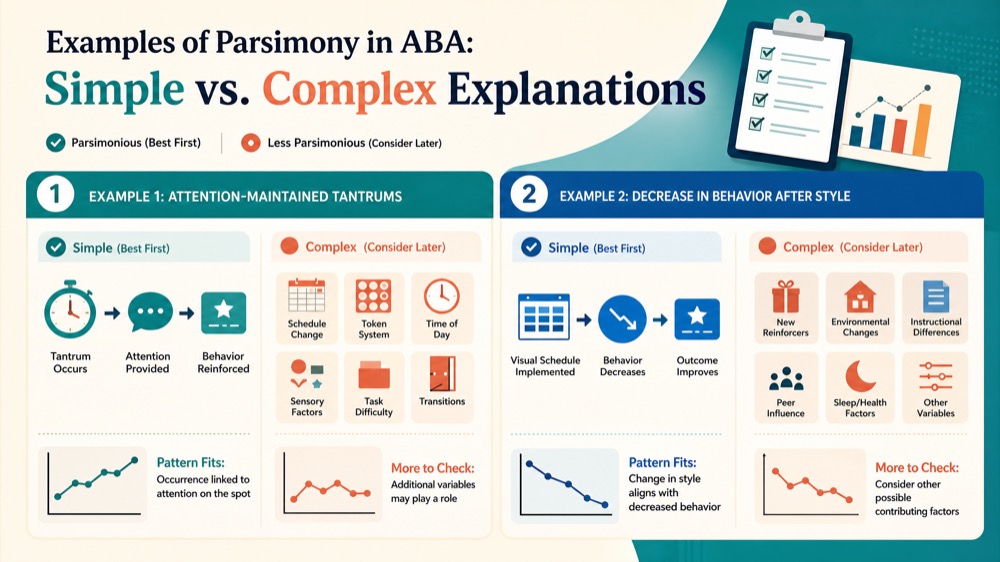
To understand parsimony, it helps to see it in action. Here are several examples and non-examples that illustrate how to apply the principle. Example 1: Attention-Maintained Tantrums: Suppose a child has tantrums only when you are on the phone. You notice that when the tantrum occurs, you immediately hang up and attend to the child. The most parsimonious explanation is that the tantrum is maintained by positive reinforcement in the form of attention. A complex explanation might say the child is “feeling neglected” or “trying to get revenge,” but those are unobservable and unnecessary. The simpler explanation fits the data and leads to effective interventions, such as providing attention on a schedule or teaching communication.
Example 2: Decrease in Behavior After a Schedule Change: A behavior analyst implements a new schedule of reinforcement, and the target behavior decreases. The parsimonious conclusion is that the schedule change caused the decrease. A more complex explanation might postulate that a new motivational variable appeared, but without evidence, that is an explanatory fiction. The schedule change is the observable event; therefore, it is the most reasonable cause. This example also shows how parsimony relies on data: you must have evidence that the behavior changed after the manipulation, not just a guess.
Non-Example: Overcomplicating an Escape-Maintained Behavior: Consider a student who leaves the classroom whenever the teacher hands out a difficult worksheet. A non-parsimonious explanation would be that the student has “low self-esteem” or is “avoidant due to anxiety.” These constructs are not directly manipulable or observable. A parsimonious explanation is that leaving the classroom removes the aversive worksheet, so the behavior is negatively reinforced by escape from the demand. This explanation leads to functional interventions like modifying the task or teaching a replacement behavior. Comparison Points: Parsimony vs. Oversimplification: Use the points below as a quick study guide.
- Parsimony prefers the simplest explanation that fits the data. It is not about picking the easiest intervention.
- Oversimplification ignores data or intervenes without understanding function. Parsimony never ignores data; it uses all available evidence.
- Parsimony allows for multiple variables. It does not mean you must always choose one variable; it means you should not assume unneeded ones.
- Parsimony is about explanation, not treatment selection. You still need to consider practical factors like safety and context.
Common Misconceptions About Parsimony
Parsimony is often misunderstood. Many people think it means always choosing the simplest intervention or that it prohibits any mention of private events. Both are false. Let’s clarify these misconceptions.
- Misconception: Parsimony means always choosing the simplest intervention. Truth: Parsimony applies to explanations, not interventions. You might still use a complex intervention for practical reasons, but the explanation of why the behavior occurs should be as simple as possible.
- Misconception: Parsimony prohibits any mentalistic concepts. Truth: Parsimony encourages you to avoid explanatory fictions, but it does not ban considering private events as behavioral phenomena. Private events can be studied if they are defined behaviorally, but they should not be used as autonomous causes.
- Misconception: Parsimony is a technique for reducing behavior. Truth: Parsimony is a principle for interpreting behavior, not an intervention. It does not directly reduce behavior; it helps you understand it.
- Misconception: Parsimony is the only assumption in behavior analysis. Truth: It is one of several assumptions, including determinism, empiricism, and selectionism.
- Misconception: One example proves the behavioral function. Truth: Parsimony is applied to a body of data, not a single observation. You need repeated observations to support a functional relation.
Stimulus Control and Parsimony
Parsimony is closely related to stimulus control. Stimulus control refers to the extent to which a behavior is more likely to occur in the presence of a particular stimulus because of a history of reinforcement. For example, a student may raise their hand only when the teacher is present, because that behavior has been reinforced in that context. A parsimonious explanation focuses on the discriminative stimulus (SD) and the reinforcement history. The behavior analyst does not need to say the student is “motivated to be polite” or “knows when it is appropriate.” The SD sets the occasion for reinforcement, and the behavior occurs.
Conversely, an S-delta signals that reinforcement is not available. If a behavior never occurs during a specific condition, the simplest explanation is that the stimulus is an S-delta for that behavior. For example, a child may say “please” in front of the toy aisle but not in the grocery store. The toy aisle is an SD because that behavior has been reinforced there. The grocery store is an S-delta because the behavior has not been reinforced there. Parsimony directs us to describe this in terms of stimulus control rather than attributing it to internal states.
When you analyze stimulus control, you often have to choose between explanations. Suppose a client requests a break only when a particular therapist is present. A parsimonious explanation is that the therapist’s presence is an SD for requesting a break because that request has been honored. An alternative explanation might be that the client “feels more comfortable” with that therapist. However, the latter is unobservable and less testable. By applying parsimony, you focus on the environmental variables you can manipulate. This is why stimulus control is such an important concept for the BCBA exam. Understanding SDs and S-deltas helps you develop parsimonious hypotheses. For further reading, see our guide on stimulus generalization.
Practical Cautions for Applying Parsimony
As a behavior analyst, you must apply parsimony carefully. It is a guide, not a rigid rule. Here are some cautions to keep in mind. Do Not Dismiss All Hypothetical Constructs: Some hypothetical constructs, like motivation, can be useful when defined in observable terms. For example, you might say, “The client is motivated to access attention,” but that is shorthand for a history of reinforcement. Parsimony does not mean you never talk about private events; it means you prefer explanations that rely on observable and measurable events. If you must refer to a private event, define it in behavioral terms.
Do Not Ignore Data: Parsimony is not about ignoring data to make things simpler. If data show that multiple variables are affecting behavior, you cannot ignore that. Parsimony asks you to account for all the data with the fewest assumptions. If two variables are clearly functional, you include both. In fact, parsimony might lead to a more complex explanation if the data demand it. For example, a behavior might be maintained by both attention and escape. A parsimonious explanation might include both if the data support both. It is not oversimplification; it is the most economical explanation that covers the evidence.
BCBA Exam Traps and How to Avoid Them
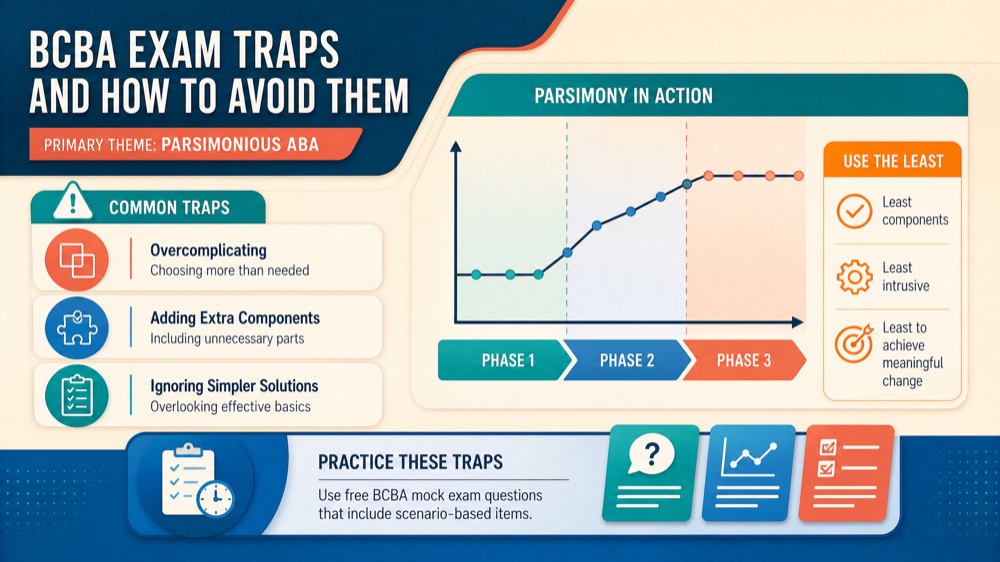
The BCBA exam loves to test parsimony through tricky questions. Here are common traps you should watch for:
- Trap 1: Choosing the most detailed explanation. The exam may offer a long, fancy answer. But if a simpler one fits, parsimony says choose the simpler. Avoid overcomplicating.
- Trap 2: Selecting an answer that uses mentalistic terms. Words like “wants,” “thinks,” or “feels” are often red flags unless they are clearly defined as behavioral shorthand. A parsimonious answer will focus on observable events.
- Trap 3: Mistaking parsimony for “simplest treatment.” The exam might ask about intervention choice. Remember parsimony is about explanation, not intervention complexity.
- Trap 4: Ignoring data that suggest multiple functions. If reinforced by both attention and escape, the correct answer may include both. Parsimony does not mean ignoring evidence.
- Trap 5: Confusing parsimony with Occam’s razor. They are similar, but parsimony in ABA is specifically about observable events and functional relations, not just any simplicity.
To practice these traps, you can use free BCBA mock exam questions that include scenario-based items. The more you practice, the better you will apply parsimony under test pressure.
Study Checklist for Parsimony
Use this checklist to solidify your understanding of parsimonious ABA:
- □ I can define parsimony in ABA and list its core assumptions.
- □ I can contrast parsimony with oversimplification.
- □ I can identify explanatory fictions in case examples.
- □ I can apply parsimony to determine a behavior’s function.
- □ I can explain how parsimony relates to SD and S-delta.
- □ I can recognize common exam traps about parsimony.
- □ I can generate my own parsimonious and non-parsimonious examples.
- □ I have practiced at least 10 BCBA-style questions on philosophical assumptions.
Review the definitions and examples regularly. Try to explain parsimony in your own words to a peer or study partner. This active recall will strengthen your memory and help you on the exam.
Conclusion and Free BCBA Mock Exam
Parsimony is a powerful tool in behavior analysis. It keeps your explanations grounded in observable events, avoids explanatory fictions, and guides effective intervention. By choosing the simplest explanation that fits the data, you become a more scientific and practical behavior analyst. As you prepare for the BCBA exam, practice applying parsimony to real and hypothetical scenarios. The more you practice, the more natural it becomes.
If you found this article helpful, take the next step in your exam preparation. Explore our free BCBA mock exam to test your knowledge of parsimony and other core concepts. With focused practice, you will be ready to pass the BCBA exam. Remember: when in doubt, choose the simplest explanation that fits the data—but never ignore the data.
Reference
Next step for BCBA exam prep
Turn this topic into exam-day practice
Use this topic as a focused review, then test it in exam-style conditions with a free mock before deciding whether five full-length mocks are the right next step.
Start the Free BCBA Mock ExamContinue with Five Full-Length Mocks — $99
Review the included materials and access details before ordering. No pass guarantee is implied.



