
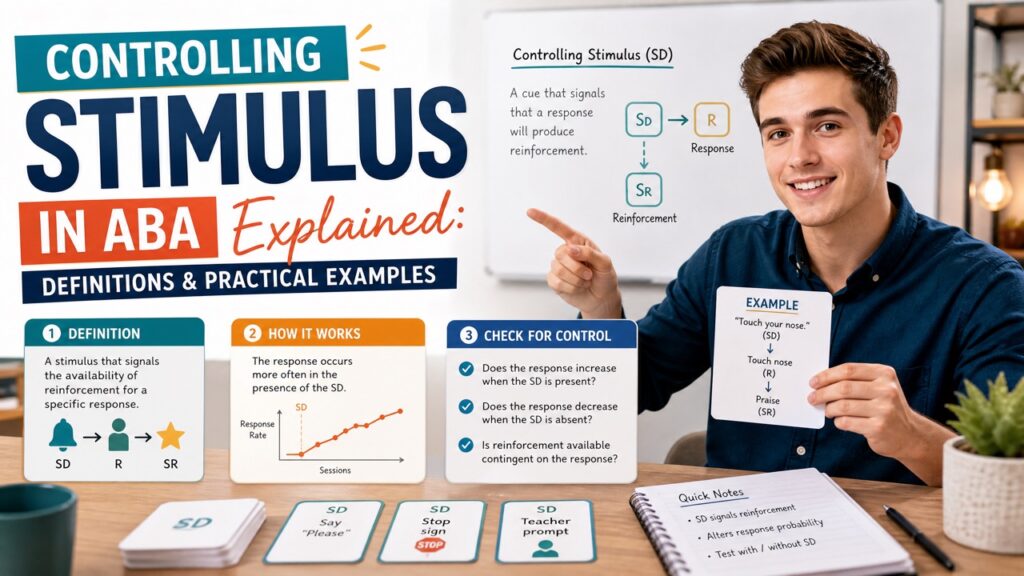
In applied behavior analysis (ABA), the term controlling stimulus refers to an antecedent stimulus that reliably evokes or suppresses a specific behavior because of a history of reinforcement. It is a functional concept: a stimulus is said to “control” a behavior when the presence of that stimulus alters the probability of the behavior occurring. This is not about physical properties or appearance; it is about the observed relationship between the stimulus and the behavior.
Table of Contents
- Defining the Controlling Stimulus in ABA
- The Role of the Controlling Stimulus in Stimulus Control
- Practical ABA Examples of Controlling Stimuli
- Distinguishing Controlling Stimulus from Related Concepts
- Common Traps When Studying the Controlling Stimulus
- Study Checklist for the Controlling Stimulus
- Test Your Knowledge with a Free BCBA Mock Exam
Understanding this term is essential for any behavior analyst, as it underpins stimulus control, discrimination training, and many intervention strategies. This guide will define the controlling stimulus precisely, provide practical examples, distinguish it from related terms, and offer study tips for your BCBA journey.
Defining the Controlling Stimulus in ABA
In ABA, a controlling stimulus is an antecedent that has acquired the ability to evoke or suppress a particular response because that response has been reinforced or not reinforced in its presence. In other words, the stimulus “controls” the behavior: when the stimulus is present, the behavior is likely to occur (or not occur), depending on the reinforcement history. This is a functional definition—it relies on the observed correlation between the stimulus and the behavior, not on the stimulus’s physical characteristics or the individual’s intentions.
The term is often used interchangeably with discriminative stimulus (Sᵉ), but there is a subtle distinction. An Sᵉ is a specific type of controlling stimulus that signals the availability of reinforcement for a particular response. However, a controlling stimulus can also be an SΔ (stimulus delta), which signals that reinforcement is not available, thereby suppressing the behavior. Both Sᵉ and SΔ are controlling stimuli because they both influence behavior, but in opposite directions. The controlling stimulus concept emphasizes the functional relationship between any antecedent and a behavior.
To understand this better, consider a traffic light. The green light is a controlling stimulus that evokes “driving forward” because that behavior has been reinforced (by moving safely) in its presence. The red light is also a controlling stimulus that suppresses “driving forward” because that behavior has been punished or not reinforced. Both lights control behavior, but they do so differently. This example illustrates that the controlling stimulus is defined by its effect on behavior, not by its color or location.
The Role of the Controlling Stimulus in Stimulus Control
Stimulus control is the process by which a behavior becomes more likely in the presence of a particular stimulus because of a history of differential reinforcement. The controlling stimulus is the specific antecedent that exerts that control. When we say “the behavior is under stimulus control,” we mean that the presence of the controlling stimulus reliably evokes the behavior, while its absence reduces the likelihood. This is a fundamental concept in ABA because it allows behavior to come under the influence of relevant environmental cues.
For example, in a classroom, a teacher might say, “Raise your hand” (the controlling stimulus) and then call on students who raise their hands. Over time, the instruction “Raise your hand” becomes a controlling stimulus for hand-raising because that response is reinforced. In contrast, when the teacher asks a question without that instruction, hand-raising is less likely. This differential reinforcement creates stimulus control.
The controlling stimulus is not limited to vocal instructions; it can be any environmental event. It could be a visual cue, such as a stop sign; a person’s presence, such as a specific therapist; a time of day, such as after lunch; or an internal state that is observable, such as a headache (though internal states are often harder to measure). The key is that the stimulus reliably predicts the availability of reinforcement for a particular behavior.
Practical ABA Examples of Controlling Stimuli
To make the concept concrete, here are original examples across different settings. These are illustrations you can use for study.
Example 1: Teaching a Child to Request a Break: A behavior analyst works with a child who engages in tantrums. The analyst teaches the child to say “break” when they feel overwhelmed. The analyst places a red card on the table as a visual cue. Whenever the red card is present, the analyst asks, “What do you need?” and reinforces “break” with a break from tasks. Over time, the red card becomes a controlling stimulus: when the card is present, the child says “break” more often; when the card is absent, the child is less likely to say it. The controlling stimulus is the red card, not the verbal prompt, because the card reliably evokes the request.
Example 2: Adult in a Job Setting: In a workplace, an employee has a supervisor who frequently checks in. The presence of the supervisor (controlling stimulus) evokes careful work behavior because that behavior has been reinforced by praise and approval. When the supervisor is absent, the employee may be less focused. Here, the controlling stimulus is the supervisor’s presence, which has acquired control over the employee’s work speed and accuracy.
Example 3: Self-Management for Studying: A college student uses a specific playlist when studying for exams. The student only listens to this playlist while studying, and studying is often followed by good grades (reinforcement). Over time, the playlist becomes a controlling stimulus: its presence evokes studying behavior, while its absence makes studying less likely. This is a practical example of using a stimulus to control one’s own behavior.
Distinguishing Controlling Stimulus from Related Concepts
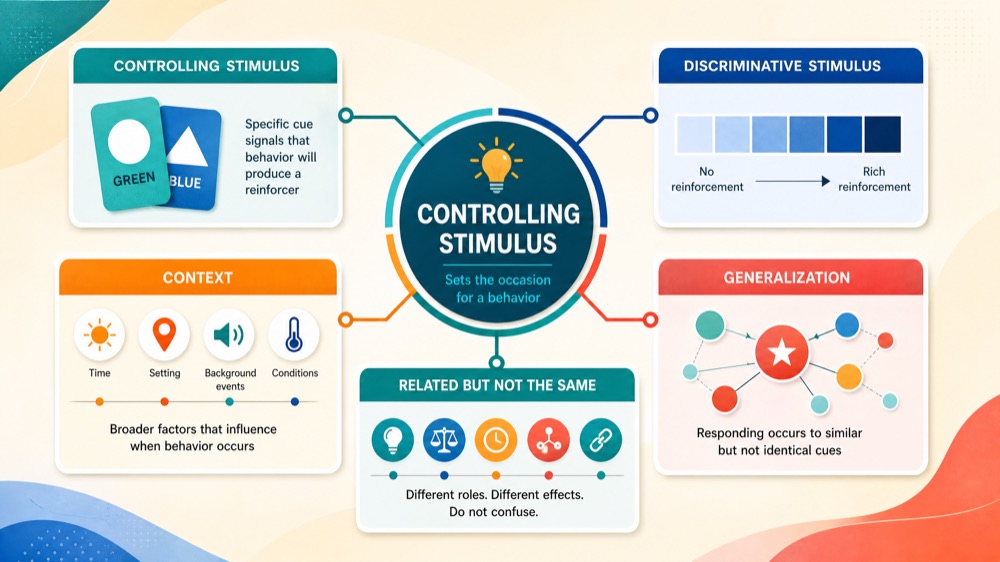
Behavior analysts often confuse the controlling stimulus with similar terms. Here is a breakdown of the most important distinctions.
- Controlling stimulus vs. stimulus control: Stimulus control is the process or effect, while the controlling stimulus is the specific antecedent that exerts that control. For example, “The teacher’s instruction (controlling stimulus) produced a hand-raise (behavior) because of differential reinforcement (process).”
- Controlling stimulus vs. discriminative stimulus (Sᵉ): An Sᵉ is a stimulus in the presence of which a response has been reinforced and in the absence of which it has not. It is the most common type of controlling stimulus that evokes behavior. However, a controlling stimulus can also be an SΔ, which suppresses behavior. All Sᵉs are controlling stimuli, but not all controlling stimuli are Sᵉs.
- Controlling stimulus vs. stimulus delta (SΔ): An SΔ is a stimulus in the presence of which a response has not been reinforced. It also controls behavior, but by reducing its probability. For example, a red light is an SΔ for “driving forward,” yet it is a controlling stimulus for stopping. So, both Sᵉ and SΔ are controlling stimuli, differing only in whether they evoke or suppress the target response.
- Controlling stimulus vs. motivating operation (MO): An MO is an environmental event that alters the value of a reinforcer and the frequency of behavior that has been reinforced by it. Unlike a controlling stimulus, an MO does not directly evoke a behavior; it changes the effectiveness of consequences. For example, food deprivation is an MO that makes food more valuable, thereby increasing the likelihood of food-seeking behaviors. A controlling stimulus, on the other hand, signals the availability of reinforcement, not its value.
Common Traps When Studying the Controlling Stimulus
Students preparing for the BCBA exam often misinterpret the controlling stimulus in several ways. Avoid these pitfalls to build a solid understanding.
- Assuming a stimulus is controlling based on its appearance: A bright light or a loud sound is not inherently controlling. Only if behavior reliably changes in its presence does it become a controlling stimulus. For instance, a phone notification ring may be a controlling stimulus for checking the phone, but only if that behavior has been reinforced by messages or alerts.
- Confusing the consequences with the controlling stimulus: The reinforcer that follows a behavior is not the controlling stimulus. The controlling stimulus precedes the behavior. For example, if a child says “please” and gets a cookie, the cookie is the reinforcer, but the presence of a cookie jar (or the sight of a cookie) might be the controlling stimulus that evokes “please.”
- Believing that all controlling stimuli are verbal: Nonverbal stimuli, such as colors, shapes, locations, and even the passage of time, can control behavior. For example, a red light at a pedestrian crossing is a visual controlling stimulus for stopping.
- Overlooking the role of SΔ: Many students think only Sᵉs are controlling stimuli. Remember that SΔs also control behavior by suppressing it. In a discrimination training procedure, both the Sᵉ and the SΔ are controlling stimuli for the same response, but in opposite directions.
Study Checklist for the Controlling Stimulus
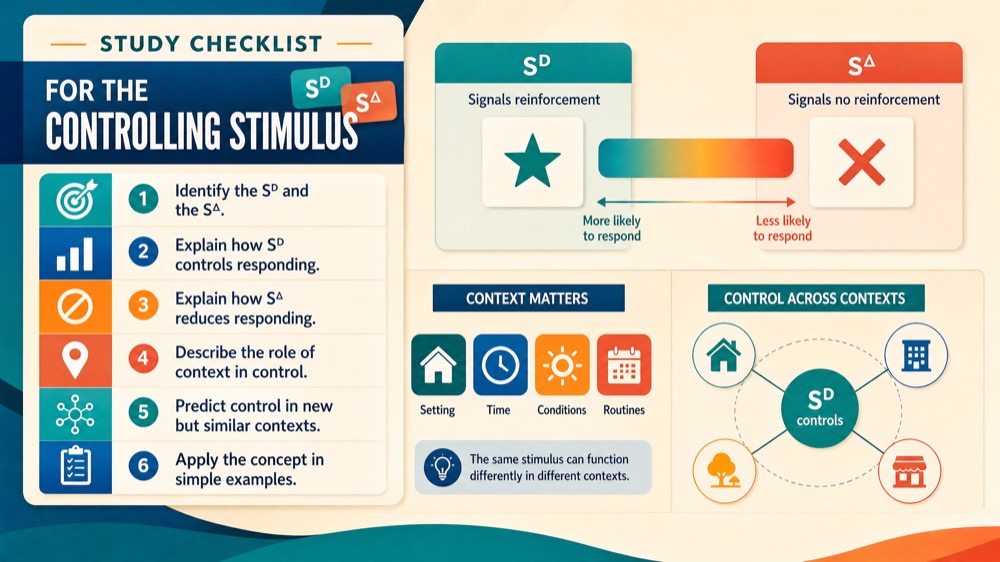
Use this checklist to test your mastery of the controlling stimulus before moving to other topics in stimulus control.
- Define the controlling stimulus functionally, using the criterion of a history of differential reinforcement.
- Identify examples of Sᵉ and SΔ in everyday contexts and explain how each exerts control.
- Explain how stimulus control is developed through reinforcement in the presence of a stimulus and extinction or punishment in its absence.
- Distinguish the controlling stimulus from the reinforcer, the motivating operation, and the response itself.
- Describe a scenario where a stimulus initially has no control, and then gains control through a discrimination training procedure.
- Explain why a stimulus cannot be called “controlling” without empirical evidence of its effect on behavior.
If you can cover each point above in your own words, you have a strong grasp of the concept.
Test Your Knowledge with a Free BCBA Mock Exam
Ready to check your understanding of stimulus control and many other ABA concepts? Take our free BCBA mock exam for realistic practice and detailed feedback. It’s an excellent way to identify areas for further study, though it does not guarantee that this exact topic will appear on the exam. Use it as a tool to reinforce your learning and build test-taking stamina. For more on related topics, explore our guides on stimulus control in ABA, stimulus generalization, and stimulus control practice questions.
For the official BCBA task list, refer to the BCBA/BCaBA Task List (6th ed.).



