
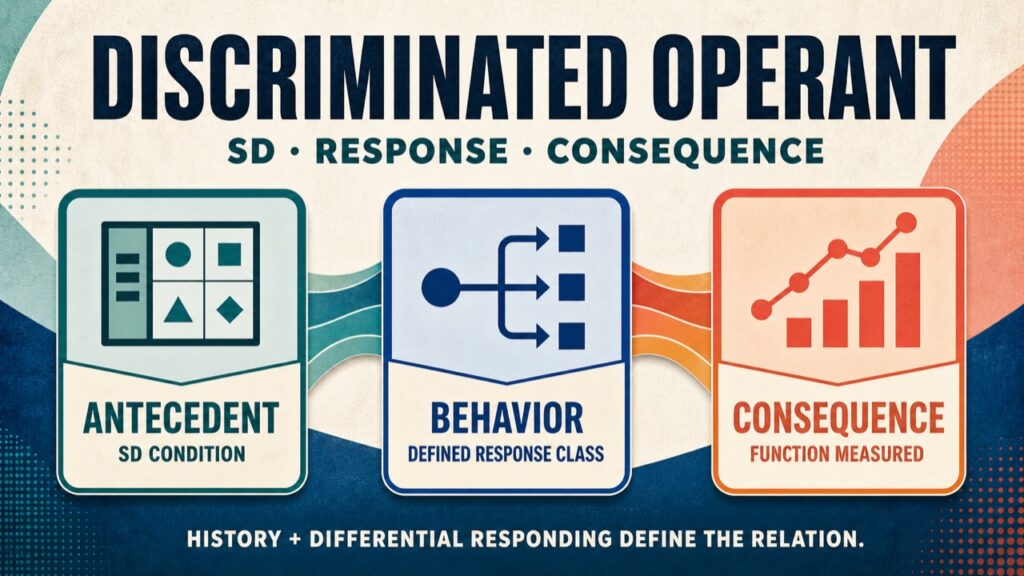
A discriminated operant is an operant response-consequence relation that comes under the control of an antecedent stimulus through a history of differential reinforcement. Responding becomes more frequent in the presence of the relevant discriminative stimulus, or SD, than under comparison conditions where the same response has not produced reinforcement as reliably. The term describes a functional three-part relation, not a visible behavior or object by itself.
Table of Contents
- What Is a Discriminated Operant?
- The Three-Term Contingency
- Original Example and Clear Nonexamples
- Respondent Behavior and Free-Operant Arrangements
- Discriminative Stimulus Versus Motivating Operation
- How Discrimination Training Is Evaluated
- Measuring Stimulus Control Conservatively
- Why the Concept Matters in ABA Study and Practice
This distinction helps explain stimulus control without treating an SD as a command, an inner cause, or a permanently meaningful cue. The article below breaks the relation into the three-term contingency, separates it from respondent and free-operant arrangements, contrasts SD and motivating-operation functions, and presents a safe instructional example. Each label depends on observed history and effects rather than how a stimulus looks or what an adult intends it to do.
What Is a Discriminated Operant?
In a discriminated operant, a response that has contacted a consequence is emitted at different rates or probabilities across antecedent conditions. The condition correlated with a more favorable response-consequence relation may acquire SD function. For example, if pressing a key has produced a point when a green shape is displayed but has not produced a point when a gray shape is displayed, key pressing may become more frequent during the green shape.
The green shape does not qualify as an SD before the relevant history or merely because an instructor calls it a cue. Its function is supported when data show differential responding related to the programmed contingency. The same green shape might control a different response for another learner, have no demonstrated function for someone without the training history, or participate in a more complex conditional discrimination when another stimulus changes what response is effective.
It is also useful to distinguish the response from the complete unit. Key pressing is the operant behavior. The discriminated operant includes the relation among the antecedent condition, the response, and its consequence. This wording prevents a common category error in which a therapist, card, light, or instruction is described as “the discriminated operant.” Those events may participate in the relation, but the term refers to the organized behavioral unit.
The Three-Term Contingency
The three-term contingency is commonly written as antecedent, behavior, and consequence. For a simple discriminated operant, the antecedent includes the SD, the behavior is the defined response class, and the consequence is the event that has followed that response under the relevant condition. Calling the event reinforcement requires evidence that it increased or maintained later responding; its intended purpose or pleasant appearance does not establish its function.
- Antecedent: the environmental condition present before the response, including the candidate discriminative stimulus.
- Behavior: the observable, measurable response class whose distribution is compared across conditions.
- Consequence: the event following the response, classified by its measured effect on future behavior.
Differential reinforcement creates the contrast that can produce stimulus control. In a basic arrangement, a response contacts reinforcement more reliably in the SD condition than in an S-delta condition. With experience, responding may become more concentrated in the SD condition. The S-delta is not defined as a prohibition, and nonreinforcement in one trial is not enough to establish either function. The terms describe patterns supported by a relevant history and current data.
Original Example and Clear Nonexamples
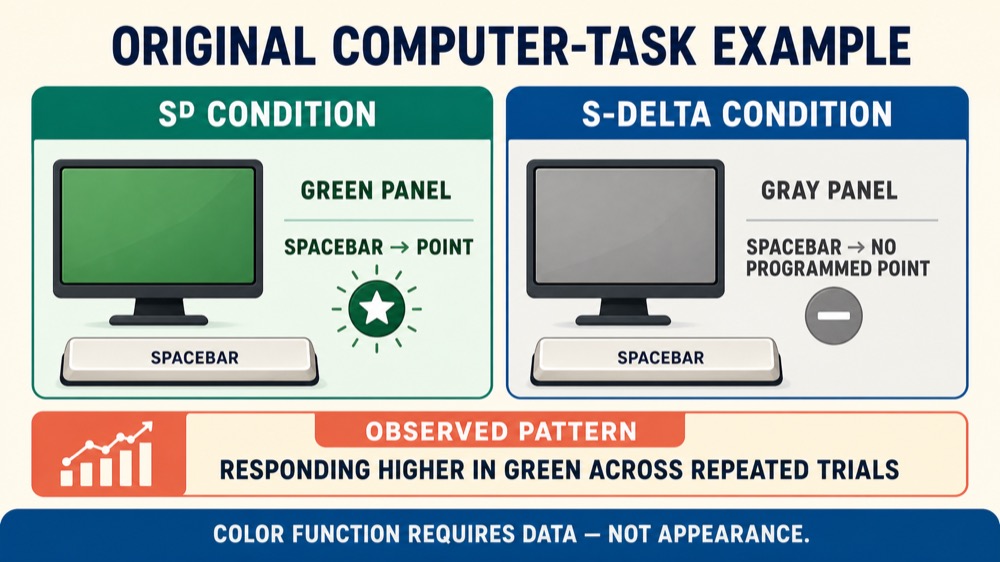
Consider a benign computer-learning task. A participant can press the spacebar whenever a colored panel appears. During green panels, a spacebar press produces a point and brief confirmation tone. During gray panels, the same press does not produce the point. Across repeated opportunities, the participant presses frequently during green panels and rarely during gray panels. Those data support green-panel SD function for spacebar pressing in that particular arrangement.
The example does not mean green is an SD in other settings. Color, brightness, screen position, the tone, prior instructions, and the broader context could each influence responding. A careful assessment varies or controls plausible features before claiming which stimulus dimension controls the response. It also evaluates whether the point functioned as reinforcement by examining later behavior rather than assuming that a score display is reinforcing for every participant.
- Before training: a green panel appears, but no response-consequence history exists; SD function has not been shown.
- No discrimination: spacebar pressing remains similar during green and gray panels; the proposed stimulus control is not demonstrated.
- Different response: green controls key pressing but not a spoken answer; stimulus function is response-specific.
- Different learner: another participant responds to screen position rather than color; physical sameness does not establish functional sameness.
Respondent Behavior and Free-Operant Arrangements
A reflex belongs to respondent behavior, not to a category called an unconditioned operant. Respondent relations involve a stimulus that elicits a response; some are unconditioned, while conditioned respondents develop through stimulus-stimulus pairing. A discriminated operant instead depends on a response-consequence history arranged differently across antecedent conditions. The two processes can occur in the same episode, so the analyst separates them by demonstrated contingencies rather than by whether the response looks voluntary.
A free-operant arrangement provides another useful contrast. In a typical free-operant procedure, the measured response is available throughout a session rather than during discrete presentations of an experimenter-programmed SD. That procedural label does not claim the environment exerts no antecedent influence. It describes how opportunities are arranged and measured. Evidence of a discriminated operant requires a documented distribution of responding across antecedent conditions tied to differential consequences.
- Discriminated operant: response distribution differs across antecedent conditions after differential consequence histories.
- Respondent relation: an antecedent stimulus elicits a response through an unconditioned or conditioned relation.
- Free-operant procedure: the response opportunity remains continuously available during the observation period.
Discriminative Stimulus Versus Motivating Operation
A discriminative stimulus concerns the differential availability of a consequence for a particular response. A motivating operation, or MO, changes the current effectiveness of a consequence and the current frequency of behavior that has previously contacted it. The distinction is functional: SD control concerns when a response has produced a consequence, while MO effects concern how effective that consequence is at the present time.
Both relations may influence one episode. After a documented period without water, water may become more effective as reinforcement and water-getting responses may increase; those changes are candidate MO effects. If an illuminated indicator on a working dispenser has accompanied successful button presses while an unlit indicator has accompanied unavailable water, the illuminated indicator may function as an SD for pressing. The deprivation condition and the indicator have different roles even when they occur together.
A report of thirst, one button press, or the mere presence of a dispenser does not establish either function. Evidence for the MO includes a consequence-value change plus a related behavior change. Evidence for the SD includes differential responding based on the response-consequence history. This is why an antecedent should not be classified from its position in a diagram: “before behavior” is a temporal description, whereas SD and MO are functional classifications.
How Discrimination Training Is Evaluated
Discrimination training can be described conceptually as arranging different response-consequence relations across antecedent conditions and measuring whether responding differentiates. In the computer example, point delivery after key pressing is more reliable during green than gray panels. A qualified practitioner would define each stimulus condition, the target response, the candidate reinforcer, data-collection rules, prompting plan, error-correction approach, mastery criteria, and conditions for reviewing or stopping the procedure.
Instruction should use benign consequences and protect access to basic needs, communication, safety responses, care, and necessary breaks. A teaching arrangement is not improved by making errors distressing or by suppressing reasonable communication outside a narrow cue. Individualized planning also considers assent, accessibility, sensory variables, cultural context, prerequisite skills, and possible adverse effects. The intended outcome is useful differential responding, demonstrated in data and generalized carefully to relevant settings.
- Define the candidate SD and comparison condition in observable terms.
- Pinpoint the response class and measure it consistently across conditions.
- Verify that the planned consequence functions as reinforcement for this learner and response.
- Use prompts when needed, then evaluate whether prompt fading transfers control to the intended stimulus.
- Measure errors, latency, response rate or accuracy, and responding to relevant novel examples.
- Review assent, accessibility, adverse effects, and practical value throughout instruction.
Prompting can create an additional source of control, so correct performance during a prompt does not by itself demonstrate SD control. Data should show that responding follows the intended stimulus after prompts are reduced. Practitioners also check for stimulus overselectivity, position bias, inadvertent facial or gestural cues, and memorized trial order. These checks distinguish genuine discrimination from performance supported by an unintended feature of the teaching arrangement.
Measuring Stimulus Control Conservatively
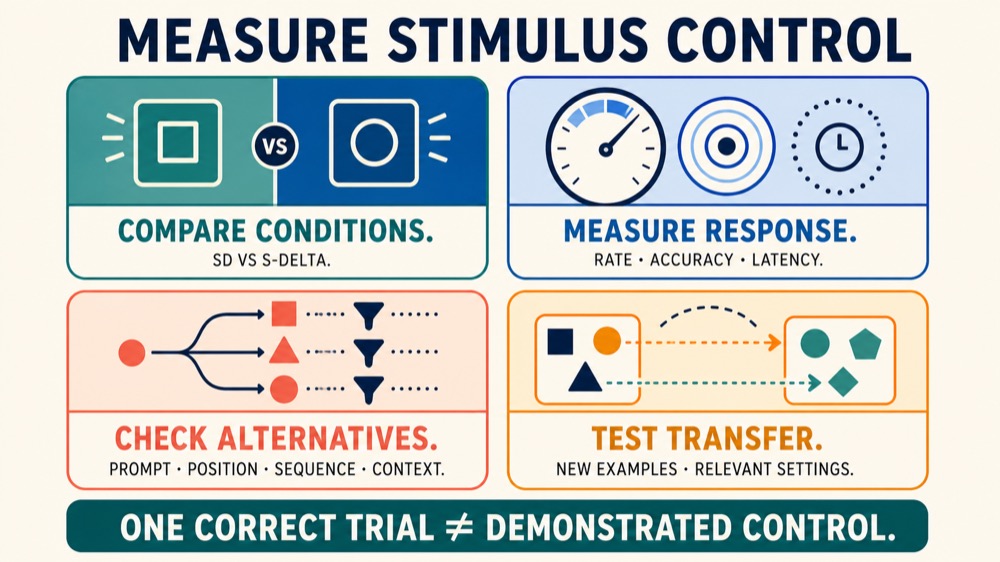
Stimulus control is supported when a response occurs at reliably different levels across relevant stimulus conditions because of the differential reinforcement history. Depending on the task, useful measures may include response rate, proportion correct, latency, errors by stimulus, and performance with untrained examples. A single correct trial is weak evidence, while repeated comparisons can show whether the effect is stable, specific to the intended dimension, and useful outside the training set.
The following questions keep conclusions close to the evidence. They also help separate a true discriminated operant from a response controlled by prompts, position, instructions, broad context, or a motivating operation. If the data do not answer one of these questions, the appropriate conclusion may remain provisional rather than forcing a familiar label onto the event.
- What response-consequence relation was programmed and what relation actually occurred?
- Which antecedent dimensions differed between the SD and comparison conditions?
- Did response frequency, accuracy, or latency differ reliably across those conditions?
- Could an unintended prompt, location, sequence, or contextual cue explain the pattern?
- Did the response transfer to relevant new examples without spreading to irrelevant ones?
- What evidence separates SD control from a change in consequence effectiveness?
Why the Concept Matters in ABA Study and Practice
Discriminated operants are central to describing how antecedent context, behavior, and consequences work together. The concept supports precise analysis of instructions, communication, academic responding, tool use, safety routines, and many other learned skills. Precision matters because a teaching cue may be intended as an SD while the learner actually responds to position, prompt timing, another person’s gaze, or a broader contextual feature.
The BACB BCBA Test Content Outline (6th ed.) organizes relevant knowledge around behavioral principles and stimulus control. A peer-reviewed analysis of verbal stimulus control describes the discriminated operant as an SD-response-reinforcer unit and shows how simple and conditional discriminations differ. These sources support the functional relation; they do not turn a memorized object example into proof of stimulus function.
For related study, review the site’s guides to stimulus control in ABA and stimulus generalization. You can also use the Free BCBA Mock Exam for practice and feedback across ABA concepts. The practice resource does not establish which topics will appear on a live examination, so use its explanations to locate concepts that need additional source-based review.



