
The Exam-Required Standard
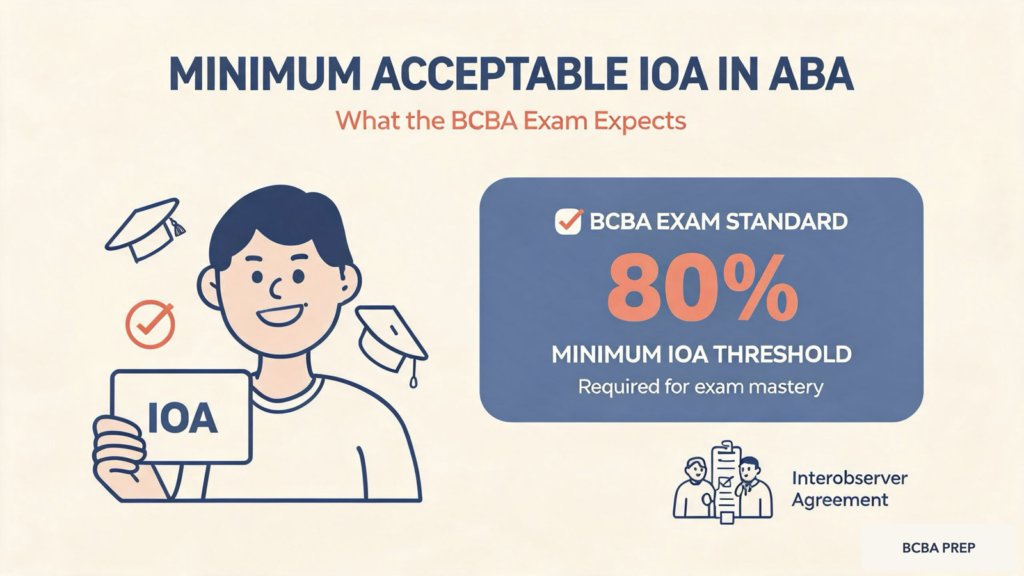
Understanding the minimum acceptable IOA in ABA is essential for BCBA exam success. Interobserver agreement (IOA) measures the consistency between two independent data collectors. Without adequate IOA, data may be unreliable, leading to faulty clinical decisions.
Practice this concept
Table of Contents
- The Exam-Required Standard
- How to Calculate IOA: Formulas for the BCBA Exam
- Worked Examples: Applying Minimum IOA to Common Scenarios
- Common Exam Traps and Misconceptions
- Quick Reference Checklist for Exam Day
- Summary: Master IOA for the BCBA Exam
What Is Interobserver Agreement (IOA)?
IOA is the degree to which two observers report the same observed behavior. It ensures objectivity and reliability in data collection. High IOA increases confidence that the measured behavior reflects actual events, not observer bias.
The Exact Minimum Threshold (80–90%)
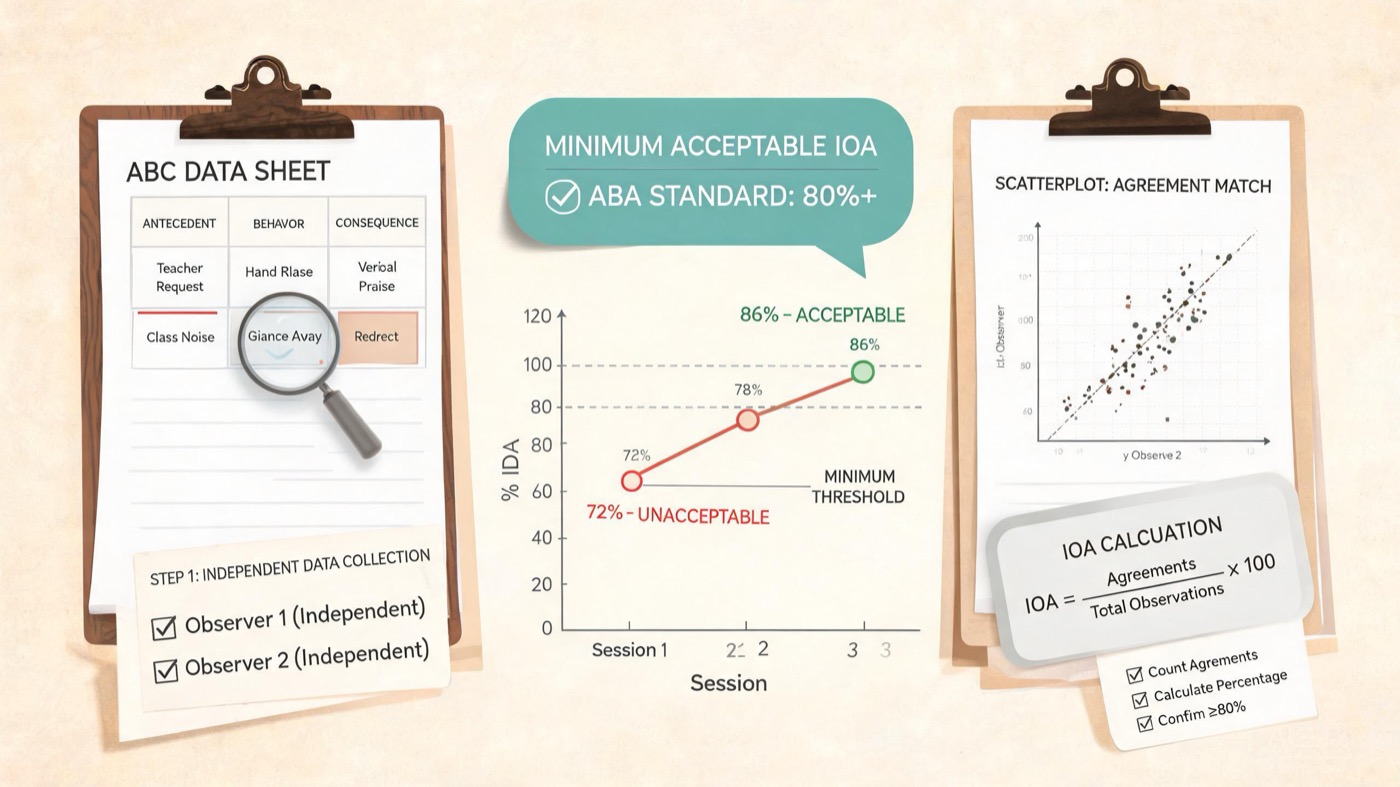
For clinical decisions, the field accepts a minimum of 80% IOA. For research purposes, a stricter criterion of 90% is often required. The BCBA exam focuses on 80% as the standard for typical practice. Items may ask whether a given IOA value meets the minimum threshold in a scenario.
Why Exam Candidates Must Know This Number
Exam questions often present IOA values and ask if they are acceptable. Knowing the 80% cutoff helps you quickly identify when to recalibrate observers or adjust data collection procedures. This concept appears across multiple test domains, including measurement and experimental design.
How to Calculate IOA: Formulas for the BCBA Exam
Calculating IOA accurately is a tested skill. The exam may require you to compute IOA from raw data or interpret reported values. Below are the most common formulas with examples.
Total Count IOA
Total count IOA compares the total number of behaviors recorded by each observer. The formula is: (smaller count / larger count) × 100. For example, if Observer A records 15 instances and Observer B records 12 instances, IOA = (12/15) × 100 = 80%, which meets the minimum acceptable IOA in ABA for clinical settings.
Point-by-Point IOA (Interval-by-Interval)
This method compares agreement on each interval. Formula: (agreements / (agreements + disagreements)) × 100. For instance, if both observers agree on 18 out of 20 intervals, IOA = (18/20) × 100 = 90%, which is excellent. Disagreements require retraining observers on operational definitions.
Calculating Mean IOA Across Sessions
When multiple IOA sessions are conducted, the mean IOA is the average of all session values. A mean below 80% indicates systemic issues. The exam may ask whether the mean IOA meets the minimum threshold. If one session drops to 70%, the overall mean may still be acceptable if other sessions are high, but the drop itself signals a problem.
Worked Examples: Applying Minimum IOA to Common Scenarios
Applying the minimum acceptable IOA in ABA to realistic examples reinforces understanding. Here are three exam-style problems using ABC analysis and hypothesized functions.
Example 1: Total Count IOA for Aggression
Scenario: A therapist records aggression (hitting) during demand sessions. Antecedent: therapist gives instruction. Behavior: hitting. Consequence: removal of demand. Hypothesized function: escape. Observer A counts 17 hits; Observer B counts 14 hits. Total count IOA = (14/17) × 100 ≈ 82%. This meets the minimum acceptable IOA in ABA (≥80%). However, because it is close to threshold, additional IOA checks are recommended.
Example 2: Interval IOA for On-Task Behavior
Scenario: A teacher uses momentary time sampling to measure on-task behavior. Antecedent: teacher instructs students to work quietly. Behavior: eyes on materials or writing. Consequence: teacher praise every 5 minutes. Over 30 intervals, observers agree on 22 intervals. IOA = (22/30) × 100 = 73%, below the minimum acceptable IOA in ABA. The BCBA should retrain observers on the operational definition of ‘on-task,’ perhaps adding examples of off-task behaviors like looking away.
Example 3: Mean IOA Across Baseline Sessions
Scenario: Three baseline sessions yield IOA of 85%, 78%, and 90%. The mean IOA = (85+78+90)/3 = 84.3%, which meets the 80% threshold. However, the 78% session indicates a need for retraining. The exam may present the mean and ask if it is acceptable; you must note the outlier even if the mean passes.
Common Exam Traps and Misconceptions
Exam candidates often miss points due to these common misunderstandings. Avoiding them can boost your score.
Confusing Minimum Acceptable IOA with Perfect Agreement
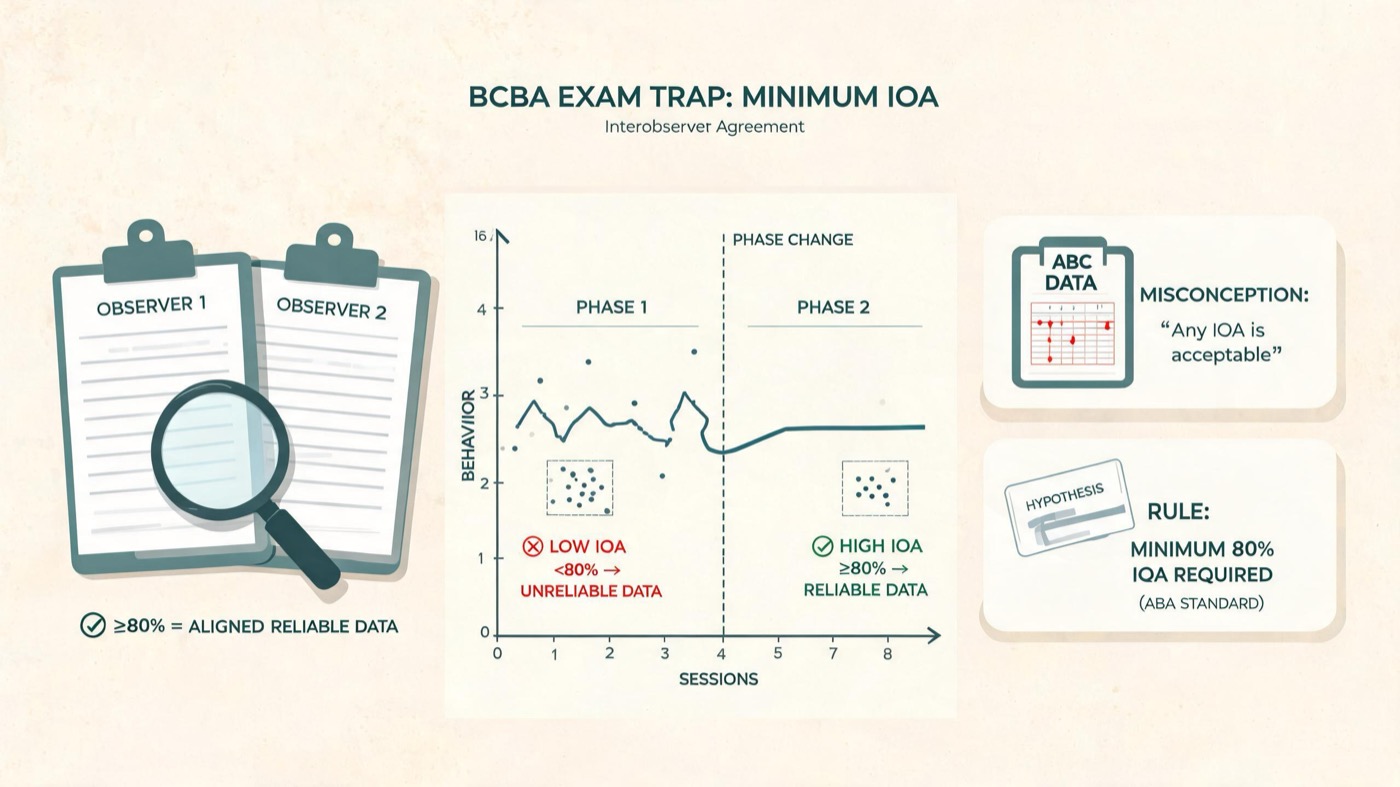
Many assume IOA must be 100% to be acceptable. In practice, 80% is sufficient for clinical decisions. The exam tests whether you recognize that values above 80% are generally acceptable unless the scenario specifies a higher standard (e.g., research).
Not Adjusting IOA for Low-Rate Behaviors
For low-rate behaviors, a single disagreement can drastically lower percentage agreement. The formula may still produce a low IOA even if observers actually agree mostly. The exam may ask you to interpret IOA cautiously for low-rate behaviors and consider using occurrence-only or non-occurrence-only IOA formulas.
Overlooking the Impact of Observer Drift
Observer drift occurs when observers change how they apply definitions over time, lowering IOA. The exam may present a scenario where IOA declines across sessions. The correct response is to recalibrate observers through retraining and review of operational definitions. Failure to address drift compromises data reliability.
Quick Reference Checklist for Exam Day
To solidify your knowledge, use this checklist to review before the test.
IOA Must-Knows
- Know the threshold: Minimum acceptable IOA in ABA is 80% for clinical decisions, 90% for research.
- Memorize formulas: Total count = smaller/larger × 100; Interval-by-interval = agreements/(agreements+disagreements) × 100.
- Interpret values: If IOA is below 80%, note that recalibration is needed.
- Watch for low-rate behaviors: Consider using alternative IOA methods (e.g., scored-interval).
- Check for observer drift: If IOA decreases over time, retrain observers.
- Calculate mean IOA: When multiple sessions are provided, compute the average and compare to threshold.
Summary: Master IOA for the BCBA Exam
The minimum acceptable IOA in ABA is a foundational concept for the BCBA exam. Remember the 80% threshold, practice the three common formulas, and apply them to realistic scenarios. Avoid common traps like confusing perfect agreement with acceptable agreement and overlooking observer drift. For more exam tips, check out our BCBA exam prep guide and review free practice questions. Additionally, refer to the BACB’s official website for the latest ethical guidelines. With these strategies, you will be well-prepared for IOA-related items on the exam.
Next step for BCBA exam prep
Turn this topic into exam-day practice
Use this topic as a focused review, then test it in exam-style conditions with a free mock before deciding whether five full-length mocks are the right next step.
Start the Free BCBA Mock Exam
Continue with Five Full-Length Mocks — $99
Review the included materials and access details before ordering. No pass guarantee is implied.



