

In applied behavior analysis (ABA), a functional analysis (FA) systematically identifies the variables that maintain problem behavior. Traditional FA often measures the rate or percentage of intervals of the target behavior. However, when a behavior is dangerous, occurs infrequently, or is very brief, these measures can be impractical or risky. A latency-based functional analysis offers an alternative. This article answers the question: what does latency based functional analysis measure? We will provide a precise definition, explain when and how to use this approach, walk through a worked example, discuss interpretation and limitations, and compare it with traditional FA. The goal is to give you a clear conceptual foundation for clinical reasoning and BCBA exam preparation.
Table of Contents
- What Is a Latency-Based Functional Analysis?
- Why Use a Latency-Based FA?
- How Is a Latency-Based FA Conducted?
- Worked Example of Latency-Based FA
- Interpreting Latency Data
- Comparison with Traditional FA
- Safety and Ethical Considerations
- Common Misconceptions
- Study Checklist
- Conclusion
What Is a Latency-Based Functional Analysis?
A latency-based functional analysis is a variation of functional analysis in which the dependent variable is the latency, defined as the time from the onset of an establishing operation (EO) or other antecedent event to the first occurrence of the target behavior. Instead of measuring how often the behavior occurs or how long it lasts, the clinician records how quickly the behavior begins after a specific environmental condition is presented.
In practice, each experimental condition—such as an attention condition, an escape condition, a tangible condition, and an alone condition—is presented in a controlled manner, and the time to the first response is measured. A shorter latency in a particular condition suggests that the EO embedded in that condition is functionally related to the behavior. For example, if a child engages in aggression almost immediately when attention is withdrawn but takes much longer when alone, an attention function is suggested. It is important to note that latency-based FA does not measure the duration of the target behavior; it only captures the time to the first instance.
Why Use a Latency-Based FA?
Traditional FA often relies on rate (responses per minute) or percentage of intervals with behavior. These measures may be impractical or unsafe when the target behavior is dangerous, low-frequency, or very brief. For example, if a behavior results in injury, allowing repeated occurrences to obtain a rate measure is unethical. If a behavior occurs only once per session, rate measures may be zero or misleading. If a behavior is so brief that it is difficult to observe, interval recording may miss it.
Latency-based FA addresses these issues by focusing on the first response after the EO is presented. This reduces the number of required behavior occurrences because the session can be terminated immediately after the first response, thereby limiting exposure to the behavior. In addition, latency is sensitive to the strength of the EO; a strong EO should evoke behavior more quickly than a weak one. This makes it a valuable tool for assessing behaviors that are dangerous or rare. However, latency-based FA still involves some risk because the behavior must occur at least once. Therefore, safety precautions and emergency procedures are necessary.
How Is a Latency-Based FA Conducted?
Conducting a latency-based FA involves systematically manipulating antecedents while recording the time to the first target behavior. The process is similar to traditional FA but with a different dependent variable. The clinician selects a target behavior and defines it objectively. Then, they design conditions that each contain a specific EO. Common conditions include:
- Attention condition: The therapist provides a low-quality item or ignores the client, and attention is delivered only contingent on the target behavior. The EO is the deprivation of attention.
- Escape condition: The therapist presents a demanding task, and termination of the task is delivered contingent on the target behavior. The EO is the aversive nature of the task.
- Tangible condition: The therapist removes a preferred item, and the item is returned contingent on the target behavior. The EO is the deprivation of the item.
- Alone/control condition: The client is alone or in a neutral environment with no social or tangible consequences. This serves as a control to rule out automatic reinforcement or other factors.
In each session, the therapist presents the relevant EO (e.g., ignores the client, instructs a task) at the start and measures the time from that onset to the first occurrence of the target behavior. If the target behavior does not occur within a predetermined maximum latency (e.g., 5 minutes), the session ends, and the latency is recorded as that maximum value (or as “no response”). Each condition is repeated several times to establish a pattern.
Worked Example of Latency-Based FA
Consider a 5-year-old with autism who engages in self-injurious behavior (SIB), specifically head-hitting. Because the behavior is dangerous, a traditional rate-based FA would require many instances, increasing risk. Instead, a latency-based FA is used.
- Attention condition: The therapist sits nearby but engages with another adult, ignoring the child. The EO is lack of attention. The first head-hit occurs after 15 seconds.
- Escape condition: The therapist places a worksheet and says, “Do your work,” while the child is given a difficult task. The EO is task demand. The first head-hit occurs after 45 seconds.
- Tangible condition: The therapist removes a preferred toy and says, “My turn.” The EO is loss of the toy. The first head-hit occurs after 30 seconds.
- Alone condition: The child is placed in a room with no toys or people. The first head-hit occurs after 300 seconds (or not at all).
The shortest latency is in the attention condition (15 seconds), suggesting that the behavior may be maintained by attention. However, this is only one data point per condition. Multiple sessions are needed to see if the pattern is consistent. If in repeated sessions the latency to head-hitting is consistently shorter in the attention condition than in other conditions, it strengthens the hypothesis that attention is the maintaining variable.
Interpreting Latency Data
In a latency-based FA, a shorter latency in a condition relative to others suggests that the EO in that condition is relevant to the behavior’s function. For instance, a short latency in the escape condition indicates that the behavior is likely maintained by negative reinforcement (escape from demands). A short latency in the tangible condition suggests positive reinforcement (access to items). A short latency in the attention condition suggests positive reinforcement (attention).
Latency can be affected by discriminative stimuli, EO strength, response effort, and learning history. The shortest latency alone does not establish function. Replicate conditions, verify procedural control, and rule out confounds. If behavior does not occur within the cutoff in any condition, the latency data are inconclusive and another assessment approach may be needed.
Comparison with Traditional FA
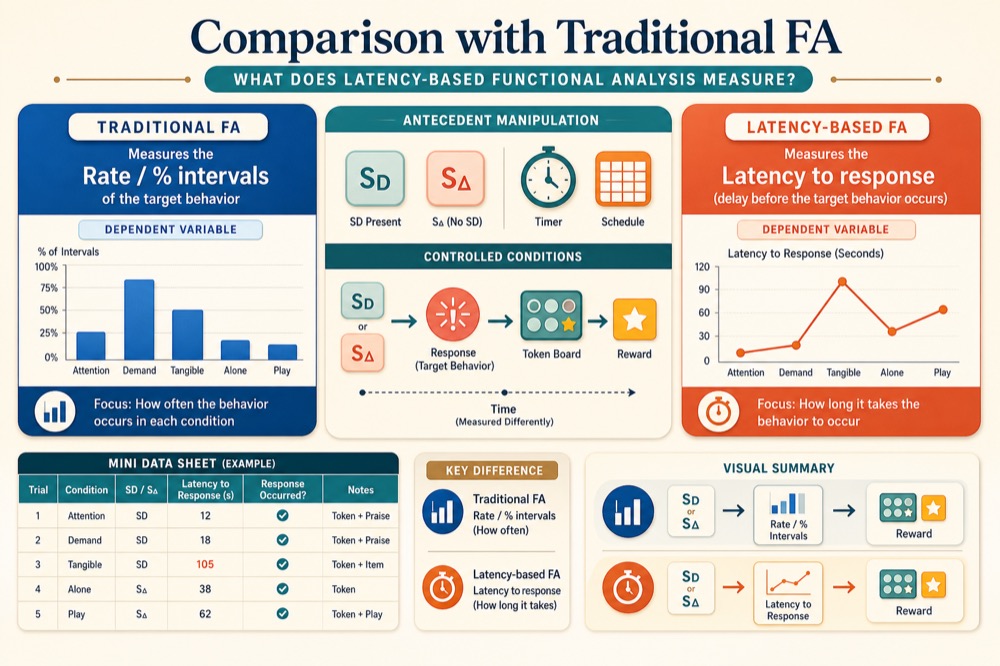
Both latency-based FA and traditional FA involve antecedent manipulation and controlled conditions. The main difference lies in the dependent variable. Traditional FA typically measures the rate or percentage of intervals of the target behavior, while latency-based FA measures the time to first response. This difference has several implications:
- Safety: Latency-based FA can be safer for dangerous behaviors because it minimizes the number of occurrences needed. The session can be terminated as soon as the behavior occurs.
- Sensitivity to EO effects: Both methods are sensitive to EOs, but latency may capture the immediacy of the EO’s effect more directly.
- Data collection: Latency is a continuous measure, while rate is a ratio of count to time. Both are valid measurement dimensions.
- Feasibility: For low-frequency behaviors, traditional FA may require long observation periods to obtain enough data; latency-based FA can be more efficient because only the first response is needed.
That said, latency-based FA is not always superior. It may not be appropriate for behaviors that are under automatic reinforcement if the alone condition is used as a control, because the behavior may not occur quickly. Also, traditional FA provides richer data on response patterns over time. The choice of method depends on the behavior and clinical context.
Safety and Ethical Considerations
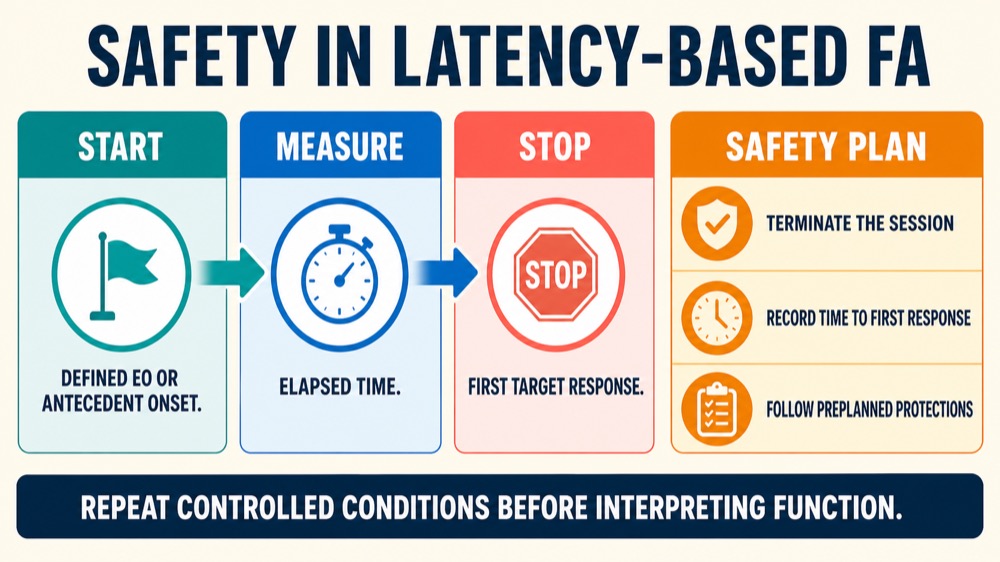
Latency-based FA, like any functional analysis, involves the risk of evoking dangerous behavior. Even though the first response is the only required occurrence, that response could cause harm. Therefore, it is essential to have emergency procedures in place, such as a plan for blocking or redirecting the behavior, and to conduct a risk-benefit analysis before implementing the assessment. The behavior analyst must ensure that the assessment is conducted by trained personnel and that protective equipment or medical support is available if needed. Ethical considerations, including client assent and informed consent, are also paramount.
The BACB BCBA Test Content Outline (6th ed.) identifies measurement and assessment competencies. A peer-reviewed latency-based FA example is available in Thomason-Sassi et al. Use these sources to distinguish the official content framework from the empirical method and to select measures based on behavior, risk, and context.
Common Misconceptions
When studying for the BCBA exam, be aware of these common misunderstandings:
- Misconception 1: Believing that latency-based FA measures the duration of the target behavior. Correction: It measures the time to the first response, not how long the behavior lasts.
- Misconception 2: Treating the shortest-latency condition as conclusive without replication or control of other variables. Correction: Multiple confounds could affect latency; replication is needed.
- Misconception 3: Thinking latency-based FA is the only valid method for dangerous behaviors. Correction: Other methods like trial-based FA or descriptive assessments may also be used.
- Misconception 4: Believing latency-based FA is always superior to traditional FA. Correction: Each method has advantages and limitations.
- Misconception 5: Expecting that a specific latency-based FA question will appear on a particular exam date. Correction: Exam content is not disclosed in advance; prepare broadly.
Study Checklist
Use this checklist to reinforce your understanding before moving on:
- I can define latency-based functional analysis and identify the dependent variable.
- I can explain why latency-based FA is preferred for dangerous or low-frequency behaviors.
- I can name the common conditions (attention, escape, tangible, alone) and the EO in each.
- I can describe how to record latency and the importance of a maximum latency cutoff.
- I can interpret latency data by comparing conditions and considering confounds.
- I can distinguish latency-based FA from traditional FA in terms of measurement and procedure.
- I can identify common traps, such as confusing latency with duration.
Conclusion
A latency-based functional analysis measures the time from the onset of an establishing operation or other defined antecedent to the first target response. Repeated, controlled comparisons of relative latency can support a functional hypothesis while limiting the number of dangerous or low-frequency responses. Interpretation still requires replication and attention to confounds. In short, the dependent measure is time to first response.
To test your understanding and get feedback, try our free BCBA mock exam. It offers practice questions across many ABA topics and provides detailed feedback to help you identify areas for improvement.
Next step for BCBA exam prep
Turn this topic into exam-day practice
Use this topic as a focused review, then test it in exam-style conditions with a free mock before deciding whether five full-length mocks are the right next step.
Start the Free BCBA Mock ExamContinue with Five Full-Length Mocks — $99
Review the included materials and access details before ordering. No pass guarantee is implied.



