
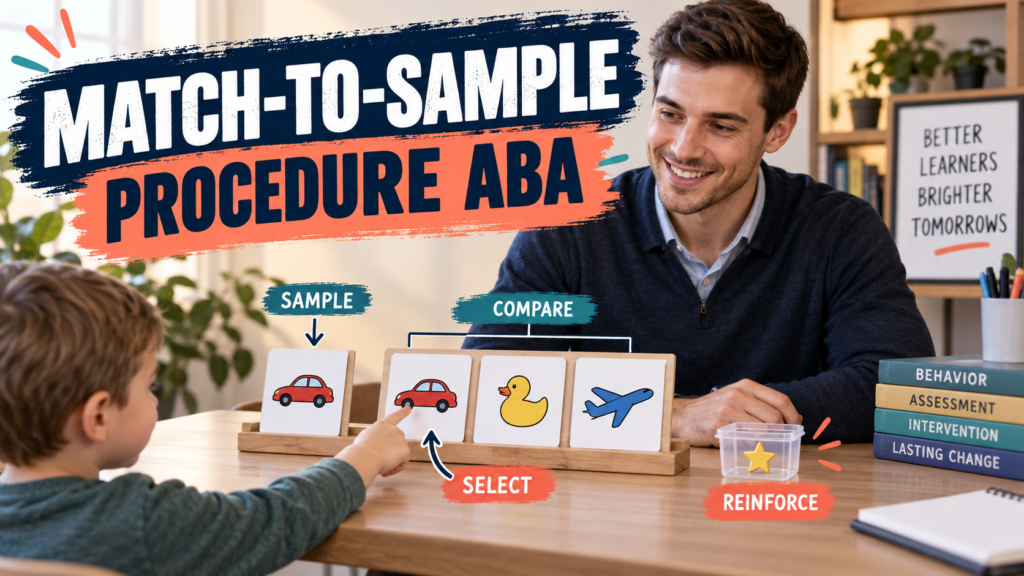
A match to sample procedure ABA trial presents a sample stimulus, presents two or more comparison stimuli, and reinforces the learner for selecting the comparison that bears the programmed relation to the sample. Because the correct comparison changes when the sample changes, matching-to-sample is a procedure for teaching or testing conditional discrimination—not just a picture-matching game.
Table of Contents
- What Is a Match to Sample Procedure ABA?
- What Happens in One MTS Trial?
- How Do You Run Match-to-Sample Step by Step?
- What Are the Main Types of Matching to Sample?
- How Do You Choose the Correct Stimulus Relation?
- What Data Should You Collect?
- How Is MTS Different From Simple Matching?
- How Is Match-to-Sample Tested on the BCBA Exam?
- What MTS Mistakes Should You Avoid?
- Match-to-Sample Procedure ABA FAQ
- Quick Review Checklist
- Take the Free BCBA Mock Exam
For BCBA exam questions, the safest way to analyze matching-to-sample is to reconstruct the trial: identify the sample, identify the comparison array, determine the programmed relation, and then ask what consequence follows the selection. This guide explains the trial sequence, identity and symbolic matching, oddity matching, data decisions, and common traps without turning the page into a general stimulus-equivalence overview. The current BCBA Test Content Outline provides the examination context. Examples below are simplified study illustrations, not a universal teaching protocol or individualized clinical advice. Table of Contents
What Is a Match to Sample Procedure ABA?
A match to sample procedure ABA, often abbreviated MTS, is a conditional-discrimination arrangement. A sample stimulus is presented first. After the learner responds to or observes the sample, an array of comparison stimuli is presented. The learner selects one comparison, and the programmed consequence depends on whether that selection matches the relation established by the sample.
The sample is not merely a picture to copy. It controls which comparison is correct on that trial. If the sample changes, the correct comparison may change too. For example, when a red circle is the sample, the red circle comparison may be correct; when a blue square becomes the sample, the blue square comparison may be correct. The relation, array, response, and consequence must be defined before the procedure can be interpreted.
MTS can be used to teach identity matching, symbolic or arbitrary relations, and other conditional discriminations. It can also be used in assessments of emergent relations, but accurate matching alone does not prove that a full stimulus-equivalence class has emerged.
What Happens in One MTS Trial?
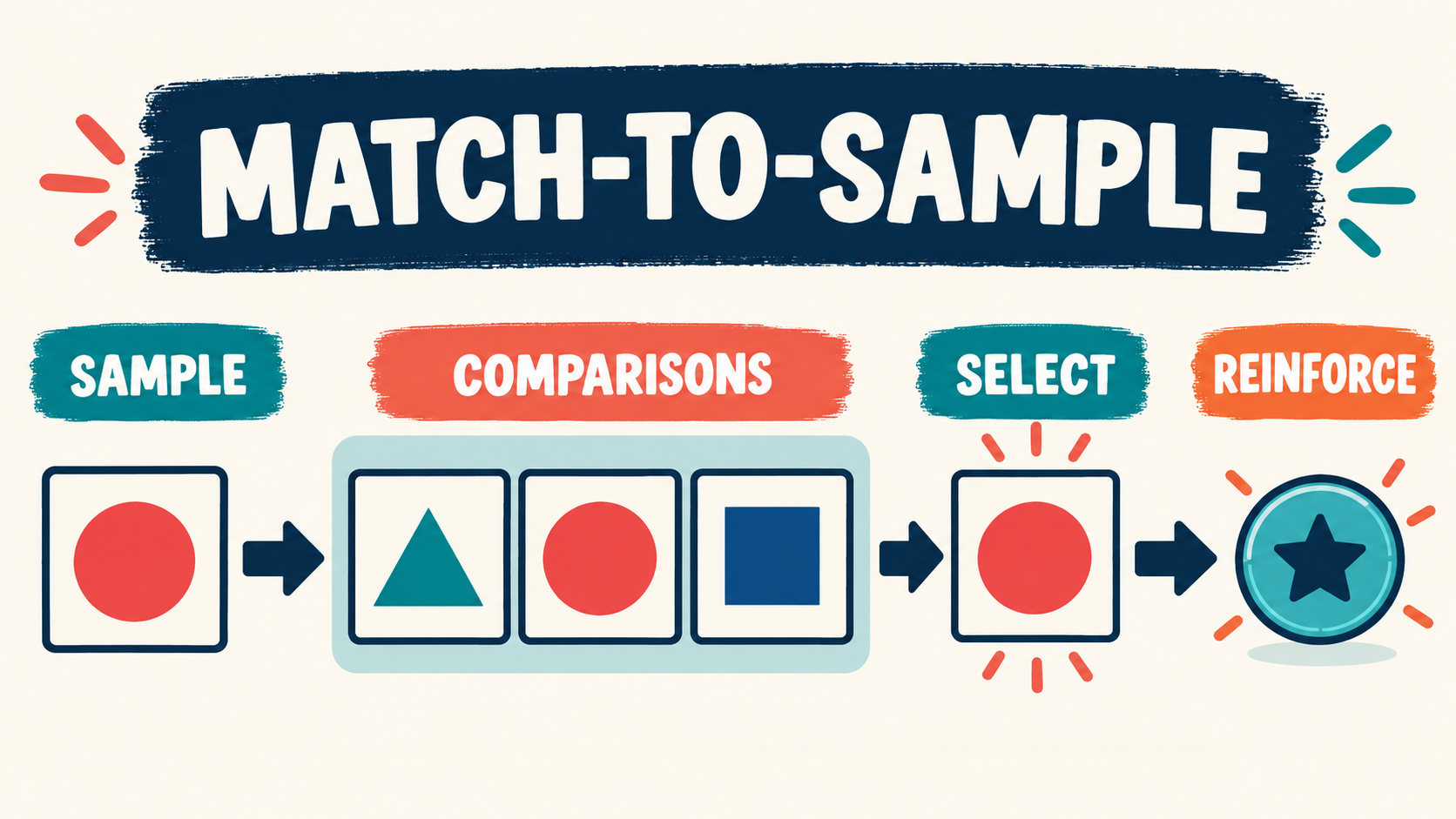
A basic trial has four parts:
- Sample presentation: the learner sees, hears, touches, or otherwise contacts the sample stimulus.
- Comparison presentation: two or more comparison stimuli are presented in a defined array.
- Selection response: the learner selects one comparison according to the response rule.
- Consequence: a correct selection contacts the programmed consequence; an incorrect selection contacts the planned error-correction or no-reinforcement procedure.
Some procedures remove the sample before presenting comparisons, while others keep it visible. The sample’s modality, delay, position, number of comparisons, prompt arrangement, and reinforcement schedule should be specified because each feature can affect what the learner is actually discriminating.
How Do You Run Match-to-Sample Step by Step?
A study-friendly sequence for a planned MTS procedure is:
- Define the relation. Decide whether the learner should select an identical stimulus, a symbolically related stimulus, an opposite, or the odd comparison.
- Select the sample and comparisons. Make the correct relation clear in the teaching materials and choose distractors that test the intended discrimination.
- Arrange the trial. Standardize how the sample appears, when comparisons appear, how the learner responds, and how positions are randomized.
- Teach or probe. Use the planned prompting, fading, reinforcement, and error-correction procedures. Do not call a prompted teaching trial an independent probe.
- Record the response. Track accuracy, prompt level, latency when relevant, comparison position, and the exact stimulus relation.
- Review the pattern. Inspect whether performance changes across samples, comparison positions, people, materials, and settings.
Position randomization matters because a learner can appear accurate by repeatedly selecting the left card. Vary the location of the correct comparison and check whether errors cluster around one position, one sample, one distractor, or one type of relation.
What Are the Main Types of Matching to Sample?
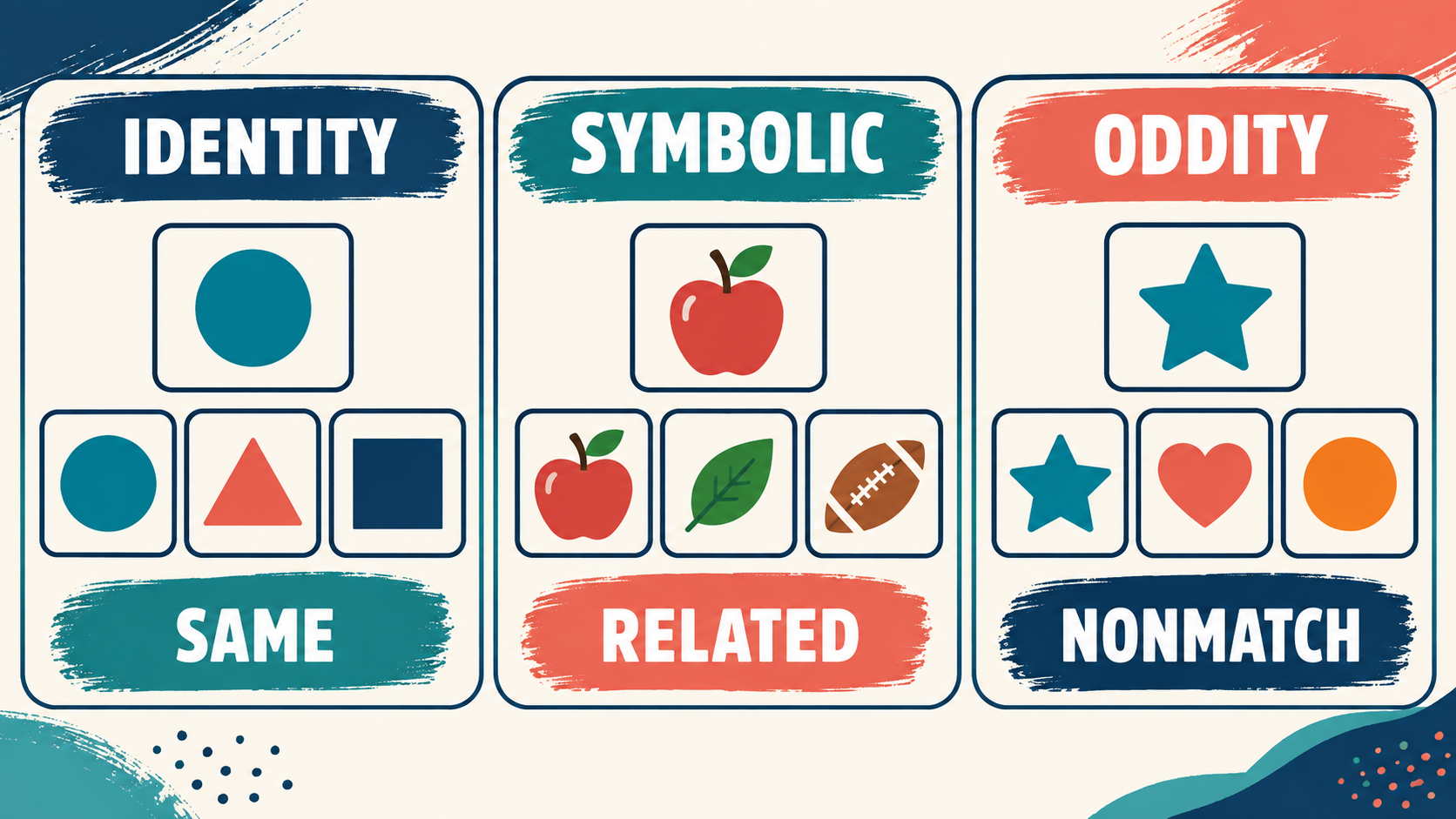
The procedure is identified by the relation between the sample and the correct comparison. The same trial format can teach different relations.
| Type | Relation | Simple example |
|---|---|---|
| Identity | The correct comparison is physically identical to the sample. | Red circle → red circle among a triangle and square. |
| Symbolic or arbitrary | The correct comparison is related by a taught or socially established relation, not physical sameness. | A spoken or written word → its associated picture. |
| Oddity | The correct comparison is the one that does not match the sample or the comparison set, according to the programmed rule. | A star sample → select the comparison that is different from the other options. |
“Symbolic” does not mean that any two related items will be correct automatically. The relation must be taught, established, or otherwise defined by the procedure. A learner selecting a picture because it is visually identical is responding to a different relation than a learner selecting a picture because it represents a spoken word.
How Do You Choose the Correct Stimulus Relation?
Start with the skill or relation that matters outside the teaching trial. If the goal is visual discrimination, identity matching may be appropriate. If the goal is receptive language or reading, the team may teach relations across modalities, such as spoken word to picture or printed word to object. If the goal is concept learning, comparisons should represent the concept rather than merely share a color or position.
Choose distractors that are informative but not needlessly confusing. A distractor may differ in shape, category, function, or another dimension. If several dimensions change at once, an incorrect response may not reveal which discrimination failed. Define what counts as a correct relation and what the learner is expected to do when the sample is ambiguous or unavailable.
What Data Should You Collect?
At minimum, record the sample, selected comparison, correctness, and prompt level. Add comparison position when position bias is possible. For teaching, calculate independent correct responding separately from prompted correct responding. A single total percentage can hide the fact that every correct answer required a prompt.
Review data by sample and by relation. A learner may match identical pictures accurately while struggling with spoken-word-to-picture relations. The team can then adjust the teaching sequence, stimulus salience, prompting, or error-correction plan instead of treating the entire MTS program as one undifferentiated skill.
Probe generalization with new exemplars, people, materials, and settings when that transfer is important. A learner who matches one set of cards in one room has demonstrated performance under those conditions; the data do not automatically establish flexible responding everywhere.
How Is MTS Different From Simple Matching?
In simple matching, the correct answer may be stable because the same feature always identifies it. In MTS, the sample changes which comparison is correct. The learner must attend to the sample-comparison relation rather than select a card based on a fixed location, color, or preferred item.
MTS is also not identical to stimulus equivalence. Matching-to-sample can be used to teach baseline relations that later support tests of reflexivity, symmetry, or transitivity. However, an accurate trained relation by itself is not proof that untrained derived relations have emerged. For a broader overview, review the site’s conditional discrimination ABA guide after learning the specific MTS trial structure.
How Is Match-to-Sample Tested on the BCBA Exam?
For a match to sample procedure ABA question, reconstruct the sequence before looking at the answer choices. Identify what appears first, what changes across trials, what the comparisons are, and what response produces the consequence.
- Sample controls the correct answer: the correct comparison changes when the sample changes.
- Identity matching: the correct comparison is physically the same as the sample.
- Symbolic matching: the correct comparison is related but not physically identical.
- Oddity matching: the correct comparison is the nonmatching option under the stated rule.
- Prompted accuracy is not independent accuracy: record the level of assistance.
A frequent trap is confusing MTS with a simple visual discrimination because both can show cards. Another is choosing “stimulus equivalence” whenever two stimuli are related. The question may only describe a trained conditional-discrimination procedure, not a test of emergent relations.
What MTS Mistakes Should You Avoid?
Do not let the correct comparison stay in one location. Do not use distractors that are so weak that the learner can answer without attending to the sample. Do not change the sample, comparison array, prompt, and reinforcer simultaneously if you want to know what caused a performance change.
Also define the response topography and consequence clearly. Touching, pointing, handing over a card, looking, or selecting on a device may require different response definitions. Build in appropriate assent, accessible materials, meaningful reinforcement, and error correction that does not create unnecessary frustration.
Match-to-Sample Procedure ABA FAQ
What is match-to-sample in ABA?: It is a conditional-discrimination procedure in which a learner responds to a sample and then selects the comparison that bears the programmed relation to that sample. What is an identity match?: Identity matching requires selecting a comparison that is physically identical to the sample, such as matching one red circle to another red circle. What is symbolic matching?: Symbolic matching uses a taught or socially established relation between stimuli that are not physically identical, such as matching a printed word to its picture. What is oddity matching?: Oddity matching reinforces selecting the comparison that is different from the other options, according to the programmed rule. Does MTS prove stimulus equivalence?: No. MTS may teach baseline relations used in stimulus-equivalence work, but trained matching alone does not demonstrate untrained derived relations. Use the free BCBA mock exam as a study checkpoint after reviewing the trial sequence. It is a study aid, not an official BACB product and not a substitute for supervision or individualized assessment. The core decision is simple: identify the sample, identify the comparison relation, record the selection, and inspect the consequence. That sequence is the foundation of a defensible match-to-sample procedure ABA answer. For targeted review, use our match to sample procedure ABA practice questions to apply the concept in exam-style scenarios.
Quick Review Checklist
Use this final checklist to turn match to sample procedure ABA into exam-ready reasoning. The goal is not to memorize a label in isolation; it is to identify the relevant evidence and explain why the best answer fits the scenario. Key ideas to review:
- State the central definition or decision point for match to sample procedure ABA in your own words.
- Identify the detail that makes match to sample procedure ABA different from its closest related ABA term.
- Separate the observable facts in a scenario from assumptions that are not supported by the facts.
- Write one example and one nonexample so you can recognize the concept in a new setting.
Exam application checks:
- Ask what the question is actually requesting before comparing the answer choices.
- Mark the antecedent, response, consequence, or other evidence that supports the selected answer.
- Look for a distractor that describes a related process but does not answer the specific question.
Final self-check:
- Explain how you would verify the interpretation with clear observations or data.
- Change one detail in the scenario and decide whether your answer should change.
- Give a one-sentence rationale that a supervisor or study partner could evaluate.
Take the Free BCBA Mock Exam
If you want a low-pressure way to check your recall, use the free practice resource below. Take the Free BCBA Mock Exam



