

Kaiser ABA reimbursement rates are not one national number. Kaiser Permanente payment can depend on the region, product, member benefit, provider contract, ABA policy, code, modifier, authorization, service date, and claim rules. This guide shows how to verify the applicable documents before quoting a rate or submitting a claim.
Table of Contents
- What Are Kaiser ABA Reimbursement Rates?
- Why Is There No Single Kaiser Rate?
- Which Kaiser Documents Control Payment?
- Which Rate and Claim Fields Must You Match?
- How Do Authorization and Limits Affect Payment?
- What Should You Confirm With the Contract?
- How Do You Verify a Current 2026 Rule?
- What Are the BCBA Exam Clues?
- What Mistakes Should You Avoid?
- Kaiser ABA Reimbursement Rates FAQ
- Sources and Date Check
- Take the Free BCBA Mock Exam
Providers, BCBAs, billers, and families often search for a Kaiser ABA reimbursement rate because they need a concrete number. The harder part is identifying which Kaiser entity, region, plan, provider agreement, and service date the number belongs to. A public policy PDF may be helpful, but it may not be the final word for a particular member or contracted provider.
What Are Kaiser ABA Reimbursement Rates?
A Kaiser ABA reimbursement rate is the amount or payment rule that applies when an eligible Kaiser member receives a defined applied behavior analysis service from an authorized provider under the applicable plan and contract. It may be expressed as a fee-schedule amount, a contracted rate, an allowable charge, a percentage, or another payment methodology. It is not automatically the provider’s charge, the clinician’s salary, or the family’s out-of-pocket amount.
The first answer to “What are Kaiser ABA reimbursement rates?” is therefore: identify the Kaiser region and product, the member’s benefit, the provider’s contract, the exact code and modifier, the authorization, and the service date. Kaiser’s public provider materials show why this matters. A payment-policy document can state that contracts, provider manuals, benefit coverage documents, or regional rules may supplement or supersede the general policy. This does not make the search impossible. It means the correct SEO and operational answer is a verification workflow, not a copied national table that may be wrong for the reader’s region.
Why Is There No Single Kaiser Rate?
Kaiser Permanente is a group of regional health plans and provider networks rather than one uniform ABA billing environment. A Kaiser policy published for Washington may not control a Kaiser member in Hawaii, Northern California, Maryland, Virginia, Colorado, or another service area. Commercial, employer-sponsored, Medicare, and Medicaid-related products can also have different benefit and contract documents. Regional differences can affect:
- which ABA services are covered and who may provide them;
- which CPT codes and modifiers can be billed;
- prior authorization, reauthorization, clinical review, and treatment-plan rules;
- weekly hours, units, concurrent billing, telehealth, or place-of-service limits;
- the negotiated provider rate, allowable charge, dispute path, and claim deadline.
A public policy can answer a general coding question without revealing the contracted amount for every provider. Conversely, a provider manual can describe authorization and billing but still require the contract or regional fee schedule for the actual payment. Read the documents together.
Which Kaiser Documents Control Payment?
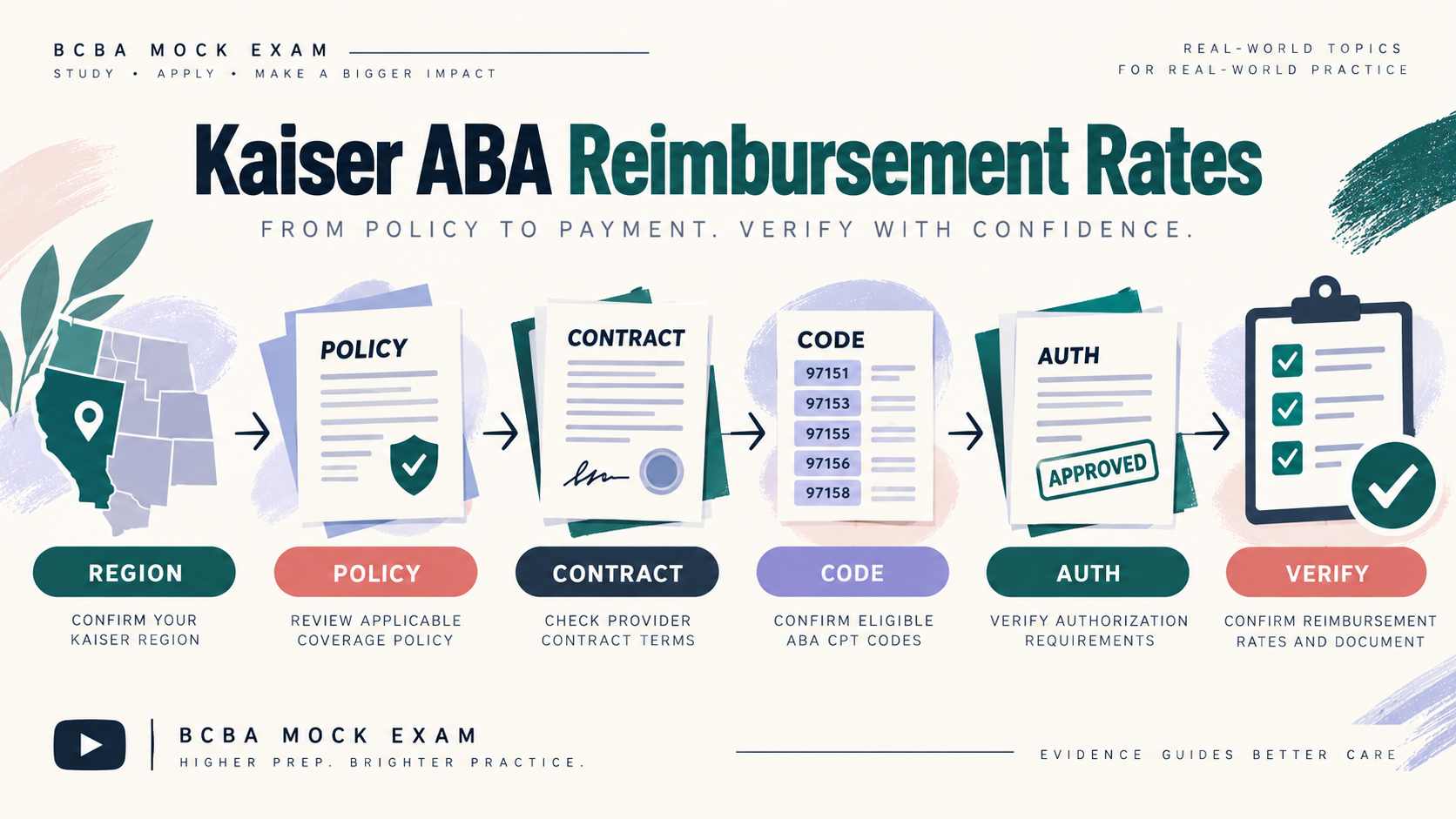
Use a source hierarchy. The document that controls the claim is usually the one tied to the member, provider, product, and service date—not necessarily the first result in a search engine.
- Provider contract and amendments: Check the signed agreement, fee schedule attachment, rate notice, and any later amendment. This is often where the negotiated amount or methodology lives.
- Regional provider manual: Read the ABA chapter and billing sections for coding, authorization, documentation, credentialing, claim submission, and dispute rules.
- Member benefit and plan documents: Confirm that the service is covered for this member and product, including exclusions, cost sharing, network rules, and benefit limits.
- Current clinical policy or payment policy: Use the policy for definitions and general coding guidance, while checking its region, revision date, and supersession language.
- Provider portal notices and written clarification: Check current updates and keep an email, ticket, or written response when a claim question is ambiguous.
Kaiser’s regional provider portals are useful starting points because they organize manuals, payment policies, notices, and contacts. A page that says “current” still needs an effective date. Save the URL, PDF title, revision date, and the date you retrieved it.
Which Rate and Claim Fields Must You Match?
When you record a Kaiser ABA rate or claim rule, capture enough context for another person to reproduce the check.
| Field | What to record | Why it matters |
|---|---|---|
| Region and product | Kaiser region, plan/product, member enrollment, and network status. | A regional manual or product rule may not apply to another member. |
| Code and modifier | Exact CPT code, modifier, provider level, and place of service. | A similar service description can have a different payable row or rule. |
| Authorization | Authorization number, approved dates, units/hours, treatment plan, and reauthorization timing. | A covered code may still deny when the required authorization is missing or expired. |
| Rate or allowable | Contract amount, fee-schedule row, percentage, unit, and effective date. | A public policy amount may not be the negotiated rate for the provider. |
| Claim conditions | Documentation, time rule, concurrent billing, submission deadline, and dispute instructions. | The amount alone does not make an incorrectly documented unit payable. |
How Do Authorization and Limits Affect Payment?
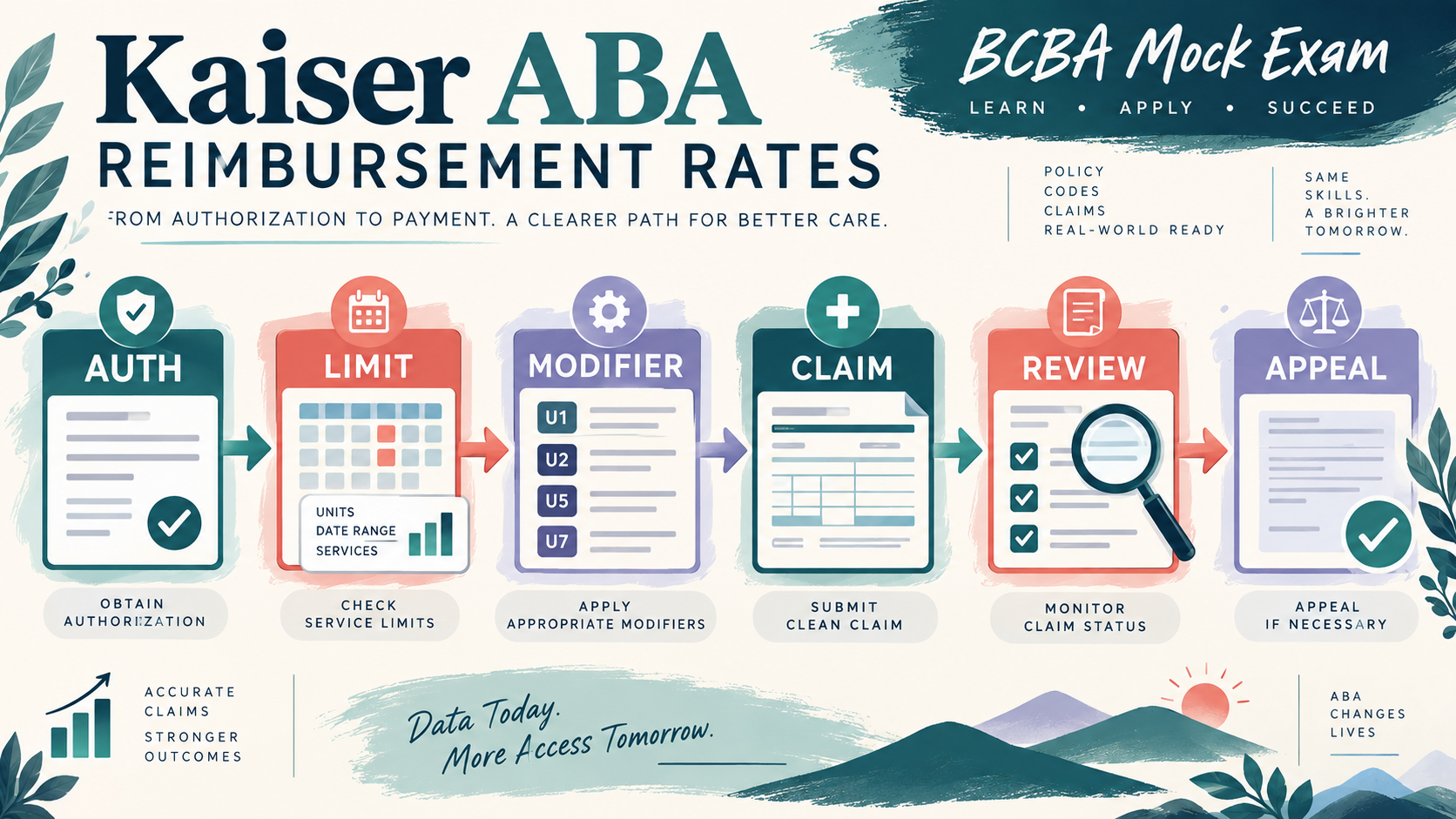
Authorization is not a clerical detail. It connects the clinical request, approved service, time period, code, provider, and member benefit. A regional manual may require prior authorization, treatment-plan review, reauthorization before the current period ends, or specific data from the recent treatment interval. The rule may also differ by product.
Public Kaiser examples show why careful reading matters. Some regional policies discuss weekly service-hour limits, concurrent billing, provider qualifications, telehealth supervision, or treatment planning. Those examples are useful prompts for what to check, but they are not permission to apply the same number to every Kaiser plan. Record the exact region, policy revision, service date, and product before using a limit in a claim workflow.
If an authorization and a contract appear inconsistent, pause the claim decision and ask the plan or provider-relations contact which rule controls. Keep the written response. A verbal estimate or an old spreadsheet is weak evidence when the claim is later reviewed.
What Should You Confirm With the Contract?
For a contracted provider, ask for a written answer to the following:
- Which Kaiser entity and product does the agreement cover?
- Where is the ABA fee schedule or payment methodology attached?
- Are rates different by code, credential, modifier, place of service, or telehealth?
- Does the contract adopt a regional provider manual, and which revision date applies?
- How are authorization, reauthorization, concurrent services, and units handled?
- What is the claim correction and dispute process if the payment does not match the contract?
Do not calculate a provider’s business model from a public policy alone. A rate can be affected by credentialing, network status, negotiated amendments, member benefits, or a service category that the policy does not describe. If a rate is not public, say that it is contract-specific and direct the reader to the correct plan or provider-relations channel.
How Do You Verify a Current 2026 Rule?
Use a dated audit trail:
- Identify the member’s Kaiser region, product, network status, and service date.
- Download the current regional ABA manual, payment policy, fee schedule, and provider updates.
- Find the exact code, modifier, credential, unit, place of service, authorization, and limit.
- Compare the rule with the provider contract and the member benefit document.
- Ask for written clarification when the documents conflict or the negotiated amount is not displayed.
- Save the source version, retrieval date, contact response, and claim-specific notes.
On September 30, 2026, the safest wording for a public article remains “verify the applicable regional and contractual rule.” A future provider update can change the result. If the question is about a denied claim, use the plan’s current explanation, correction process, and dispute deadline rather than relying on an educational article.
What Are the BCBA Exam Clues?
Kaiser ABA reimbursement rates are not a BCBA exam number to memorize. The exam-relevant skill is separating payer administration from clinical and ethical reasoning. The current BCBA Test Content Outline and BACB Ethics Code remain the study anchors.
- If a stem gives two payment documents: identify which region, product, contract, and service date apply before selecting the rule.
- If a stem gives a code and a modifier: read the full service description and provider qualification instead of assuming the base code is enough.
- If a stem asks about a clinical decision: reimbursement pressure does not override client welfare, competence, assessment, data, or ethical safeguards.
- If a stem asks why a claim is denied: check authorization, documentation, timing, coding, provider enrollment, and contract conditions before changing the clinical plan.
For additional scenario practice, the free BCBA mock exam is an independent study aid. It is not an official BACB product and does not replace the current payer documents or professional judgment.
What Mistakes Should You Avoid?
- Publishing one Kaiser ABA rate as if it applies nationwide.
- Using a Washington, Hawaii, or another regional policy for a different member without checking the region and product.
- Assuming a public payment-policy PDF reveals a contracted provider rate.
- Ignoring the authorization period, modifier, credential, place of service, or concurrent-billing rule.
- Confusing a covered benefit with a payable claim or a payable claim with a provider’s final net revenue.
- Making a legal or parity conclusion from a rate difference without the required contract, benefit, and regulatory context.
Kaiser ABA Reimbursement Rates FAQ
Does Kaiser have one national ABA reimbursement rate? No. Kaiser payment can vary by region, product, member benefit, provider contract, code, modifier, authorization, and service date. Verify the regional and contractual source before using a number.
Where can I find Kaiser ABA billing rules? Start with the appropriate Kaiser community provider portal, regional ABA provider manual, payment policy, fee-schedule or contract attachment, and current provider notices. Keep the revision date and retrieval record with the claim or verification file.
Does a Kaiser payment policy show the exact rate my clinic will receive? Not necessarily. A public policy may explain coding or general reimbursement conditions while the provider agreement or regional fee schedule controls the negotiated amount for the contracted provider.
What should I do if the rate or claim rule is unclear? Ask provider relations or the plan for written clarification and include the member, region, product, code, modifier, authorization, and service date. Save the response with the claim record.
Sources and Date Check
This article was reviewed on September 30, 2026 against Kaiser Permanente provider resources including the ABA payment policy, a regional ABA provider manual, and the community provider portal, along with the BACB Ethics Code and BCBA exam materials. Kaiser rules and negotiated rates can change by region, product, contract, and effective date; verify the controlling source before billing or making a coverage decision.
Take the Free BCBA Mock Exam
If you want a low-pressure way to check your recall, use the free practice resource below. Take the Free BCBA Mock Exam



