
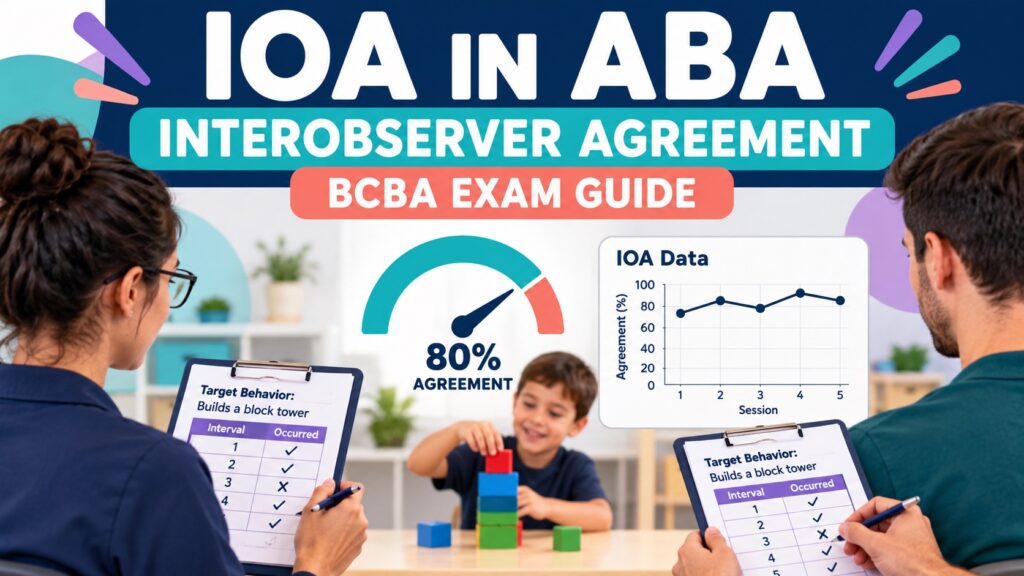
IOA in ABA means interobserver agreement: how similarly two observers independently record the same behavior. It checks measurement quality, not treatment success, by testing the definition, recording system, and observer training.
The formula must match the measurement system. Total count compares smaller and larger totals; exact count-per-interval checks each interval; duration compares time; trial-by-trial compares trial scores. A wrong formula can make a neat percentage misleading.
This guide covers the IOA ABA definition, formulas, examples, observer procedures, mistakes, and exam traps. Use the current BACB BCBA Test Content Outline for terminology.
What Is IOA in ABA?
IOA is the agreement percentage between two independent observers recording the same defined behavior. Both use the same operational definition and procedure, but record independently rather than copying.
IOA asks whether observers produce similar records. High IOA cannot rescue a vague definition, biased sample, or system that misses behavior; reliability and validity are different.
| Term | Definition | What it tells you |
|---|---|---|
| IOA | Agreement between two independent observers’ records. | Whether observers are recording similarly under the procedure. |
| Operational definition | Observable, measurable description of what counts as the behavior. | What observers are supposed to record. |
| Primary observer | Observer whose data are used for the session or decision. | The record that may enter the clinical graph. |
| IOA observer | Independent observer who records the same session or sample. | A comparison record for measurement quality. |
| Validity | Whether the measure represents the construct or behavior of interest. | Whether the data answer the intended question. |
Plan IOA before collection: select sessions or trials, train observers, record independently, use the matching formula, and review disagreements. Do not add a convenient formula after an unusual result.
Why Interobserver Agreement Matters in ABA
Measurement supports description and decisions. If aggression falls from 12 to 4 events, IOA helps distinguish change from inconsistent observation, definition drift, or recording error; it cannot prove treatment causation.
Low agreement may signal unclear start/stop rules, fast behavior, poor visibility, or a cumbersome form. Improve the system rather than blaming the learner or inflating the percentage.
| Reason | IOA contribution | Limit |
|---|---|---|
| Measurement confidence | Shows whether two observers record similarly. | Agreement can be high even when both use a flawed definition. |
| Observer training | Identifies response classes or intervals that produce disagreement. | A single IOA session may not represent all conditions. |
| Clinical decisions | Flags data that may need review before changing a plan. | IOA does not replace functional assessment or visual analysis. |
| Research quality | Documents reproducibility of the measurement procedure. | It does not establish treatment efficacy by itself. |
| Ethical practice | Supports accountable, transparent measurement. | Observers still need scope-appropriate training and supervision. |
Sample representative people, settings, observers, and response rates. Easy low-rate sessions can hide problems during dense behavior; justify the sampling plan.
How to Choose the Correct IOA Formula
Start with the data form, not the desired percentage. Identify total count, interval count, duration, latency, trial score, or interval occurrence; choose the matching denominator.
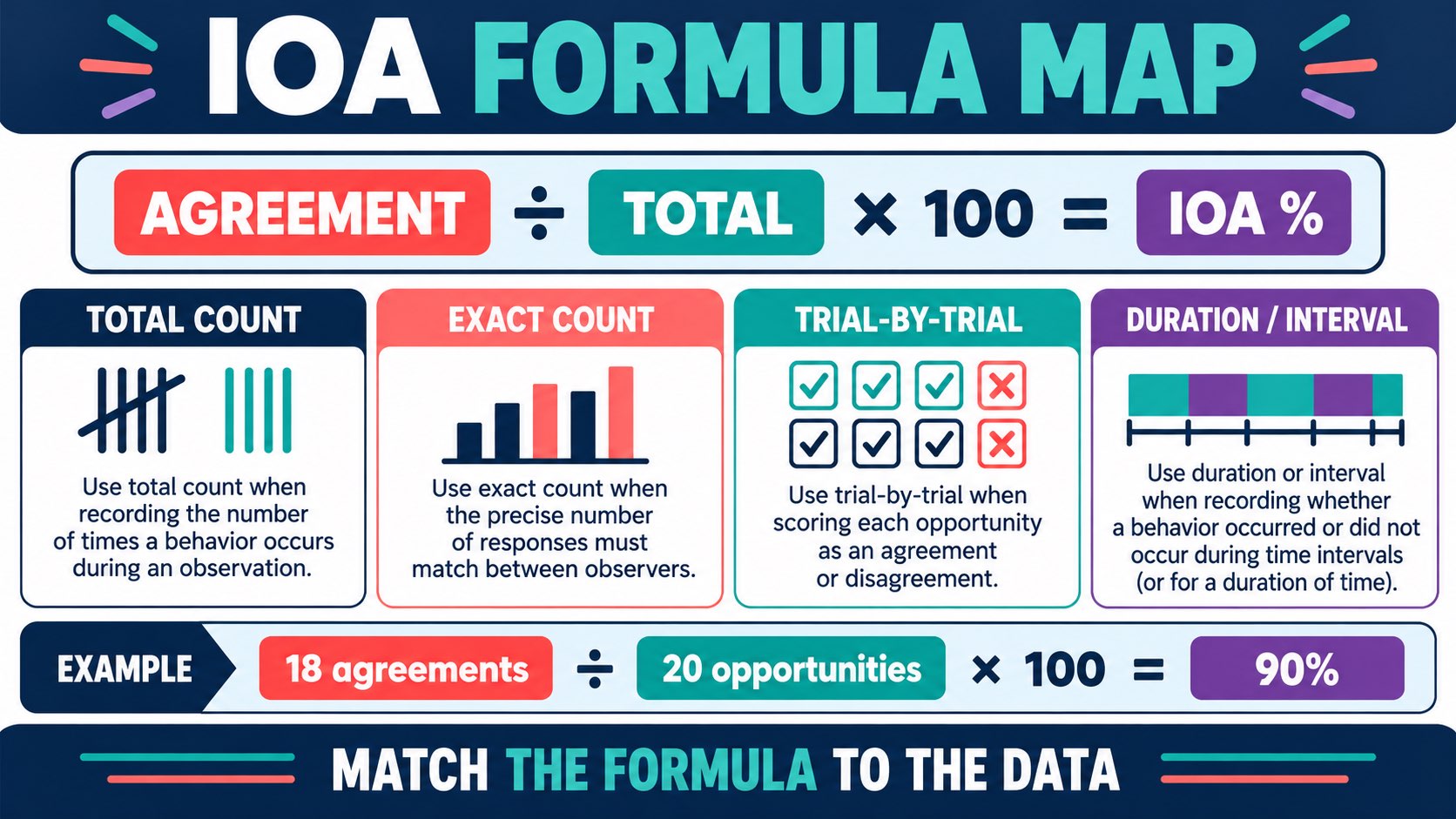
For one session total, total count IOA is smaller count ÷ larger count × 100. Exact count-per-interval compares counts within each interval. Duration methods compare time values when that matches the plan.
| Data type | Common IOA method | Basic formula |
|---|---|---|
| Total frequency or count | Total count IOA | Smaller count ÷ larger count × 100. |
| Counts recorded in intervals | Exact count-per-interval IOA | Intervals with exact count agreement ÷ total intervals × 100. |
| Counts recorded in intervals | Mean count-per-interval IOA | Average of smaller count ÷ larger count for each interval × 100. |
| Occurrence or nonoccurrence by interval | Scored-interval or interval-by-interval IOA | Agreed interval scores ÷ total scored intervals × 100. |
| Duration | Duration-per-occurrence or total-duration IOA | Smaller duration ÷ larger duration × 100, when appropriate. |
| Discrete teaching trials | Trial-by-trial IOA | Trials with identical scores ÷ total trials × 100. |
Names vary across texts. Follow the method in the stem and document the method, raw data, denominator, and rounding rule for replication.
Total Count IOA: Formula and Example
Total count IOA is used when each observer reports one total count for the entire observation period. Suppose Observer A records 18 instances of the defined behavior and Observer B records 20. The smaller count is 18 and the larger count is 20:
18 ÷ 20 × 100 = 90% total count IOA.
Total count is easy but can hide timing disagreement. For high-rate or complex behavior, interval or event-by-event data may better answer the clinical question.
| Step | Calculation or decision | Example |
|---|---|---|
| 1. Confirm the unit | Both observers recorded one total count for the same observation. | One count for a 30-minute session. |
| 2. Identify values | Record each observer’s count. | A = 18; B = 20. |
| 3. Select smaller value | Use the smaller count as the numerator. | 18. |
| 4. Select larger value | Use the larger count as the denominator. | 20. |
| 5. Calculate | Smaller ÷ larger × 100. | 18 ÷ 20 × 100 = 90%. |
| 6. Interpret | Report the method and context, not only the percentage. | Total count IOA was 90% for this session. |
Do not choose total count because it looks high. If agreement on each opportunity matters, use interval, trial, or exact-count data that preserve it.
Exact Count, Mean Count, and Interval IOA
For four intervals, A records 2, 1, 3, 0 and B records 2, 2, 3, 1. Exact agreement occurs in intervals 1 and 3: 2 of 4, or 50%.
Mean count-per-interval retains agreement degree within each interval: divide smaller by larger, convert to a percentage, and average as specified. Use the documented rule for zero-zero intervals.
| Interval | Observer A | Observer B | Exact agreement? |
|---|---|---|---|
| 1 | 2 | 2 | Yes |
| 2 | 1 | 2 | No; counts differ. |
| 3 | 3 | 3 | Yes |
| 4 | 0 | 1 | No; occurrence differs. |
| Total | 6 | 8 | Exact count-per-interval IOA = 2 ÷ 4 × 100 = 50%. |
Scored-interval IOA fits binary occurrence scores. Rare behavior can yield high agreement from many nonoccurrence intervals, so interpret it with base rate and occurrence sensitivity.
Duration, Trial-by-Trial, and Other IOA Methods
For duration, A’s 40 seconds versus B’s 50 gives 40 ÷ 50 × 100 = 80% total-duration IOA. Multiple episodes require corresponding-duration comparisons and the documented average.
Trial-by-trial IOA is common in skill acquisition. Identical scores on 9 of 10 trials equal 90%. Define categories such as independent correct, prompted, incorrect, and no response; a prompt-scoring disagreement is a training issue.
| Method | When to use | Illustrative calculation |
|---|---|---|
| Total-duration IOA | One duration value per observation. | 40 seconds ÷ 50 seconds × 100 = 80%. |
| Duration-per-occurrence IOA | Multiple episodes with corresponding durations. | Compare each pair, then average the agreement percentages. |
| Trial-by-trial IOA | Each teaching trial has a categorical score. | 9 identical trials ÷ 10 trials × 100 = 90%. |
| Latency IOA | Latency is the target measurement and the method is specified. | Compare observer latency values using the program’s planned rule. |
| Interval-by-interval IOA | Each interval is scored occurrence or nonoccurrence. | Agreed interval scores ÷ total intervals × 100. |
Do not mix scoring rules without documenting the change. If observers start latency timing at different events, clarify the procedure; a formula cannot repair mismatched records.
How to Collect Reliable IOA Data
Reliable IOA starts before the session: define the behavior, identify the unit, train with examples and nonexamples, rehearse difficult cases, schedule the second observer, and record independently.
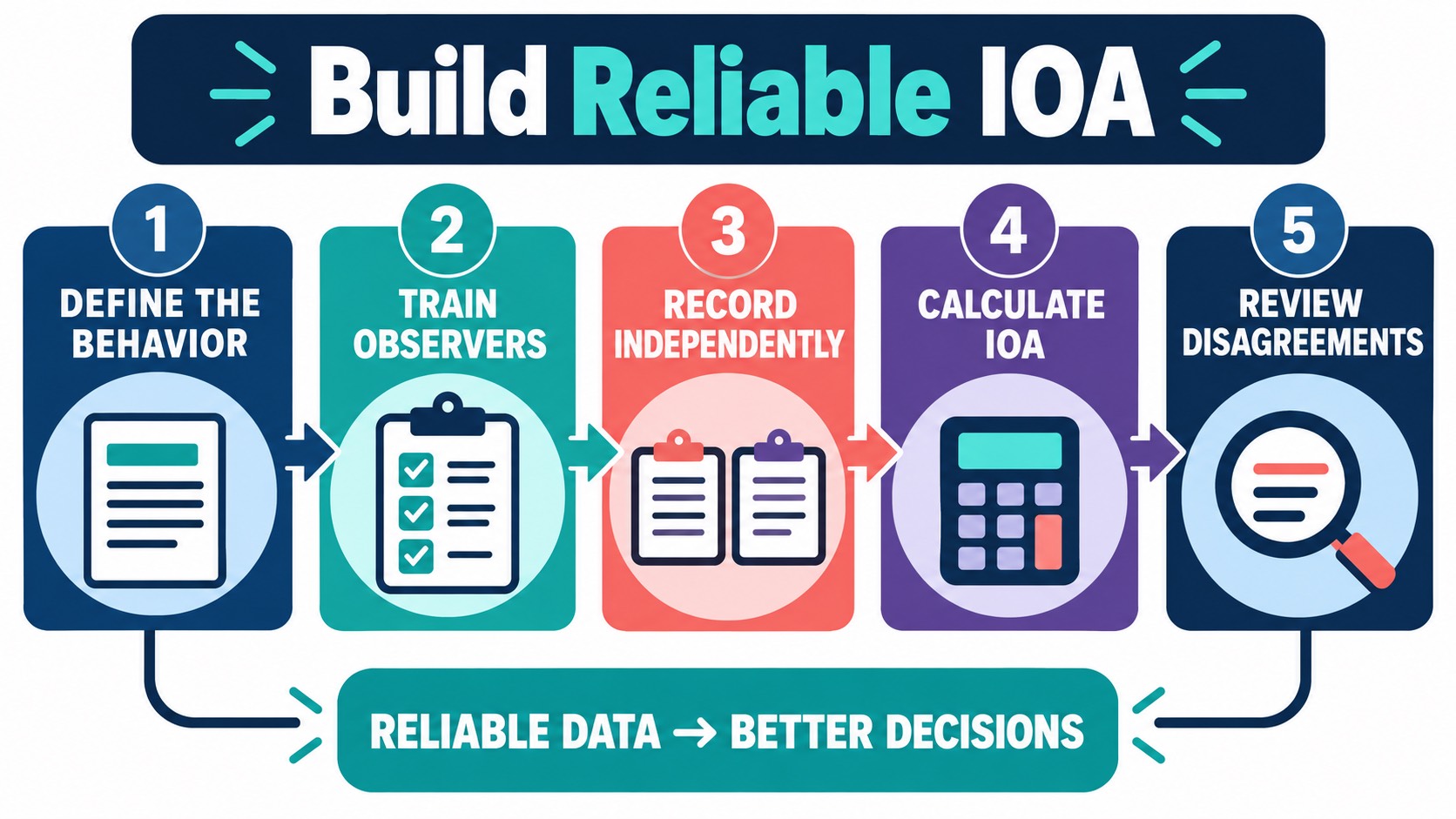
Calculate IOA from raw records and inspect disagreements. If low, review definition, timing, form, rate, prompts, distractions, and visibility; retrain and repeat. Report low values rather than hiding them.
| Collection step | Implementation | Quality question |
|---|---|---|
| Define | Write observable start, stop, and boundary rules. | Could two trained observers identify the same event? |
| Train | Use examples, nonexamples, practice, and feedback. | Can observers apply the rule without coaching during collection? |
| Schedule | Select representative IOA sessions or trials. | Does the sample include relevant rates and conditions? |
| Record | Collect data independently with the same system. | Are observers blind to one another’s scores? |
| Calculate | Use the formula matched to the data unit. | Are numerator, denominator, and rounding documented? |
| Review | Inspect disagreements and revise training or definitions. | Does the result improve future measurement? |
IOA observers should not prompt, announce scores, or resolve ambiguity by consensus during observation. Follow safety plans and document interruptions; balance independent measurement with humane practice.
Interpreting IOA Without Overclaiming
Percentages need context: 90% across five opportunities differs from 90% across 200 intervals. Many agreed nonoccurrences can inflate interval IOA; dense behavior can expose measurement problems.
Interpret IOA with base rate, measurement dimension, session length, training, and decisions. Mark definition changes and use graphs or notes to explain shifts.
| Interpretation issue | Why it matters | Follow-up |
|---|---|---|
| Small sample | A percentage can look unstable with few trials or intervals. | Collect more representative opportunities when feasible. |
| Rare behavior | Agreement on nonoccurrence may inflate interval IOA. | Inspect occurrence sensitivity and the measurement purpose. |
| High-rate behavior | Observers may miss or merge events. | Clarify event boundaries and consider a suitable recording system. |
| Definition change | Pre- and post-change scores are not directly comparable. | Document the revision and retrain observers. |
| Observer drift | Agreement may fall as staff apply rules differently over time. | Use periodic calibration and feedback. |
| High agreement, wrong behavior | Observers can agree on a biased or irrelevant measure. | Review validity, social significance, and the operational definition. |
Do not use IOA as a pass/fail gate without rationale. Ask whether the target is appropriate, disagreement meaningful, and data sufficient for the decision.
Common IOA Mistakes and Better Practice
Common errors are a wrong denominator, nonindependent records, and reporting one easy high-IOA session while ignoring difficult conditions.
IOA asks whether observers agree about behavior; treatment integrity asks whether intervention was implemented as planned. They are different and do not replace fidelity, preference, or functional assessment.
| Mistake | Why it fails | Better practice |
|---|---|---|
| Using total count for interval data | Hides where disagreements occurred. | Use an interval-based method that matches the recording plan. |
| Observers compare forms during collection | Data are no longer independent. | Record separately and compare after the observation. |
| Using the wrong denominator | The percentage no longer represents the opportunities observed. | Write the formula and denominator before calculating. |
| Rounding raw values first | Small changes can alter the final agreement percentage. | Keep raw data and round only at the documented final step. |
| Calling IOA validity | Agreement does not prove the target is measured correctly. | Review operational definition and validity separately. |
| Ignoring low IOA | Measurement problems remain hidden. | Analyze disagreement, retrain, and report the context. |
Compare the site’s operational-definition guide, FBA data guide, and empiricism guide for the measurement chain.
BCBA Exam Traps, Checklist, and FAQ
On an IOA in ABA question, identify the data unit and each observer’s values. Then choose total count, exact/mean interval, duration, or trial-by-trial IOA; do not choose the easiest percentage.
| Exam clue | Likely method or issue | Reasoning move |
|---|---|---|
| Two observers record 18 and 20 responses for the whole session. | Total count IOA. | 18 ÷ 20 × 100 = 90%. |
| Each interval contains an observer count. | Exact or mean count-per-interval IOA. | Use the interval data, not only session totals. |
| Each trial is scored correct or incorrect. | Trial-by-trial IOA. | Count trials with identical scores. |
| Each interval is occurrence or nonoccurrence. | Scored-interval IOA. | Compare interval scores and disclose the method. |
| Observers record 40 and 50 seconds. | Duration IOA. | Compare the smaller duration with the larger duration. |
| Observers watch one another while recording. | Independence problem. | IOA data are compromised; collect independently. |
Checklist:
- Define the behavior.
- Identify the data unit.
- Select the matching formula.
- Train observers.
- Collect independently.
- Calculate from raw data.
- Inspect disagreements.
- Sample representative conditions.
- Separate IOA from validity and integrity.
- Do not infer treatment effect from IOA.
What does IOA stand for in ABA?
IOA stands for interobserver agreement: a comparison of two independent records of the same behavior under the same conditions.
What is the easiest IOA formula?
Total count IOA is smaller total ÷ larger total × 100, and fits one total count per observation.
Does high IOA prove the data are valid?
No. Observers can agree on a vague or biased measure. High IOA supports consistency; validity requires a separate review.
How often should IOA be collected?
Justify sampling across relevant observers, settings, and response rates. Follow current supervision, research, and organizational requirements rather than one universal percentage.
What should I do if IOA is low?
Inspect definition, training, timing, form, rate, and conditions. Retrain or revise, repeat measurement, and document disagreement.
IOA is a method-matched comparison of independent records that tests whether measurement is consistent enough for responsible decisions.
Use the free BCBA mock exam and identify the data unit before doing arithmetic.



