Functional Communication Training represents a cornerstone intervention in applied behavior analysis that teaches individuals to use appropriate communication to meet their needs. This evidence-based approach focuses on replacing challenging behaviors with functionally equivalent communication responses. For BCBA candidates, understanding FCT is essential for both clinical practice and exam success.
Table of Contents
- What is Functional Communication Training (FCT) in ABA?
- Implementing FCT: From Assessment to Intervention
- FCT on the BCBA Exam: Key Focus Areas and Common Traps
- Your FCT Implementation and Study Checklist
What is Functional Communication Training (FCT) in ABA?
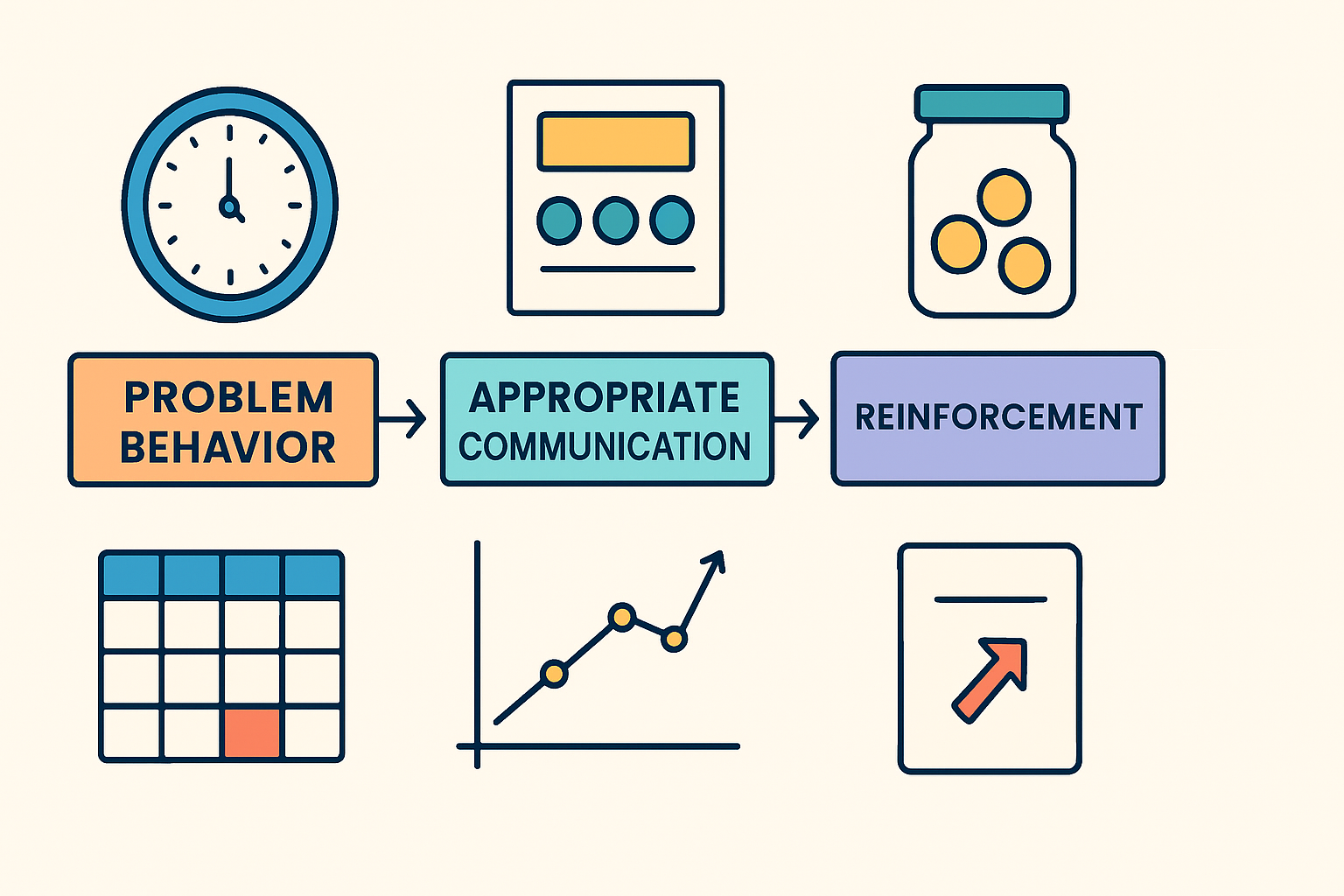
Functional Communication Training is a differential reinforcement procedure that teaches individuals to use appropriate communication to access the same reinforcers that maintain their problem behavior. The core philosophy centers on providing individuals with effective ways to communicate their needs rather than simply suppressing unwanted behaviors.
The Core Principle: Replacing Behavior, Not Just Reducing It
FCT operates on the principle of functional equivalence, where the new communication response serves the same function as the problem behavior. This approach contrasts with extinction-only plans by providing an alternative pathway to reinforcement. The goal is to establish a more socially appropriate behavior that achieves the same outcome as the challenging behavior.
FCT and the BACB Ethics Code: A Foundation of Dignity
Teaching communication aligns with the BACB Ethics Code‘s emphasis on client dignity and autonomy. By providing individuals with effective communication tools, practitioners empower clients to express their needs and preferences. This approach respects client welfare and promotes meaningful participation in their environments.
Implementing FCT: From Assessment to Intervention
Effective FCT implementation follows a systematic process that begins with thorough assessment and progresses through careful intervention planning.
Step 1: The Non-Negotiable Functional Behavior Assessment (FBA)
An FBA is essential before implementing FCT. This assessment identifies the maintaining variables for problem behavior, including common functions like escape, attention, tangible access, or automatic reinforcement. Without a clear functional hypothesis, FCT cannot be appropriately matched to the individual’s needs.
Step 2: Selecting and Teaching the Communicative Response
The chosen communication response must match the identified function while considering the individual’s capabilities. Response selection involves evaluating response effort and ensuring the response is within the learner’s repertoire. Communication modalities can include vocal speech, sign language, picture exchange systems (PECS), or speech-generating devices.
Step 3: Worked ABA Examples of FCT in Action
Example 1: Escape-Maintained Aggression
- Target behavior: Hitting during difficult academic tasks
- Hypothesized function: Escape from demands
- ABC data: Antecedent: Math worksheet presented; Behavior: Hits table; Consequence: Task removed
- Chosen response: “Break, please” card exchange
- Implementation: Teach card exchange before task presentation, reinforce with immediate break
Example 2: Attention-Maintained Screaming
- Target behavior: Loud screaming during independent work
- Hypothesized function: Access to adult attention
- ABC data: Antecedent: Alone at table; Behavior: Screams; Consequence: Teacher approaches
- Chosen response: Raising hand or saying “Help, please”
- Implementation: Teach attention-seeking response, reinforce with brief interaction
FCT on the BCBA Exam: Key Focus Areas and Common Traps
BCBA exam questions often test understanding of FCT principles and implementation considerations.
Must-Know Terms and Concepts for Test Day
- Functional equivalence: The new response serves the same function as problem behavior
- Mand: A verbal operant that requests or demands
- Extinction: Withholding reinforcement for problem behavior
- Reinforcement schedule thinning: Gradually increasing response requirements
- Generalization: Transfer of skills across settings and people
- Maintenance: Long-term retention of learned skills

Top 3 Exam Traps to Avoid with FCT Questions
Common mistakes include implementing FCT without proper assessment or failing to plan for skill maintenance.
- Implementing FCT without FBA: Always conduct functional assessment first
- Neglecting schedule thinning: Must gradually increase response requirements
- Choosing non-equivalent responses: Communication must match function
Your FCT Implementation and Study Checklist
Use this checklist for both clinical implementation and exam preparation.
- Conduct comprehensive functional behavior assessment to identify maintaining variables
- Select communication response that matches the identified behavioral function
- Ensure response is within learner’s current repertoire or can be taught efficiently
- Implement differential reinforcement of the communication response
- Apply extinction procedures for problem behavior (when safe and appropriate)
- Begin with continuous reinforcement for the new communication response
- Systematically thin reinforcement schedules to promote maintenance
- Program for generalization across settings, people, and materials
- Collect ongoing data to monitor progress and make adjustments
- Address response maintenance through periodic review and booster sessions
For more information on behavioral functions, see our guide on the four functions of behavior. To understand differential reinforcement procedures, visit our differential reinforcement guide. For ethical considerations in ABA practice, explore our ethics guide.
For authoritative information on FCT research and applications, consult the Behavior Analyst Certification Board resources and peer-reviewed journals on applied behavior analysis.
Complete BCBA Exam Prep
Turn this topic into exam-day practice
Practice concepts in context with five full-length 6th Edition mock exams, two bonus practice exams, a 6th Edition study guide, and key-term flashcards—all in one $120 USD package.
Get the $120 All-in-One Prep Pack
Review everything included on the product page before ordering. No pass guarantee is implied.