
A practical issuer-and-recognition checklist for comparing IBA, BCBA, local authorization, and employer requirements before you apply or relocate. If you search for international behavior analyst certification, you are probably trying to answer a practical question: which credential will actually support the work you want to do in a specific country, state, employer, or payer system? There is no single label that answers every part of that question.
Table of Contents
- The short answer: identify the issuer first
- Start with the issuer, not the word “international”
- Identify the issuer before comparing requirements
- Compare the requirements without mixing routes
- Run a four-corner recognition check
- Check local authorization before accepting a role
- Recheck the date and country for 2027–2029 changes
- Avoid the four most expensive comparison mistakes
- Use BCBA practice questions after the route is clear
- International behavior analyst certification FAQ
- The bottom line
- Sources to recheck
- Quick Review Checklist
- Take the Free BCBA Mock Exam
Start by separating four layers: the organization that issues the credential, the jurisdiction where you will work, the employer or payer that must recognize it, and the scope of practice you will perform. A BCBA credential, an IBA credential, a local license, and an employer’s internal approval can overlap in one career plan without being interchangeable. This guide gives you a decision record you can verify against current official sources.
The short answer: identify the issuer first
International behavior analyst certification is not one universal credential. “International” may describe where a credential is used, where a candidate lives, or the organization that offers the credential. Before comparing tuition, coursework, or exam dates, write down the exact issuer and the exact recognition question you need answered.
| Credential or approval | What it can establish | What it does not automatically establish |
|---|---|---|
| BCBA certification | A current certification issued and maintained under the BACB’s requirements. | Automatic permission to use a protected title, practice independently, bill a payer, or work in every country. |
| IBA credential | An IBA credential issued through the International Behavior Analysis Organization’s route and current rules. | BACB certification, a local license, or recognition by a particular employer or government. |
| Local license or registration | Authorization defined by a country, state, province, or other competent local authority. | A national or international credential from a different organization. |
| Employer or payer approval | That a particular organization accepts the credential for a named role, contract, or network. | A license, a certification, or permission to work for a different organization. |
Use the BACB international development resources and the current BCBA Handbook for BACB-specific questions. Use the official IBAO International Behavior Analyst page and its current IBA Handbook for IBA questions. Then ask the local authority and employer the questions that those credential pages cannot answer for your situation.
Start with the issuer, not the word “international”
A credential name is not enough. The issuer controls the entry route, evidence, examination, maintenance rules, and the meaning of the credential. The IBAO’s official page describes the IBA as its credential and distinguishes its registration, addition, and certification routes. The same page states that IBAO is not affiliated with, authorized by, endorsed by, or connected with the BACB. That boundary matters: compare the programs, but do not present IBA and BCBA as two names for one certificate.
For a BCBA plan, start with BACB materials and the candidate’s current application date. For an IBA plan, start with the IBAO handbook version and the route that matches your education and experience. For a local practice plan, start with the authority that regulates the role in the location where the services will be delivered. A blog can organize the questions; it cannot replace the issuer’s record or the local rule.
Identify the issuer before comparing requirements
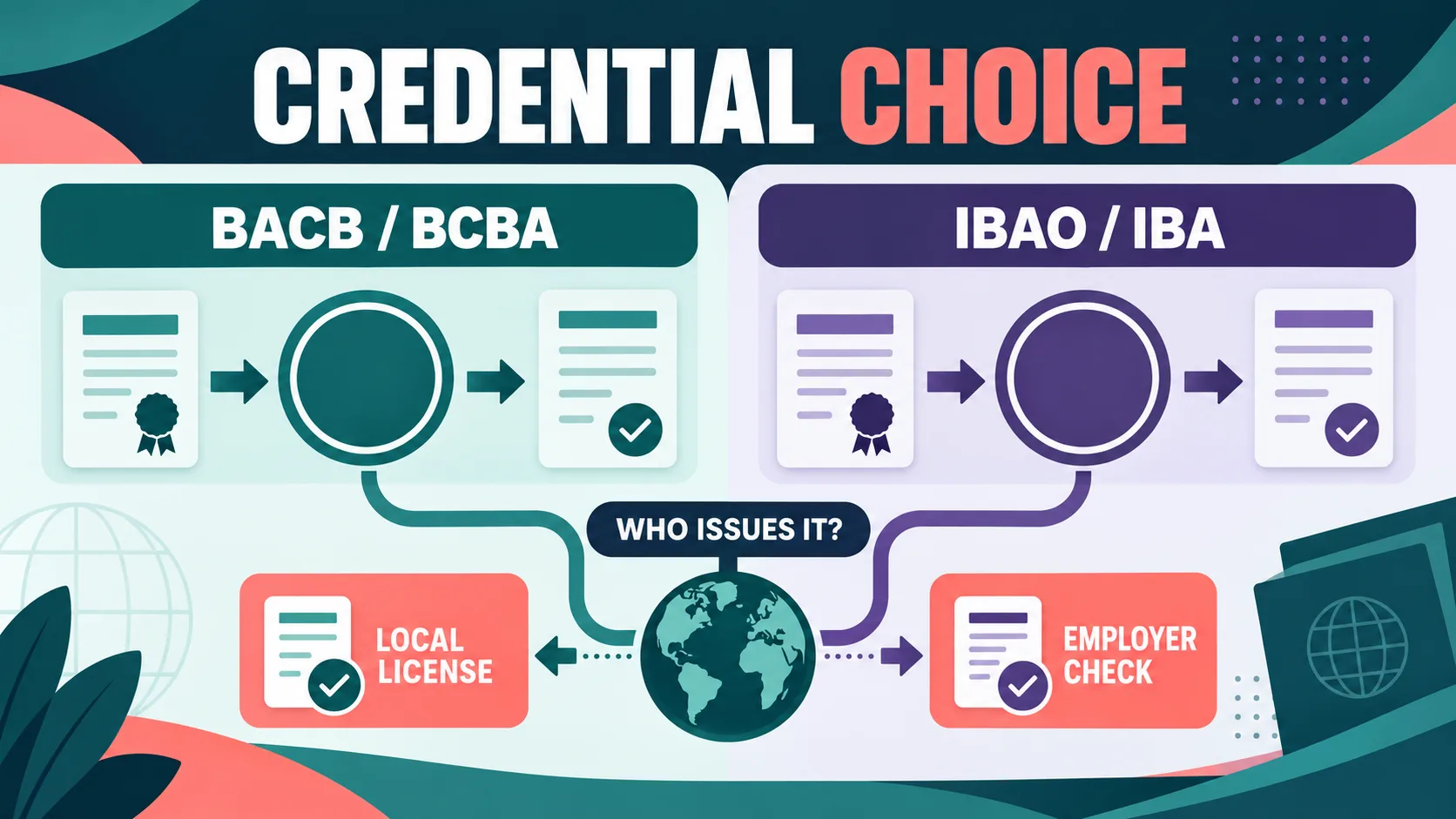
Use the visual below as a routing map, not as a claim that one lane is universally better. Your first decision is “who issues this?” Your second is “who must recognize it for my actual work?” Keep the two answers in separate fields in your notes.
For each candidate credential, capture the official name, issuer, handbook or rule URL, version date, route name, and the contact channel for unresolved questions. If a training provider uses a broad phrase such as “international certification,” ask the provider to identify the credentialing organization and the official public standard before you pay or submit documents.
Compare the requirements without mixing routes
Requirements should be compared at the route level. The current IBA Handbook describes routes involving registration, completion, supervision, and an online examination. It also describes education objectives, a bachelor’s degree or equivalent entry point, a graduate-level or experience-based route, supervised practice, supervision hours, continuing education, candidate skills tests, and the IBA examination. The exact route and handbook version control what applies to an individual candidate.
For BCBA certification, use the current BACB Handbook for the candidate’s application date and pathway. Do not copy an old checklist into a new application, and do not assume that an IBAO requirement is a BACB requirement. The point of the table is to show what must remain separate, not to replace either organization’s official instructions.
| Comparison field | BCBA route | IBA route | Your verification question |
|---|---|---|---|
| Issuer | BACB | IBAO | Which organization will issue the credential shown on my record? |
| Education and route | Follow the current BCBA Handbook and the route available on your application date. | Follow the current IBA Handbook route, education objectives, and entry conditions. | Which handbook version and route applies to my evidence? |
| Supervised practice | Use the BACB’s current fieldwork rules and documentation. | Verify the IBAO route’s supervised-practice and supervision requirements, including the current handbook’s stated hours. | Who approves the supervisor, hours, forms, and completion record? |
| Examination | Use the BACB examination authorization and current examination instructions. | Verify the IBAO examination and any route-specific skills-test requirement. | What does an exam pass change, and what still remains to be authorized? |
| Maintenance | Check BACB maintenance, ethics, and renewal instructions. | Check IBAO continuing-education and maintenance instructions. | How do I keep this credential current after issuance? |
Run a four-corner recognition check
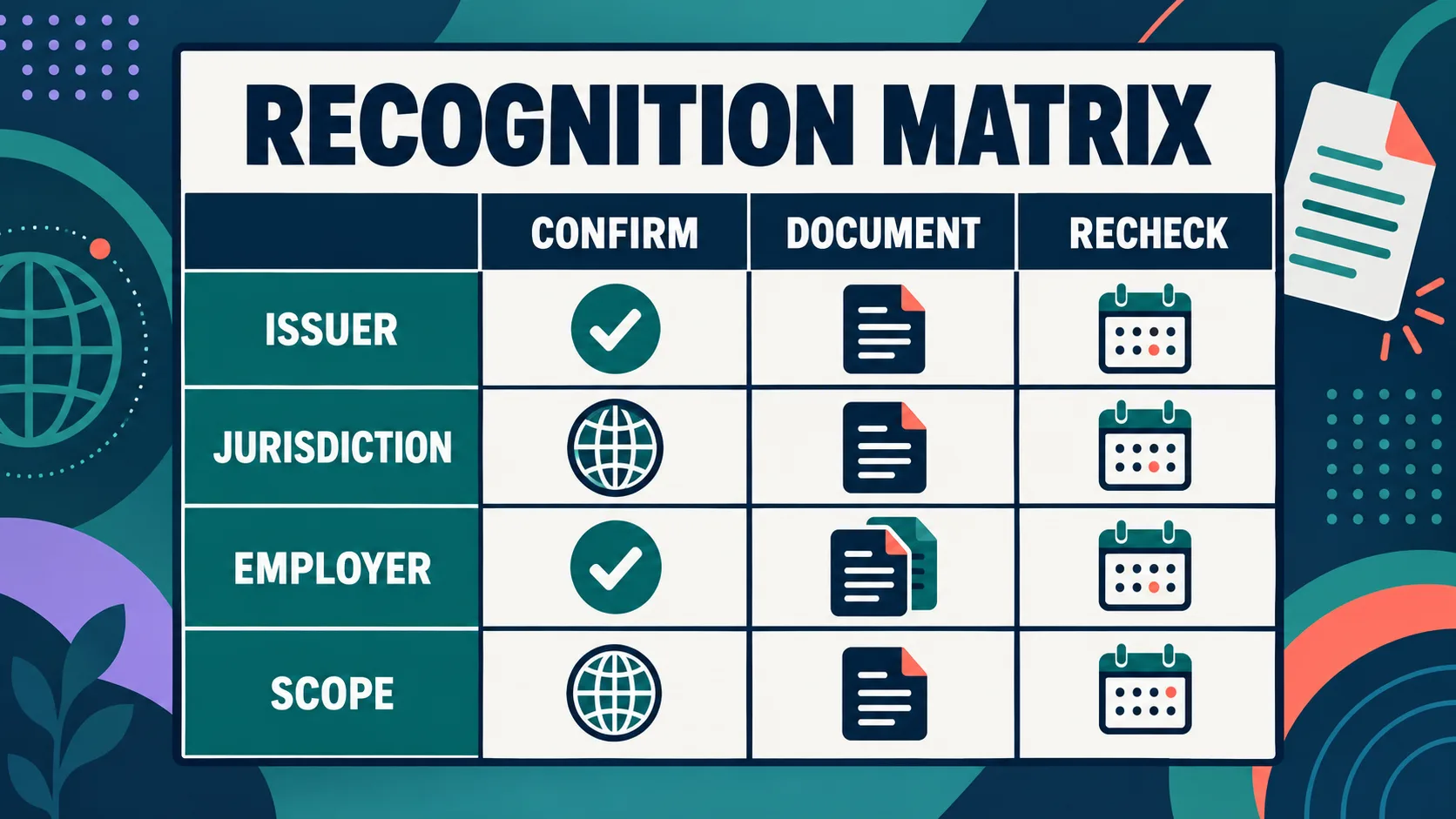
Recognition is not one yes-or-no property. Check four corners separately: the issuer, the jurisdiction, the employer or payer, and the scope of the role. A credential can be authentic and current while still requiring a local license or additional approval for the work you plan to do.
| Recognition corner | Confirm | Document | Recheck |
|---|---|---|---|
| Issuer | The official credential name, issuer, current status, and credential number. | Issuer record, handbook version, email, or account notice. | Before renewal, relocation, or a change in route. |
| Jurisdiction | Whether the country, state, province, or regulator requires a local license, registration, or reserved title. | Current government or regulator page and written response when needed. | Before starting services, moving, or changing the service model. |
| Employer or payer | Whether the organization accepts the credential for the named role, contract, or network. | Written job, credentialing, or contracting response. | Before accepting an offer or submitting claims. |
| Scope | Whether the credential and local rules cover assessment, supervision, telehealth, documentation, and the service population. | Role description, scope rule, supervision plan, and service agreement. | When duties, supervisor, client group, or delivery location changes. |
Ask narrow questions. “Is the IBA recognized?” is usually too broad. “May a person holding a current IBA provide this named service in this jurisdiction under this employer’s supervision, and is a local registration required?” creates a record that can actually guide a decision.
Check local authorization before accepting a role
Local rules can concern the title you use, the services you provide, the setting, the supervisor, telehealth, reimbursement, or immigration and employment paperwork. The answer may differ even between nearby jurisdictions. Do not treat a country page, an employer’s job title, or a credentialing advertisement as a complete local authorization opinion.
| Local question | Evidence to request |
|---|---|
| Is the title regulated or reserved? | The current regulator page, statute, rule, or written authority response. |
| Is a local license or registration required? | Application name, eligibility language, status lookup, and any local examination or jurisprudence requirement. |
| Who may supervise the work? | Local supervision rule, employer policy, and a written supervision arrangement. |
| Will the payer credential the provider? | Payer enrollment criteria and confirmation for the exact credential and service code. |
| Can the person legally work there? | Separate employment or immigration advice from the relevant authority; certification alone is not work authorization. |
Recheck the date and country for 2027–2029 changes
Credential rules are date-sensitive. The BACB’s upcoming-changes resources should be checked against your application date and country. A transition notice may affect which evidence, pathway, or form applies to a BCBA candidate, but it does not automatically decide whether a local authority or employer will recognize the resulting credential.
Make a snapshot before you submit: save the official handbook or transition page, record the access date, and write the exact rule that affects your route. Then recheck the live source immediately before payment, application, examination, relocation, and employment. Avoid promises such as “this credential will work everywhere.” A defensible plan names the jurisdiction and the authority responsible for the answer.
Avoid the four most expensive comparison mistakes
- Treating IBA and BCBA as synonyms: the credentials have different issuers and rule books. Compare them without merging their identities.
- Calling an exam authorization a certification: an authorization can permit an exam step while the final credential remains pending.
- Assuming “recognized internationally” means licensed locally: local title, practice, payer, and employment rules still need their own answer.
- Using a training provider as the final authority: ask the issuer, regulator, employer, or payer that owns the decision.
If you already hold a credential, do not start by buying another course. First document the gap: issuer recognition, local authorization, role scope, employer acceptance, or a genuinely missing eligibility requirement. That single distinction can prevent a costly duplicate application.
Use BCBA practice questions after the route is clear
Practice questions are useful when your chosen route includes BCBA exam preparation or when you want to test your behavior-analytic reasoning before an application milestone. They do not establish IBAO membership, BACB eligibility, local licensure, immigration status, or employer recognition. Keep the study plan separate from the credential-recognition tracker.
For candidates preparing for the BCBA exam, use the Free BCBA Mock Exam to practice scenario-based decisions and record why each answer is correct. Then return to the issuer and jurisdiction checklist for the administrative question that practice tests cannot answer.
International behavior analyst certification FAQ
Is an IBA the same as a BCBA?: No. They are credentials associated with different organizations and rule books. The IBAO’s official materials describe the IBA credential and separately state that IBAO is not affiliated with, authorized by, endorsed by, or connected with the BACB. Verify the credential you need with the employer and local authority.
Does a BCBA let me practice in any country?: Not automatically. Check the local title, license or registration, scope, supervision, payer, and employment rules for the country or jurisdiction where the service will be delivered. A current BCBA record answers the BACB certification question; it does not answer every local practice question.
Which IBA requirements should I check first?: Start with the current IBA Handbook version and the route that matches your education and experience. Confirm the education conditions, supervised-practice and supervision requirements, skills-test or examination steps, continuing education, and maintenance rules before relying on a provider’s summary.
What should I ask an employer?: Ask which issuer and credential name the role accepts, whether a local license or registration is required, whether the payer has separate enrollment rules, and whether the approval is limited to a named role, location, or supervisor. Request the answer in writing.
The bottom line
Choose an international behavior analyst certification by starting with the issuer and ending with the actual work location. Compare BCBA and IBA requirements in their own official handbooks, then verify local authorization, employer or payer acceptance, and scope of practice. Save the version and date of every rule you rely on, recheck 2027–2029 transition information before applying, and treat a credential as one part of a recognition decision—not as a universal license.
Sources to recheck
Official references: the IBAO International Behavior Analyst page, the IBA Handbook, the BACB international development page, the BCBA Handbook, and the BACB upcoming-changes page. Requirements, transition dates, local rules, and employer policies can change, so verify the live authority before relying on this checklist. For targeted review, use our international behavior analyst certification practice questions to apply the concept in exam-style scenarios.
Quick Review Checklist
Use this final checklist to turn international behavior analyst certification into exam-ready reasoning. The goal is not to memorize a label in isolation; it is to identify the relevant evidence and explain why the best answer fits the scenario. Key ideas to review:
- State the central definition or decision point for international behavior analyst certification in your own words.
- Identify the detail that makes international behavior analyst certification different from its closest related ABA term.
- Separate the observable facts in a scenario from assumptions that are not supported by the facts.
- Write one example and one nonexample so you can recognize the concept in a new setting.
Exam application checks:
- Ask what the question is actually requesting before comparing the answer choices.
- Mark the antecedent, response, consequence, or other evidence that supports the selected answer.
- Look for a distractor that describes a related process but does not answer the specific question.
Final self-check:
- Explain how you would verify the interpretation with clear observations or data.
- Change one detail in the scenario and decide whether your answer should change.
- Give a one-sentence rationale that a supervisor or study partner could evaluate.
Take the Free BCBA Mock Exam
A useful next step is to apply this idea in a fresh set of BCBA-style practice questions and review the feedback. Take the Free BCBA Mock Exam



