

A critical-path audit for finding the shortest compliant BCBA route without skipping eligibility, fieldwork, application, or examination requirements. If you are searching for the fastest way to become a BCBA, the useful answer is not a promise of a magic number of months. The fastest route is the shortest compliant critical path from your current starting point to a complete application and a successful examination. That path depends on your degree, coursework route, fieldwork access, supervisor, application date, and exam readiness.
Table of Contents
- The fastest way to become a BCBA is a compliant critical path
- Start with a five-minute readiness inventory
- Separate non-compressible gates from preparation
- Map the gates before you optimize the calendar
- Choose the pathway using the application date
- Find the current bottleneck
- Protect the fieldwork record while moving quickly
- Prepare the application before the gate opens
- Start exam preparation before the final week
- Avoid false shortcuts
- Turn the audit into a seven-day plan
- Fastest way to become a BCBA FAQ
- The bottom line
- Sources to recheck
- Quick Review Checklist
- Take the Free BCBA Mock Exam
This guide is deliberately different from a general “how to become a BCBA” roadmap or a duration calculator. It helps you find the gate that is actually slowing you down, identify work you can prepare in parallel, and avoid spending time on a step that cannot count yet. Always verify the current rules in the BACB BCBA Handbook before you enroll, accrue fieldwork, apply, or schedule an exam.
The fastest way to become a BCBA is a compliant critical path
Think in gates, not shortcuts. A gate is a requirement that must be satisfied and documented before the next official decision can occur. Some preparation can overlap, but overlapping work does not remove a gate. For example, you can study for the exam while completing eligible fieldwork, but practice questions do not replace the degree, coursework, fieldwork, application, or authorization requirements.
| Gate | What must be true | What can slow it down |
|---|---|---|
| Eligibility pathway | You have selected a current BACB pathway that matches your degree, behavior-analytic content, and evidence. | Choosing a program before confirming the pathway or application-date rule. |
| Coursework | The required behavior-analytic coursework is complete or progressing under the route you will use. | A course sequence, verification, or program contact that is unavailable when needed. |
| Fieldwork | Eligible practical fieldwork is accrued with qualified supervision and complete records. | No supervisor, an unsuitable site, missing contracts, or hours that cannot be verified. |
| Application | The application contains the correct current forms and evidence for the pathway and date. | Deficiencies, outdated forms, name mismatches, or a document that must come from another person. |
| Examination | You receive authorization, schedule under the current instructions, and pass the BCBA examination. | Waiting to become eligible before starting preparation, or scheduling before authorization. |
Start with a five-minute readiness inventory
Do not begin by copying someone else’s timeline. Write your current status beside each item below. The first blank or uncertain item is usually more valuable than a generic estimate.
- Degree: What degree do you hold, when was it awarded, and which pathway are you considering?
- Coursework: Is the behavior-analytic content complete, in progress, verified, or not yet selected?
- Fieldwork: Do you have a qualifying site, a supervisor, a signed arrangement, and a system for monthly records?
- Application evidence: Can you identify the current forms, signatures, transcripts, and pathway-specific attestations you will need?
- Exam readiness: Are you learning the content, practicing application questions, or already correcting recurring errors?
If you cannot answer one of these questions, that is not a reason to give up. It is the next research task. The shortest plan usually comes from resolving the first blocking uncertainty before adding more activity elsewhere.
Separate non-compressible gates from preparation
The BACB handbook describes the certification path as a sequence of eligibility, application, examination, and maintenance requirements. The exact pathway and rules can change. Treat official eligibility and documentation gates as fixed constraints; treat scheduling, study, document organization, and communication as work you can optimize.
| Activity | Can often be prepared in parallel | Cannot replace |
|---|---|---|
| Compare eligible programs | Review pathway, faculty, schedule, costs, and how evidence will be verified. | The current BACB eligibility requirements. |
| Find a supervisor and site | Interview supervisors, check qualifications, and build a documentation system. | Qualifying fieldwork hours or a signed supervision arrangement. |
| Study for the exam | Learn concepts, practice scenarios, and repair weak task-list areas while other gates progress. | Eligibility, application approval, or examination authorization. |
| Prepare documents | Check names, dates, signatures, current versions, and storage before submission. | A missing record that only a university, supervisor, or BACB can issue. |
Map the gates before you optimize the calendar
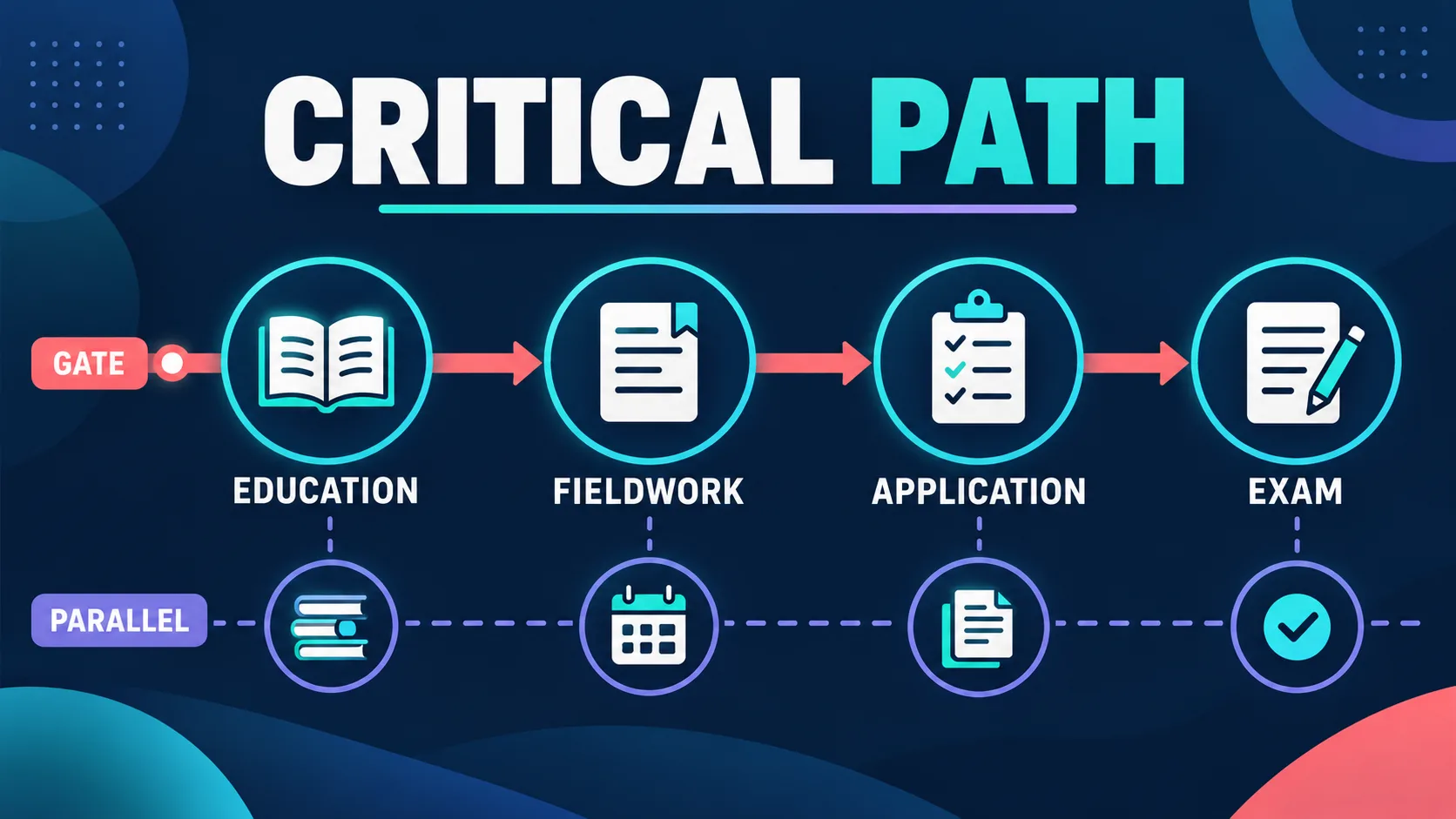
Use the critical-path graphic as a planning model. The path begins with the requirements that control your route, moves through coursework and eligible fieldwork, and then reaches application and examination. The side branch represents preparation that can begin early, such as comparing programs, finding a supervisor, organizing records, and practicing exam-style reasoning.
Parallel work is useful only when it is attached to a real next gate. For example, if your coursework route is not confirmed, do not spend weeks optimizing a fieldwork calendar that may not qualify. If your application evidence is complete but your exam reasoning is weak, shift the bottleneck to targeted practice instead of collecting more general information.
Choose the pathway using the application date
The June 2026 BCBA Handbook says that applicants must meet the requirements in place at the time of application and take the examination version in effect when they schedule the examination. It also notes that new handbook versions may be published quarterly as needed. That makes “fastest” a date-sensitive planning question, not a permanent shortcut.
The BACB’s current upcoming-changes table lists January 1, 2027 revisions to core BCBA eligibility and maintenance requirements, including degree, coursework, supervised fieldwork, continuing education, and ongoing supervision; it also lists the discontinuation of Pathways 3 and 4. If your plan crosses that date, save the current official handbook, identify the rule version that controls your application, and recheck before committing to a program or submitting evidence.
Find the current bottleneck
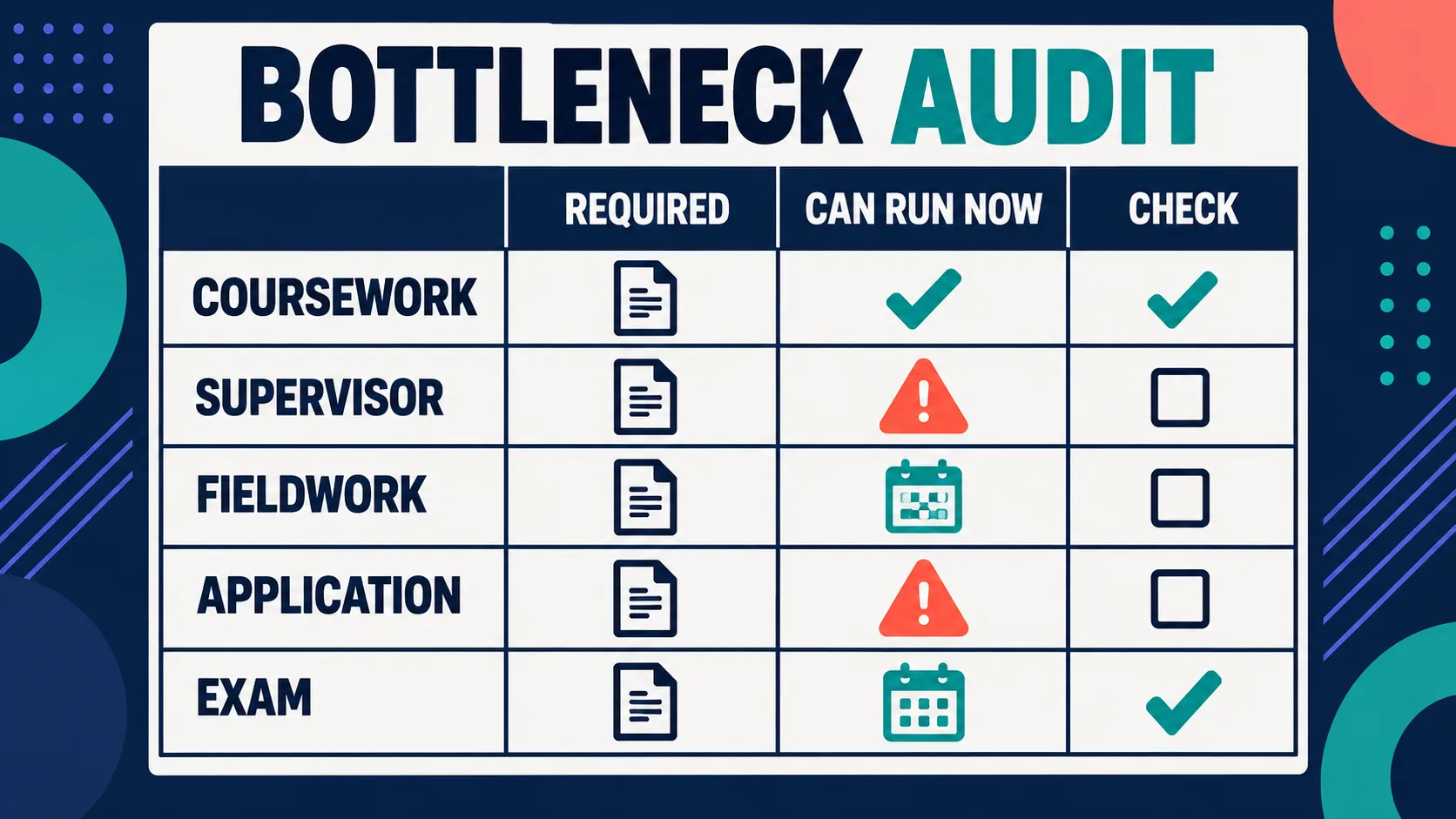
A bottleneck is the unresolved requirement that prevents the next official gate from moving. Mark each row as required, can run now, or needs confirmation. Then work on the earliest row that blocks a later row. This keeps the plan candidate-specific instead of pretending every person starts at the same point.
| Bottleneck | Required evidence | Next question |
|---|---|---|
| Coursework route | Current pathway, program or course evidence, and any required verification. | Who confirms that this coursework counts for my application date? |
| Supervisor | Supervisor qualification, availability, written contract, and fieldwork plan. | Can this supervisor and site support compliant hours and records? |
| Fieldwork | Monthly evidence, supervision contacts, observations, and unrestricted activity records. | Are my hours countable now, or am I collecting activity that cannot be verified? |
| Application | Current forms, signatures, transcripts, attestations, and correct personal information. | Which item could create a deficiency if I submit today? |
| Exam | Authorization, scheduled appointment, content review, and scenario-practice accuracy. | Which task-list area produces repeated reasoning errors? |
Protect the fieldwork record while moving quickly
Fieldwork is a common source of delay because a candidate may have been active without having evidence that can be verified. The current handbook says a written supervision contract should be developed and signed before supervision begins. It also describes ongoing documentation, monthly fieldwork verification forms, final forms, signatures, and record retention. Use the current BACB forms and instructions; do not rely on a spreadsheet alone.
| Record control | Why it matters for speed |
|---|---|
| Signed contract before supervision | It prevents a later discovery that the relationship or responsibilities were never documented correctly. |
| Monthly records and signatures | A missing or late form can turn completed activity into an evidence problem. |
| Current BACB versions | Using an outdated or non-BACB form can create avoidable rework. |
| Seven-year retention | Keep the signed records so an audit or later question does not force reconstruction from memory. |
Prepare the application before the gate opens
You may prepare a document checklist, check your legal name, request transcripts, and confirm who must complete an attestation before you are ready to submit. That is efficient preparation. It is not the same as submitting early. The safest fast plan has a “ready to upload” folder and a separate “still needs official confirmation” folder.
Review the application-date rule each time you make a major change to your path. A course, degree, fieldwork record, or form can be valid in one context and not fit the pathway or date you ultimately use. When a question belongs to BACB, a university, a supervisor, or a local licensing body, send it to that owner and save the answer.
Start exam preparation before the final week
Exam preparation can often run alongside eligibility work, but it should be diagnostic rather than endless. Begin with a short baseline set, classify each error by task-list area and reasoning type, and schedule targeted practice. If you miss questions because you misread the stem, use a different correction routine than if you lack fluency with measurement, assessment, intervention, ethics, or supervision concepts.
Once you are eligible or actively preparing for the exam, use the Free BCBA Mock Exam to practice scenario-based decisions. The CTA is for study readiness only: a practice score does not establish eligibility, fieldwork compliance, application approval, or authorization to test.
Avoid false shortcuts
- Skipping the pathway check: a fast enrollment decision can create a slow correction if the program does not fit your route.
- Counting hours before confirming the setup: activity is not automatically qualifying fieldwork.
- Scheduling before authorization: exam preparation can begin early, but appointment rules still control scheduling.
- Using old transition advice: requirements and handbook versions change; save the current official source and date.
- Confusing speed with quality: rushing documentation can create a deficiency that takes longer to repair than careful preparation.
Turn the audit into a seven-day plan
Use one week to remove uncertainty, not to pretend that every candidate can finish in seven days:
- Day 1: write your degree, pathway, coursework, fieldwork, application, and exam status in one page.
- Day 2: identify the earliest blank or unverified gate and locate the official owner of the answer.
- Day 3: contact the program, supervisor, university, BACB, or licensing authority with one narrow question.
- Day 4: organize current forms, contracts, transcripts, records, and a version/date log.
- Day 5: complete a short practice set and classify your errors instead of only recording the score.
- Days 6–7: choose the next action that removes the bottleneck and set a recheck date.
Fastest way to become a BCBA FAQ
Can I skip fieldwork if I already have experience?: Do not assume that general work experience replaces the current BACB fieldwork requirement. Compare your experience with the current pathway and documentation rules, then ask the responsible authority or qualified program contact before counting it.
Can I study for the exam while completing fieldwork?: Often, yes. Study can be planned in parallel with eligible fieldwork, but it does not replace fieldwork, the application, or examination authorization. Use the critical-path audit to protect the gate that is currently blocking you.
What changes on January 1, 2027?: The BACB’s current upcoming-changes table lists revisions to core BCBA eligibility and maintenance requirements, including degree, coursework, supervised fieldwork, continuing education, and ongoing supervision, and lists Pathways 3 and 4 as discontinued. Check the current BACB materials for the rule that applies to your application date and pathway.
The bottom line
The fastest way to become a BCBA is not to search for a shortcut. It is to identify the exact pathway and application date, remove the earliest bottleneck, prepare parallel work without confusing it with eligibility, and protect every fieldwork and application record. Use official BACB sources for the gates, use targeted practice for exam readiness, and update the critical path whenever the rules or your starting point changes.
Sources to recheck
Official references: the BACB BCBA Handbook, which is updated as needed and sets the application-date and examination-version boundaries, and the BACB Recent & Upcoming Changes page, including the January 1, 2027 BCBA changes. Existing BCBA Mock Exam timeline and roadmap pages are linked for context; they do not replace the live official rules. For targeted review, use our fastest way to become a bcba practice questions to apply the concept in exam-style scenarios.
Quick Review Checklist
Use this final checklist to turn fastest way to become a bcba into exam-ready reasoning. The goal is not to memorize a label in isolation; it is to identify the relevant evidence and explain why the best answer fits the scenario. Key ideas to review:
- State the central definition or decision point for fastest way to become a bcba in your own words.
- Identify the detail that makes fastest way to become a bcba different from its closest related ABA term.
- Separate the observable facts in a scenario from assumptions that are not supported by the facts.
- Write one example and one nonexample so you can recognize the concept in a new setting.
Exam application checks:
- Ask what the question is actually requesting before comparing the answer choices.
- Mark the antecedent, response, consequence, or other evidence that supports the selected answer.
- Look for a distractor that describes a related process but does not answer the specific question.
Final self-check:
- Explain how you would verify the interpretation with clear observations or data.
- Change one detail in the scenario and decide whether your answer should change.
- Give a one-sentence rationale that a supervisor or study partner could evaluate.
Take the Free BCBA Mock Exam
A useful next step is to apply this idea in a fresh set of BCBA-style practice questions and review the feedback. Take the Free BCBA Mock Exam



