
A two-authority checklist for verifying BACB certification, New Jersey LBA status, deficiencies, and the next documented follow-up. If you search for BCBA certification NJ, you may be asking one of two different questions: “Am I eligible for or certified by the BACB?” or “Am I authorized to practice under New Jersey’s state system?” Those questions can be related, but they are not the same status.
Table of Contents
- The short answer: track two credential layers
- Separate the two credential layers
- Build a New Jersey status tracker
- Respond to a deficiency without guessing
- Check the New Jersey layer separately
- Recheck the application-date rule
- Avoid four status mistakes
- Use exam practice while status is pending
- BCBA certification NJ FAQ
- The bottom line
- Sources to recheck
- Quick Review Checklist
- Take the Free BCBA Mock Exam
The site’s New Jersey BCBA roadmap explains the broad education-to-exam route, and the route-selector and evidence planner explains how to prepare the two layers. This page is for the next checkpoint: verify what has actually been submitted, what has been received, what is deficient, which authority owns the next answer, and whether a credential is active.
The short answer: track two credential layers
Use one tracker for the national BACB certification and another for New Jersey’s LBA authorization. Do not label an exam authorization “certified,” and do not label BACB certification “licensed in New Jersey” without checking the state authority and current status.
| Layer | Authority question | Status evidence |
|---|---|---|
| BACB certification | Has the national eligibility, application, authorization, examination, and certification sequence reached the relevant stage? | BACB account message, application record, authorization notice, examination result, or current certification record. |
| New Jersey LBA | Has the state application and any state-specific requirement reached the status needed for New Jersey practice? | State board or licensing-system correspondence, application status, license record, and applicable jurisprudence documentation. |
| Employer or payer check | Does the organization require a credential, license, enrollment, or additional verification? | Written employer, payer, or contract request; never infer it from a job title. |
For a state-sensitive question, use the current BACB materials and the New Jersey State Board of Applied Behavior Analyst Examiners. If the issue is a rule, form, or license status, ask the body that owns that record instead of forwarding the same question to the wrong inbox.
Separate the two credential layers
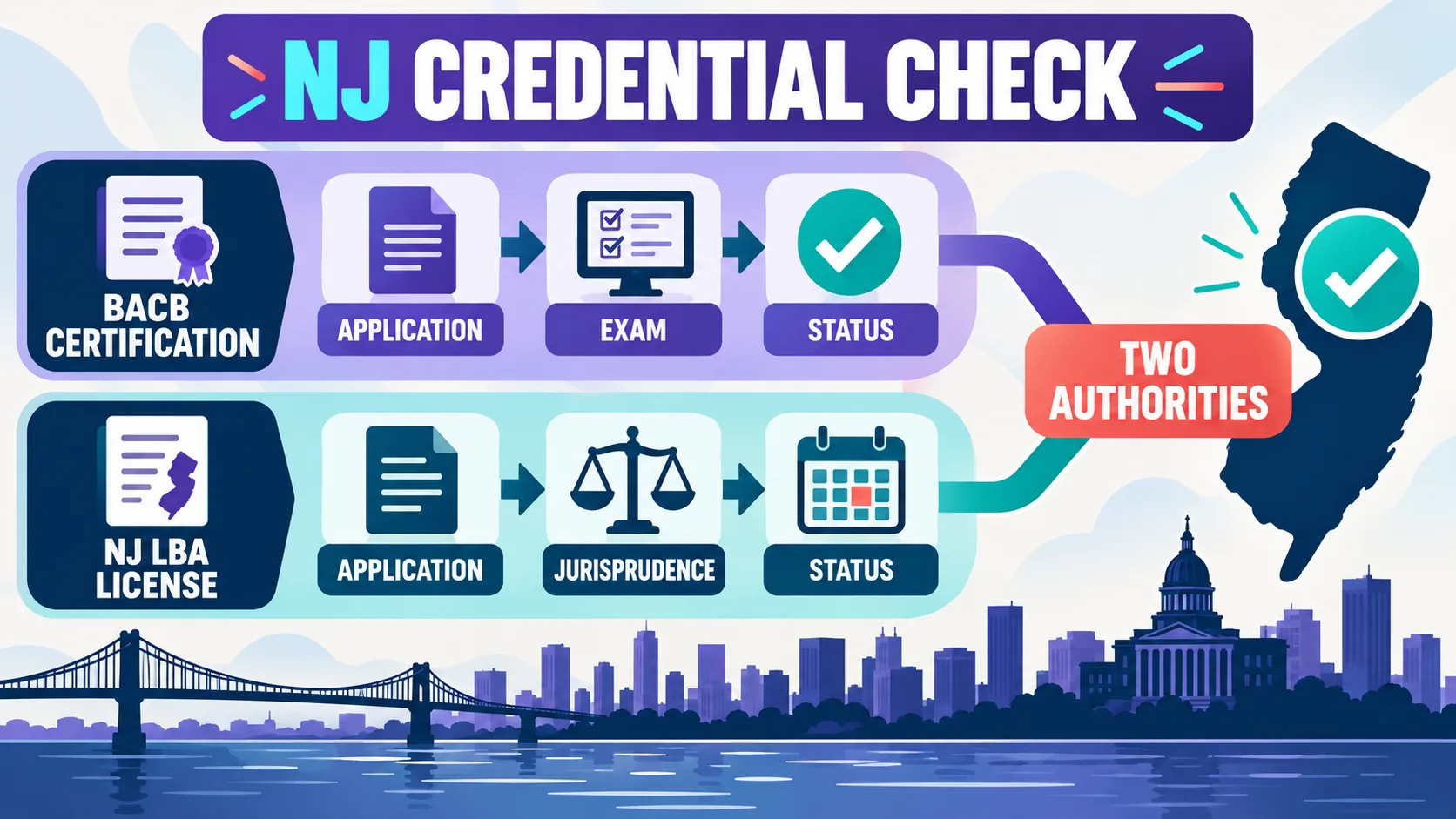
Before you read a status message, name the layer in the first line of your notes. “BACB application received” and “NJ LBA application received” are different facts. A person can be certified nationally and still need a state authorization check; another person can have a state application moving while the national certification is not yet active.
| If your message says… | Do not call it… | Record instead |
|---|---|---|
| Application received | Approved or certified | Received date, authority, reference number, and the next review point. |
| Deficiency or missing document | Rejected without reading the notice | Exact requested item, deadline, sender, submission route, and confirmation after sending. |
| Exam authorization | BCBA certification | Authorization date, exam window, result, and the separate certification status. |
| State license application | National BACB credential | New Jersey application status, state reference, and license record when issued. |
These labels prevent a common handoff error: one person sees “approved” in an email and assumes every credential layer is complete. Copy the exact status wording into the tracker, then add your plain-language interpretation in a separate column.
Build a New Jersey status tracker

A status tracker is useful only if every row has an owner and a next date. Use one row per evidence item or status event. Keep the original email, upload receipt, or account message with the row instead of relying on memory.
| Status | What to record | Next action |
|---|---|---|
| Submitted | Date, channel, fee or confirmation number, and the exact layer. | Set a reasonable follow-up date from the official instructions. |
| Received | Authority’s receipt, application number, and documents shown as received. | Check whether any third-party transcript, verification, or clearance is still pending. |
| Deficient | Exact deficiency, due date, allowed format, and who must send it. | Resolve the item through the named channel; save the delivery proof. |
| Authorized | What the authorization permits, its start or expiry, and which authority issued it. | Do not rename it certification or licensure until the next status is confirmed. |
| Certified or licensed | Credential number, current status, renewal or maintenance date, and display record. | Recheck employer, payer, and state requirements before beginning the role. |
The matrix is not a substitute for an official account or license lookup. It is a memory and handoff control: it tells you what to ask, where the answer belongs, and when to check again.
Respond to a deficiency without guessing
When an application is marked deficient, resist the urge to upload a random document or send a long explanation. First extract the exact request. Then ask four questions:
- Which authority issued the request, and which credential layer does it concern?
- What exact document, form, explanation, or verification is missing?
- Who must provide it: you, a university, a supervisor, an examination provider, or another office?
- What channel, format, and deadline does the notice specify?
After responding, save the file name, upload confirmation, email thread, and date. If the notice is unclear, ask one narrow question that quotes the status language. A clear paper trail reduces the chance that a state question is mistakenly answered with a BACB document, or vice versa.
Check the New Jersey layer separately
New Jersey’s applied behavior analyst board and state information pages are the place to verify the LBA layer, state forms, jurisprudence information, and authorization questions. The state application is not the same as a BACB application. Follow the current New Jersey instructions and use the site’s NJ BCBA licensure application support page for a deeper checklist, but do not treat a blog summary as the official status record.
| New Jersey check | Verification boundary |
|---|---|
| State application | Confirm the state system received the application and any requested supporting record. |
| Jurisprudence information | Check the current state instruction and completion evidence; do not assume a national exam result covers it. |
| License record | Verify the issued license, status, and renewal conditions through the state authority. |
| Scope and employer use | Confirm what the employer, payer, and role require; a job title is not credential proof. |
Recheck the application-date rule
The BACB’s upcoming-changes resources make date-sensitive planning important. If your application or evidence crosses a transition date, save the official page and handbook version you used, then recheck the current instructions before submitting. Do not assume a program advertisement, an old checklist, or a previous candidate’s result controls your application.
Keep the date check separate from the New Jersey license check. The BACB transition may change national eligibility evidence or forms; it does not turn the national credential into a state license. The New Jersey authority may also have its own forms, jurisprudence information, and status process.
Avoid four status mistakes
- Exam authorization equals certification: authorization permits an examination step; it is not the final credential.
- BCBA equals NJ LBA: national certification and state practice authority must be verified separately.
- Received equals complete: an office can receive an application and later request a missing item.
- Job title equals evidence: an employer’s title cannot replace an official certification or license record.
These errors are easy to fix when the tracker uses exact status wording and an authority column. They become expensive when a candidate announces completion before checking the correct record.
Use exam practice while status is pending
You can continue preparing for the BCBA examination while an application or New Jersey status is pending, as long as you keep the purposes separate. Practice questions can reveal gaps in measurement, assessment, intervention, ethics, supervision, and decision-making. They cannot change an application status, satisfy a state requirement, or guarantee eligibility. When you want targeted scenario practice, use the Free BCBA Mock Exam and record the reasoning behind each answer. Keep the status tracker and the study error log as two separate documents.
BCBA certification NJ FAQ
Is BCBA certification the same as an NJ LBA license?: No. They are separate national and state questions. Verify BACB certification through BACB resources and New Jersey authorization through the state board or licensing system.
What does “application received” mean?: It means the authority records the submission as received. It does not automatically mean that every document has been reviewed, that the applicant is authorized to test, or that the credential has been issued.
Should I contact BACB or New Jersey about a status problem?: Start with the authority named in the status message and identify the credential layer. A BACB application question belongs with BACB; a New Jersey license or jurisprudence question belongs with the state authority. Keep the question narrow and save the response.
The bottom line
For BCBA certification in New Jersey, write the status in two columns: BACB certification and NJ LBA authorization. Record the exact message, evidence, owner, and next date. Recheck the current application-date rule, respond to deficiencies through the named channel, and do not let an exam authorization, email receipt, or job title stand in for a credential record.
Sources to recheck
Current reference points: the BACB BCBA Handbook, upcoming-changes page, and BCBA resource page, plus the New Jersey applied behavior analyst board and New Jersey ABA information. Requirements and statuses can change; verify the live authority before relying on a checklist. For targeted review, use our bcba certification nj practice questions to apply the concept in exam-style scenarios.
Quick Review Checklist
Use this final checklist to turn bcba certification nj into exam-ready reasoning. The goal is not to memorize a label in isolation; it is to identify the relevant evidence and explain why the best answer fits the scenario. Key ideas to review:
- State the central definition or decision point for bcba certification nj in your own words.
- Identify the detail that makes bcba certification nj different from its closest related ABA term.
- Separate the observable facts in a scenario from assumptions that are not supported by the facts.
- Write one example and one nonexample so you can recognize the concept in a new setting.
Exam application checks:
- Ask what the question is actually requesting before comparing the answer choices.
- Mark the antecedent, response, consequence, or other evidence that supports the selected answer.
- Look for a distractor that describes a related process but does not answer the specific question.
Final self-check:
- Explain how you would verify the interpretation with clear observations or data.
- Change one detail in the scenario and decide whether your answer should change.
- Give a one-sentence rationale that a supervisor or study partner could evaluate.
Take the Free BCBA Mock Exam
A useful next step is to apply this idea in a fresh set of BCBA-style practice questions and review the feedback. Take the Free BCBA Mock Exam



