
The Role of Informed Consent in Applied Behavior Analysis
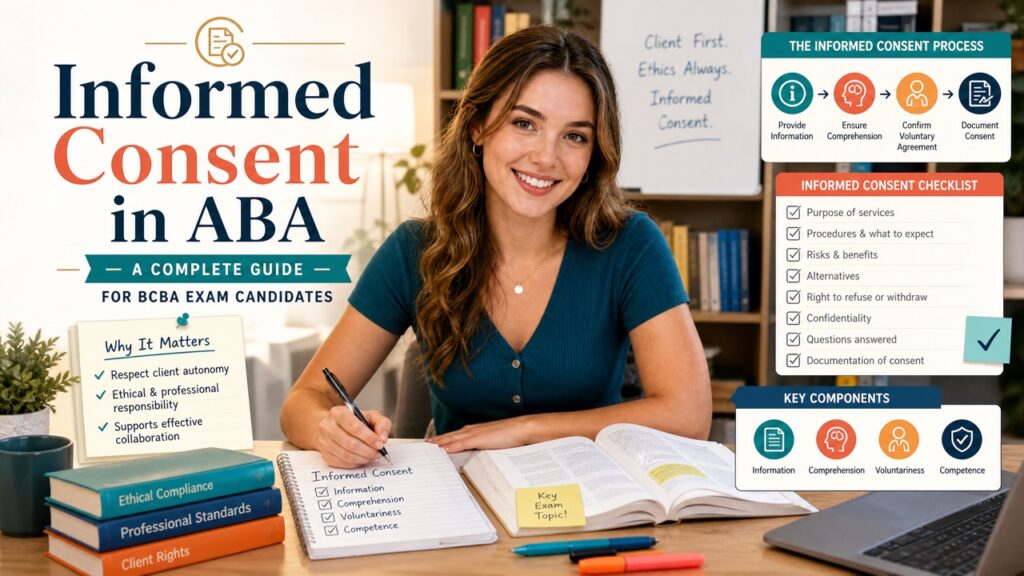
Informed consent in ABA is not merely a procedural checkbox; it is a fundamental ethical obligation that shapes the entire therapeutic relationship. For BCBA exam candidates, understanding this concept goes beyond memorizing a definition—it requires grasping why consent matters in daily practice and how it protects the rights of clients. The BACB Ethics Code for Behavior Analysts emphasizes the need for behavior analysts to obtain informed consent before providing services, but the exam often tests your ability to apply this principle in nuanced scenarios. By mastering the underlying principles, you will be better prepared for both the BCBA exam and real-world practice.
Table of Contents
- The Role of Informed Consent in Applied Behavior Analysis
- Definition and Legal Foundations of ABA Informed Consent
- ABA Examples of Informed Consent in Action
- Exam Tips: Common Traps and How to Avoid Them
- Quick Checklist for BCBA Candidates
- Final Summary: Informed Consent as a Core Competency
- Quick Review Checklist
- Take the Free BCBA Mock Exam
Think of informed consent as a continuous process, not a one-time signature on a form. It involves ongoing communication between the behavior analyst and the client (or their guardian) about the nature of services, potential risks and benefits, and the right to withdraw at any time. When you approach consent as a dynamic dialogue, you align with both ethical guidelines and the practical needs of your clients. This perspective is crucial for exam questions that describe changing circumstances or new procedures.
Beyond a Signature: What Informed Consent Really Means: At its core, informed consent comprises five key elements: disclosure of relevant information, comprehension by the client, voluntariness (free from coercion), competence to make a decision, and agreement. In ABA, this means explaining the assessment and intervention procedures in language the client or guardian can understand, checking for understanding, and ensuring that no pressure is applied. For example, before implementing a behavior reduction plan, you must clearly describe the procedures, potential risks (such as extinction bursts), and alternative approaches.
This multi-faceted definition is frequently tested on the exam, often through scenario questions that require you to identify which element is missing. For instance, if a parent signs a consent form but does not fully understand the risks of a procedure, consent is not truly informed. Recognizing these subtle gaps is a key skill for both exam success and ethical practice.
Why the BCBA Exam Covers This Topic Heavily: The BCBA exam dedicates a significant portion to ethics and professional conduct, and informed consent is a recurring theme. According to the BACB Ethics Code, behavior analysts must obtain informed consent in various situations, from assessments to interventions, and even when collaborating with other professionals. The exam often presents vignettes where candidates must decide whether consent was properly obtained, when to re-consent, or how to handle a client who cannot provide consent.
Understanding the rationale behind consent helps you answer these questions with confidence. The exam is not asking you to regurgitate the code; it is evaluating your ability to apply ethical principles in complex situations. By learning why consent is essential—respecting autonomy, promoting transparency, and protecting clients from harm—you will be better equipped to make sound judgments.
Definition and Legal Foundations of ABA Informed Consent
In behavioral services, informed consent is defined as the client’s or guardian’s voluntary agreement to participate in assessment or treatment after receiving comprehensive information about the procedures, risks, benefits, and alternatives. This definition aligns with general medical and psychological standards, but ABA has its own nuances, such as the distinction between consent and assent (discussed later). On the exam, you may be asked to identify elements that must be included in a consent process, such as the purpose of services, expected outcomes, potential risks, and the right to refuse or withdraw.
The legal foundation for informed consent in professional practice stems from landmark court cases that established standards for disclosure. While these cases originate from medicine, they are directly applicable to behavior analysis and are often referenced in ethics courses and exam prep materials. Let’s examine three pivotal cases that every BCBA candidate should know.
The Core Definition: What Counts as Consent in Behavioral Services: Informed consent in ABA must include three core components: capacity (the client is legally and cognitively able to consent), information (all relevant details are provided), and voluntariness (the decision is made without duress). In practice, this means you must assess whether the client (or guardian) has the capacity to understand, provide complete information about what services will involve, and ensure they freely agree. For clients who are minors or have developmental disabilities that impair capacity, consent must be obtained from a legal guardian, but the client’s assent (agreement) should also be sought when possible.
The definition also emphasizes that consent is an ongoing process. You should revisit consent periodically, especially when there are changes in the intervention plan, such as introducing a new procedure or increasing intensity. This dynamic aspect is a common exam point, as many candidates mistakenly believe consent is a one-time event.
Legal Precedents That Shape Consent Requirements: The community disclose standard, established in DiFilippo v. Preston (1961), requires that professionals disclose information that a reasonable practitioner in the same community would disclose. This standard sets a baseline for what information should be shared, but it has been criticized for being too vague. Canterbury v. Spence (1972) introduced the reasonable person standard, which states that professionals must disclose all information that a reasonable person would need to make an informed decision. This is more client-centered and emphasizes the client’s perspective.
Johnson v. Kokemoor (1996) added a critical layer for behavior analysts: the need to disclose your level of expertise. In this case, a surgeon failed to disclose his lack of experience with a specific procedure, and the court ruled that information about a provider’s experience could be material to a patient’s decision. In ABA, this means you must be transparent about your qualifications, especially when using specialized techniques or when your experience is limited. These cases collectively highlight the importance of effective communication and transparency in consent processes.
ABA Examples of Informed Consent in Action
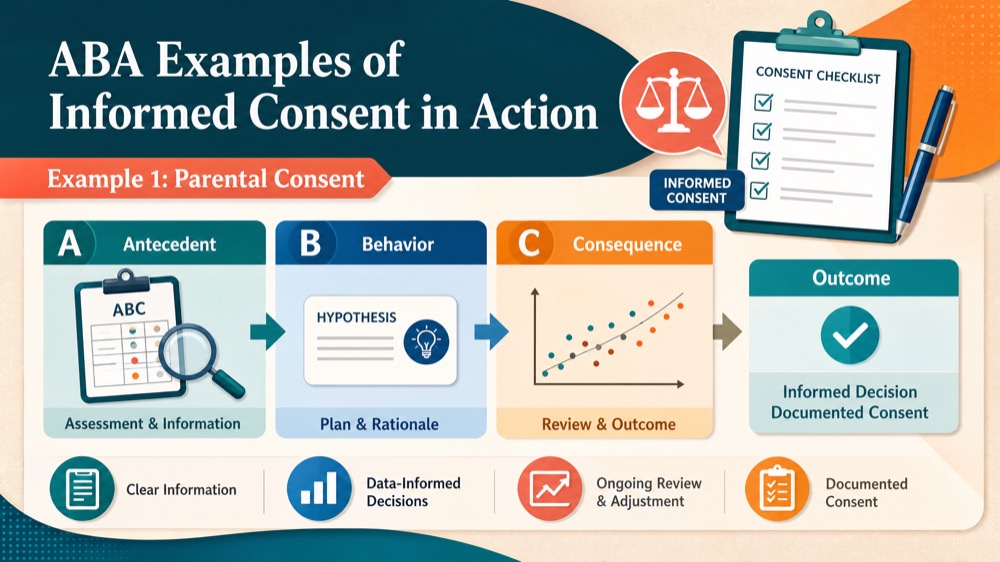
To truly understand informed consent, it helps to see how it operates in real behavioral interventions. The following examples are presented in an ABC (Antecedent-Behavior-Consequence) format to illustrate the context, actions, and outcomes, with hypothesized functions to deepen your understanding. These scenarios mirror exam questions that ask you to evaluate whether consent was appropriately obtained.
Example 1: Parental Consent for a School-Based Intervention: Antecedent: A teacher reports that a student frequently engages in off-task behavior during independent work. The BCBA plans to conduct a functional behavior assessment (FBA) and implement a token economy. Behavior: The BCBA meets with the parent to discuss the assessment, the proposed intervention, and the risks and benefits. The parent signs a consent form after asking clarifying questions. Consequence: The intervention is implemented with the parent’s ongoing involvement.
In this scenario, the hypothesized function of the parent’s compliance is informed agreement—the parent consents because they understand and support the plan. As a BCBA, you would also document the discussion and provide a copy of the consent form. On the exam, you might be asked to identify what additional information the BCBA should have disclosed, such as alternative interventions or the right to revoke consent.
Example 2: Client Assent and Consent in a Center-Based Program: Antecedent: A 10-year-old client with autism is starting a new social skills group. The client is not legally able to consent, so the parent provides consent. Behavior: The BCBA explains the group’s activities using visual supports and asks the client if they are willing to participate. The client nods and says “okay.” Consequence: The client joins the group, and the BCBA continues to monitor the client’s willingness to participate.
This demonstrates the crucial difference between consent (from the guardian) and assent (from the client). Assent is not a substitute for consent, but it is ethically important to seek whenever the client has some capacity to understand. The hypothesized function of the client’s nod is agreement, and the BCBA must respect any signs of dissent. On the exam, you may be asked how to handle a client who refuses to provide assent—the correct answer is to consider modifying the procedure or withholding it until assent is obtained.
Exam Tips: Common Traps and How to Avoid Them
When preparing for the BCBA exam, informed consent questions can be deceptively tricky. Many candidates lose points by falling into common traps. Understanding these pitfalls will help you approach scenario-based questions with a sharper eye. Below, we break down the most frequent misconceptions and provide strategies to avoid them.
Confusing Consent with Assent (and Why It Matters): One of the biggest traps is treating consent and assent as interchangeable. Consent is a legal authorization given by a competent individual (or guardian), while assent is a client’s agreement to participate, which is especially relevant for children or individuals who cannot legally consent. For example, in a school setting, you need parental consent, but you should also seek the child’s assent when possible. If a client does not actively object to a procedure, that does not constitute assent; you must actively seek their agreement. Exam questions often describe situations where a parent has signed, but the child is reluctant—here, you must address the child’s dissent, even though consent is valid.
Overlooking the Ongoing Nature of Consent: Another common error is viewing consent as a one-time event. In reality, consent must be re-assessed whenever there are significant changes, such as introducing a new intervention or modifying the existing plan. Additionally, clients have the right to withdraw consent at any time, and you must respect that decision immediately. For example, if a client’s family decides to discontinue services, you must cease interventions and assist with transition planning. On the exam, watch for scenarios that involve a change in procedures—you should always consider whether new consent is needed.
Misjudging What Information Must Be Disclosed: Behavior analysts must disclose reasonably foreseeable risks and benefits of the proposed services. This includes potential side effects of interventions, such as extinction bursts or temporary increases in problem behavior, as well as the likelihood of success. You must also discuss alternative procedures that might be equally effective, and the client’s right to refuse or withdraw. A common trap is assuming that if a procedure is “evidence-based,” you do not need to discuss risks. However, the ethical obligation remains regardless of the intervention’s empirical support.
Quick Checklist for BCBA Candidates
Use this checklist to review your understanding of informed consent before the exam. Each item represents a key concept that frequently appears in test questions.
- Define the five elements of informed consent (disclosure, comprehension, voluntariness, competence, agreement).
- Distinguish between consent and assent, and know when each is required.
- Explain the three legal standards: community disclose, reasonable person, and expertise disclosure.
- Identify what information must be disclosed (risks, benefits, alternatives, right to withdraw).
- Recognize situations that require re-consent (new procedures, significant changes).
- Apply the concept of “ongoing consent” in real-life scenarios.
- Understand how to handle clients who cannot consent (guardian consent, client assent).
Review each point and ensure you can provide concrete examples. The ability to articulate these concepts in your own words is a strong indicator of exam readiness. For additional BCBA exam strategies, check out our guide on the 5 things you need to know about the BCBA exam.
Final Summary: Informed Consent as a Core Competency
Mastering informed consent is not just about passing the BCBA exam; it is about becoming a competent, ethical behavior analyst. The ability to obtain véritable informed consent demonstrates respect for client autonomy and aligns with the core values of the profession. On the exam, questions on this topic test your practical reasoning more than rote memorization. By understanding the definition, legal foundations, and real-world applications, you are better prepared to handle ethical dilemmas with confidence.
Remember that informed consent is a process, not a form. Continuously reassess, communicate openly, and document thoroughly. With this comprehensive guide, you are now equipped to tackle informed consent questions on the exam and uphold the highest standards in your future practice. For more in-depth prep, explore our resources on the goals of behavior analysis and procedural integrity to strengthen your overall knowledge base. For official guidelines, refer to the BACB Ethics Information and review relevant professional standards. Good luck with your exam preparation!
Quick Review Checklist
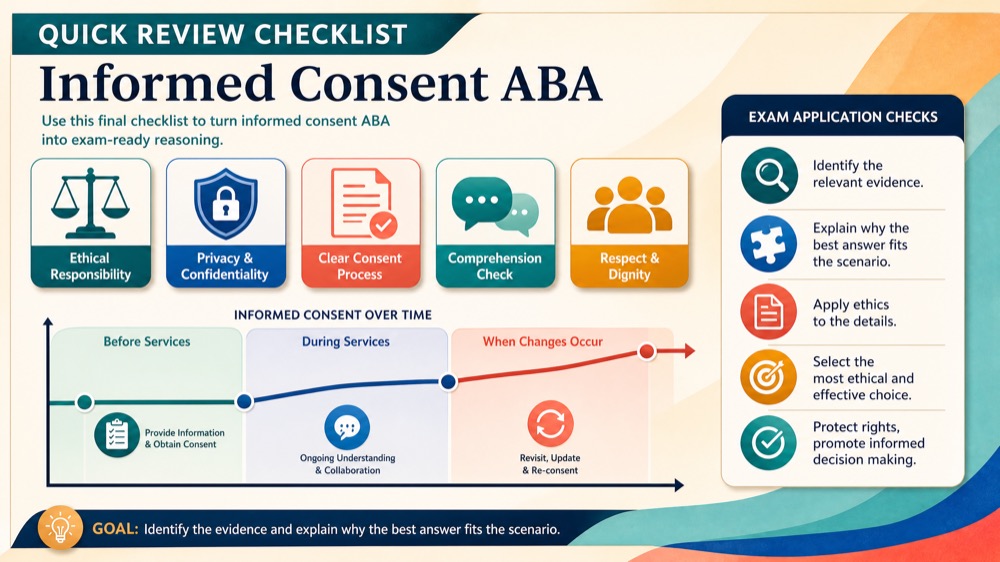
Use this final checklist to turn informed consent aba into exam-ready reasoning. The goal is not to memorize a label in isolation; it is to identify the relevant evidence and explain why the best answer fits the scenario. Key ideas to review:
- State the central definition or decision point for informed consent aba in your own words.
- Identify the detail that makes informed consent aba different from its closest related ABA term.
- Separate the observable facts in a scenario from assumptions that are not supported by the facts.
- Write one example and one nonexample so you can recognize the concept in a new setting.
Exam application checks:
- Ask what the question is actually requesting before comparing the answer choices.
- Mark the antecedent, response, consequence, or other evidence that supports the selected answer.
- Look for a distractor that describes a related process but does not answer the specific question.
Final self-check:
- Explain how you would verify the interpretation with clear observations or data.
- Change one detail in the scenario and decide whether your answer should change.
- Give a one-sentence rationale that a supervisor or study partner could evaluate.
Take the Free BCBA Mock Exam
Ready for more practice? Use the free mock exam to keep testing your accuracy with realistic BCBA-style items. Take the Free BCBA Mock Exam
Next step for BCBA exam prep
Turn this topic into exam-day practice
Use this topic as a focused review, then test it in exam-style conditions with a free mock before deciding whether five full-length mocks are the right next step.
Start the Free BCBA Mock ExamContinue with Five Full-Length Mocks — $99
Review the included materials and access details before ordering. No pass guarantee is implied.



