
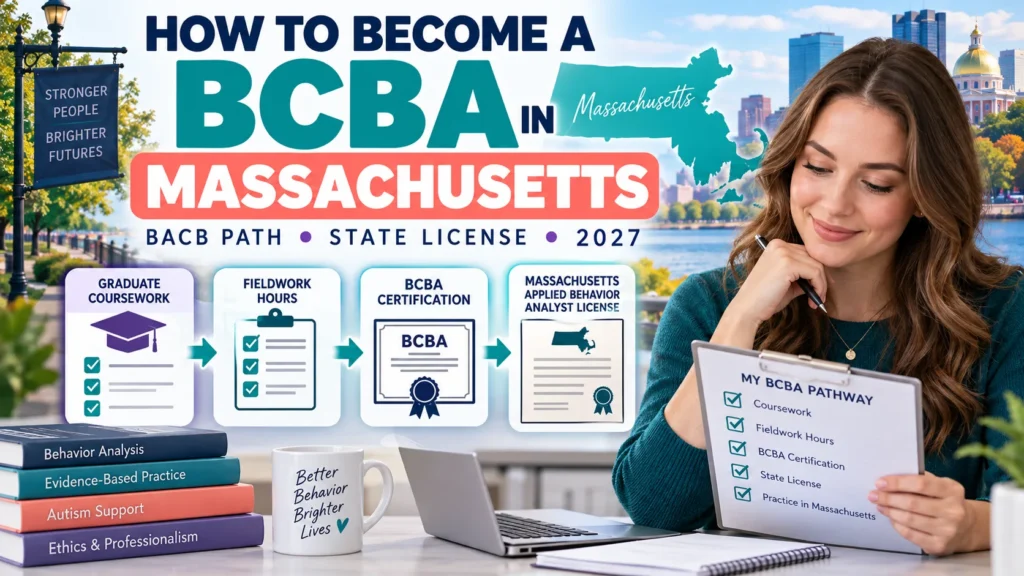
A source-first Massachusetts guide to the national BCBA credential, the state applied behavior analyst license, application evidence, and 2027 planning. If you are searching for how to become a BCBA in Massachusetts, separate two connected but different tasks before you choose a program or submit an application. The Behavior Analyst Certification Board (BACB) issues the national BCBA certification. Massachusetts regulates applied behavior analyst practice through its Board of Registration of Allied Mental Health and Human Services Professions and its own statutes, regulations, application checklist, and licensing system.
Table of Contents
- How to Become a BCBA in Massachusetts: The Short Answer
- The Two Credentials to Separate
- The National BCBA Pathway
- Massachusetts Applied Behavior Analyst License
- Massachusetts Application Map
- Planning Around the 2027 Transition
- When to Start BCBA Exam Practice
- Frequently Asked Questions
- Quick Review Checklist
- Take the Free BCBA Mock Exam
That means a Massachusetts candidate should plan a national credential path and a state-license path. Your graduate degree, behavior-analytic coursework, supervised experience, and BCBA examination belong to the BACB pathway. Your state application can require BCBA evidence, education records, a criminal-record form, an application fee, and other Massachusetts-specific documents. The exact rule can depend on the version of the state regulations and your history, so treat the live official pages as the final authority.
Short answer: Complete an applicable BACB eligibility route, submit the BCBA application, pass the BCBA exam, and then follow the Massachusetts applied behavior analyst license instructions. Keep national certification and state licensure as two separate checklists, with separate evidence and renewal reminders.
How to Become a BCBA in Massachusetts: The Short Answer
For most candidates, the order looks like this:
- Choose an applicable BACB eligibility pathway.
- Complete the required graduate degree, behavior-analytic coursework, and supervised fieldwork.
- Submit a complete BCBA certification application, payment, and evidence to the BACB.
- Receive authorization and pass the BCBA examination.
- Review Massachusetts licensure requirements and submit the applied behavior analyst application with its state-specific documents.
- Track the state review, then maintain the national certification and state license on their separate calendars.
Do not interpret “BCBA certification Massachusetts” as a state-issued version of the BCBA. Massachusetts can license applied behavior analysts, but the national BCBA title and examination remain BACB matters. The site’s national BCBA roadmap covers the broad credential sequence; this page adds the Massachusetts application layer.
The Two Credentials to Separate
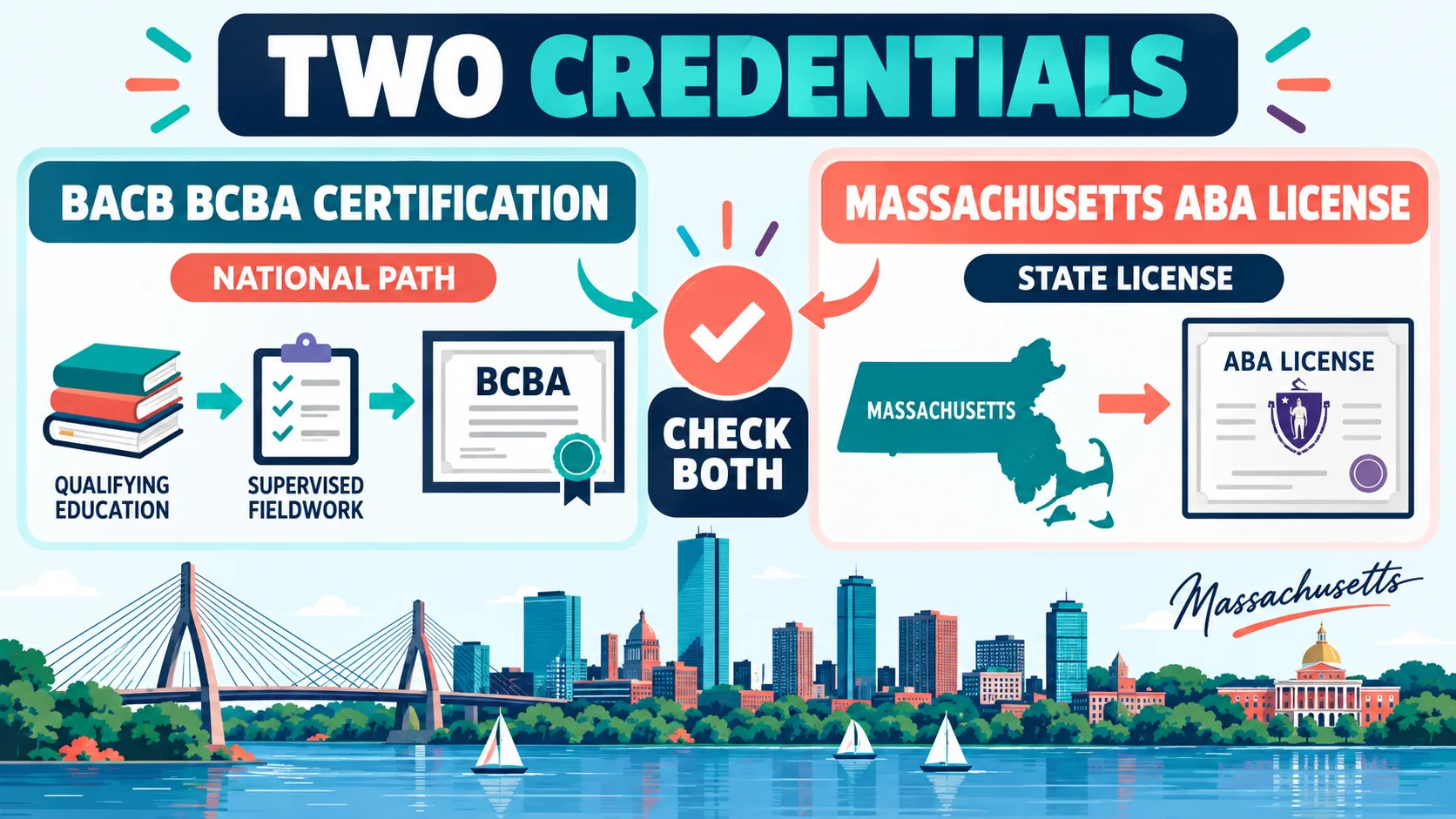
The distinction matters because each authority asks a different question. BACB asks whether you meet national eligibility and examination requirements. Massachusetts asks whether you meet the state’s applied behavior analyst licensing requirements and have supplied the required state documents.
| Question | BACB BCBA certification | Massachusetts state license |
|---|---|---|
| Who controls it? | Behavior Analyst Certification Board. | Massachusetts Board of Registration of Allied Mental Health and Human Services Professions. |
| Main evidence | Degree, coursework, supervised fieldwork, application, authorization, and BCBA examination. | BCBA examination/certification evidence, education records, CORI form, online application, fee, and any requested verification. |
| What it permits | Use of the national BCBA credential when the credential is active. | Practice and title permissions controlled by Massachusetts law, subject to exemptions and the current board rules. |
| Where to verify | Current BCBA Handbook and BACB transition resources. | Mass.gov licensing hub, current regulations, application checklist, and Board communications. |
Keep separate folders even if the same transcript or certificate supports both applications. A state application receipt does not prove that the BACB has approved your certification, and a BACB certificate does not automatically answer every Massachusetts practice or renewal question.
The National BCBA Pathway
The current BACB Handbook controls the national eligibility details. At a high level, a candidate should:
- Choose a route. Confirm the pathway that applies to your degree, coursework, and the date your evidence will be reviewed.
- Complete graduate education and coursework. Ask a program how its transcript and course content map to the current BACB requirements. Keep official transcripts and supporting records.
- Complete supervised fieldwork. Save dates, hours, supervision records, activities, signatures, and verification forms. Your own copy matters because the BACB may require evidence during review.
- Apply in your BACB account. Select the correct pathway, pay the fee, submit the required documents, and make sure your name and other personal information match across records.
- Pass the BCBA examination. Use the current exam and handbook instructions, then keep the score or certification evidence required for the next state step.
Do not choose a program because it promises a “Massachusetts BCBA license.” A school can provide education or fieldwork support, but the BACB and Massachusetts Board remain the authorities that decide credentials and licensure.
Massachusetts Applied Behavior Analyst License
Massachusetts’ official application checklist says applicants must apply online through the Health Professions Licensing System. The checklist asks for a head-and-shoulders photograph, the date the applicant passed the BCBA examination, the BCBA certification document from BACB, and a notarized Criminal Offender Record Information (CORI) form. It also lists a nonrefundable application fee of $117 in the current checklist. Because fees and forms can change, verify the amount on the live Mass.gov page immediately before submitting.
Massachusetts regulations also describe education and supervised-experience standards for applied behavior analyst licensure. The state’s statute and regulations should be read together with the current application checklist. If your degree predates a stated date, your education is in another field, or your experience was obtained in another jurisdiction, look for the applicable attestation or verification requirement rather than assuming the national BCBA certificate answers every state question.
The Massachusetts licensing FAQ currently states that applied behavior analyst applicants must pass the BCBA examination issued by BACB. That is why the article’s pathway puts the national examination before the state application evidence. If your circumstances involve a different license category, exemption, or older practice history, contact the Board before filing.
| State application item | What to prepare | Check before filing |
|---|---|---|
| BCBA evidence | Exam date and current BCBA certificate or other document listed by the Board. | Use the current checklist, not an older screenshot or program brochure. |
| Education and experience | Official transcript, degree evidence, practicum or supervised-experience records, and any required attestation. | Match your history to the current Massachusetts regulation. |
| CORI and identity documents | Notarized CORI form, photograph, and any license verification requested for another jurisdiction. | Confirm the delivery and notarization instructions before uploading. |
| Online application and fee | Health Professions Licensing System account, application, payment, and confirmation. | Save the receipt and record the date the state file became complete. |
Massachusetts Application Map
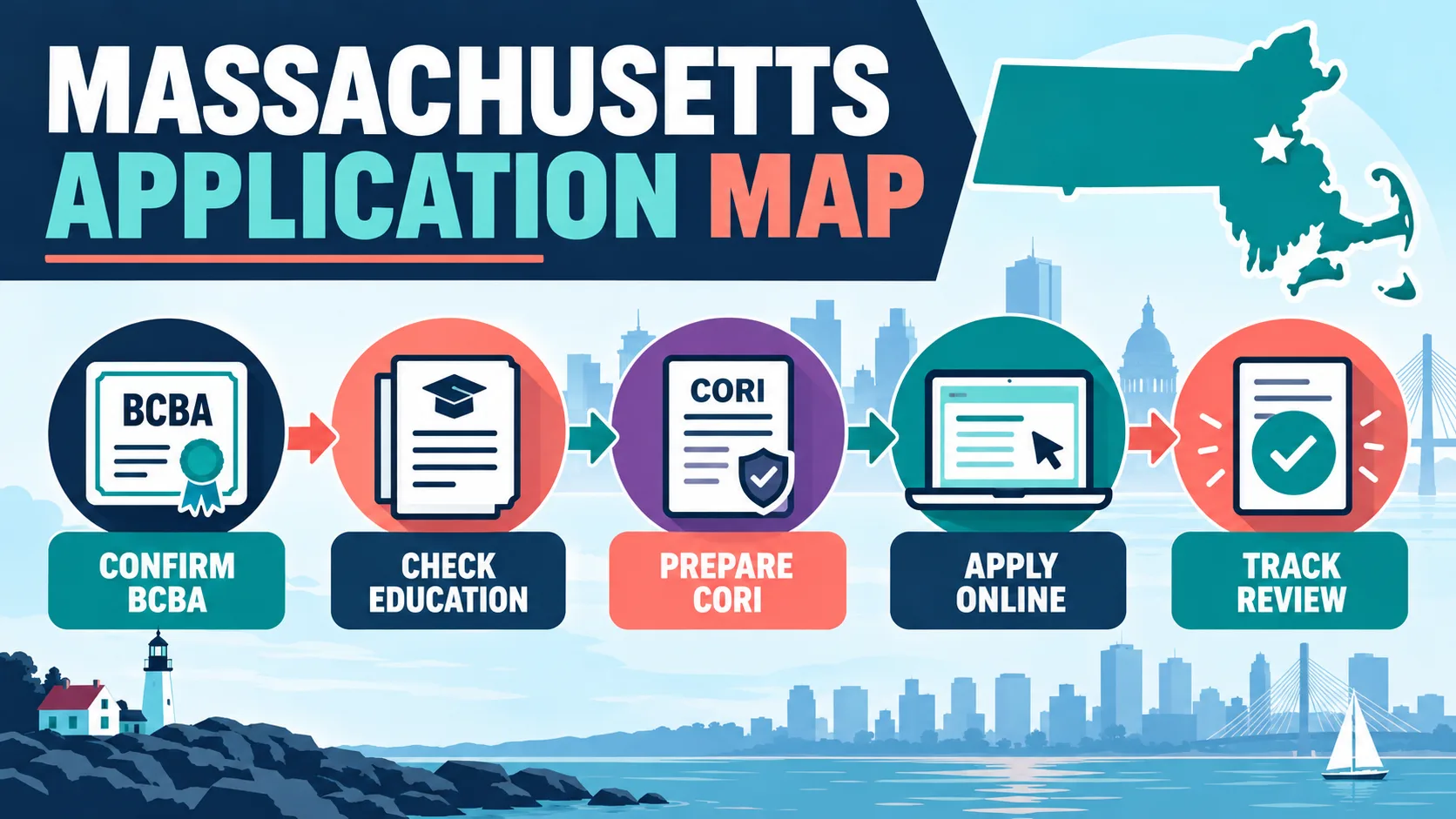
Use this sequence to reduce backtracking:
- Confirm the national route. Read the current BACB Handbook and identify the degree, coursework, fieldwork, application, and examination evidence you will need.
- Check Massachusetts categories. Open the current applied behavior analyst checklist and regulations. Confirm that your education and supervised experience fit the state’s language.
- Request records early. Order transcripts, license verifications, and any required attestations before you are ready to click submit.
- Prepare CORI and identity items. Follow the current notarization and photograph instructions. A missing or incorrectly prepared form can delay the review.
- Apply online. Complete the Health Professions Licensing System application, pay the current fee, and keep the confirmation.
- Track review. Respond to requests from the Board, save messages, and do not describe yourself as state-licensed until the Board has issued the license or otherwise confirmed your status.
Massachusetts employers, insurers, schools, and payers can also request their own credentialing documents. Employer credentialing is not the same as state licensure. Keep those requests in a third checklist so you do not assume an insurance enrollment email is a board approval.
Planning Around the 2027 Transition
The BACB has announced major requirement changes effective January 1, 2027. Those national changes can affect education, coursework, fieldwork, application, and maintenance planning, but they do not automatically rewrite Massachusetts licensing regulations. Track both sources separately.
If you are close to applying, review the BACB transition guidance and current handbook together. The relevant boundary may involve whether a complete application and required documents have been received, not merely when you began a class. Do not assume that starting a Massachusetts program before 2027 guarantees that the older national rule applies. Write a dated note with two columns:
- BACB: pathway, transcript, coursework, fieldwork, application, examination, and transition status.
- Massachusetts: state license category, education/experience regulation, CORI, online application, fee, verification, and renewal instructions.
When a website summary and an official rule appear different, use the authority that owns the question. The BACB can answer national certification. Massachusetts can answer state licensure. Save the URL and access date for every time-sensitive statement.
When to Start BCBA Exam Practice
Start exam practice once you have enough coursework to understand the scenarios and have confirmed your eligibility plan. Practice questions cannot replace a qualifying degree, fieldwork, the BACB application, the BCBA examination, or a Massachusetts license. They are most useful for finding decision-making gaps in measurement, ethics, assessment, intervention, and supervision.
When you are ready, the Free BCBA Mock Exam can help you rehearse scenario-based decisions. Review why an answer fits the data and ethics, not only whether you got a question right. A practice score is not a guarantee of certification, licensure, employment, or exam success.
Frequently Asked Questions
Do I need a Massachusetts license after becoming a BCBA?: Massachusetts regulates applied behavior analyst practice through its state licensing framework, and the state’s official pages describe an applied behavior analyst license application. Whether an exemption or a specific role changes your requirement depends on your circumstances. Verify the current Board rules before practicing or using a regulated title.
What documents does Massachusetts ask for?: The current application checklist lists a photograph, BCBA examination date, BCBA certification evidence, a notarized CORI form, the application fee, and education/verification documents as applicable. Read the live checklist for the exact upload and delivery instructions.
How much is the Massachusetts application fee?: The current checklist available from Mass.gov lists a $117 nonrefundable application fee. Confirm the current amount in the online licensing system before paying because fees and forms can change.
Can I use my Massachusetts degree for BACB certification?: A Massachusetts degree may support your BACB route if it and your behavior-analytic coursework meet the current BACB pathway requirements. The state location does not make a program automatically qualifying. Ask the program how it documents the current BACB pathway and retain official records.
What should I do first?: Open the current BACB Handbook, the Massachusetts applied behavior analyst checklist, and the Massachusetts regulation. Then build separate evidence folders for national certification, state licensure, and any employer or payer credentialing.
Final reminder: becoming a BCBA in Massachusetts is a two-authority process. Verify the BACB national pathway, verify the Massachusetts license instructions, save every document and receipt, and keep the 2027 transition in a dated source-controlled plan.
Quick Review Checklist
Use this final checklist to turn how to become a bcba in massachusetts into exam-ready reasoning. The goal is not to memorize a label in isolation; it is to identify the relevant evidence and explain why the best answer fits the scenario. Key ideas to review:
- State the central definition or decision point for how to become a bcba in massachusetts in your own words.
- Identify the detail that makes how to become a bcba in massachusetts different from its closest related ABA term.
- Separate the observable facts in a scenario from assumptions that are not supported by the facts.
- Write one example and one nonexample so you can recognize the concept in a new setting.
Exam application checks:
- Ask what the question is actually requesting before comparing the answer choices.
- Mark the antecedent, response, consequence, or other evidence that supports the selected answer.
- Look for a distractor that describes a related process but does not answer the specific question.
Final self-check:
- Explain how you would verify the interpretation with clear observations or data.
- Change one detail in the scenario and decide whether your answer should change.
- Give a one-sentence rationale that a supervisor or study partner could evaluate.
Take the Free BCBA Mock Exam
When you are ready to apply the idea, use the free practice resource below for additional feedback. Take the Free BCBA Mock Exam



