
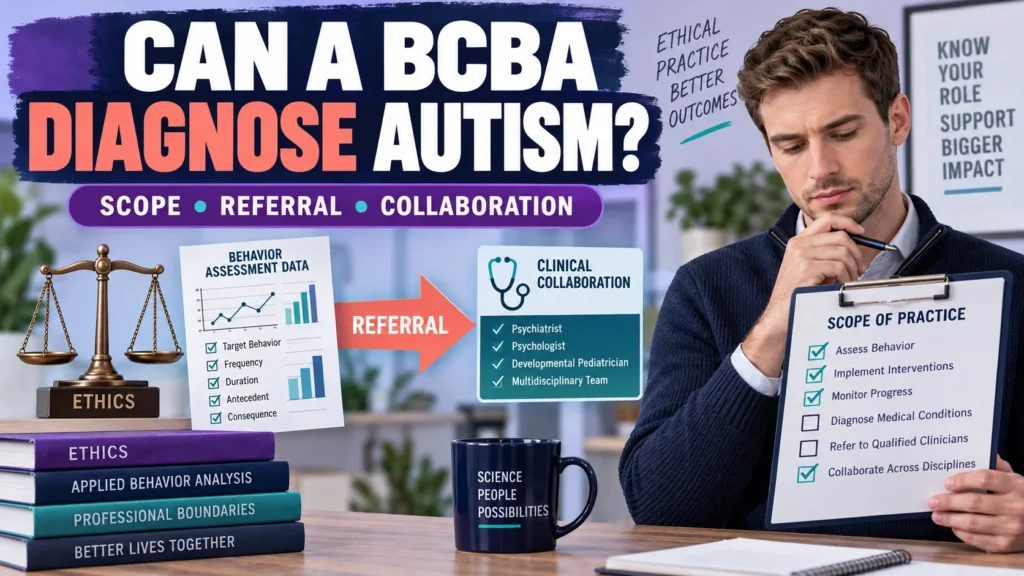
A source-first guide to BCBA scope, behavior assessment, formal autism diagnosis, referral, collaboration, and exam-ready decision making. If you are asking can bcba diagnose autism, the safest short answer is: BCBA certification by itself does not automatically make someone a formal autism diagnostician. A BCBA may assess behavior, analyze patterns, design behavior-analytic services, measure progress, and collaborate with a diagnostic professional. Whether a particular person can participate in or issue a formal autism diagnosis depends on that person’s other professional license, state law, training, competence, and the scope of the service being provided.
Table of Contents
- Can bcba diagnose autism? The Short Answer
- What a BCBA Can Assess and Treat
- Formal Autism Diagnosis Is a Separate Question
- What to Do When Diagnosis Questions Arise
- Why State Law and Additional Licenses Matter
- The Exam-Ready Scope Rule
- How BCBA Practice Questions Fit In
- Frequently Asked Questions
- Quick Review Checklist
- Take the Free BCBA Mock Exam
That distinction matters for families, clients, employers, and BCBA exam candidates. A behavioral assessment can identify observable patterns and support treatment planning. A formal autism diagnosis is a separate clinical or legal determination that should be handled by a qualified professional whose license and training authorize that work. Do not use a BCBA title as a shortcut for a state-specific diagnosis rule.
Scope note: This article is educational, not a diagnosis or legal opinion. Rules differ across jurisdictions and professional licenses. For a real diagnostic question, consult the appropriate licensed clinician and verify the current rules in your state.
Can bcba diagnose autism? The Short Answer
A BCBA is a behavior analyst credentialed by the Behavior Analyst Certification Board. The credential is connected to behavior analysis: defining observable behavior, assessing behavioral function, designing interventions, measuring outcomes, and supervising or coordinating behavior-analytic services within competence. It is not, standing alone, a universal license to make every medical, psychiatric, developmental, or psychological diagnosis. So the practical answer is:
- A BCBA can conduct behavior-analytic assessment. This may include interviews, direct observation, data review, preference assessment, functional behavior assessment, skill assessment, and treatment-planning activities that fall within the practitioner’s training and authorization.
- A BCBA can provide ABA services when qualified and authorized. The BCBA may design, monitor, and adjust behavior-change programs, teach skills, train caregivers, and evaluate progress.
- A BCBA should not imply that a behavior-analytic assessment is automatically a formal autism diagnosis. The diagnostic question may require a different professional scope, a multidisciplinary evaluation, or a state-specific process.
- A BCBA may refer and collaborate. When a client or family needs a diagnostic evaluation, the BCBA should explain the boundary, document relevant observations, obtain appropriate consent, and coordinate with qualified professionals.
Some people hold more than one credential. A person who is both a BCBA and independently licensed in a profession that authorizes diagnosis may have a broader scope in that separate role. The deciding factor is not the BCBA letters alone. It is the full license, training, competence, law, and service context.
What a BCBA Can Assess and Treat
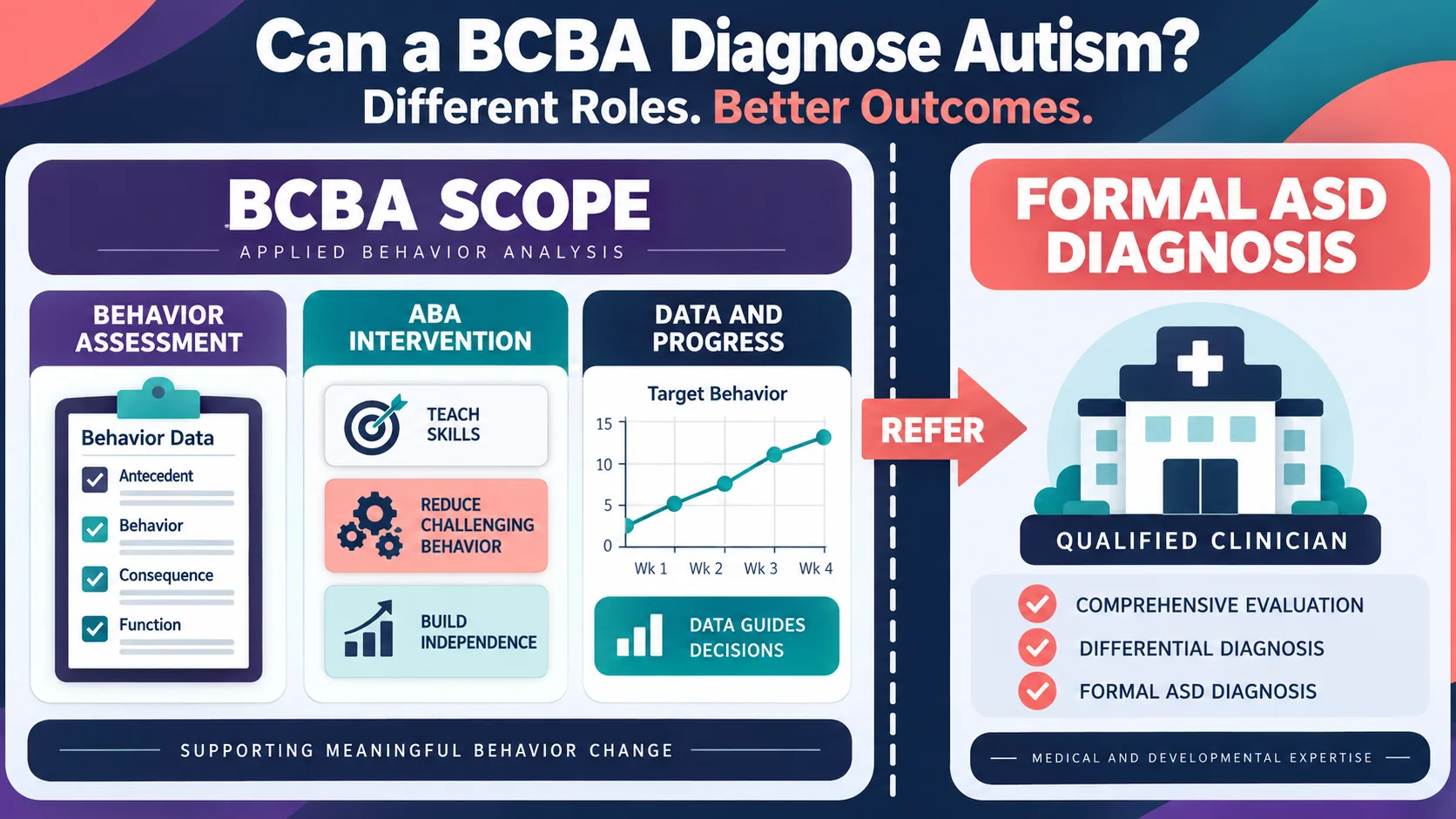
The phrase “assessment” can create confusion because it does not always mean “diagnosis.” In applied behavior analysis, assessment commonly asks questions such as: What behavior is occurring? When does it occur? What events precede and follow it? What skills are present? What environmental changes could improve learning, safety, communication, or independence?
Those questions can be clinically valuable without answering every question involved in an autism diagnosis. A BCBA may use the results to write measurable goals, select teaching procedures, conduct a functional behavior assessment, recommend environmental supports, and evaluate whether an intervention is working. The work should be based on observable behavior and data rather than on an unsupported label.
| Question | Behavior-analytic scope | Boundary to check |
|---|---|---|
| What is happening? | Define observable behavior, collect data, review patterns, and identify skills or barriers. | Do not turn a behavioral description into a diagnosis without the authority and evidence required for that diagnosis. |
| What should treatment target? | Design measurable ABA goals, teach skills, reduce unsafe behavior, and monitor outcomes. | Stay within competence, consent, client priorities, and the current service authorization. |
| Does the client need an autism evaluation? | Notice concerns, document relevant observations, discuss the next step, and support a referral. | Confirm who is authorized to diagnose in the client’s jurisdiction and make the referral appropriately. |
| How is progress judged? | Use data to evaluate behavior change, generalization, maintenance, and treatment effects. | Progress data support treatment decisions; they do not by themselves establish a formal ASD diagnosis. |
This is also why a BCBA should avoid presenting an ABA intake, functional behavior assessment, or treatment plan as a substitute for a diagnostic evaluation. The documents can be shared with consent and can help a qualified evaluator understand the client, but each document answers a different question.
Formal Autism Diagnosis Is a Separate Question
A formal autism diagnosis generally involves a broader developmental, medical, psychological, and functional evaluation than a single behavior-analytic assessment. The exact process varies by age, setting, jurisdiction, and the clinician’s profession. The evaluator may review developmental history, communication, social interaction, restricted or repetitive patterns, differential considerations, medical information, and information from caregivers or other professionals.
When a family asks a BCBA, “Does my child have autism?” a responsible response can acknowledge the concern without making an unsupported determination. The BCBA can explain that the team can assess behavior and provide ABA-related support, then recommend a qualified diagnostic evaluation if the family wants an answer about autism. The response should be respectful, plain-language, and documented according to the service setting’s policies.
What to Do When Diagnosis Questions Arise
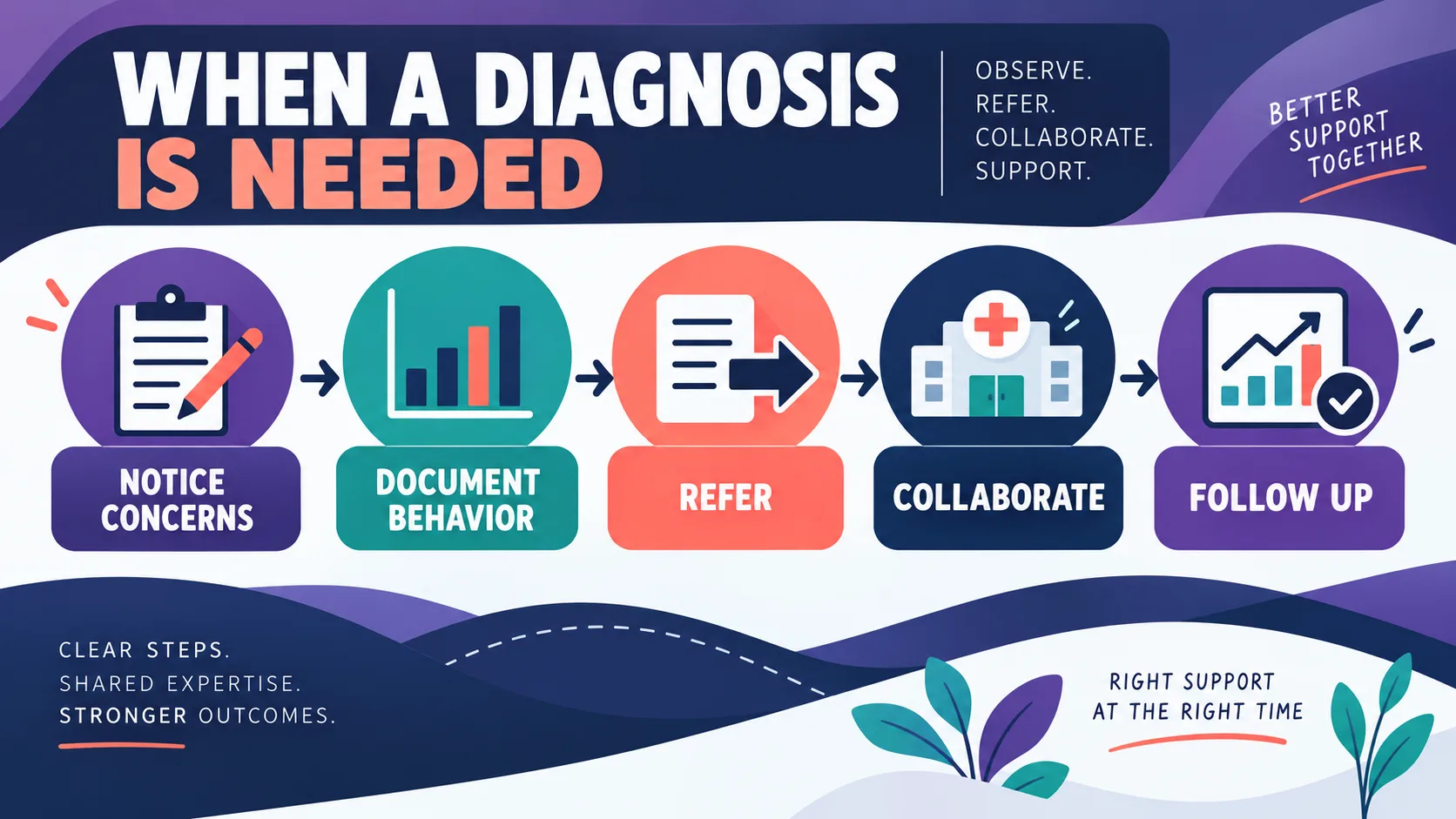
A simple workflow helps keep the client’s needs in view while protecting professional boundaries:
- Notice the question. A caregiver, client, teacher, or physician may ask whether observed behavior indicates autism. Treat the question as a request for guidance, not as permission to diagnose.
- Document observations. Record relevant behavior, context, frequency, duration, intensity, skill information, and the source of the report. Separate direct observation from interpretation.
- Explain the scope boundary. Say what your BCBA role can address and what it cannot establish by itself. Avoid making the family feel dismissed or blamed.
- Refer to the appropriate professional. Depending on the client and jurisdiction, this may involve a licensed psychologist, developmental-behavioral pediatrician, psychiatrist, physician, or another professional authorized to conduct the needed evaluation.
- Collaborate with consent. Share relevant records only through an appropriate release and follow privacy, documentation, and organizational requirements. Ask what information the evaluator needs.
- Follow up on treatment needs. ABA services and learning supports may still be appropriate while a diagnostic question is being evaluated, but the service plan should remain within scope and should not promise a diagnostic outcome.
Referral does not mean the BCBA has failed to help. It is often the correct professional action when a question falls outside the credential’s authority or the practitioner’s competence. A strong team keeps the diagnostic question, treatment question, and authorization question distinct while coordinating care.
Why State Law and Additional Licenses Matter
The BACB credential is national, but scope of practice is not determined by a single national label alone. State licensing laws, employer policies, payer rules, informed-consent requirements, and the practitioner’s additional credentials can all affect what a person may legally or ethically do. A BCBA working in one state may need to review different rules from a BCBA working in another.
For that reason, do not use a generic article, an old social-media answer, or an employer’s job title as the final authority. Check the current state board or licensing agency when the question involves a regulated diagnosis, a protected title, billing, a school evaluation, or a medical record. If the practitioner holds a second license, verify that license’s current scope and use the correct professional role when conducting that service.
| Before giving an answer | Check | Why it matters |
|---|---|---|
| Your role | Are you acting as a BCBA, another licensed professional, or both? | A second credential may change the analysis, but it must be active and relevant. |
| Jurisdiction | What do the current state rules and setting policies say? | Licensing, school, payer, and medical settings can have different requirements. |
| Competence | Do your education, supervision, training, and experience support the service? | A legal permission does not remove the duty to practice within competence. |
| Consent and privacy | Is there a clear release and an appropriate reason to share information? | Collaboration should protect the client’s rights and use only relevant information. |
The Exam-Ready Scope Rule
For a BCBA exam scenario, use this rule: identify the question being asked, identify the role authorized to answer it, then choose the least overreaching action that protects the client and moves the case forward. If the scenario asks about behavior function or treatment effectiveness, behavior-analytic assessment and data may be central. If it asks for a formal autism diagnosis, do not infer that authority from BCBA certification alone. A strong answer will usually include some combination of:
- clarifying the client’s concern and the purpose of the evaluation;
- collecting objective, relevant behavior data;
- consulting or referring to a qualified professional;
- obtaining consent before sharing records;
- staying within competence, law, ethics, and the service agreement; and
- continuing appropriate behavior-analytic support without promising a diagnosis.
Watch for answer choices that sound helpful but overstep, such as labeling a client from a brief observation, using an ABA treatment plan as proof of autism, or sending records to another provider without permission. The exam is often testing professional judgment and scope, not whether you can guess a diagnosis from a behavior description.
How BCBA Practice Questions Fit In
Once you understand the scope distinction, scenario-based practice can help you rehearse it under time pressure. Practice questions should ask you to identify the client’s need, the relevant data, the ethical boundary, the appropriate referral, and the next least-intrusive action. A practice score cannot diagnose a client, authorize a service, guarantee BCBA certification, or replace the current BACB Ethics Code.
When you are ready to test this decision pattern, the Free BCBA Mock Exam can provide scenario-based practice. Review the rationale after each question and ask: Did I separate observation from diagnosis? Did I stay within the role? Did I protect consent and the client’s best interests?
Frequently Asked Questions
Can a BCBA diagnose autism without another license?: Do not assume that BCBA certification alone authorizes a formal autism diagnosis. A BCBA can provide behavior-analytic assessment and ABA services within competence and authorization, but the formal diagnostic question must be checked against the professional’s other credentials and the current law in the jurisdiction.
Can a BCBA identify signs that lead to an autism referral?: Yes. A BCBA can observe and document behavior, discuss concerns, and recommend that the family or team seek an evaluation from an appropriately qualified clinician. The BCBA should describe observations and limitations accurately rather than presenting a referral recommendation as a diagnosis.
Does an ABA assessment prove autism?: No. An ABA assessment may answer questions about behavior, skills, environmental variables, and intervention needs. It can contribute useful information to a broader evaluation, but its findings do not automatically establish an autism diagnosis.
Can a BCBA and a psychologist work on the same case?: They can collaborate when the arrangement is lawful, clinically appropriate, within competence, and supported by informed consent and privacy-compliant information sharing. The team should define each professional’s role and avoid representing one service as the other.
What is the best BCBA exam answer when a client needs an autism diagnosis?: Recognize the concern, document relevant behavior, explain the BCBA scope, and refer or collaborate with the qualified professional authorized to conduct the needed evaluation. Continue appropriate behavior-analytic support without making an unsupported diagnostic claim.
Bottom line: A BCBA can be an important member of an autism-support team without treating BCBA certification as a universal autism-diagnosis license. Separate behavior assessment from formal diagnosis, verify state-specific rules, refer when needed, collaborate with consent, and keep the client’s safety and rights at the center. For targeted review, use our can bcba diagnose autism practice questions to apply the concept in exam-style scenarios.
Quick Review Checklist
Use this final checklist to turn can bcba diagnose autism into exam-ready reasoning. The goal is not to memorize a label in isolation; it is to identify the relevant evidence and explain why the best answer fits the scenario. Key ideas to review:
- State the central definition or decision point for can bcba diagnose autism in your own words.
- Identify the detail that makes can bcba diagnose autism different from its closest related ABA term.
- Separate the observable facts in a scenario from assumptions that are not supported by the facts.
- Write one example and one nonexample so you can recognize the concept in a new setting.
Exam application checks:
- Ask what the question is actually requesting before comparing the answer choices.
- Mark the antecedent, response, consequence, or other evidence that supports the selected answer.
- Look for a distractor that describes a related process but does not answer the specific question.
Final self-check:
- Explain how you would verify the interpretation with clear observations or data.
- Change one detail in the scenario and decide whether your answer should change.
- Give a one-sentence rationale that a supervisor or study partner could evaluate.
Take the Free BCBA Mock Exam
When you are ready to apply the idea, use the free practice resource below for additional feedback. Take the Free BCBA Mock Exam



