
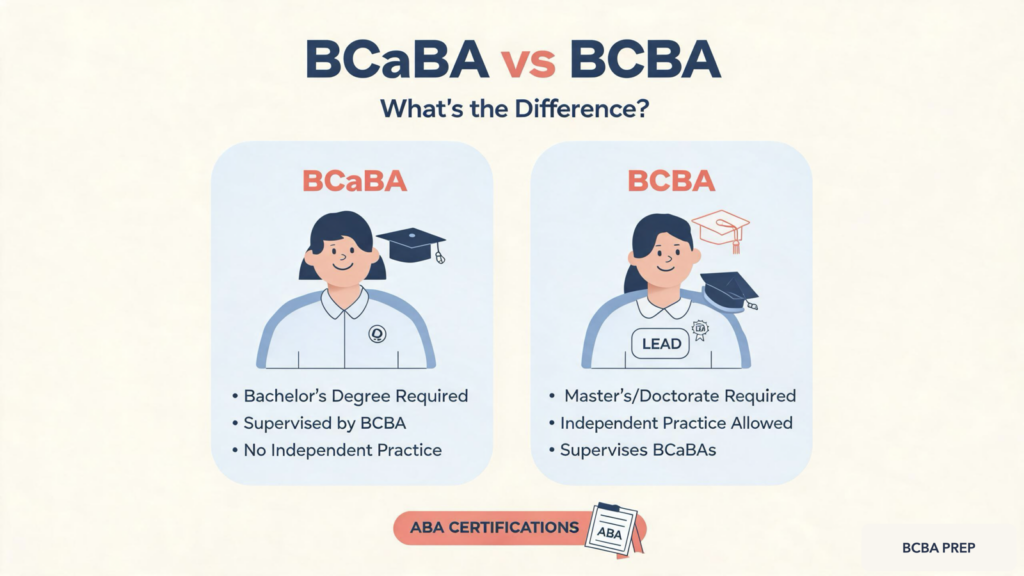
What Are BCaBA and BCBA?
If you’re pursuing a career in applied behavior analysis, you’ve likely encountered the acronyms BCaBA and BCBA. While both are certifications offered by the Behavior Analyst Certification Board (BACB), they represent different levels of training, responsibility, and autonomy. Understanding these differences is essential for exam candidates and professionals alike, as it directly impacts your career path and daily practice.
Table of Contents
- What Are BCaBA and BCBA?
- Key Differences in Supervision and Scope of Practice
- Educational Requirements and Fieldwork
- ABA Examples: How the Roles Differ in Practice
- Exam Relevance and Common Traps
- Quick Checklist for Candidates
- Summary
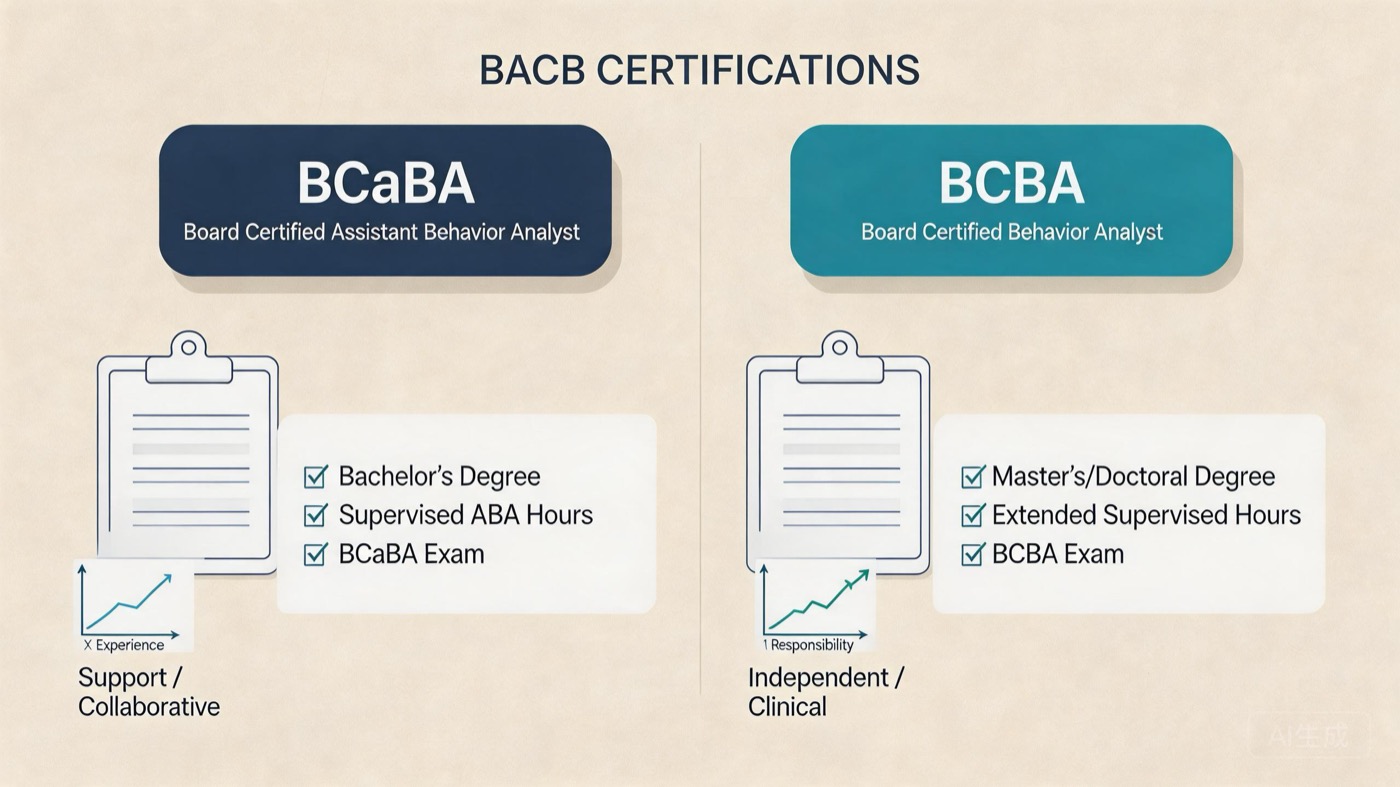
BCaBA Definition
The Board Certified Assistant Behavior Analyst (BCaBA) is an undergraduate-level certification. Individuals holding this credential typically hold a bachelor’s degree and have completed coursework in behavior analysis. BCaBAs work under the supervision of a BCBA and are not qualified to practice independently. Their role is crucial in implementing behavior plans and collecting data, but they rely on a BCBA for design and oversight.
BCBA Definition
The Board Certified Behavior Analyst (BCBA) is a graduate-level certification requiring a master’s degree or higher. BCBAs are trained to design, implement, and oversee behavior-analytic interventions independently. They also supervise the work of BCaBAs, Registered Behavior Technicians (RBTs), and other staff. BCBAs often lead teams and are responsible for ethical and effective treatment outcomes.
Key Differences in Supervision and Scope of Practice
The most critical distinction lies in supervision requirements and the scope of practice. These differences directly affect what each professional can do in the field and how they interact with clients and colleagues.
Supervision Requirements
- BCaBA: Must be supervised by a BCBA who meets BACB supervision standards. The BCaBA cannot provide supervision to others without additional credentials. Supervision must be documented and occur regularly, typically a minimum of 5% of direct service hours per month.
- BCBA: Can independently practice and supervise BCaBAs, RBTs, and other behavior-analytic staff. Supervision requires documented training and ongoing oversight, including performance monitoring and feedback. BCBAs must also maintain their own supervision for continuing education.
Scope of Practice
- BCaBA: Implements behavior intervention plans (BIPs) under direction. They may collect data, conduct assessments like preference assessments, and assist in training, but they do not design interventions. Their work is always under the responsibility of a BCBA.
- BCBA: Designs and oversees all aspects of behavior-analytic programming. This includes conducting functional assessments, developing BIPs, ensuring treatment fidelity, and making data-based decisions. BCBAs also handle ethical dilemmas and program modifications.
Exam Content Comparison
The BCBA and BCaBA exams share many topics, but the depth and focus differ. The BCBA exam emphasizes independent practice and systems-level thinking, including supervision and ethical leadership. The BCaBA exam focuses on implementation, data collection, and understanding of basic principles under supervision. For a detailed breakdown of the BCBA exam blueprint, see our BCBA 6th Edition Exam Blueprint Weighting Guide.
Educational Requirements and Fieldwork
The path to each certification starts with different educational prerequisites. BCaBA candidates must complete a bachelor’s degree from an accredited institution and undergo BACB-approved coursework, typically a verified course sequence. Fieldwork hours for BCaBA are 1,000 hours (supervised independent fieldwork) or 500 hours (practicum). In contrast, BCBA candidates need a master’s degree or higher, with 1,500 hours (supervised independent fieldwork) or 750 hours (practicum). These differences reflect the increased responsibility and complexity of BCBA duties. Understanding these requirements helps candidates plan their career trajectory and exam preparation timeline.
ABA Examples: How the Roles Differ in Practice
Let’s look at three common clinical scenarios to illustrate how BCBAs and BCaBAs collaborate.
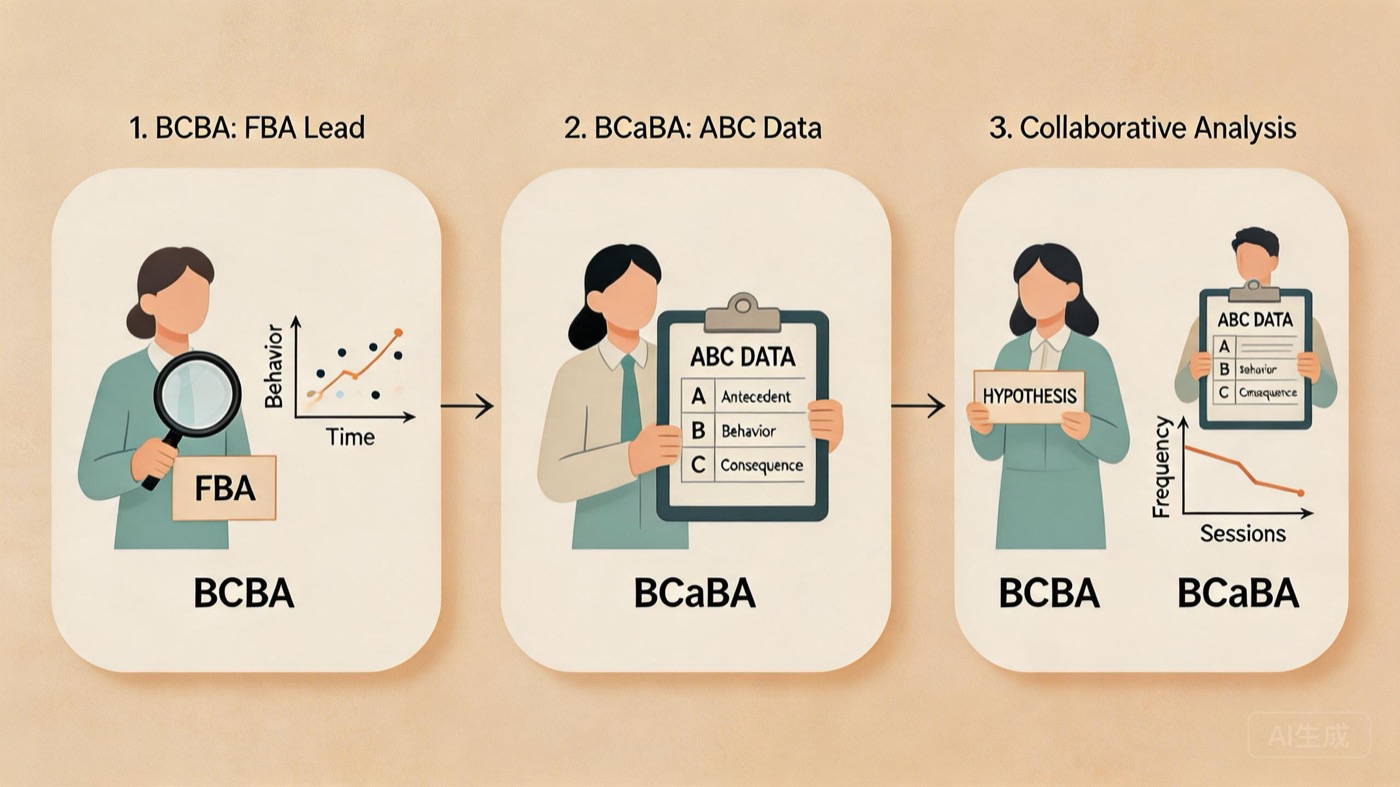
Example 1: Functional Behavior Assessment
A BCBA leads the functional behavior assessment (FBA) process, including indirect and direct assessments, and may conduct a functional analysis. The BCaBA assists by collecting ABC data, summarizing results, and helping with environmental arrangements. For instance, during an FBA for a child who hits peers, the BCaBA records antecedents and consequences, while the BCBA hypothesizes that the function is access to attention and designs the analysis.
Example 2: Behavior Intervention Plan Implementation
After the BCBA designs the behavior intervention plan (BIP), the BCaBA implements the plan with the client. The BCaBA ensures that procedures like differential reinforcement of alternative behavior (DRA) are followed correctly. The BCBA monitors treatment fidelity through periodic observations, data review, and adjustments to the plan as needed. The BCaBA provides valuable feedback on implementation challenges.
Example 3: Parent Training
The BCBA designs the parent training curriculum based on the client’s needs and behavior-analytic principles. The BCaBA may deliver the training under supervision, role-playing with parents and providing feedback on specific techniques. The BCBA evaluates outcomes, ensures the training is effective, and adjusts the plan if progress stalls. This collaborative model maximizes efficiency and quality of care.
Exam Relevance and Common Traps
Both exams test candidates on ethical and professional boundaries. Understanding the differences between BCaBA and BCBA roles is crucial to avoid common mistakes and score well on scenario-based questions.
Traps on the BCBA Exam
- Assuming a BCBA can delegate all responsibilities to a BCaBA without oversight — BCBAs retain ultimate responsibility.
- Forgetting that BCBAs must document supervision and ensure the BCaBA’s competence through training and performance reviews.
- Confusing the scope: only a BCBA can design interventions, modify BIPs, and supervise others. BCaBAs cannot independently adjust plans.
Traps on the BCaBA Exam
- Overstating the BCaBA’s autonomy — they cannot work independently or supervise others without a BCBA.
- Misidentifying who can modify a BIP; only the supervising BCBA can make changes. The BCaBA must report the need for changes.
- Forgetting that BCaBAs must disclose their supervised status to clients and families, ensuring transparency and ethical practice.
For more exam prep strategies, check out our BCBA Exam Prep Guide.
Quick Checklist for Candidates
- Determine your career goals: Do you want to practice independently (BCBA) or work under supervision (BCaBA)? Consider the time and cost of education.
- Review BACB requirements for education, supervised fieldwork, and exam eligibility. Each certification has specific prerequisites.
- Study the ethical code: Both levels must follow the BACB Ethics Code, but responsibilities differ — BCBAs have additional obligations as supervisors.
- Practice scenarios that test role boundaries, especially on exams. Use case studies to differentiate what each professional can do.
- Use mock exams to identify knowledge gaps — our BCBA Mock Exam 6th Edition can help you prepare and build confidence.
Summary
In summary, the BCaBA vs BCBA distinction comes down to education level, supervision requirements, and scope of practice. BCaBAs assist under supervision, while BCBAs lead and oversee. Understanding these differences is not only critical for passing the exam but also for ethical and effective practice in applied behavior analysis. For further reading, visit the BACB official website for current standards and updates.



