

Good supervision in ABA is an active teaching-and-evaluation process. A common study prompt asks: in learning applied behavior analysis procedures good supervision includes what? The best answer is not simply “a meeting” or “a required number of hours.” Effective ABA supervision develops the trainee’s behavior-analytic, professional, and ethical repertoires while also protecting the quality of services delivered to clients.
Table of Contents
- What Does Good Supervision in ABA Include?
- The Effective Supervision Cycle
- Eight Core Elements of Effective ABA Supervision
- What Good Supervision Looks Like in a Real Case
- Good Supervision Is More Than Counting Hours
- How to Recognize the Best Answer on a BCBA Question
- A Practical Checklist for Supervisees
- Frequently Asked Questions
- Sources for Further Study
- Take the Free BCBA Mock Exam
In practical terms, good supervision includes clear expectations, ongoing skill monitoring, behavioral skills training, direct observation, specific feedback, modeling, case conceptualization, review of written work, evaluation of service delivery, and evaluation of the supervision itself. The current BACB Handbook is the controlling source for current requirements; this article turns its supervision elements into a study-friendly framework.
What Does Good Supervision in ABA Include?
Good supervision is an active teaching-and-evaluation process. The supervisor identifies the skills the trainee needs, defines what competent performance looks like, arranges opportunities to practice, observes performance, gives usable feedback, and checks whether both trainee behavior and client services improve.
The important word is performance. A trainee may be able to explain a procedure during a meeting but still need modeling, rehearsal, or feedback to implement it accurately with a client. Conversely, a trainee may understand the skill but fail to use it because expectations, materials, time, or consequences are poorly arranged. Effective supervision gathers enough information to distinguish those possibilities before choosing a response.
The BACB’s official Supervision, Assessment, Training, and Oversight resource directs supervisors to the relevant handbook and training materials. For exam study, use that source to verify the current rules, then use the framework below to identify what a supervision vignette is actually describing.
The Effective Supervision Cycle
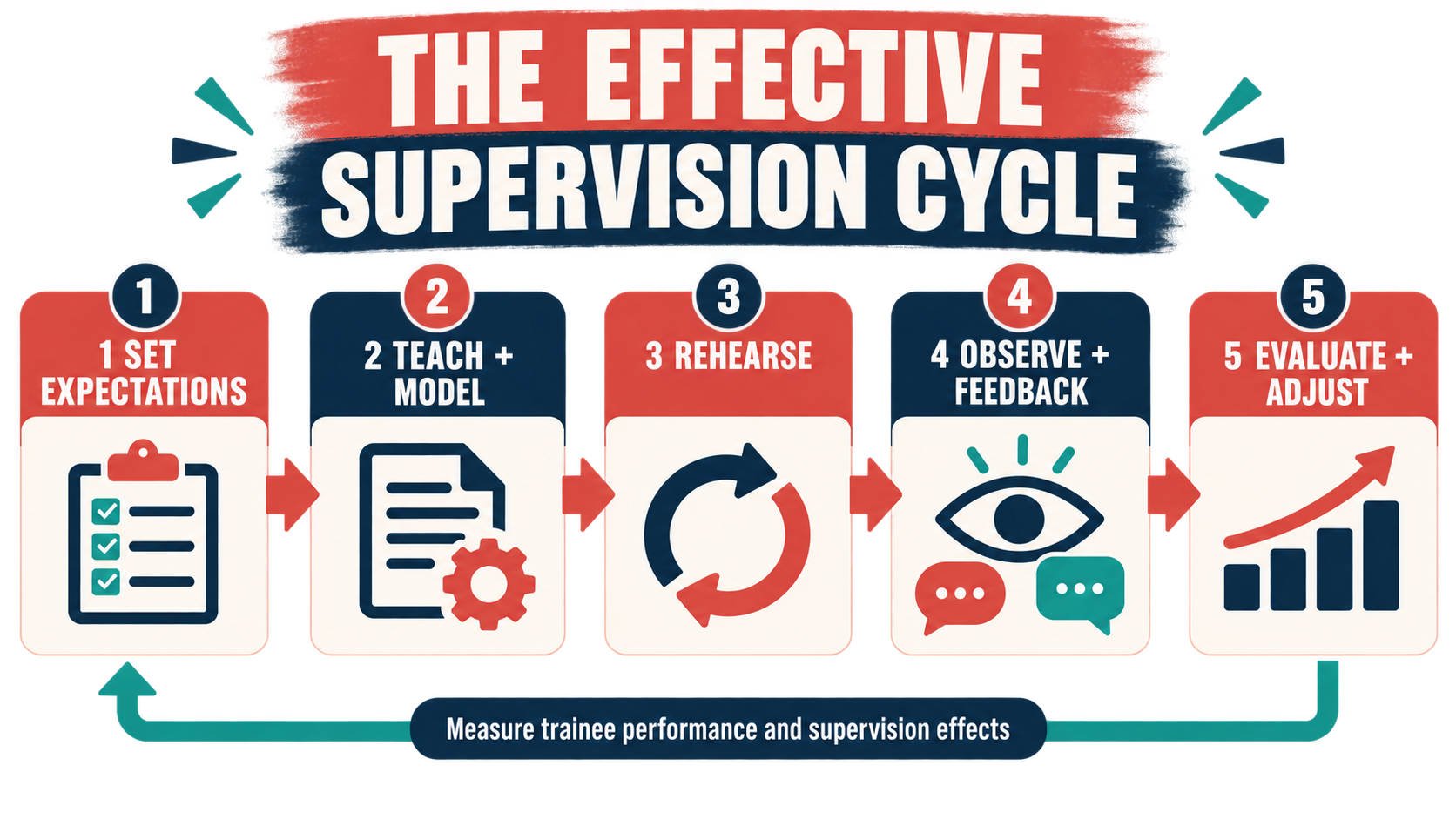
Think of effective supervision as a repeating cycle rather than a single conversation. Each step produces information for the next decision:
- Set expectations. Define the target professional behavior, the conditions in which it should occur, the quality criterion, and how performance will be measured.
- Teach and model. Explain the procedure and rationale, then demonstrate the technical, professional, and ethical behavior expected of the trainee.
- Arrange rehearsal. Give the trainee a chance to perform the skill in role-play, practice, or an appropriate client context. A verbal “I understand” is not the same as demonstrated competence.
- Observe and give feedback. Watch performance directly or review an appropriate product. Give feedback that names the behavior, describes the effect, and identifies the next practice step.
- Evaluate and adjust. Review trainee performance, client-service data, treatment integrity, and the effects of supervision. Change the training or supervisory arrangement when the data show that the current approach is not enough.
This cycle does not require every meeting to look identical. The content should fit the trainee’s goals, the client’s needs, the setting, and the supervisor’s area of competence. What should remain visible is the link between a defined skill, observable evidence, feedback, and a decision.
Eight Core Elements of Effective ABA Supervision
The current BCBA Handbook describes effective behavior-analytic supervision through a set of connected responsibilities. The table below paraphrases those responsibilities and adds the exam signal to look for.
| Element | What it looks like | Exam signal |
|---|---|---|
| Monitor trainee skills | The supervisor checks skill development across time instead of assuming attendance equals competence. | Look for direct evidence of what the trainee did. |
| Communicate expectations | The trainee knows the target behavior, quality criterion, responsibilities, and review process. | Vague instructions are a supervision problem, not a trainee personality trait. |
| Conduct behavioral skills training | Instruction, modeling, rehearsal, and feedback are arranged when a skill must be taught. | A manual alone is not the complete training package. |
| Observe and give feedback | The supervisor sees performance with clients or reviews a meaningful product and gives timely, specific feedback. | “Looks fine” without observation or behavioral detail is weak evidence. |
| Model technical, professional, and ethical behavior | The supervisor demonstrates the standards expected in assessment, intervention, documentation, communication, and decision-making. | The supervisor is also a model, not only a grader. |
| Build case-conceptualization skills | The trainee practices problem-solving, behavioral reasoning, and defensible clinical decisions. | Choose the option that teaches reasoning, not just rule memorization. |
| Review written materials | Programs, data sheets, reports, and other products are reviewed with feedback tied to observable quality. | Documentation is a performance product that can be taught and measured. |
| Evaluate service and supervision effects | The supervisor asks whether trainee behavior, client services, and the supervision arrangement are improving. | A supervisor evaluates the supervision system too. |
These elements work together. For example, reviewing a data sheet without teaching the measurement procedure may only document an error. Teaching the procedure, observing it, rehearsing it, and reviewing later data turns the same problem into a supervision opportunity.
What Good Supervision Looks Like in a Real Case
Imagine a trainee who records frequency data inconsistently. On some sessions, the trainee counts every instance. On others, similar responses are grouped together, so the data cannot be compared reliably. A weak supervisory response would be, “Be more careful,” followed by a reminder to log more hours. That statement does not define the performance, identify why the error occurs, or provide a way to test improvement.
An effective response starts with assessment. The supervisor reviews the operational definition and watches the trainee collect data. If the trainee cannot discriminate an instance of the target response, the supervisor provides instruction, models examples and nonexamples, arranges rehearsal, and gives corrective feedback. If the trainee can perform the skill during practice but not during a rushed transition, the supervisor examines environmental variables such as materials, timing, competing demands, and prompts.
The supervisor then uses a simple fidelity or accuracy checklist, observes another session, and compares the new data with the earlier sample. The trainee also practices explaining what the data mean and what decision would follow. This is supervision because it connects a defined skill to training, observation, feedback, and evaluation. The site’s function-based performance diagnostics guide explores the skill-versus-performance distinction in greater depth, while the BST guide reviews the training package itself. Before the next supervision contact, a useful review record would identify:
- the operational definition or written procedure being used;
- the trainee’s baseline accuracy and the conditions under which errors occurred;
- the teaching, modeling, rehearsal, and feedback delivered;
- the next observation or product review that will test whether performance changed.
Good Supervision Is More Than Counting Hours
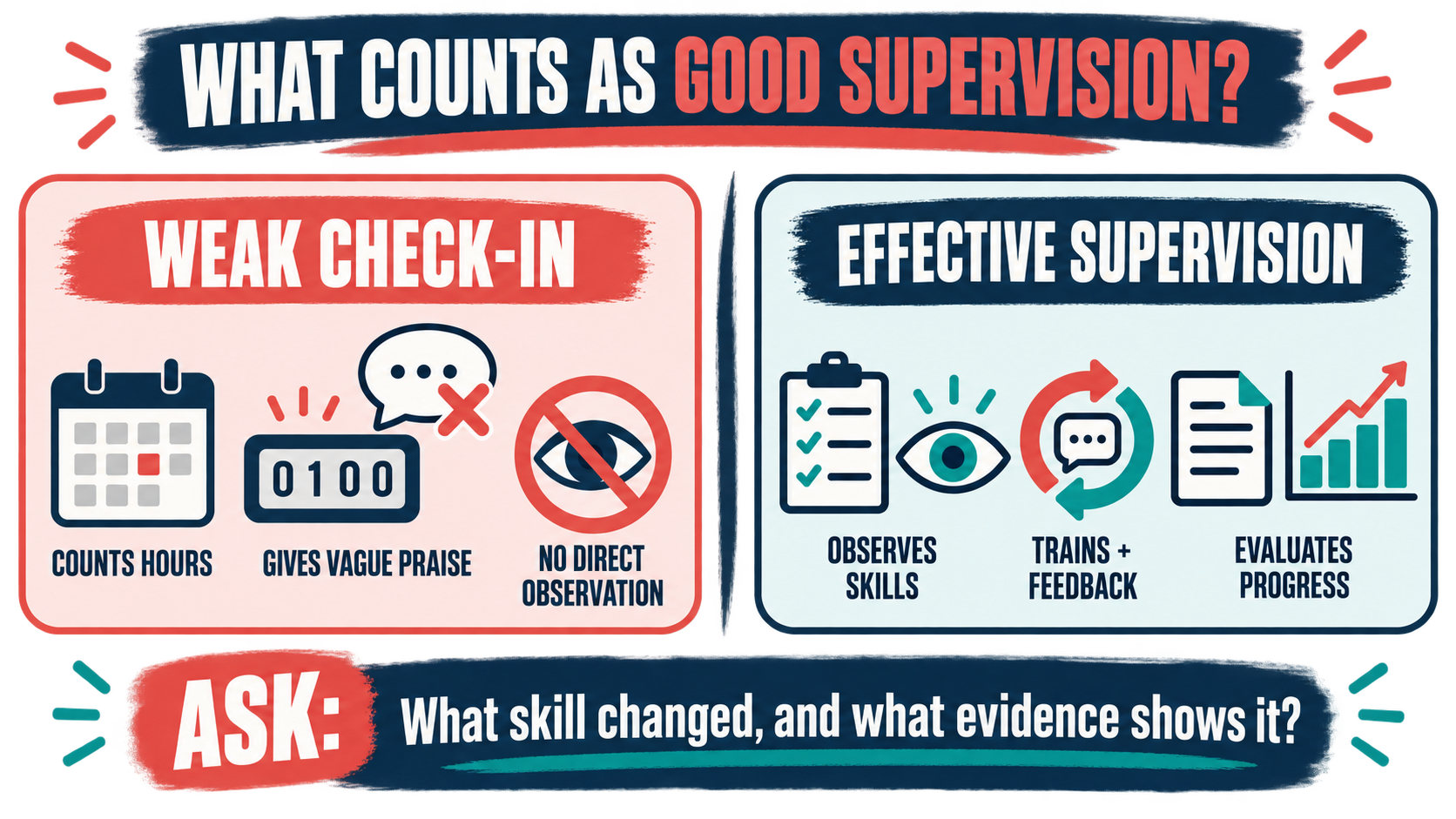
Fieldwork documentation and quantitative requirements matter, but a complete log does not automatically prove that supervision was effective. The BCBA fieldwork and supervision requirements guide is the better destination for current pathways, hours, percentages, and documentation rules. This page answers a different question: what should happen during supervision so that the trainee and client services benefit?
| Hour-counting only | Effective supervision |
|---|---|
| Treats meeting attendance as the main outcome. | Defines and measures trainee performance over time. |
| Uses general praise without describing the behavior. | Uses specific, timely feedback and creates another practice opportunity. |
| Reviews forms only when a deadline is near. | Reviews written products as part of ongoing skill development. |
| Assumes a trainee’s difficulty reflects motivation or attitude. | Assesses skill, prompts, resources, competing demands, and consequences before choosing an intervention. |
| Evaluates the trainee but never the supervision arrangement. | Uses data to evaluate whether supervision itself is producing useful change. |
The distinction is not “rules versus relationships.” Quality supervision must be organized, ethical, and documented while also being behaviorally useful. A friendly conversation can be part of supervision, but friendliness does not substitute for observable teaching and evaluation.
How to Recognize the Best Answer on a BCBA Question
When a question asks what good supervision includes, look for the option that combines training with direct evidence of performance. Use this sequence:
- Identify the target. What trainee skill or professional behavior is supposed to change?
- Find the evidence. Does the supervisor observe the performance, review a product, or examine a meaningful data sample?
- Check the teaching component. If the problem is a skill deficit, does the response include instruction, modeling, rehearsal, and feedback?
- Check the feedback. Is the feedback specific enough to guide the next response, or is it only praise or criticism?
- Check the outcome. Does the supervisor evaluate trainee performance, client service delivery, treatment integrity, or the effects of supervision?
- Check the boundary. Is the supervisor acting within competence, protecting client interests, and avoiding responsibility that the trainee cannot yet perform safely?
Common traps include choosing “provide a handbook” as if written instructions were complete BST, choosing “meet the required percentage” as if quantity were the whole purpose of supervision, or choosing a vague motivational statement without observation. The stronger answer usually contains a measurable performance target and a feedback loop.
A Practical Checklist for Supervisees
Use these questions to prepare for a supervision meeting or to study a vignette:
- What observable skill is the trainee expected to perform?
- What does competent performance look like, and how will it be measured?
- Has the supervisor explained the procedure and modeled it?
- Has the trainee had a chance to rehearse before being evaluated in a high-stakes situation?
- When was the trainee last observed with a client or working on a relevant product?
- Was feedback tied to a specific behavior and a specific next step?
- Were data sheets, programs, reports, or other written products reviewed?
- Did the discussion build case conceptualization and ethical decision-making rather than only recall?
- What evidence shows that client services and trainee performance are improving?
- What should the supervisor change if the current training or supervision arrangement is not working?
For exam preparation, practice applying this checklist to short scenarios instead of memorizing a list in isolation. The free BCBA mock exam can provide additional practice with behavior-analytic reasoning. It is an independent study resource, not official BACB content and not a guarantee of examination success.
Frequently Asked Questions
Is good supervision the same as giving feedback?: No. Feedback is one element of supervision. Good supervision also includes defining expectations, teaching and modeling skills, arranging rehearsal, observing performance, reviewing work products, and evaluating the effects of both services and supervision.
Does a supervision meeting need to include every element every time?: No. The emphasis should fit the trainee’s current goals and the client context. Across the supervisory relationship, however, the supervisor should be able to show how training, observation, feedback, and evaluation are being connected.
Why is direct observation important?: Direct observation helps the supervisor compare what a trainee says with what the trainee does. It can reveal a skill deficit, an unclear protocol, a resource problem, or a performance consequence that would be missed by relying only on self-report.
Where should I check current supervision requirements?: Start with the BACB’s supervision and training resource hub and the current BCBA Handbook. Requirements can change, so an older study card or blog post should not override the current official source.
Sources for Further Study
- BACB: Supervision, Assessment, Training, and Oversight
- BACB: BCBA Handbook
- BACB: BCBA Test Content Outline, 6th edition
- Recommended Practices for Individual Supervision of Aspiring Behavior Analysts
For targeted review, use our good supervision in ABA practice questions to apply the concept in exam-style scenarios.
Take the Free BCBA Mock Exam
If you want a low-pressure way to check your recall, use the free practice resource below. Take the Free BCBA Mock Exam



