
How to write ABA goals starts with a behavior you can observe, a meaningful situation in which it matters, and a measurement plan that tells the team whether the learner is making progress. “Improve communication” or “pay attention” may describe a concern, but neither sentence is specific enough to guide teaching or data collection.
Table of Contents
- What Makes an ABA Goal Usable?
- How to Write ABA Goals: The 7-Part Formula
- How Do You Turn a Vague ABA Target Into a Measurable Goal?
- How Should You Match a Goal to a Measurement System?
- How Should You Set Mastery, Generalization, and Review Rules?
- What Common ABA Goal-Writing Mistakes Should You Avoid?
- What Is a Practical ABA Goal Review Workflow?
- Frequently Asked Questions
- Sources for Further Study
- Take the Free BCBA Mock Exam
A usable ABA goal connects an assessment finding to an observable response, condition, baseline, measurement system, mastery criterion, and review plan. The wording should reflect the learner’s communication mode, preferences, culture, environment, support needs, and socially important outcomes.
Short answer: write the goal so a second trained person could identify the response, arrange or recognize the opportunity, record the same data, and decide what happens next. A strong goal is not a prediction that a learner will “do better.” It is a testable statement that supports instruction, progress review, and a meaningful life outcome.
What Makes an ABA Goal Usable?
An ABA goal is a clinical decision tool, not just a sentence in a treatment plan. It should help the team answer four questions:
- What response are we teaching or reducing? Describe an action or response class, not a personality trait, diagnosis, or vague quality such as “appropriate.”
- When does the response matter? Name the opportunity, instruction, materials, people, setting, or antecedent that makes the goal meaningful.
- How will we know what happened? Select a measurement that matches the dimension of the behavior and define the denominator when using a percentage.
- What decision will the data support? State a reasonable mastery criterion, review period, generalization plan, and response if progress stalls.
A goal such as “the learner will improve social skills” is weak because it does not identify the response, context, or evidence of improvement. A better target might be initiating a conversation, responding to a peer, requesting a break, or completing a defined routine. Choose it from assessment and client-informed priorities, not a generic list.
The current BACB BCBA Test Content Outline places measurement, behavior assessment, behavior-change procedures, and intervention selection within the certification content. Goal-writing practice brings those skills together, but this article is a study explanation—not official BACB exam content or a promise about a particular question.
How to Write ABA Goals: The 7-Part Formula
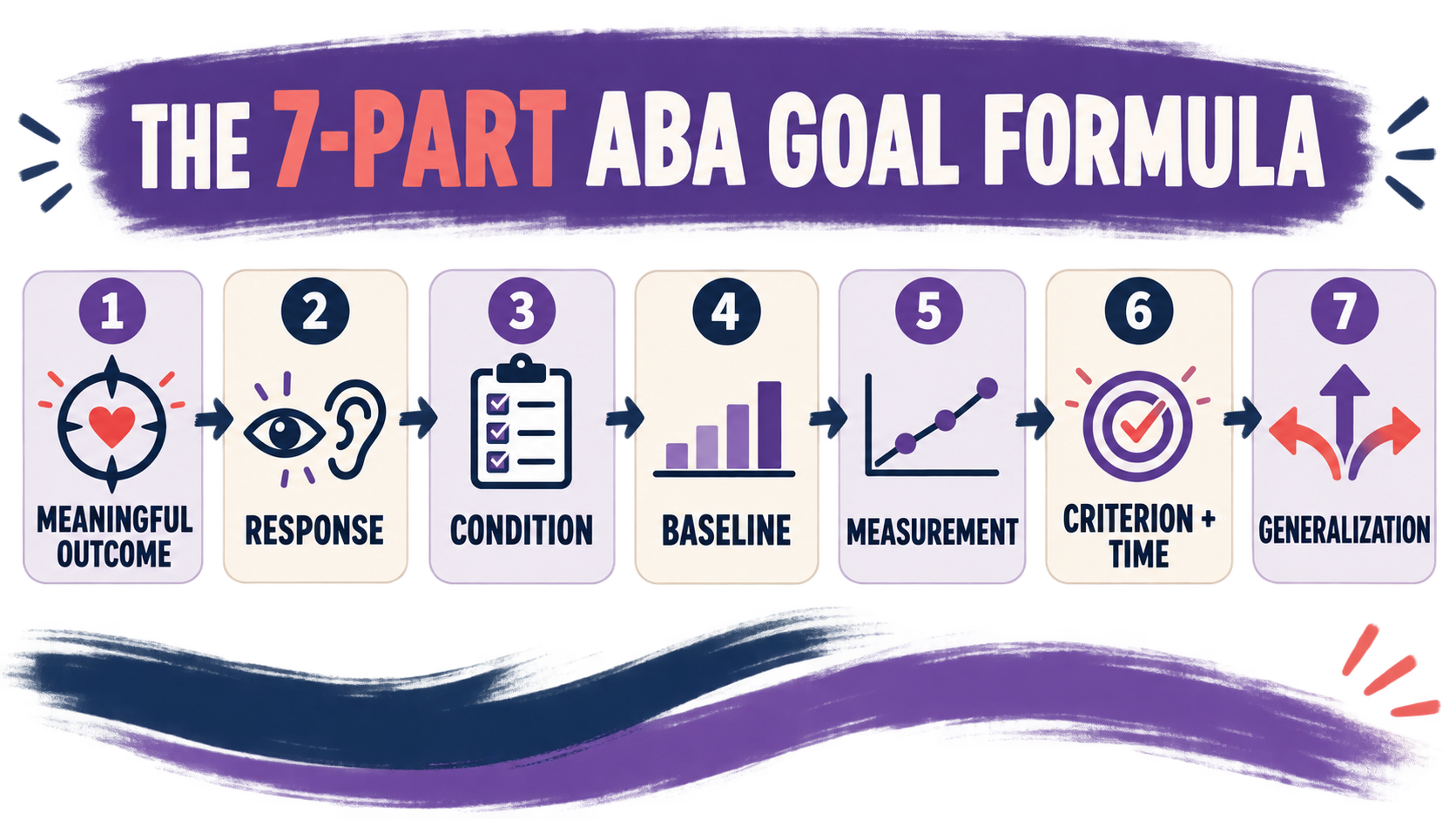
Use the following seven parts as a drafting checklist. You do not have to force every part into one awkward sentence; some details can live in the treatment plan or data sheet. The important point is that the team can find and apply each decision.
| Part | Question to answer | Example detail |
|---|---|---|
| Meaningful outcome | Why does this response matter to the learner? | Accessing a preferred item, participating in a routine, communicating a need, or staying safe. |
| Observable response | What would an observer see or hear? | Hands an AAC device to an adult, says “help,” or places the finished item in the labeled bin. |
| Condition | What opportunity, instruction, material, or context is present? | When a preferred item is visible but unavailable, or when a transition timer ends. |
| Baseline | What does the learner do now under comparable conditions? | Four independent requests in 20 opportunities across three baseline sessions. |
| Measurement | Which dimension and recording method fit the response? | Percentage of independent opportunities, rate, duration, latency, or a defined interval measure. |
| Criterion and time | What performance level and review window indicate progress? | At least 8 of 10 opportunities for three consecutive sessions, reviewed weekly. |
| Generalization | Where, with whom, and with what materials should the skill maintain? | Two familiar adults, two settings, and a new but functionally similar item. |
Define “independently”: no verbal prompt, model, gesture, or physical assistance? Record prompt level separately so prompted success is not confused with independence, and define accepted communication forms. Speech, sign, picture exchange, or AAC may all be valid request responses.
How Do You Turn a Vague ABA Target Into a Measurable Goal?
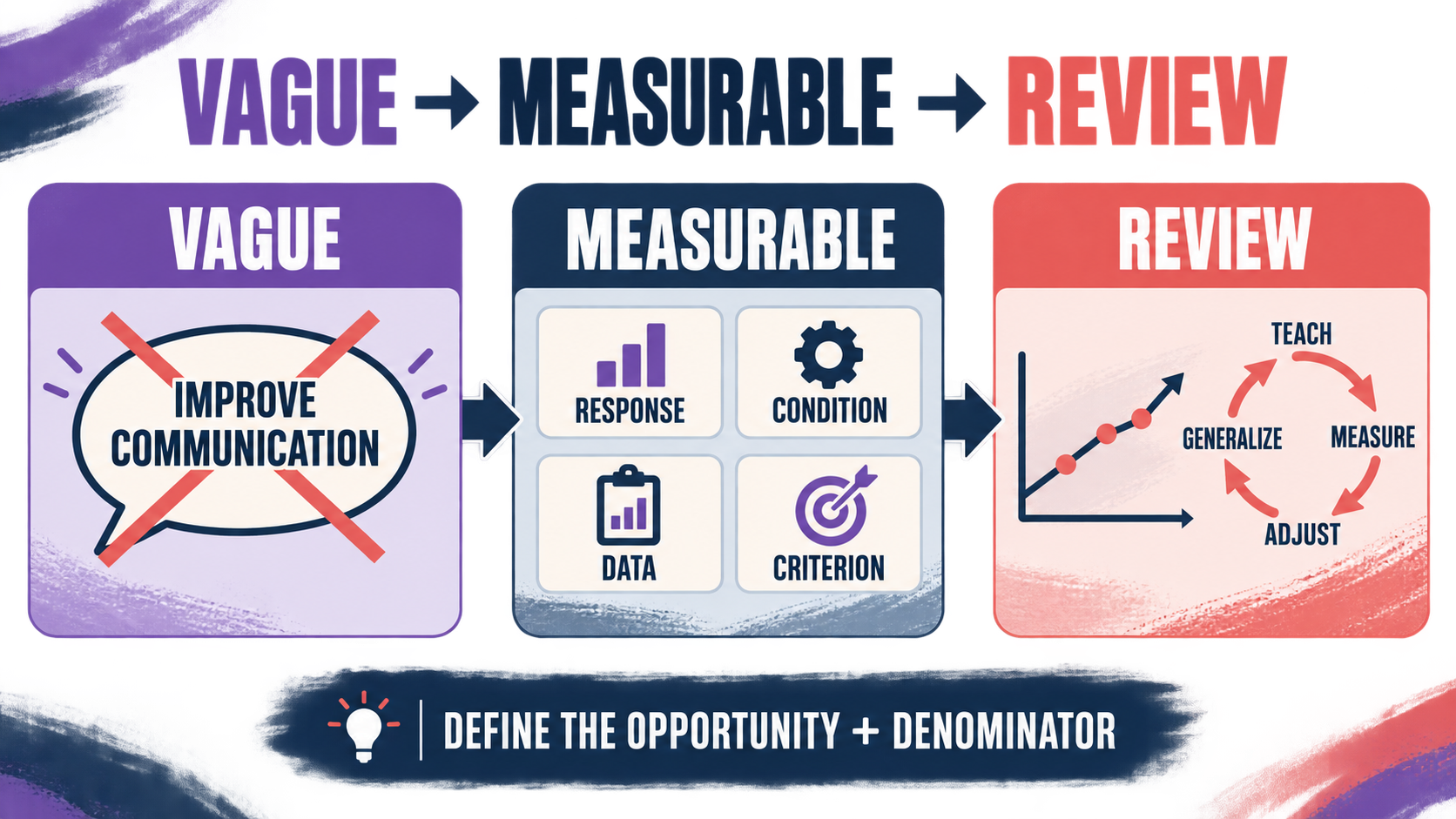
Start by preserving the useful intention and replacing the vague verb with a response that can be observed. Then add the opportunity, measurement, criterion, and generalization boundary. The example below is a model for reasoning, not a universal target for every learner.
| Draft | What is missing? | Repair |
|---|---|---|
| Improve communication. | No response, condition, measure, or reason the skill matters. | Given access to a preferred item and an opportunity, the learner will independently request using an agreed speech, sign, or AAC response in at least 8 of 10 opportunities across three sessions. |
| Will be compliant during transitions. | “Compliant” can hide several behaviors and may center adult convenience rather than a meaningful outcome. | When a planned transition cue occurs, the learner will use the agreed transition routine or request a break within two minutes, with the prompt level recorded, in 4 of 5 opportunities across two settings. |
| Reduce aggression to zero. | The topography, risk context, time window, replacement response, and measurement are unclear. | Define the safety-relevant response and teach a functionally appropriate replacement; measure rate or opportunities in the specific context rather than using an unexplained zero target. |
Avoid turning every concern into a behavior-reduction goal. A harmless difference in movement, communication style, eye gaze, or self-regulation is not automatically a problem to eliminate. Ask whether the target improves access, autonomy, safety, communication, participation, or another outcome the learner and relevant stakeholders value. When risk is involved, define the risk precisely and pair reduction with a replacement response and a support plan.
How Should You Match a Goal to a Measurement System?
Choose measurement after you define the behavior, not before. A percentage is useful when the team can identify a comparable set of opportunities. It is misleading when the number of opportunities changes from session to session or when the denominator is never recorded.
- Count or rate: use when the number of responses matters and observation time can be held constant or converted to a rate.
- Duration: use when how long the response lasts is the clinical question, such as remaining engaged in a chosen activity.
- Latency: use when the delay between an instruction or opportunity and the response is meaningful.
- Percentage of opportunities: use when each opportunity can be defined and the numerator and denominator are recorded.
- Interval or time-sampling measures: use when continuous recording is impractical and the limits of the sampling method are understood.
- Product or task analysis measures: use when a completed product or a sequence of defined steps provides valid evidence of performance.
Write the scoring rule beside the goal. For example, “independent request” might require the learner to initiate the response before any prompt and within five seconds of the opportunity. If a caregiver or staff member supplies a verbal model, score that trial as prompted rather than independent. Consistent scoring protects the usefulness of the graph.
Baseline should resemble the teaching condition. A quiet-clinic baseline may not explain performance in a noisy classroom or community setting. If context changes for safety or access, document the difference rather than treating the numbers as interchangeable.
How Should You Set Mastery, Generalization, and Review Rules?
Mastery is a decision rule, not a magic percentage. Set it from the skill’s function, current performance, error risk, expected independence, and everyday opportunities. An 80% criterion may fit one communication target and be inadequate for a safety skill; 100% is not automatically more scientific. Separate three decisions that are often collapsed:
- Acquisition: Is the learner performing the response under the teaching conditions?
- Generalization: Does the response occur with new people, materials, examples, or settings?
- Maintenance: Does the response continue after prompts, dense teaching, or frequent reinforcement are reduced?
Also state when the team will review the data. A goal without a review rule can remain in a plan after the learner has stalled, mastered it, or shown that the target is no longer meaningful. Predefine possible actions: adjust prompting, change the teaching arrangement, reassess the measurement, consult on barriers, revise the criterion, or close the goal after evidence supports that decision.
What Common ABA Goal-Writing Mistakes Should You Avoid?
- Using labels instead of responses: “be more independent,” “be appropriate,” and “improve social skills” are directions for discussion, not finished goals.
- Combining unrelated skills: “sit, look, listen, answer, and finish work” may require different conditions and measures. Split the response classes when the decisions differ.
- Leaving out the denominator: “80% accuracy” is incomplete if the team cannot tell 80% of what.
- Counting prompted and independent performance together: record the prompt level so the goal reflects the intended independence.
- Choosing an arbitrary deadline: a date should support review and planning, not create a false guarantee about learning speed.
- Ignoring context: a goal mastered in one room may not be generalized to home, school, community, or telehealth.
- Targeting adult convenience alone: connect the response to communication, access, autonomy, safety, participation, or another meaningful outcome.
- Writing without a decision rule: the team needs to know what it will do when data are flat, variable, or improving.
What Is a Practical ABA Goal Review Workflow?
Use this short workflow before a goal enters a treatment plan or teaching program:
- Start with the assessment and the person’s priorities. Identify the skill strength, barrier, context, and outcome that make the goal worth pursuing.
- Write the observable response. Define what counts and what does not count; include accepted communication forms and safety boundaries.
- Add the opportunity and condition. Describe when the goal is scored and whether the opportunity is naturally occurring or arranged.
- Check the baseline. Use enough comparable observations to understand level, variability, prompt dependence, and context.
- Select the measurement and scoring rule. Record the numerator, denominator, timing, prompt level, and any quality requirement.
- Set the criterion and review date. Explain why the level is meaningful and what decision follows the review.
- Plan generalization and maintenance. Name people, settings, materials, and later probes instead of writing “generalize” as an afterthought.
- Read the goal as another person. Ask whether a trained colleague would score it the same way and whether the learner would recognize the outcome as useful.
If the target is specifically attending, our attending goals ABA guide narrows the same writing process to observable participation and measurement. If you are building a broader program, the skill acquisition plan sample and terminal goal ABA guide address related planning layers without replacing individualized assessment.
For exam preparation, first study the current BACB materials and then practice distinguishing vague targets, operational definitions, measurement systems, and decision rules in scenarios. The free BCBA mock exam can be a separate practice tool. It is not official BACB content, a clinical plan, or a guarantee of certification.
Frequently Asked Questions
What makes an ABA goal measurable?: A measurable goal identifies an observable response, a condition or opportunity, a recording method, and a criterion that can be evaluated over a defined period. If the team cannot agree on what to count, the goal needs more operational detail.
Should every ABA goal use a percentage?: No. Use the measurement that matches the behavior and the decision. Rate, duration, latency, interval measures, task-analysis steps, or product measures may be more informative than a percentage. Percentages are only interpretable when the opportunities and denominator are clear.
How many goals should a learner have?: There is no universal number. Prioritize targets that are meaningful, feasible to teach and measure, and connected to the learner’s current needs and resources. Too many simultaneous goals can dilute instruction, data quality, caregiver participation, and review.
Can an ABA goal change after it is written?: Yes. Goals should be reviewed against data and the learner’s changing priorities. A change should preserve the record of what was originally targeted, explain why the decision changed, and identify the new measurement or criterion rather than silently rewriting history.
Are ABA goals the same as IEP goals?: They may address related outcomes, but they are not automatically interchangeable. An IEP follows education-law and school-team requirements, while an ABA treatment goal follows the assessment, service context, clinical documentation, and applicable payer or professional requirements. Coordinate language without assuming one document satisfies the other.
Is goal writing part of the BCBA exam?: The official BCBA Test Content Outline covers related skills such as measurement, assessment, behavior-change procedures, and intervention selection. Use the current BACB outline as the source of exam scope; do not treat any third-party article or mock exam as an official blueprint.
Sources for Further Study
- BACB BCBA Test Content Outline (6th ed.) — official scope for measurement, assessment, intervention, and related practice skills.
- BACB Ethics Codes — current ethics resource hub for applicants and certificants.
In short, the best ABA goal is specific enough to measure and flexible enough to remain meaningful. Start with the person and the context, define the response, match the data system, set a defensible decision rule, and review the plan when the evidence or priorities change.
Take the Free BCBA Mock Exam
If you want a low-pressure way to check your recall, use the free practice resource below. Take the Free BCBA Mock Exam



