
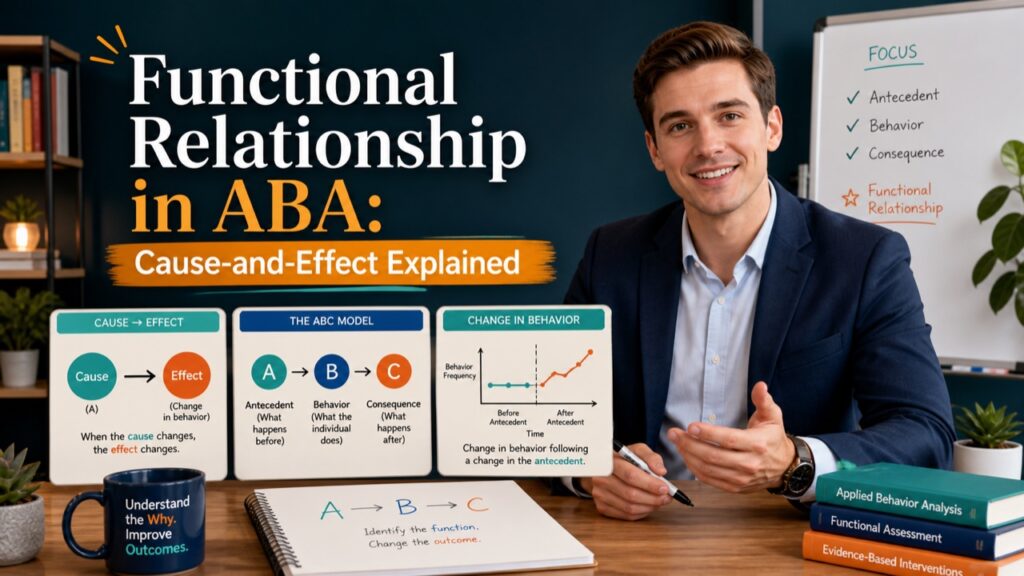
In applied behavior analysis (ABA), a functional relationship is a cause-and-effect relation between environmental events and behavior. It is demonstrated when systematic changes in an independent variable (IV) reliably produce changes in a dependent variable (DV) under controlled conditions. This concept is central to evidence-based practice because it distinguishes scientifically validated behavioral interventions from those based on mere observation or intuition. Understanding functional relationships is essential for conducting functional behavior assessments, designing effective treatments, and interpreting research. This guide explains the precise definition, how it differs from correlation, how it is established, and its role in functional behavior assessment (FBA). It also addresses common misconceptions and clarifies how visual analysis contributes to the evaluation of functional relationships in single-subject designs.
Table of Contents
- Defining Functional Relationship in ABA
- Functional Relationship vs. Correlation
- How to Demonstrate a Functional Relationship
- Functional Relationship in Functional Behavior Assessment (FBA)
- Misconceptions and Interpretation Limits
- Practical Study Points for BCBA Candidates
- Conclusion and Free Practice
Defining Functional Relationship in ABA
A functional relationship is a specific type of causal relationship: it exists when a change in an IV produces a consistent and reliable change in a DV, and this change is demonstrated through experimental manipulation. In ABA, the IV is typically an environmental event or intervention, while the DV is the target behavior. For example, a teacher systematically delivers attention (IV) contingent on hand-raising and observes a corresponding increase in hand-raising (DV). When this effect is replicated across phases, a functional relationship is established. This relationship is not assumed; it must be empirically demonstrated using rigorous experimental methods—a hallmark of applied behavior analysis.
The term functional relationship emphasizes the function of behavior: what environmental variables maintain or influence it. A functional relationship is context-specific; it describes a relation under particular conditions and for a particular individual. Therefore, conclusions about functional relationships are limited to the scope of the study, and generalization to other settings, stimuli, or behaviors requires additional evidence. This precision is a cornerstone of scientific practice in behavior analysis.
Functional Relationship vs. Correlation
A correlation is a statistical association between two variables, meaning they tend to co-vary. However, correlation does not imply causation. In ABA, descriptive assessments often reveal correlations—for example, a child’s off-task behavior may frequently occur when a teacher is not attending. Yet without experimental manipulation, we cannot determine whether inattention causes the off-task behavior or if some other factor is responsible. In contrast, a functional relationship is established only when the IV is systematically manipulated and the DV changes accordingly, while other variables are controlled. This distinction is critical because interventions based solely on correlations may be ineffective or even harmful.
- Correlation: two events co-occur; no manipulation; cannot infer cause.
- Functional relationship: IV manipulation leads to DV change; cause inferred through experimental control.
- Example: A correlation: a student frequently leaves the classroom when a particular peer is present. A functional relationship: removing that peer (IV) reduces leaving (DV) in a controlled reversal design.
In research and practice, relying on correlational data can lead to faulty assumptions about behavior function. For instance, if a child tantrums when demands are placed, one might assume escape is the function. But only a functional analysis can confirm that by manipulating demand presentation and observing tantrums. Without experimental evidence, the tantrum might be maintained by attention or automatic reinforcement. Therefore, behavior analysts must prioritize experimental methods when the goal is to establish a functional relationship.
How to Demonstrate a Functional Relationship
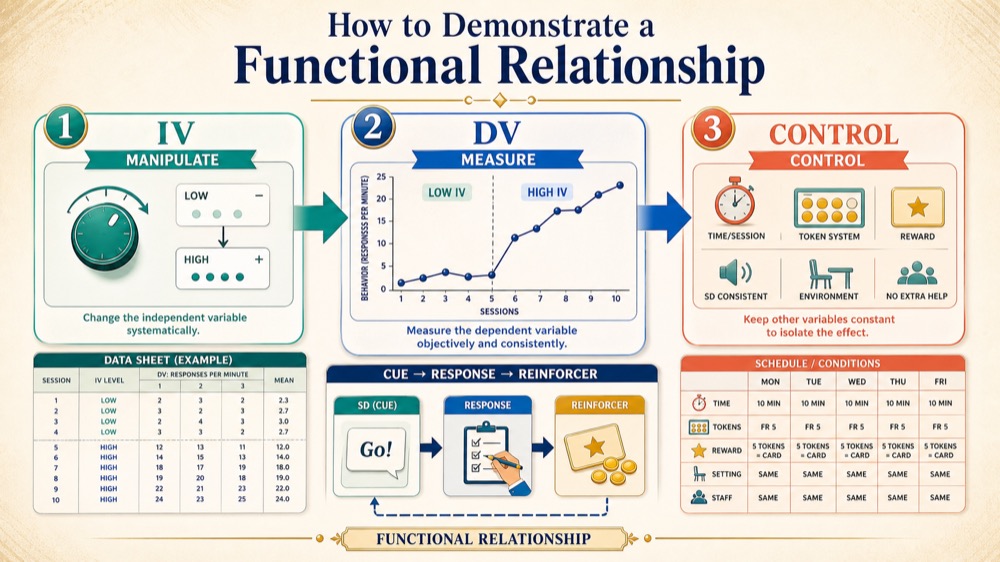
To demonstrate a functional relationship, three essential components are required: systematic manipulation of the IV, objective measurement of the DV, and control of extraneous variables. Manipulation involves actively changing the environmental event (e.g., delivering or withdrawing attention) while measuring the target behavior. Objective measurement ensures that the DV is defined clearly and measured reliably (e.g., frequency, duration). Control of extraneous variables prevents confounding influences from affecting the results. These components are operationalized through various single-subject designs, such as withdrawal designs (ABAB), multiple baseline designs, and alternating treatments designs.
- Withdrawal design: measures behavior during baseline (A) and intervention (B), then repeats the conditions to replicate effects.
- Multiple baseline design: introduces the IV at different times across settings, behaviors, or subjects to show control.
- Alternating treatments design: rapidly alternates between conditions to compare effects of the IV.
An original example illustrates this: Ms. Lopez, a classroom teacher, notices that a student’s off-task behavior seems to occur when she is not giving him attention. To test whether attention maintains off-task behavior, she conducts a simple withdrawal design. She measures baseline off-task behavior (A), then provides attention contingent on off-task behavior (B), then withdraws attention (A), then reintroduces it (B). If off-task behavior is higher during B phases than A phases, a functional relationship is demonstrated. This contrasts with a mere observation where off-task behavior and attention co-occur without manipulation; in that case, no cause-and-effect can be inferred.
Functional Relationship in Functional Behavior Assessment (FBA)
FBA is a process for identifying the function of problem behavior. It typically includes indirect assessments (e.g., interviews), descriptive assessments (e.g., observation), and experimental functional analysis (FA). While indirect and descriptive methods yield correlations and hypotheses, only an experimental FA can demonstrate a functional relationship. In an FA, the behavior analyst systematically manipulates antecedent and consequent events—such as attention, escape, tangible, and alone conditions—and observes which condition produces the highest rate of behavior. This experimental evidence allows the analyst to state confidently that a specific environmental variable functionally maintains the behavior.
Descriptive assessments, such as scatterplots or ABC data collection, are valuable for identifying patterns and generating hypotheses, but they do not provide the experimental control needed to establish a functional relationship. For example, if a child engages in aggression mainly during math tasks, a descriptive assessment might suggest escape from math. However, a functional analysis would test that by varying math demands and consequences. Only if aggression consistently decreases when math demands are removed or increased when demands are present can a functional relationship be concluded. Thus, while descriptive data inform the FBA, the FA is the method that can demonstrate functional relations.
Misconceptions and Interpretation Limits
A frequent misconception is that the terms functional relationship and functional analysis are interchangeable. They are not. A functional analysis is a specific experimental method—typically conducted within an FBA—that manipulates variables to identify a function. A functional relationship is the causal relation that the functional analysis aims to demonstrate. Another misconception is that any correlation or observation can prove a functional relationship. In reality, a functional relationship requires experimental control, replication, and careful measurement. Without these elements, we only have a hypothesis, not a demonstrated cause-and-effect relation.
Another misunderstanding is to treat a demonstrated relation as universal across people and settings. In fact, a functional relationship is specific to the conditions under which it was demonstrated. For example, a functional relationship between attention and tantrums for one child may not apply to another child. Even for the same child, changes in setting or stimuli could alter the relation. Therefore, behavior analysts must exercise caution when generalizing from single-subject studies. Visual analysis of data—examining level, trend, and variability—is used to evaluate whether a functional relationship is present. However, visual analysis alone cannot establish a functional relationship; experimental control and replication are essential. Replication across subjects or settings strengthens the evidence for generality.
Practical Study Points for BCBA Candidates
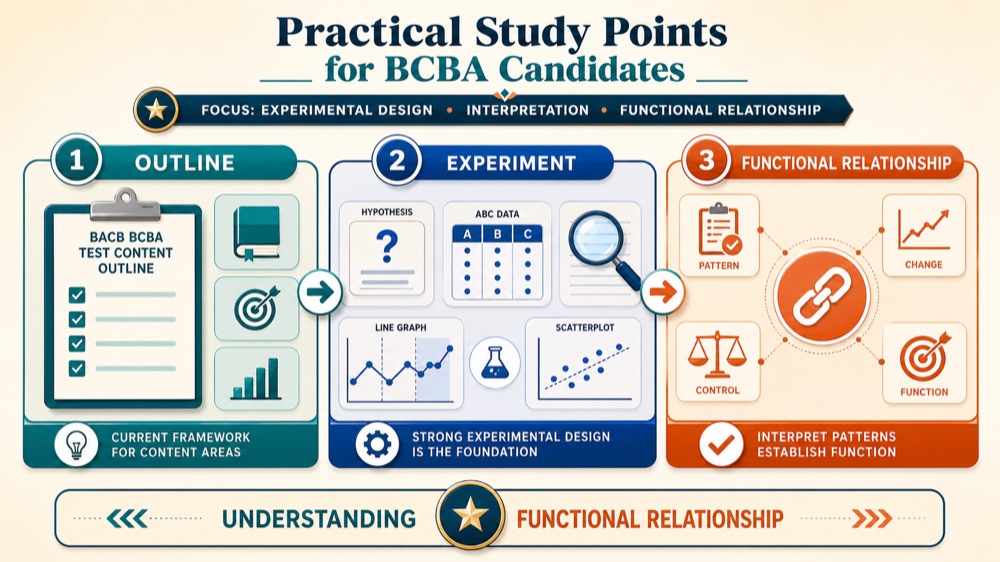
- Remember the key components: IV manipulation, objective DV measurement, and control of extraneous variables. Know that these are necessary for demonstrating a functional relationship.
- Differentiate from correlation: Be able to explain why correlation does not establish cause and give an example.
- Know experimental designs: Review withdrawal, multiple baseline, and alternating treatments designs, including their strengths and limitations.
- Understand FBA and FA: Clarify that FA is a method to demonstrate functional relations, while descriptive assessments only provide correlations.
- Use visual analysis: Practice interpreting graphs to identify level, trend, and variability, but remember that visual analysis alone is not sufficient without experimental control.
- Avoid overgeneralization: Recognize that functional relationships are context-specific and require replication for broader conclusions.
As you prepare for the BCBA exam, focus on the core concepts of experimental design and interpretation. The official BACB BCBA Test Content Outline provides the current framework for content areas, and understanding functional relationships supports your grasp of behavior-change procedures and experimental design. While this article provides a comprehensive overview, regular practice with mock questions will help solidify your understanding. The exam tests your ability to apply these concepts to real-world scenarios, not just memorize definitions.
Conclusion and Free Practice
In summary, a functional relationship in ABA is a cause-and-effect relation established through experimental manipulation, not mere correlation. It is demonstrated through controlled single-subject designs that show reliable changes in behavior when the environment is systematically altered. This concept is fundamental to effective behavioral assessment and intervention, as it ensures that treatments are based on verified causes rather than assumptions. Keep this distinction clear, and always seek experimental evidence when claiming that an intervention works. To further your preparation, take our Free BCBA Mock Exam, which provides practice questions and feedback on key ABA concepts, helping you assess your readiness for the real exam.
Ready to test your knowledge? Access the Free BCBA Mock Exam to get practice questions and detailed feedback. For more on related topics, explore our guides on stimulus control and stimulus generalization. These resources are designed to enhance your understanding and test-taking skills.
Next step for BCBA exam prep
Turn this topic into exam-day practice
Use this topic as a focused review, then test it in exam-style conditions with a free mock before deciding whether five full-length mocks are the right next step.
Start the Free BCBA Mock ExamContinue with Five Full-Length Mocks — $99
Review the included materials and access details before ordering. No pass guarantee is implied.



