
Function based vs topography based examples are easier to understand when you ask two different questions: What does the behavior look like, and what outcome does it produce or maintain? Topography describes the observable form of a response. Function describes the environmental consequence that helps explain why the response continues. A strong BCBA answer keeps both lenses available instead of treating them as competing labels.
Table of Contents
- What Is the Difference Between Function and Topography?
- Function Based vs Topography Based Examples
- When Should You Use Each Definition?
- How Does the Difference Change Assessment?
- How Does It Change Intervention Planning?
- What Are the BCBA Exam Traps?
- Frequently Asked Questions
- Sources for Further Study
- Quick Review Checklist
- Take the Free BCBA Mock Exam
For example, “hits the table with an open hand” is a topography-based description. “Hits the table and the worksheet is removed” describes a possible consequence pattern; if that pattern is confirmed, escape may be a maintaining function. The same topography could occur for attention, access to a tangible item, automatic reinforcement, pain, or another outcome in a different context. The form alone does not prove the function.
What Is the Difference Between Function and Topography?
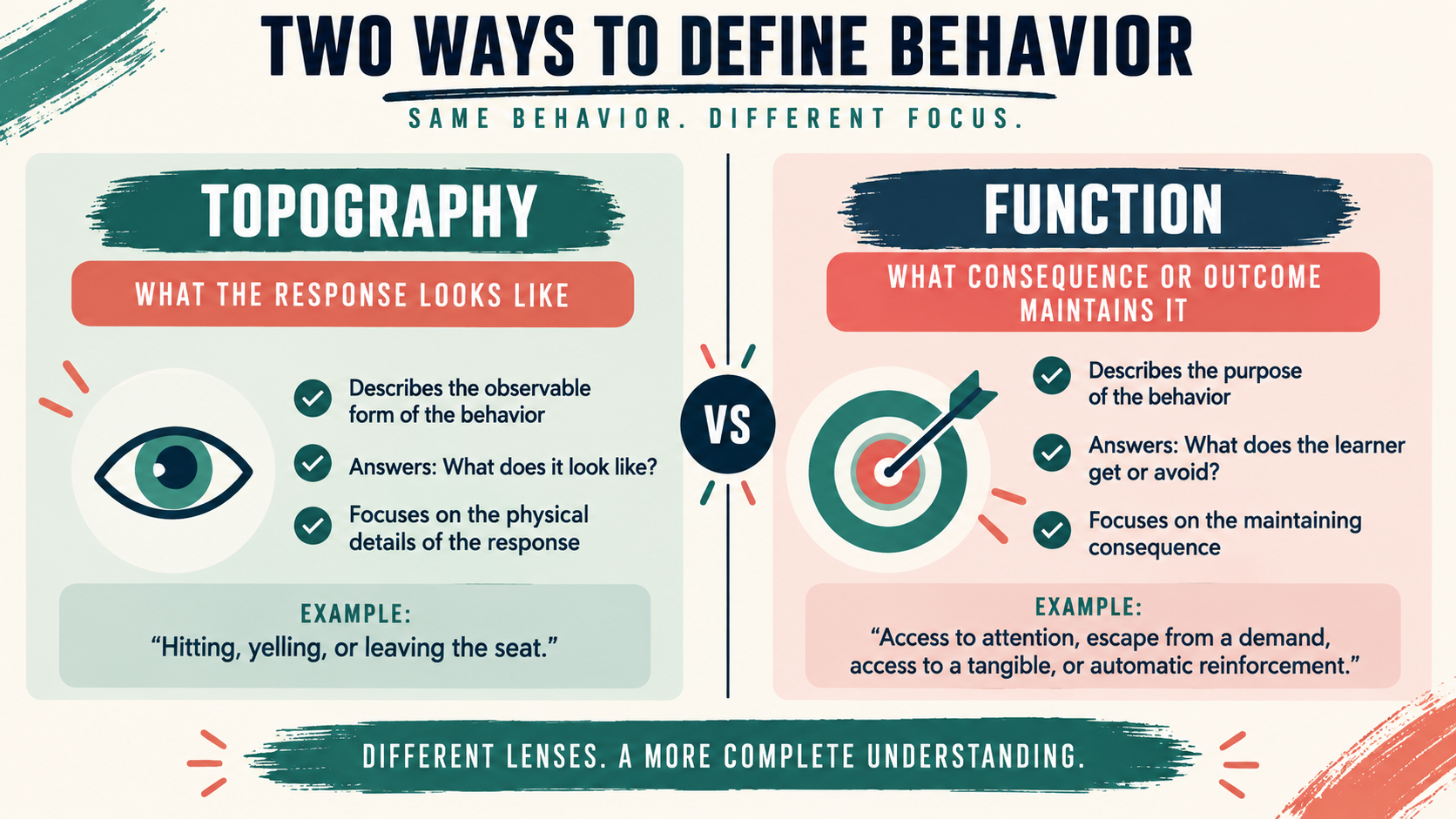
In applied behavior analysis, topography means the physical form or observable shape of a response. It answers, “What did the person do?” A topographic definition might describe the movement, sound, location, duration, or other observable features of the behavior. It should be specific enough that two trained observers can agree about whether an instance occurred.
Function refers to the effect or consequence that maintains behavior. It answers, “What does this response accomplish in this context?” Common socially mediated functions include attention, escape or avoidance, access to tangibles or activities, and access to social interaction. Automatic reinforcement is another possible function when the maintaining outcome is produced by the response itself rather than by another person.
Function is not a personality trait, intention, diagnosis, or guess about what someone “really wants.” It is a testable behavioral relation. An analyst can describe a hypothesis based on interviews and observation, then use an appropriate assessment to evaluate whether the pattern is supported. The topography remains important because it tells the team what to measure and helps protect the definition from vague labels. If you need the vocabulary of observable form on its own, review the site’s topography in ABA guide first, then use this comparison page to connect form, consequence, assessment, and intervention decisions.
Function Based vs Topography Based Examples
The phrase “function-based” can describe a definition, assessment, or intervention. The phrase “topography-based” usually points to the observable form of the response. The two descriptions can refer to the same event while serving different purposes. A topographic description is often the starting point for reliable measurement; a function-based description helps the team choose what to assess and how to match support.
| Lens | Question | Example wording | Main use |
|---|---|---|---|
| Topography-based | What does the response look or sound like? | “Places both hands on the table and strikes it once or more.” | Observable definition and measurement. |
| Function-based | What consequence or outcome maintains it? | “A response that reliably produces a break from a difficult task.” | Assessment hypothesis and function-matched planning. |
Consider three short scenarios. In the first, a learner screams, and an adult immediately provides attention. The scream is the topography; attention is a possible maintaining consequence. In the second, the learner screams before a demand, and the demand is removed. The topography is the same, but escape is a possible function. In the third, screaming happens alone during quiet time and produces no reliable social change; automatic reinforcement is one hypothesis to evaluate. Do not assign the function from the sound alone.
| Observable topography | Possible function to test | What would strengthen the hypothesis? |
|---|---|---|
| Leaves the seat after a worksheet is presented. | Escape from the task. | Leaving is followed by a predictable reduction or delay in the task, and the pattern replicates across observations. |
| Taps a communication partner’s arm and vocalizes. | Attention or access to interaction. | The response reliably produces social attention, not merely an adult moving nearby for unrelated reasons. |
| Pushes a closed container toward an adult. | Help opening it or access to the contents. | Opening or the relevant item follows the response, and the response changes when that outcome is unavailable. |
These are hypotheses, not conclusions. A function-based statement should still be linked to observable antecedents, responses, and consequences. A topography-based statement should not be stretched into a claim about why the person responded.
When Should You Use Each Definition?
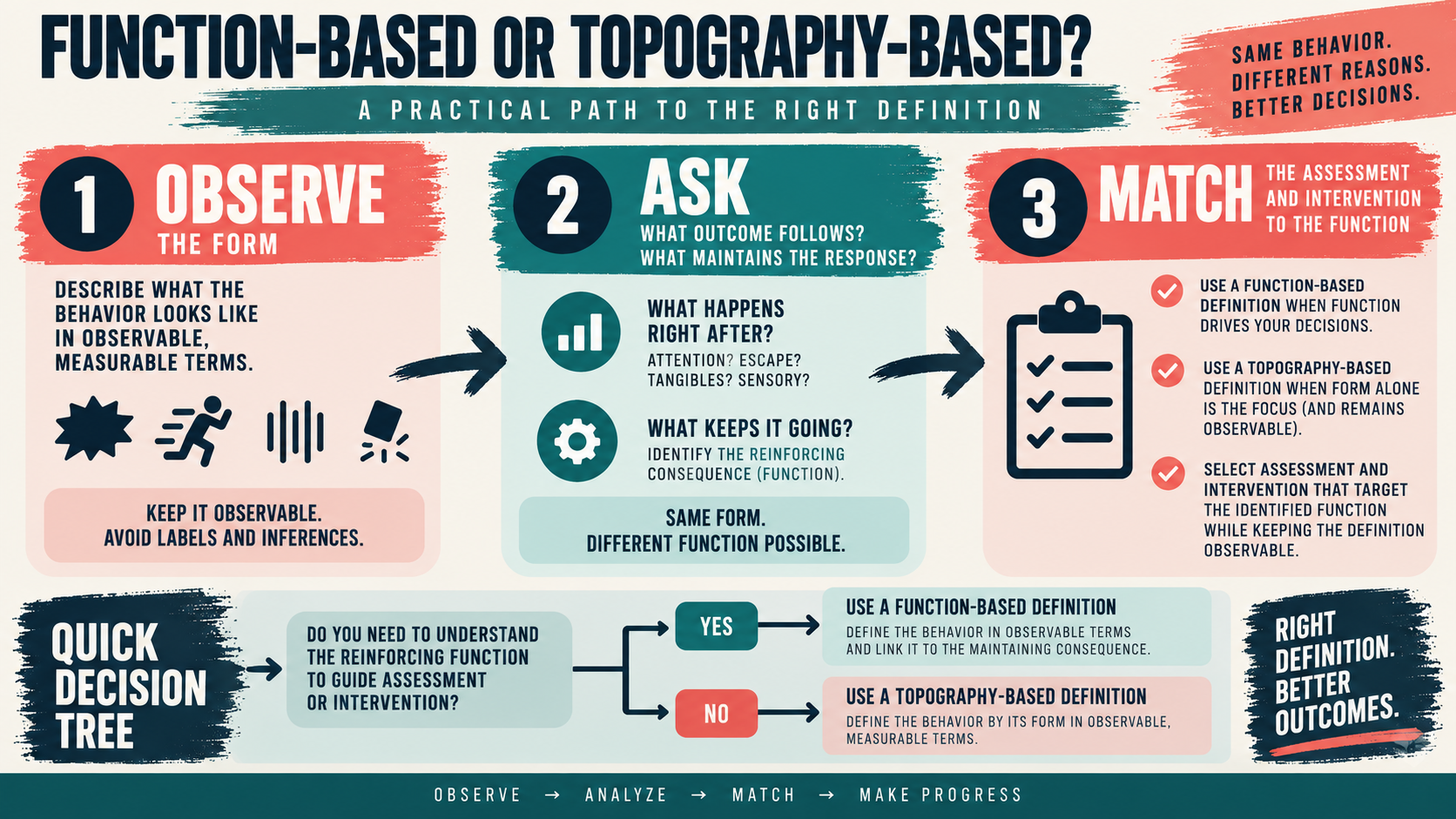
Use a topography-based definition when the immediate job is to identify and measure the response. This is especially important when the function is not known, when several behaviors look similar, or when the team needs objective onset and offset rules. “Noncompliance,” “aggression,” and “tantrum” may be useful conversation labels, but they are not sufficient measurement definitions unless the plan spells out the observable actions that count.
Use function-based wording when the maintaining relation drives the assessment or intervention decision. A function-based intervention might teach a break request when assessment supports escape, teach an attention request when attention maintains the behavior, or arrange functional communication for access to a tangible. The replacement response should be functionally equivalent enough to contact the relevant outcome, while remaining accessible and socially meaningful.
A useful rule is: define the response topographically; choose the decision functionally. The rule prevents two opposite errors. One error is measuring a vague function label without defining what occurred. The other is selecting an intervention solely because of the behavior’s form, without examining what consequence is maintaining it.
How Does the Difference Change Assessment?
Assessment begins with a clear target. Write what counts, what does not count, how one episode starts and ends, and which dimension matters: frequency, duration, latency, intensity, or another measure. Then collect information about setting events, antecedents, response topography, and consequences. Interviews and rating scales can suggest a hypothesis, but indirect information should not be treated as proof when direct observation or another appropriate assessment is needed.
When a functional behavior assessment is being considered, the analyst chooses procedures based on the question, risk, available evidence, and client context. A descriptive pattern may support a hypothesis, while an experimental functional analysis can provide stronger evidence when clinically appropriate and safely implemented. The appropriate method is not selected from the topography alone. Risk, severity, low rate, medical variables, and feasibility also matter.
- Start with the form: identify the response precisely enough to measure.
- Map the context: record what happened before and after, including changes in demands, attention, access, and activity.
- Test competing explanations: the same topography can have different functions, and multiple functions can coexist.
- Review agreement and integrity: observers need the same definition, and the procedure must be implemented as written.
How Does It Change Intervention Planning?
A topography-only plan can fail because it treats every instance of the same-looking response as if it has the same cause. If leaving the seat sometimes produces escape and sometimes produces attention, one consequence procedure may be poorly matched. A function-based plan asks what meaningful outcome the learner is contacting and whether an appropriate alternative can access that outcome more efficiently and safely.
Function-based does not mean “ignore the form.” The team still needs to define the target and replacement, teach the response, select prompts, arrange reinforcement, monitor treatment integrity, and plan for generalization. A replacement response that is harder, slower, or less reliable than the problem behavior may not compete effectively. The intervention should also respect communication modality, assent, preferences, cultural context, and the learner’s right to pause or decline when appropriate.
For a study scenario, compare the options in order: Does the plan match the assessed function? Does it teach a usable alternative? Does the relevant consequence follow the alternative? Is the procedure measurable and safe? Does it include a way to fade prompts and transfer the skill to natural conditions? The best answer usually connects assessment, function, teaching, and data rather than promising instant suppression.
What Are the BCBA Exam Traps?
When a BCBA question uses function-based vs topography-based examples, slow down at the wording. “What does it look like?” signals topography. “What does the response produce?” signals function. “Which intervention is appropriate?” requires the function, assessment evidence, response effort, consequence, and ethical context—not just the behavior label.
- Do not equate form with function. Hitting, yelling, crying, and leaving can each contact different outcomes.
- Do not call a consequence an antecedent. Attention delivered after a response is not the same as an SD that signals its availability.
- Do not treat an indirect hypothesis as certainty. Ask what data or assessment would support the conclusion.
- Do not replace an observable definition with an intention. “Trying to escape” is not enough to score an event.
- Do not choose a punitive or restrictive answer merely because the topography looks severe. Look for assessment, safety, dignity, and function-matched teaching.
For additional practice with behavior-analysis distinctions, the free BCBA mock exam is a separate study tool. It is not official BACB content and does not guarantee a certification result.
Frequently Asked Questions
Is function-based the opposite of topography-based?: No. They describe different dimensions of the same behavioral event. Topography identifies the observable form; function describes the consequence relation that maintains responding. A complete plan often uses both.
Can two behaviors with different topographies have the same function?: Yes. Saying “break please,” handing over a break card, and leaving the area may all contact escape in a particular context, although they differ in form. Their functions should be assessed rather than assumed. Can the same topography have different functions?: Yes. A scream may produce attention in one setting and escape from a demand in another. Context and consequence data are necessary to distinguish the hypotheses. Which definition should I use first?: Begin with an observable, measurable topographic definition. Add function-based language when the assessment evidence supports a maintaining relation and the function is needed to guide intervention or interpretation.
Sources for Further Study
- BACB BCBA Test Content Outline — current certification-study scope.
- Functional Assessment of Problem Behavior: Dispelling Myths, Overcoming Implementation Obstacles, and Developing New Lore — peer-reviewed functional-assessment discussion.
- FBA Screening and Assessment — overview of function-based assessment context.
- Functional Analysis Decision-Making Considerations — recent discussion of assessment selection factors.
- Topography vs. Function of Behavior — concise terminology comparison.
For targeted review, use our function based vs topography based examples practice questions to apply the concept in exam-style scenarios.
Quick Review Checklist
Use this final checklist to turn function based vs topography based examples into exam-ready reasoning. The goal is not to memorize a label in isolation; it is to identify the relevant evidence and explain why the best answer fits the scenario. Key ideas to review:
- State the central definition or decision point for function based vs topography based examples in your own words.
- Identify the detail that makes function based vs topography based examples different from its closest related ABA term.
- Separate the observable facts in a scenario from assumptions that are not supported by the facts.
- Write one example and one nonexample so you can recognize the concept in a new setting.
Exam application checks:
- Ask what the question is actually requesting before comparing the answer choices.
- Mark the antecedent, response, consequence, or other evidence that supports the selected answer.
- Look for a distractor that describes a related process but does not answer the specific question.
Final self-check:
- Explain how you would verify the interpretation with clear observations or data.
- Change one detail in the scenario and decide whether your answer should change.
- Give a one-sentence rationale that a supervisor or study partner could evaluate.
Take the Free BCBA Mock Exam
When you are ready to apply the idea, use the free practice resource below for additional feedback. Take the Free BCBA Mock Exam



