
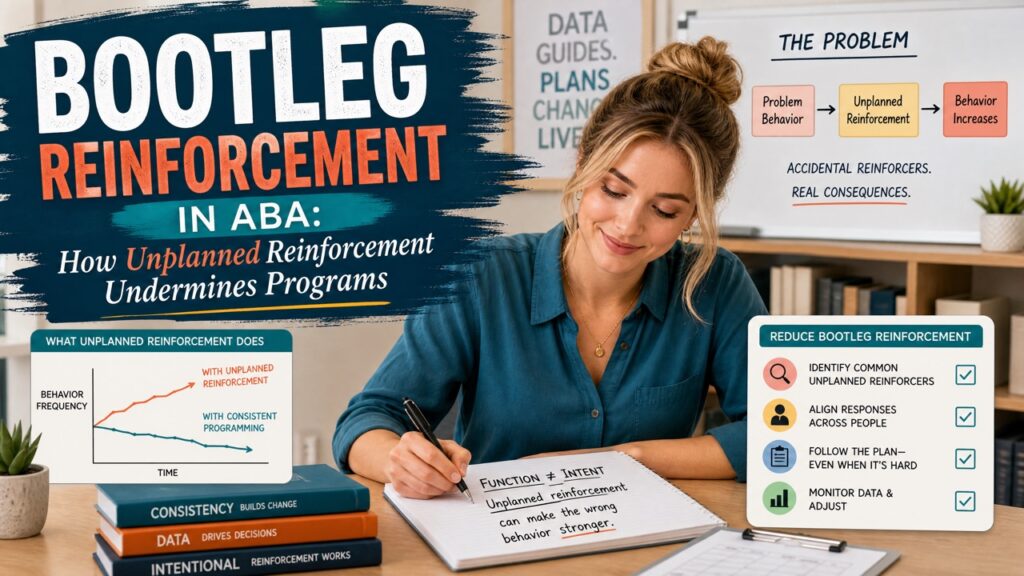
Bootleg reinforcement is a term used in applied behavior analysis (ABA) to describe unplanned reinforcement that occurs when a behavior contacts an unintended reinforcer during an intervention. This phenomenon can undermine even the most carefully designed behavior change program, because it inadvertently strengthens behaviors that are not the target of the intervention. In this guide, we define bootleg reinforcement, explain how it differs from planful reinforcement, and provide practical strategies for detecting and preventing it in your practice.
Table of Contents
- What Is Bootleg Reinforcement?
- Why Bootleg Reinforcement Matters in ABA
- Bootleg Reinforcement vs. Planful Reinforcement
- How to Detect Bootleg Reinforcement
- Preventing Bootleg Reinforcement
- Common Traps That Lead to Bootleg Reinforcement
- Ethical Considerations and Procedural Integrity
- Study Checklist for BCBA Candidates
- Reference
What Is Bootleg Reinforcement?
Bootleg reinforcement is a procedural integrity issue, not a formal reinforcement schedule. It occurs when a behavior is followed by a reinforcer that was not part of the programmed contingency. For example, if a teacher attempts to implement differential reinforcement of alternative behavior (DRA) by ignoring a student’s tantrum and praising appropriate requests, but a peer laughs at the tantrum, that laughter may serve as a bootleg reinforcer. The student’s tantrum is inadvertently reinforced, even though the teacher is following the plan.
In technical terms, bootleg reinforcement is an unplanned reinforcement operation that increases the future frequency of the behavior it follows. It can happen in any behavior change program, regardless of whether the program uses extinction, punishment, or reinforcement. The key is that the reinforcer is not part of the intervention’s design. This is why bootleg reinforcement is often described as an “accidental” or “leaky” contingency.
Understanding bootleg reinforcement is essential for BCBA candidates because it highlights the importance of procedural integrity—the extent to which an intervention is implemented as planned. When procedural integrity is compromised, the functional relation between the intervention and the target behavior may be obscured, making it difficult to determine whether the intervention is effective.
Why Bootleg Reinforcement Matters in ABA
Bootleg reinforcement matters because it can lead to treatment failure, frustration for practitioners, and ethical concerns. When a behavior is inadvertently reinforced, it may persist or even increase, despite the implementation of an evidence-based intervention. This can result in a lack of measurable outcome, making it difficult to justify the continuation of services. Moreover, if practitioners do not detect bootleg reinforcement, they may mistakenly conclude that the intervention is ineffective and abandon a potentially effective strategy.
Consider a common scenario: a child is placed in a time-out area for hitting a sibling. The time-out area happens to contain a preferred toy. The child plays with the toy while in time-out, and the toy serves as a reinforcer for hitting. The intended punisher (time-out) is effectively neutralized or even reversed, and the hitting behavior may be strengthened. This is a classic example of bootleg reinforcement undermining a punishment procedure.
Another example occurs during extinction. Suppose a parent is ignoring a child’s whining to extinguish it. However, a grandparent who is present occasionally gives the child a cookie to stop the whining. That cookie is a bootleg reinforcer, and the whining may continue because it is intermittently reinforced. This illustrates why bootleg reinforcement is not limited to punishment procedures; it can also interfere with extinction and differential reinforcement.
Bootleg Reinforcement vs. Planful Reinforcement
Bootleg reinforcement is the opposite of planful reinforcement. Planful reinforcement is deliberately arranged so that a specific target behavior is followed by a specific reinforcer, based on a functional assessment. Bootleg reinforcement, by contrast, is unplanned and often accidental. It is not part of the behavior intervention plan and is not intended to influence behavior.
It is also important to distinguish bootleg reinforcement from other concepts. Bootleg reinforcement is not a reinforcer itself; it is a circumstance in which a behavior contacts an unintended reinforcer. The reinforcer itself may be a tangible item, attention, escape, or automatic sensory stimulation. What makes it “bootleg” is that it is not part of the contingency analysis.
Bootleg reinforcement is also not the same as procedural drift, although the two can co-occur. Procedural drift refers to gradual changes in how an intervention is implemented, which can lead to bootleg reinforcement. For instance, if a therapist begins to deliver praise more often than planned, that extra praise may inadvertently reinforce off-task behavior. While the therapist’s behavior drifted, the off-task behavior is receiving bootleg reinforcement.
How to Detect Bootleg Reinforcement
Detecting bootleg reinforcement is crucial for maintaining procedural integrity. Here are several methods:
- Functional assessment: Conduct a functional behavior assessment (FBA) to identify potential reinforcers in the environment that may be inadvertently delivered. This includes interviews, observations, and functional analysis.
- Direct observation: Observe the intervention implementation and note any immediate consequences that follow the target behavior, even if they are not part of the plan. A second observer can help identify bootleg reinforcers that the primary therapist misses.
- Data analysis: Graph and analyze data for unexpected trends. If the target behavior is not decreasing as expected, bootleg reinforcement may be present. Look for increases in behavior that coincide with changes in environmental events.
- Fidelity checks: Use treatment integrity checklists to ensure that the intervention is being implemented as designed. If integrity is high but behavior is not changing, bootleg reinforcement may be at play.
For example, a BCBA might review session footage and notice that a child receives a high-five from a peer every time the child engages in scripting. That peer attention is a bootleg reinforcer, because the plan was to provide attention only for commenting on activities. By identifying this, the BCBA can modify the environment to prevent the peer from providing that attention.
Preventing Bootleg Reinforcement
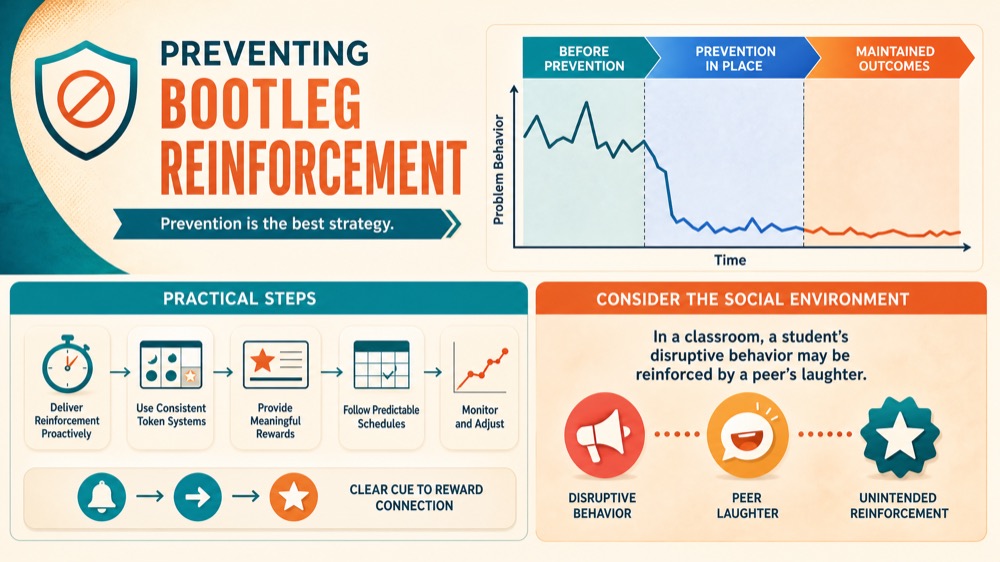
Prevention is the best strategy for mitigating bootleg reinforcement. Here are practical steps:
- Environmental management: Ensure that the session environment is free of unauthorized reinforcers. For example, remove preferred items from a time-out area or place them out of reach during intervention sessions.
- Staff training: Train all individuals involved in the intervention to recognize potential bootleg reinforcers and to implement the plan with high fidelity. Use role-play and feedback to strengthen skills.
- Monitor for accidental consequences: Regularly review data and observe sessions to catch any unplanned reinforcers that may have been delivered. Use visual prompts or scripts to help staff stay on track.
Additionally, consider the social environment. In a classroom, a student’s disruptive behavior may be reinforced by a peer’s laughter. To prevent this, you might rearrange seating or teach peers to ignore disruptive behavior. In a home setting, siblings might inadvertently reinforce tantrums by giving in. Parent training can address these dynamics.
It is also important to plan for extinction bursts. When implementing extinction, be aware that the escalation in behavior may be mistakenly reinforced by well-meaning individuals who try to calm the learner. Prepare caregivers for this possibility and provide them with alternative responses that do not deliver the bootleg reinforcer.
Common Traps That Lead to Bootleg Reinforcement
Professionals often make mistakes that inadvertently create bootleg reinforcement. Here are some common traps:
- Incomplete functional assessment: Failing to identify all potential reinforcers for the target behavior, leading to unplanned reinforcement.
- Inconsistent implementation: When staff apply the intervention inconsistently, they may accidentally reinforce the behavior on weekends or when the lead analyst is not present.
- Overlooking automatic reinforcement: Some behaviors produce their own sensory consequences. For example, stimming may be automatically reinforcing, and if the intervention focuses on social consequences, automatic reinforcement is a form of bootleg reinforcement if not accounted for.
To avoid these traps, maintain a high level of vigilance and continuously assess the environment for potential sources of unplanned reinforcement. Use checklists and systematic observation to catch these issues early.
Ethical Considerations and Procedural Integrity
The BACB Ethics Code requires behavior analysts to design interventions that are effective and to maintain procedural integrity. Section 2.09 of the Code emphasizes the need to monitor implementation and make necessary adjustments. Failing to address bootleg reinforcement could be considered a violation of this standard, as it may lead to ineffective treatment and potential harm.
As a practitioner, you have a responsibility to ensure that your interventions are implemented as designed and that any unintended reinforcement is corrected. This includes training and supervising staff, conducting fidelity checks, and modifying the environment to eliminate bootleg reinforcers. Additionally, you should document any instances of bootleg reinforcement and the steps taken to address them, as part of your professional practice.
It is also important to recognize that bootleg reinforcement can occur in any behavior change program, not just those using punishment or extinction. Even in a purely reinforcement-based program, a learner might receive attention from a peer for an undesirable behavior, or a natural consequence might inadvertently follow a behavior. Therefore, ongoing monitoring is always necessary.
Study Checklist for BCBA Candidates
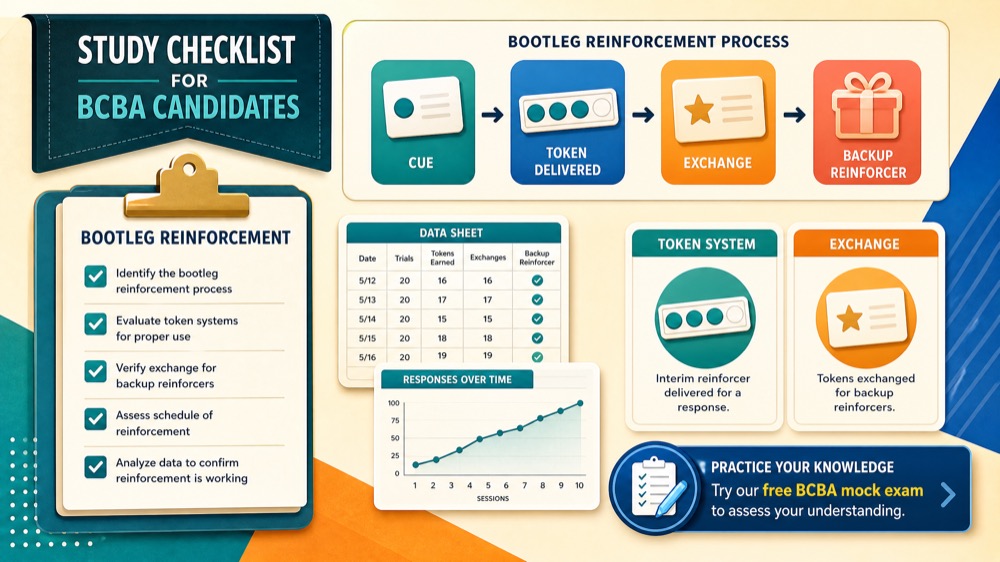
If you are preparing for the BCBA exam, use this checklist to solidify your understanding of bootleg reinforcement:
- Define bootleg reinforcement in your own words and contrast it with planful reinforcement.
- Identify three original examples of bootleg reinforcement in different settings (e.g., school, home, clinic).
- Explain how bootleg reinforcement relates to procedural integrity, citing the BACB Ethics Code.
- List at least four methods for detecting bootleg reinforcement and describe when to use each.
- Describe two prevention strategies, and explain how they reduce the likelihood of bootleg reinforcement.
- Be able to analyze a graph and hypothesize whether bootleg reinforcement might be affecting the data.
To practice applying these concepts, consider using our free BCBA mock exam. It provides practice questions and feedback to help you assess your knowledge. Note that the mock exam is a study tool and does not guarantee that this specific topic will appear on the live exam, but it offers a broad range of behavioral concepts.
Bootleg reinforcement is a nuanced concept that highlights the importance of careful analysis and implementation. By understanding its definition, detection methods, and prevention strategies, you can enhance your effectiveness as a behavior analyst and avoid common pitfalls. For more in-depth study, explore related topics like stimulus control in ABA and stimulus generalization.
Remember, bootleg reinforcement is not a formal reinforcement schedule, and it is not always intentional. It is a threat to treatment efficacy that can be managed through careful attention to the environment and intervention fidelity. By staying vigilant, you can ensure that your interventions are truly effective and ethically sound.
Reference
Next step for BCBA exam prep
Turn this topic into exam-day practice
Use this topic as a focused review, then test it in exam-style conditions with a free mock before deciding whether five full-length mocks are the right next step.
Start the Free BCBA Mock ExamContinue with Five Full-Length Mocks — $99
Review the included materials and access details before ordering. No pass guarantee is implied.



