
Short answer: Florida BCBA license verification is not one universal search. First identify what the person is claiming: a BACB certification, a Florida Department of Health record, an APD provider or service relationship, or the legacy Florida Certified Behavior Analyst (FL-CBA) designation. Then use the official source that owns that record and save the result date.
Table of Contents
- What does Florida BCBA license verification actually verify?
- Which record are you trying to verify?
- How do you verify BCBA certification through the BACB?
- How do you use Florida MQA when a state record is relevant?
- What can APD provider information prove?
- How do you verify an FL-CBA?
- What is the safest seven-step verification workflow?
- What common false matches should you reject?
- What does active status not prove?
- How does verification reasoning appear on the BCBA exam?
- What 15-minute study method works?
- Bottom line: what should you remember?
- Florida BCBA license verification FAQ
- Take the Free BCBA Mock Exam
A search result is evidence of a status in one system, not automatic proof of every kind of authority. The BACB Certificant Registry can verify a BACB credential and reportable disciplinary information. Florida’s APD resources describe provider and service requirements, while the Florida Department of Health MQA portal contains certain state license or registration records. The practical goal is to match the claim, name, credential number, status, and purpose without confusing certification, licensure, and provider enrollment. Table of Contents: Use the points below as a quick study guide.
What does Florida BCBA license verification actually verify?
The phrase sounds singular, but it can refer to several different questions. An employer may want to know whether a candidate currently holds BCBA certification. A payer may need written verification for credentialing. A family may want to confirm that a practitioner is listed in an official record. An APD provider may need to demonstrate that a professional meets the qualifications for a particular service level. Those are related questions, but they are not interchangeable.
Florida law and agency materials also use more than one route to recognize behavior-analytic qualifications. Florida Statute 393.17 describes an agency certification process and recognition of certification awarded by a qualifying nonprofit credentialing organization. The Florida APD behavioral-services resource page then points readers to provider resources, service rules, and official behavior-analysis contacts.
Verification should answer a defined question: is the person currently listed as a BCBA, or does the provider appear in the relevant APD or Medicaid context? It should not expand into permission for every task; scope, supervision, payer, and employer rules still matter.
- Credential status: Is the person currently certified, inactive, or expired in the named credentialing system?
- State record: Does an official Florida licensing or registration portal show a matching record?
- Service context: Is the person or organization connected to the APD or Medicaid program being discussed?
- Purpose: Does the evidence meet the employer, payer, licensing board, or family’s actual documentation requirement?
Which record are you trying to verify?
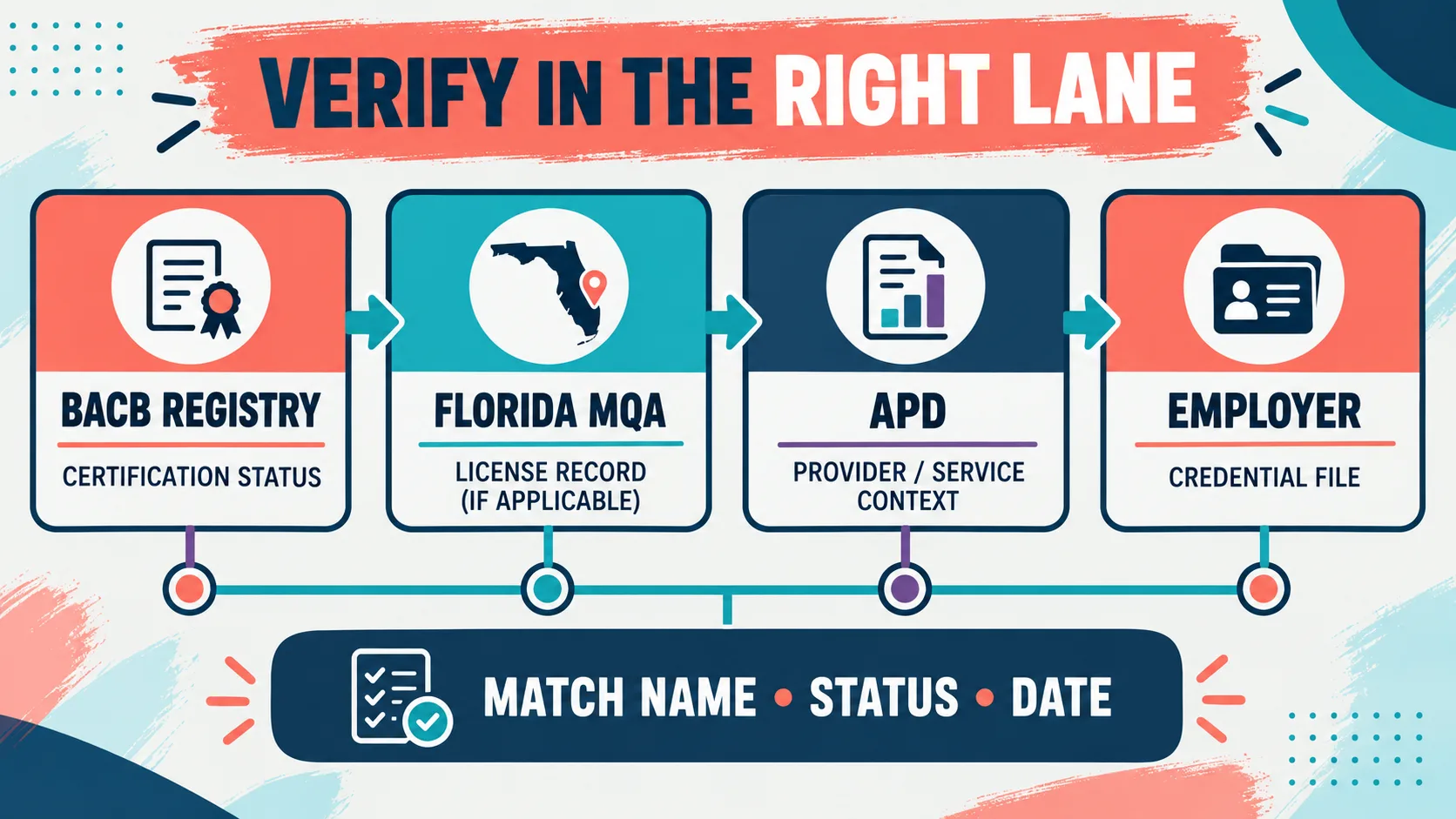
Start by copying the exact claim from the résumé, website, contract, or application. “BCBA,” “licensed behavior analyst,” “APD provider,” and “FL-CBA” are not just different spellings of the same record. They point to different authorities. A name-only search is especially risky when the person has a common surname or when a practice lists several clinicians under one organization.
| Claim | Primary source | What it can show | What it does not automatically show |
|---|---|---|---|
| BCBA certification | BACB Certificant Registry or BACB verification letter | Certification type, status, dates, and reportable disciplinary information | A Florida license, payer enrollment, or permission to provide every service |
| Florida license or registration | Florida Department of Health MQA, when the profession or record is listed there | The matching state record, number, profession, and displayed status | BACB certification status or APD provider enrollment |
| APD service context | APD behavioral-services resources and provider search | Provider or service information connected to the APD program | A personal BACB certificate or unrestricted clinical authority |
| FL-CBA designation | BACB’s FL-CBA information and verification-letter process | Whether the legacy Florida designation is documented through the BACB route | A current BCBA record if the FL-CBA has expired |
Use the narrowest source that answers the claim. If the document says “BCBA certified,” begin with the BACB. If it says “Florida license,” identify the profession and use the relevant state portal. If it says “APD provider,” check the program or provider record rather than treating a personal credential as the whole answer.
How do you verify BCBA certification through the BACB?
The BACB verification page identifies the online Certificant Registry as the primary resource for checking a certificant’s status and reportable disciplinary actions. The registry is the right first stop when an individual claims to be a BCBA, BCaBA, RBT, or BCBA-D. Our BCBA credential lookup guide covers the same registry concept from a broader verification angle. Search using the most identifying information available, then open the matching record instead of relying on a search-preview line.
Compare the record with the document in front of you. Check the person’s full name, certification type, status, certification number, and relevant dates. Newly certified BCBAs may not appear immediately, so a recent exam result may require a different form of confirmation. For formal employment, funding, or licensure purposes, the BACB also describes an on-demand report in the portal and a paid verification-letter option. The current BACB page states that a verification letter includes the name and certification number, current status, dates, and, when applicable, the reason for inactive status. Prefer a dated registry record or official verification letter over an uploaded certificate image. The BACB says certification numbers may be public while certificates should be protected from copying or alteration.
- Search the BACB-owned registry, not a commercial directory that merely repeats a name.
- Match certification type and number, not only the person’s first and last name.
- Read the displayed status and dates; do not treat “found” as equivalent to “active.”
- Use a formal verification letter when the employer, payer, or licensing authority requires written evidence.
How do you use Florida MQA when a state record is relevant?
The Florida Department of Health MQA Search Services home page offers license verification and practitioner-profile tools. The health-care-provider search lets a user narrow by board, profession, license number, name, location, and status. Use it only when the claim belongs to a profession or registration that the MQA system actually lists.
When a result appears, open the record and read the profession label, registration or license number, status, effective date, expiration date if shown, and any discipline or administrative-action section. Save the record’s access date because public records change. If the name matches but the profession does not, the result is not proof of the claimed BCBA or behavior-analyst credential.
Do not assume that every BCBA must have the same Florida Department of Health record. MQA may be relevant for a specific state record or telehealth registration, but an absent MQA result does not by itself cancel BACB certification or answer an APD-provider question. If the record is missing, identify which authority owns the original claim.
What can APD provider information prove?
Florida APD materials are especially important when the verification request concerns developmental-disability services, Medicaid providers, or APD program participation. APD’s behavioral-services page links to an updated provider list and explains that the list is intended to help families search for behavior-analysis providers. APD provider materials also describe active-status, certification or licensure, supervision, service-level, and documentation expectations.
That is a service-delivery context, not a substitute for checking the individual’s BACB record. An organization’s listing does not automatically verify each clinician’s certification, supervision arrangement, or role; a current BCBA may also be unrelated to the provider record you need for a particular APD or Medicaid service. Use the APD Provider Search for organization or service questions; use BACB or MQA for the individual credential or state record. If sources disagree, pause and contact the responsible agency or payer.
How do you verify an FL-CBA?
The BACB FL-CBA page explains that the BACB maintains the certification issued to a small number of FL-CBAs originally certified through the former Florida program. It directs readers to request verification through the BACB process. The designation is Florida-specific, and the page states that an FL-CBA whose certification has expired must reapply under current BCBA requirements.
“FL-CBA” is not a casual abbreviation for a BCBA who works in Florida. It is a legacy, Florida-specific designation. Verify it through the BACB source and do not rewrite it as current BCBA certification without checking status.
What is the safest seven-step verification workflow?
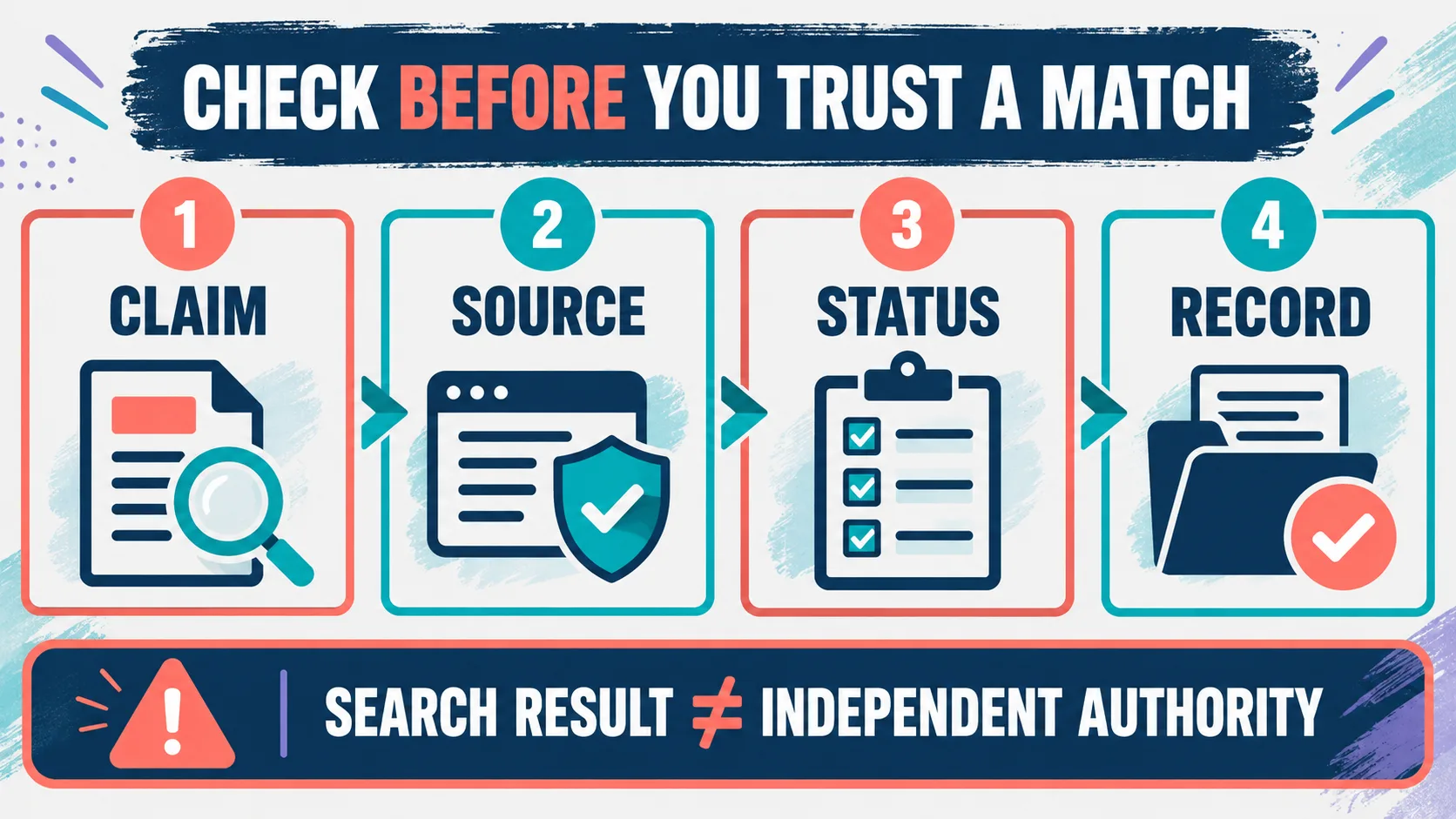
Use a repeatable workflow so that the same evidence standard applies to every candidate or provider. The workflow is designed for verification, not for making a legal conclusion about someone’s scope of practice.
- Copy the claim: write down the exact title, credential, license, registration, or provider status being asserted.
- Identify the person or organization: collect the full name, business name, certification number, license number, and location if available.
- Choose the owner of the record: use BACB for BACB certification, Florida MQA for a listed state record, APD for APD program context, and the BACB FL-CBA route for the legacy designation.
- Search with the least ambiguous identifier: a credential number is generally stronger than a common name, but check that the number belongs to the same person.
- Read status and dates: record active, inactive, expired, clear, or other displayed wording exactly as shown.
- Check the purpose: confirm whether the evidence satisfies employment, payer, licensure, supervision, or family-information needs.
- Save and escalate: keep the URL, access date, and relevant screenshot or letter, then ask the responsible authority about any mismatch.
Never fill a gap by guessing. “No result” can mean a misspelled name, a recently changed record, a different credential system, or a source that does not publish that type of information. A careful verifier reports the limitation rather than turning a search failure into an accusation.
What common false matches should you reject?
Verification errors happen when a plausible result is mistaken for proof: the name may match another person, an organization may list someone else, or a directory may copy an old status. Match the record to the original claim.
- Same name, different person: compare city, employer, credential number, and profession.
- Certification confused with license: a BACB result does not automatically satisfy a state-license requirement.
- Provider confused with practitioner: an APD or Medicaid organization listing does not verify every employee’s personal credential.
- Old certificate image: a screenshot without a date or current registry match may be stale.
- Search snippet treated as a record: open the official page and inspect status, dates, and source ownership.
What does active status not prove?
Active status is important, but it is not a universal permission slip. It tells you how the source currently labels the record. It does not, by itself, establish that the person has been trained for a particular procedure, has a current supervision contract, is enrolled with a specific payer, or may practice outside documented competence.
For a service decision, combine status verification with role and context checks. Confirm who designs treatment, who supervises implementation, what the employer or payer requires, and whether Florida or APD procedures apply. Competence, documentation, supervision, and client protection still matter.
- Check the person’s role in the service plan, not only the credential label.
- Confirm that supervision and competency documentation are current when the task requires them.
- Separate a payer or provider enrollment decision from an individual certification decision.
- Use the narrowest conclusion supported by the evidence and date it.
How does verification reasoning appear on the BCBA exam?
BCBA-style questions may present a technician, supervisor, provider, license, or credential record and ask what the analyst should do next. The key is to identify the authority and the decision boundary. A registry can establish a credential status; it does not automatically establish competence for an untrained task. A supervisor can review implementation data; a direct-care worker should not silently make an assessment-based treatment change. When a question contains conflicting records, apply the same order used in real verification:
- Define the claim and the requested decision.
- Choose the primary source that owns the record.
- Match identifiers and read the status and dates.
- Protect the client by pausing an unsupported conclusion.
- Consult the responsible supervisor, agency, or licensing authority when the evidence is incomplete.
The strongest answer uses direct evidence, respects scope, documents the discrepancy, and avoids an irreversible decision based on a directory or assumption. No single portal answers every verification question.
What 15-minute study method works?
Make four columns labeled claim, source, status, and boundary. Practice with a BCBA claim, an APD provider listing, and an FL-CBA claim. Name the official source, the evidence to capture, and one thing it does not prove.
Then complete a short timed set with verification and ethics scenarios. Use the free BCBA mock exam as a practice resource. It is not an official BACB examination and cannot replace the current handbook, Florida rules, agency instructions, or a formal verification letter when one is required.
Bottom line: what should you remember?
Florida BCBA license verification starts with the claim, not the search box. Use the BACB for BACB certification, Florida MQA for a relevant state record, APD resources for APD provider and service context, and the BACB’s FL-CBA process for the legacy designation. Match the person or organization, status, dates, and purpose; save the access date; and do not treat one positive result as proof of every kind of practice authority.
Florida BCBA license verification FAQ
Where do I verify a BCBA in Florida? Start with the BACB Certificant Registry for the person’s BCBA certification. If the request concerns a Florida state record, use the relevant Florida Department of Health MQA search. If it concerns APD or Medicaid services, check the APD or program provider source as a separate step.
Does a BACB result prove that someone has a Florida license? No. It verifies a BACB credential. State licensure, registration, telehealth authorization, payer enrollment, and APD service qualifications are separate questions that may require separate sources.
Can I verify an FL-CBA in the regular BACB Registry? The BACB’s FL-CBA page directs people to its verification-letter process. Follow that source rather than assuming that an old Florida designation will appear exactly like a current BCBA record.
What should I do if the official records do not match? Do not accuse or approve based on a guess. Save the URLs and access date, check spelling and identifiers, ask the person or organization for clarification, and contact the BACB, Florida agency, payer, or employer that owns the disputed requirement.
Take the Free BCBA Mock Exam
When you are ready to apply the idea, use the free practice resource below for additional feedback. Take the Free BCBA Mock Exam



