

Short answer: BACB credentials are professional certifications and designations connected to behavior analysis. The BACB currently presents three certifications at different experience levels: Registered Behavior Technician (RBT), Board Certified Assistant Behavior Analyst (BCaBA), and Board Certified Behavior Analyst (BCBA). The BCBA-D is a doctoral designation for eligible BCBAs, not a fourth certification.
Table of Contents
- What are BACB credentials?
- How do the credential levels relate to supervision?
- What is the difference between RBT, BCaBA, and BCBA?
- What is the BCBA-D designation?
- What do candidates need to verify?
- How should the 2027 changes affect planning?
- What credential mistakes should candidates avoid?
- How should BCBA candidates prepare?
- BACB credentials FAQ
- Take the Free BCBA Mock Exam
The fastest way to understand the credential system is to ask three questions: What level is the credential? What work does the person perform? Who supervises that work? A title alone does not answer every practice question. State licensure, employer policy, payer enrollment, and the current BACB Handbook may add requirements beyond the credential label. Table of Contents
What are BACB credentials?
The Behavior Analyst Certification Board (BACB) is the organization that administers the RBT, BCaBA, and BCBA certification programs. Its consumer-resources page explains that the three certifications are offered at different experience levels and that each has specialized eligibility, examination, ethics, and maintenance requirements. That structure is more useful than treating every ABA job title as a certification.
RBT stands for Registered Behavior Technician. It is a paraprofessional certification. RBTs assist with behavior-analytic services under the close, ongoing supervision required by the applicable BACB role and current handbook. The credential does not turn an RBT into an independent behavior analyst.
BCaBA stands for Board Certified Assistant Behavior Analyst. It is an undergraduate-level certification. BCaBAs may provide behavior-analytic services under BCBA supervision and may supervise RBT work within the applicable requirements. A BCaBA is not a BCBA simply because both titles contain “behavior analyst.” The certification level and supervision relationship are different.
BCBA stands for Board Certified Behavior Analyst. It is a graduate-level certification. The BACB describes BCBAs as independent practitioners who may provide behavior-analytic services and supervise the work of RBTs, BCaBAs, and other professionals who implement behavior-analytic interventions. Independence still exists within ethics, law, organizational policy, and any state practice rules.
The BACB also recognizes the BCBA-D, or Board Certified Behavior Analyst-Doctoral, as a designation. It is attached to an active BCBA certification when the doctoral eligibility requirements are met. It is not a separate certification and does not grant privileges beyond the BCBA certification.
How do the credential levels relate to supervision?
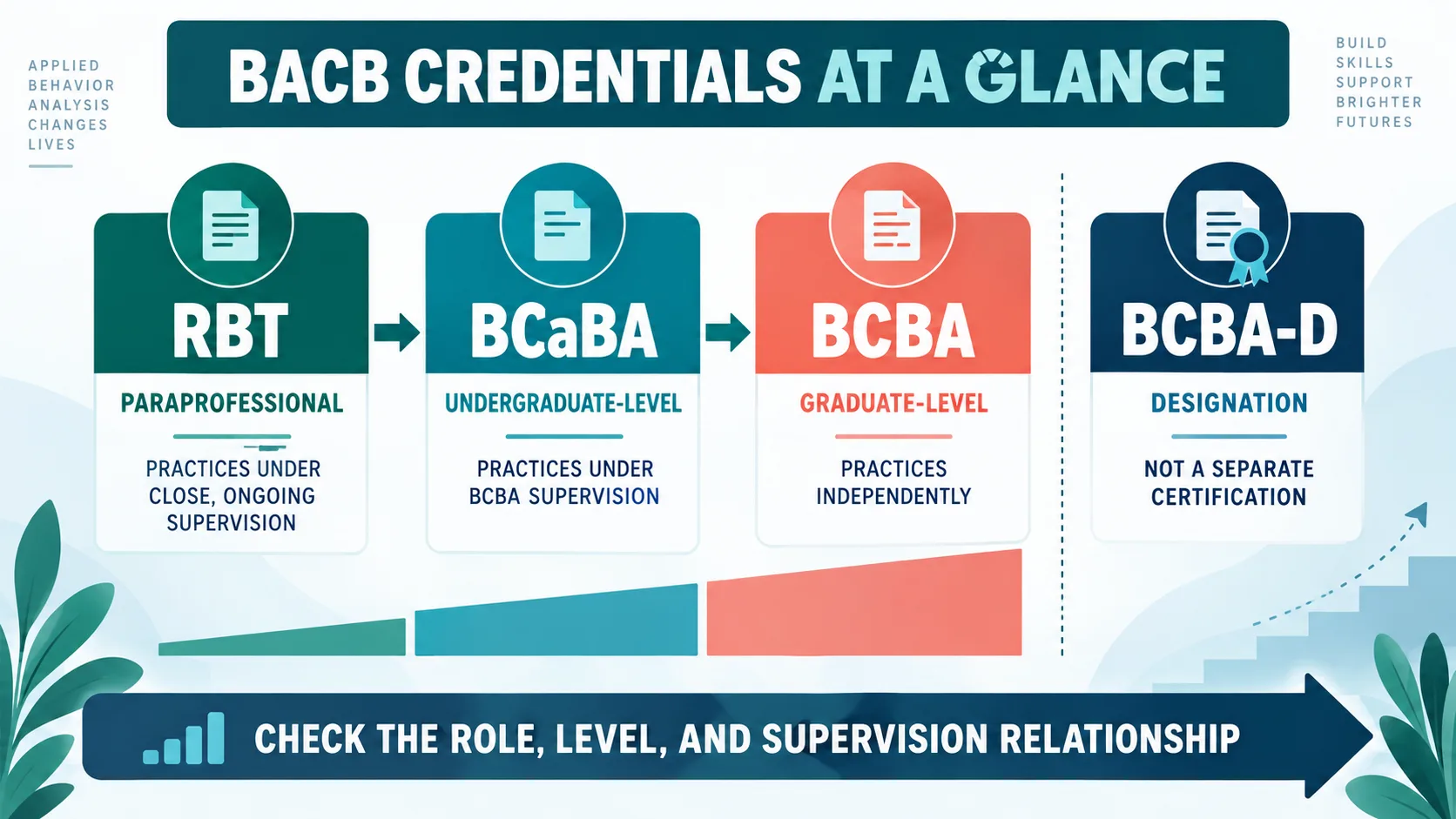
The visual ladder is a learning aid, not a required career sequence. Someone may enter behavior analysis through different education and employment routes, and local practice rules can change the details. Still, the level-and-supervision pattern helps you decode a job description, a client’s care team, or a BCBA exam scenario.
| Credential | Typical level | Core role | Supervision boundary |
|---|---|---|---|
| RBT | Paraprofessional | Assists with implementation of behavior-analytic services | Close, ongoing supervision under the applicable BACB structure |
| BCaBA | Undergraduate level | Provides behavior-analytic services | Works under BCBA supervision; may supervise RBTs within requirements |
| BCBA | Graduate level | Independent behavior-analytic practitioner | May supervise BCaBAs and RBTs under current requirements |
| BCBA-D | Doctoral designation | Functions in the same capacity as a BCBA | Follows BCBA maintenance and supervision requirements |
Do not read “level” as a complete job description. An RBT’s daily tasks depend on the implementation plan and organization. A BCaBA’s responsibilities depend on the supervising BCBA, setting, law, and scope of competence. A BCBA’s independence does not eliminate consultation, oversight, documentation, or legal obligations. The level tells you where to look next; it does not replace the current source document.
What is the difference between RBT, BCaBA, and BCBA?
When a candidate asks which credential is right, compare the intended work rather than choosing the highest-sounding title. The three certifications represent different education, examination, and supervision expectations.
- Choose the RBT question when the work is paraprofessional implementation under close supervision and the person is not seeking independent behavior-analytic practice.
- Choose the BCaBA question when the person is pursuing an undergraduate-level behavior-analytic credential and expects to provide services under a BCBA.
- Choose the BCBA question when the person is planning graduate-level eligibility, the BCBA examination, independent practice, and supervision responsibilities.
- Choose the BCBA-D question only after confirming that the person is already a BCBA and is asking about the separate doctoral designation.
The examination is only one part of the distinction. The BACB’s examination-information page says that candidates first need an approved certification application before taking the applicable examination. Passing a test does not erase missing eligibility documents, a missing fieldwork verification, a state authorization requirement, or a maintenance obligation.
What is the BCBA-D designation?
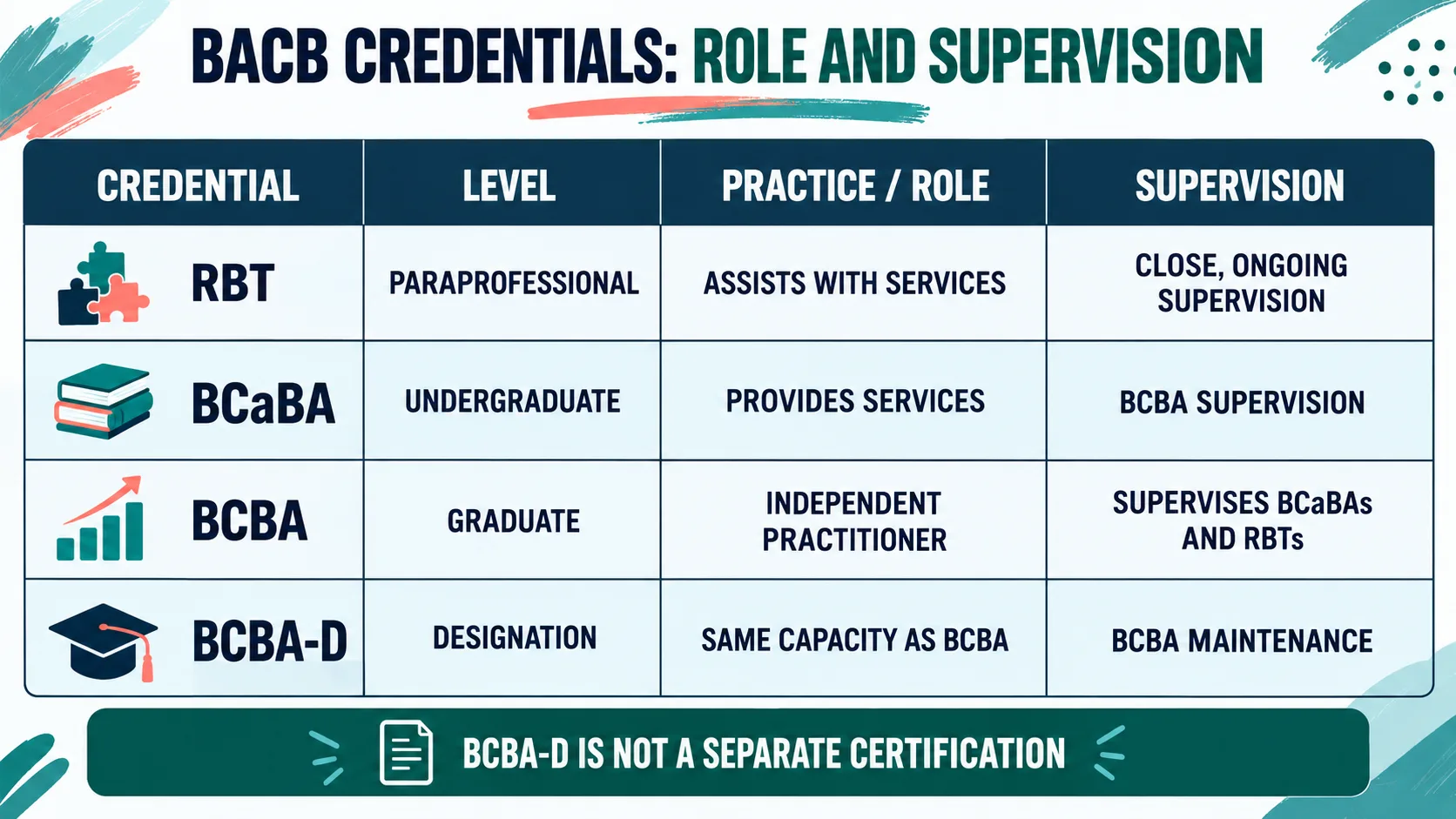
The BCBA-D is often misunderstood because its name looks like another certification level. The current BCBA materials state that BCBAs with doctoral or postdoctoral training in behavior analysis may apply for the designation. The designation is not a separate certification and does not grant privileges beyond the BCBA certification. A person with the designation functions in the same capacity as a BCBA and must meet BCBA maintenance requirements.
That means a doctoral degree by itself does not automatically create BCBA-D status. The applicant must already hold the BCBA certification and meet the designation’s documentation requirements. The current BCBA Handbook describes options such as an eligible doctoral program and supplemental documentation. Because application forms and accepted evidence can change, read the live BCBA-D section before submitting a designation application.
For a scenario question, use a two-step test: first ask whether the person is an active BCBA; then ask whether the stem is describing a doctoral designation rather than a new practice privilege. If the person is not a BCBA, “BCBA-D” is not a shortcut around BCBA eligibility.
What do candidates need to verify?
Every credential has its own evidence chain. Before paying a fee or promising a start date, identify the current handbook, application route, exam information, supervision documents, and maintenance rules for the credential you are considering.
- Eligibility: confirm the education, training, fieldwork, competency, or other requirements for the selected credential.
- Application: use the current BACB portal instructions, forms, identity information, and document-submission rules.
- Examination: verify the applicable test, authorization, appointment, timing, and examination policies.
- Supervision: identify who is responsible for supervision, what must be documented, and when the arrangement begins.
- Ethics: read the ethics code that applies to the certification or designation and keep the current version.
- Maintenance: record renewal, continuing education, supervision, status, and reporting obligations after certification.
Also separate BACB certification from local authorization. The BACB’s consumer resources note that many, but not all, US states require behavior analysts to be licensed. A state license may use BACB status as one requirement while still asking for a separate application, fee, background check, or state-specific document. The credential registry and the state board answer different verification questions.
How should the 2027 changes affect planning?
For BCBA and BCaBA candidates, January 1, 2027 is a meaningful date in the BACB planning calendar. The BACB has published transition resources and updated handbooks for requirements that take effect on that date. This article is not a replacement for those documents; it is a reminder to match your credential plan to the date and pathway that apply to your record.
For BCBA applicants, the published 2027 summary describes two eligibility pathways and changes to degree, coursework, supervised fieldwork, continuing education, and ongoing supervision requirements. For BCaBA applicants, the BACB likewise publishes a separate 2027 requirements framework. RBT rules have their own timeline and should not be inferred from BCBA or BCaBA changes. Use these checkpoints:
- Write down the certification or designation you are actually pursuing.
- Record your expected application date and compare it with the effective date of the rule.
- Open the current handbook for that credential instead of applying a BCBA rule to an RBT or BCaBA plan.
- Ask your program or supervisor which current form, attestation, or verification document supports your route.
- Recheck the official change page immediately before submitting an application.
What credential mistakes should candidates avoid?
- Calling every ABA job a BACB credential: job titles such as behavior technician or case manager may not be BACB certifications.
- Treating BCBA-D as a fourth certification: it is a designation attached to an eligible BCBA.
- Assuming BCaBA means independent practice: BCaBA services are provided under BCBA supervision within the applicable requirements.
- Assuming a certificate from a course is a BACB certification: training completion and professional certification are different records.
- Using a title as proof of current status: verify certification status and reportable disciplinary information through the BACB’s registry when appropriate.
- Ignoring state law: national certification and local authorization may be separate requirements.
- Studying from a stale handbook: check the current official page and effective-date notices.
How should BCBA candidates prepare?
If your goal is the BCBA credential, use the current BCBA Test Content Outline as the study map. Practice should move from definition to application: identify the task, explain the contingency or assessment logic, solve a scenario, and review why each distractor fails. Credential vocabulary is only the beginning; the exam also tests measurement, data display, assessment, ethics, interventions, and supervision.
For a timed checkpoint, try our free BCBA mock exam for BACB credentials study planning. It is an independent study resource, not a BACB certification, not state licensure, and not a claim that the questions reproduce official BACB items.
BACB credentials FAQ
How many BACB certifications are there? The BACB’s consumer-resources page describes three certifications at different levels: RBT, BCaBA, and BCBA. BCBA-D is a designation, not a separate certification. Which BACB credential is independent? The BCBA is the graduate-level certification associated with independent behavior-analytic practice, subject to ethics, law, competence, organizational requirements, and applicable state rules.
Can a BCaBA supervise an RBT? BCaBAs may supervise RBT work within the applicable BACB requirements and organizational or jurisdictional rules. The BCaBA itself remains a credential whose behavior-analytic services are provided under BCBA supervision. Is BCBA-D higher than BCBA? It signals doctoral or postdoctoral training recognized through a designation, but the BACB states that it is not a separate certification and does not grant privileges beyond BCBA certification.
Does an RBT credential lead automatically to BCBA certification? No. RBT experience may be part of a person’s career story, but BCBA certification has its own education, fieldwork, application, examination, ethics, and maintenance requirements.
Where can I verify a practitioner’s BACB status? Use the BACB Certificant Registry and separately check the state license or authorization when the jurisdiction requires one. A credential record and a state license record answer different questions.
Take the Free BCBA Mock Exam
When you are ready to apply the idea, use the free practice resource below for additional feedback. Take the Free BCBA Mock Exam



