

If you are comparing BCBA CEUs online, the most important question is not whether a course is convenient. It is whether the activity fits the BACB rules that apply to your credential, category, and recertification cycle. Online delivery can be self-paced, live, or recorded, but the format alone does not make every course count.
Table of Contents
- BCBA CEUs Online: What Can Count?
- How Do You Verify the Provider and Course?
- How Do You Match CEUs to a Category and Cycle?
- What Should You Save and Self-Report?
- Which Online Format Fits Your Study Habits?
- What Online BCBA CEU Mistakes Should You Avoid?
- Practice the BCBA Exam While You Track CE
- Take the Free BCBA Mock Exam
- References
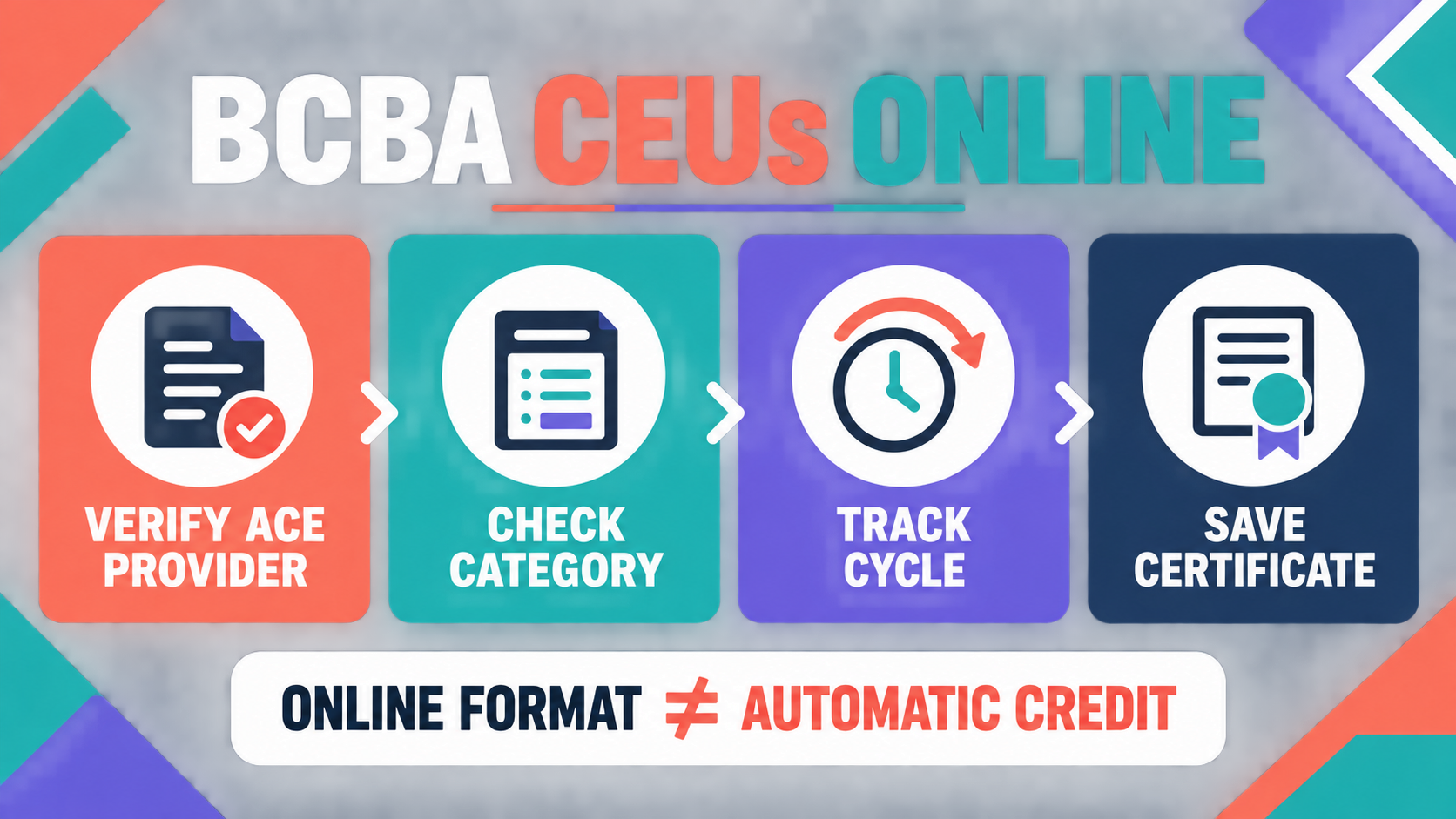
A reliable process is simple: verify the provider, check the category and number of CEUs, confirm the event documentation, record the activity in the correct cycle, and keep the certificate. The BACB’s official ACE resources and provider registry should be your starting point. Provider approval also does not mean the BACB endorses a particular course or replaces your responsibility to verify the details.
This guide is educational information, not a certification decision or legal advice. Requirements and provider rules can change, especially as the 2027 BCBA requirement set takes effect. Use the current BACB Handbook, your account, and the official provider registry for the final check. Table of Contents
BCBA CEUs Online: What Can Count?
Online continuing education may qualify when it is a recognized learning activity, offered or documented through an appropriate source, and reported according to the requirements for your BCBA maintenance cycle. In practice, that means checking more than a marketing badge. Look for the provider’s BACB authorization details, the event type, the number of CEUs, the category, the completion date, and the certificate or other documentation you will need.
The current BACB 2027 requirements page describes 32 CEUs in each two-year BCBA recertification cycle and identifies ethics and supervision categories for applicable certificants. Because a person’s cycle and the effective date of a requirement matter, do not copy a number from a provider’s sales page without comparing it with the current BACB guidance that applies to you. A course can be valuable professional learning and still not fill the category you need.
Also separate BCBA/BCaBA learning CE from RBT professional development. The BACB’s ACE program describes both types of events, but they are not interchangeable labels. If a page advertises “ABA training” without stating the credential, provider status, event category, and documentation, pause before purchasing.
How Do You Verify the Provider and Course?
Use this four-part check before you start an online course:
- Verify the provider: search the official BACB ACE Provider Verification Registry using the provider name or number. Save a screenshot or note the date of the check when the purchase is important.
- Verify the audience: confirm that the event is offered for BCBA or BCaBA learning CE, not only for RBT professional development, another profession, or general attendance.
- Verify the category: read whether the course is learning, ethics, supervision, or another category recognized for your cycle. Do not infer the category from the title alone.
- Verify the documentation: confirm what certificate or completion record will show the provider, event title, date, CEU value, category, and any provider number required for self-reporting.
Provider status is a verification step, not an endorsement. The BACB registry itself cautions that authorization does not imply approval or endorsement of the content. This distinction matters when you compare price, teaching quality, topic fit, accessibility, and refund terms. A catalog can be useful, but the final responsibility is still to select a course that meets your professional and maintenance needs.
How Do You Match CEUs to a Category and Cycle?
Start with your personal recertification date and write down the remaining balance in each required category. Then compare the course details with that list. A simple tracker should include:
- Your certification and recertification dates.
- The required total for the applicable cycle.
- Ethics CEUs completed and still needed.
- Supervision CEUs needed if you supervise trainees, RBTs, or other applicable staff.
- General learning CEUs completed and the remaining balance.
- The completion date, provider, title, category, and certificate location for every activity.
Do not assume that extra general CEUs can replace an unmet ethics or supervision category. If you are planning around the 2027 transition, read the current 2027 requirements page and the applicable handbook together. The fact that a course is completed online does not move it into the right cycle, and an activity completed before a cycle begins generally cannot be used to fill that later cycle.
For supervisors, check whether the event is explicitly labeled for the supervision requirement rather than merely discussing supervision in one paragraph. For ethics, check whether the majority of the content actually addresses ethics requirements or cultural and contextual responsiveness when that category definition applies. Keep the course description you relied on, especially if the provider changes its catalog later.
What Should You Save and Self-Report?
Save the certificate and enough supporting information to reconstruct the event. A practical file name can include the date, provider, course title, category, and CEU amount. Store the PDF in two locations if the activity matters to an upcoming renewal. If the provider offers a transcript or completion history, save that as well.
Before entering the activity into your BACB account, compare the certificate with the course page and your tracker. Check spelling, completion date, category, provider number, and the number of CEUs. Enter the event in the correct account field and keep the original evidence after self-reporting. If the portal or a handbook gives different instructions than an older blog post, follow the current BACB source and contact the BACB for a credential-specific question.
Common documentation gaps include a certificate that shows only a company name, a missing category, a course advertised as “hours” without a CEU value, or a completion date that falls outside the cycle. Fix the record while the provider can still answer questions. Waiting until the week before renewal makes a small paperwork issue much harder to resolve.
Which Online Format Fits Your Study Habits?
Once the compliance check passes, choose the format that you can actually complete and retain:
- Self-paced asynchronous: useful for busy schedules, but set a completion deadline and confirm how quizzes, attendance, and certificates work.
- Live online: helpful when you want discussion and a fixed time, but verify attendance rules and what happens if you miss part of the event.
- Recorded or on-demand: convenient for review, but confirm that the provider identifies it as a qualifying event and supplies the required completion evidence.
- Subscription library: efficient for a large CEU balance, but check whether unused access equals earned CEUs and whether category labels are clear for each completed course.
Quality matters too. Read the learning objectives, instructor credentials, accessibility information, assessment method, and refund terms. A cheap course that does not match your required category or that you cannot document is not a bargain. Choose the smallest useful next step, complete it, save the evidence, and update your tracker.
What Online BCBA CEU Mistakes Should You Avoid?
- Trusting a “BACB approved” badge: verify the provider in the official registry and confirm the event details.
- Confusing CEUs with RBT PDUs: check the credential and event type before enrolling.
- Tracking only total hours: record ethics, supervision, learning, dates, and documentation separately.
- Using the wrong cycle: compare the completion date with your actual recertification period.
- Assuming a topic title proves a category: read the course description and certificate language.
- Deleting certificates after self-reporting: retain the original evidence in case you need to answer a records request.
- Following an old 2027 summary: use current BACB pages because transition guidance and provider requirements can be updated.
Practice the BCBA Exam While You Track CE
Continuing education maintains a credential; it does not replace exam preparation. If you are still preparing for the BCBA examination, keep your study plan separate from your CE tracker and use current BACB exam materials for the exam framework. Our free BCBA mock exam can help you practice scenario-based questions while you build your study routine. Try the Free BCBA Mock Exam
Take the Free BCBA Mock Exam
If you want a low-pressure way to check your recall, use the free practice resource below. Take the Free BCBA Mock Exam
References
- BACB Authorized Continuing Education Providers
- BACB ACE Provider Verification Registry
- BACB 2027 BCBA Requirements
- BACB Recent and Upcoming Changes
- BACB BCBA Resource Hub



