
What Is Positive Punishment in ABA?
Positive punishment is a behavioral consequence in which a stimulus is presented immediately after a response, and the future frequency or probability of that response class decreases under similar conditions. In ABA, “positive” means the addition or presentation of a stimulus; it does not mean good, pleasant, or helpful. The decrease in behavior defines punishment functionally, not the intent or severity of the added event. For example, if a child touches a hot stove (response) and experiences a burn (stimulus presentation), the child is less likely to touch a hot stove in the future (decreased future frequency). The burn functioned as a positive punisher because its contingent presentation reduced the behavior. Note that the same event may not function as punishment for everyone; a reprimand may decrease one student’s talking-out behavior but increase another’s.
Table of Contents
- What Is Positive Punishment in ABA?
- Examples of Positive Punishments in ABA
- Positive Punishment vs. Negative Punishment
- Common Traps and Misconceptions
- Distinguishing Positive Punishment from Close Concepts
- Ethics and Guidelines for Using Punishment
- BCBA Exam Study Checklist
- Test Your Knowledge with Free BCBA Mock Exam
- References
Understanding the contingency is essential. Begin with the antecedent context and a clearly defined response class, then identify what stimulus was presented contingent on that response and compare later responding under relevant conditions. An SD ordinarily signals that a particular response will contact reinforcement; a stimulus correlated with punishment should not automatically be relabeled as an SD. The positive-punishment classification rests on the response-consequence relation and the measured decrease in future responding, not on the appearance of the antecedent or consequence.
Examples of Positive Punishments in ABA
Effective positive punishment examples must be analytically complete: they identify the response, the stimulus added, the observed decrease in future frequency, and the relevant context. Below are original, low-risk examples suitable for study and practice.
- Oven mitt reminder: A parent instructs a child to wear an oven mitt when removing a hot dish. The child forgets, touches the hot dish (response), and feels mild discomfort (stimulus added). The child subsequently wears the mitt more consistently (decreased future frequency under similar cooking conditions).
- Traffic ticket: A driver runs a red light (response) and receives a traffic citation with a fine (contingent presentation of a ticket). The driver stops at red lights more frequently in that intersection (future decrease).
- Spill cleanup: A toddler throws a cup of milk (response). The parent adds a brief cleanup task (e.g., wiping the table with a cloth) immediately (stimulus added). The toddler throws cups less often in similar mealtime settings (decreased future frequency).
- Office tardiness: An employee arrives late (response) and is assigned an extra duty (e.g., filing) by the supervisor (stimulus added). Tardiness decreases for at least two weeks (future frequency measure).
Nonexamples to Avoid: Use the points below as a quick study guide.
- Immediate interruption only: A teacher says “stop” when a student runs (response). The student stops running, but running frequency later remains the same or increases. The “stop” did not function as punishment because no future decrease occurred.
- Added event that increases behavior: A peer laughs when a student makes a joke in class (response). The joke-telling increases (future frequency rises). The laughter functioned as reinforcement, not punishment.
- No demonstrated effect: A parent scolds a child for hitting (response). The hitting behavior continues at the same rate. The scold did not function as punishment (no decrease).
These examples highlight the importance of measuring behavior over time. A single instance of stopping does not confirm punishment; only a sustained decrease in frequency under similar stimulus conditions indicates a punishing function.
Positive Punishment vs. Negative Punishment
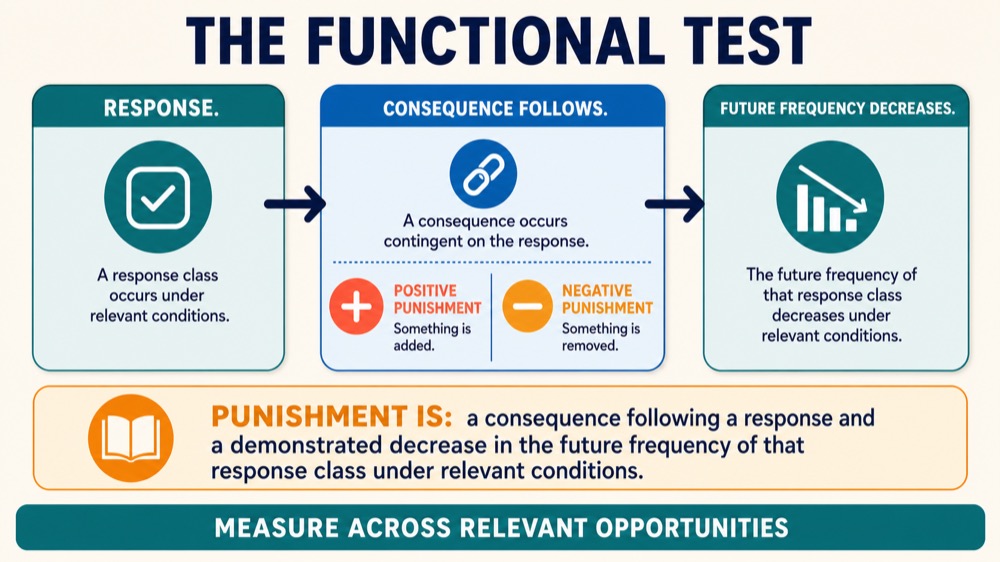
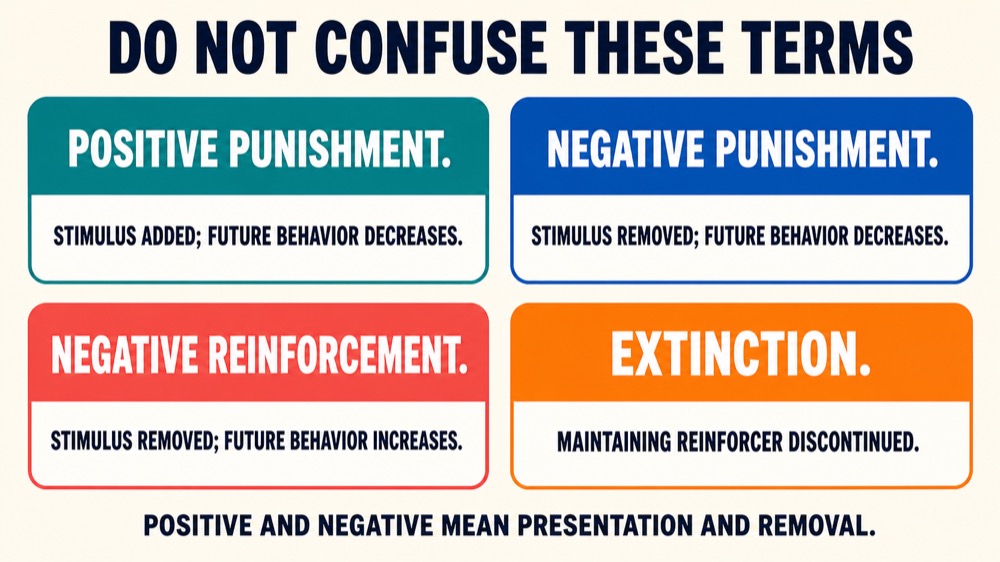
Positive punishment involves presenting a stimulus after a behavior; negative punishment involves removing a stimulus after a behavior. Both aim to decrease future frequency, but they differ in the operation.
- Positive punishment: Response + added stimulus → decrease. Example: A driver starts the car without fastening the seat belt (response), the car presents a warning chime (stimulus added), and unbelted starts decrease under comparable conditions.
- Negative punishment: Response + removed stimulus → decrease. Example: A teen stays out past curfew (response) and loses access to video games (stimulus removed). Curfew violations decrease.
Both describe punishment operations, but arranging an operation does not by itself demonstrate a punishing effect; the future behavior must be measured. Time-out from reinforcement, when it reduces the target response, is negative punishment rather than positive punishment. Likewise, an unpleasant added event is not automatically a positive punisher. Antecedent stimuli can come to signal different consequence conditions, but those stimulus-control relations should be analyzed separately from the response-consequence relation used to classify positive versus negative punishment.
Common Traps and Misconceptions
Many misconceptions about positive punishment arise from everyday language. Here are traps to recognize when studying for the BCBA exam:
- Trap: Adding something unpleasant is automatically positive punishment. Fact: The operation must be followed by decreased behavior. An added unpleasant stimulus that does not reduce future responding is not punishment.
- Trap: Reprimands are always positive punishers. Fact: A reprimand may function as reinforcement (e.g., peer attention) for some individuals. The effect on future behavior determines function.
- Trap: Positive punishment means “good punishment.” Fact: “Positive” refers to addition only, not ethical valence.
- Trap: Behavior stopped immediately, so positive punishment occurred. Fact: Immediate cessation is not evidence of punishment; only future frequency under similar conditions confirms the punishing effect.
- Trap: Punishment procedures should be tried before reinforcement-based procedures. Fact: The BACB Ethics Code (standards 2.14 and 2.15) emphasizes prioritizing positive reinforcement procedures whenever possible.
Distinguishing Positive Punishment from Close Concepts
Understanding positive punishment requires contrasting it with negative reinforcement, extinction, and redirection.
Positive Punishment vs. Negative Reinforcement: Negative reinforcement involves removing an aversive stimulus contingent on a response, which increases future behavior. For example, a student studies (response) to avoid a parent’s nagging (removal of nagging). Studying increases. In positive punishment, a stimulus is added and behavior decreases. The key difference: negative reinforcement increases behavior, positive punishment decreases it.
Positive Punishment vs. Extinction: Extinction involves withholding the reinforcer that previously maintained a behavior, leading to a decrease. For example, a child whines for candy (response) and the parent no longer provides candy (reinforcer withheld). Whining decreases. In positive punishment, a stimulus is added; in extinction, nothing is added—reinforcement is terminated.
Positive Punishment vs. Redirection: Redirection usually involves prompting an alternative behavior, often without a punisher. For example, a child engages in self-stimulatory hand-flapping (response); the teacher guides the child’s hands to a toy (prompt). The hand-flapping may decrease temporarily but not necessarily through punishment. Redirection may function as differential reinforcement if the alternative behavior is reinforced.
Understanding stimulus control is crucial: an SD for the target behavior sets the occasion for the response, and the punisher must be contingent on that response. For more on stimulus control, see our article on stimulus control in ABA and stimulus generalisation.
Ethics and Guidelines for Using Punishment
The BACB Ethics Code places positive-punishment procedures within a broader behavior-change intervention and risk-minimization framework. Standard 2.14 says interventions must be based on behavioral principles, scientific evidence, and assessment results; prioritize positive reinforcement; fit the client’s context and resources; and consider risks, benefits, side effects, preferences, efficiency, cost, and maintenance. Standard 2.15 says restrictive or punishment-based procedures are recommended and implemented only after less intrusive means have not produced the desired results, or when an existing intervention team determines that the risk posed by the behavior outweighs the intervention risk. It also requires compliance with any applicable review process, continual evaluation and documentation, and timely modification or discontinuation when ineffective. See the BACB Ethics Code for Behavior Analysts.
In practice, this means starting from assessment, prioritizing reinforcement-based and less intrusive options, and documenting why any punishment-based procedure is justified under the applicable standard. If a risk-based intervention-team determination is used instead of first demonstrating failure of less intrusive means, that determination must match the Code’s stated condition. Required consent and review processes, implementation oversight, behavioral data, side-effect monitoring, and continual effectiveness evaluation remain essential.
BCBA Exam Study Checklist
- Define positive punishment functionally: stimulus addition leads to decreased future behavior under similar conditions.
- Memorize the operation: contingent presentation of a stimulus after a response.
- Practice identifying the response, added stimulus, and measured decrease in examples.
- Distinguish positive punishment from negative punishment, negative reinforcement, extinction, and redirection using complete contingencies.
- Understand that intent does not determine function; always rely on observed behavioral change.
- Know the BACB Ethics Code standards 2.14 and 2.15: use assessment results, prioritize positive reinforcement, minimize risk, follow any required review process, and continually evaluate and document effects.
- Avoid common traps: reprimands are not automatically punishers; time-out is negative punishment; punishment is not the first choice.
- Study original examples rather than relying solely on extreme or controversial applications.
- Keep the relations separate: antecedent stimuli may signal consequence conditions, while the punishing operation is the contingent presentation after the response and the punishing effect is the later decrease. For the current exam content domains, consult the BACB BCBA Test Content Outline.
Test Your Knowledge with Free BCBA Mock Exam
Ready to practice identifying examples of positive punishments and other ABA concepts? Our free BCBA mock exam offers realistic practice questions with detailed feedback to strengthen your understanding. Drills cover punishment, reinforcement, stimulus control, and more. Start your free practice today and build confidence for exam day.
References
- BACB BCBA Test Content Outline (6th Edition)
- BACB Ethics Code for Behavior Analysts
- PMC Article: The Use of Punishment in Applied Behavior Analysis
Next step for BCBA exam prep
Turn this topic into exam-day practice
Use this topic as a focused review, then test it in exam-style conditions with a free mock before deciding whether five full-length mocks are the right next step.
Start the Free BCBA Mock ExamContinue with Five Full-Length Mocks — $99
Review the included materials and access details before ordering. No pass guarantee is implied.



