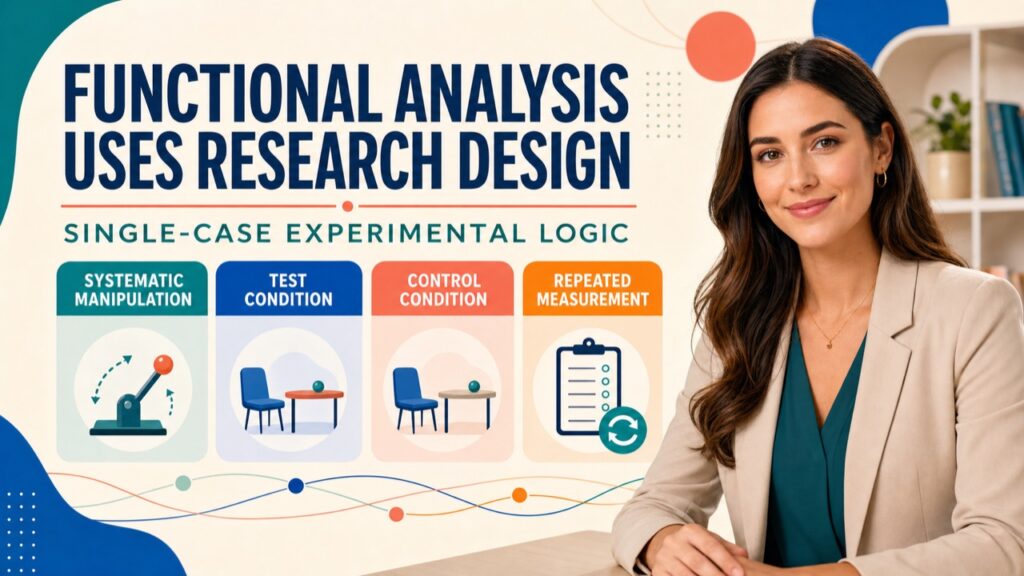
What Is a Functional Analysis and Why Does It Use Research Design?
A functional analysis (FA) is an experimental methodology that systematically manipulates environmental variables to determine which antecedent and consequence conditions maintain a target behavior. Unlike indirect assessments (e.g., interviews, rating scales) or descriptive assessments (e.g., ABC observation), an FA uses single-case experimental design logic to establish a functional relation between behavior and specific environmental events. The key distinction: functional analysis uses research design to test hypotheses under controlled conditions, not merely to describe correlations. This experimental approach is considered the gold standard in behavior analysis because it directly demonstrates the operant function of behavior through repeated measurement and systematic manipulation. By arranging test conditions (e.g., attention, escape, alone, tangible) and comparing them to a control condition (e.g., play), the behavior analyst can determine whether the behavior is maintained by social-positive reinforcement, social-negative reinforcement, automatic reinforcement, or a combination.
Table of Contents
- What Is a Functional Analysis and Why Does It Use Research Design?
- Core Components: Dependent and Independent Variables
- How Functional Analysis Uses Research Design: Single-Case Experimental Logic
- Contrasting Functional Analysis with Indirect and Descriptive Assessments
- Variants of Functional Analysis: Multielement, Pairwise, Reversal, and More
- Ethical and Practical Considerations
- Study Checklist: Understanding How Functional Analysis Uses Research Design
Core Components: Dependent and Independent Variables
Every functional analysis operationalizes a dependent variable (DV) – the directly measured target behavior – and independent variables (IVs) – the arranged antecedent and consequence conditions. The DV must be objectively defined, observable, and measurable. For example, “aggression” might be defined as hitting, kicking, or biting that makes contact with another person. The IVs are the programmed test conditions such as attention delivery contingent on behavior, escape from demands, or no social consequences. A control condition (e.g., play) enriches the environment and provides noncontingent attention and no demands, serving as a comparison to isolate the specific reinforcer. The logic of functional analysis uses research design to compare differentiated responding across conditions: if the DV occurs consistently more in one test condition than the control, that condition likely contains the maintaining variable. This single-case logic means the individual serves as their own control – no group or randomized control group is needed.
How Functional Analysis Uses Research Design: Single-Case Experimental Logic
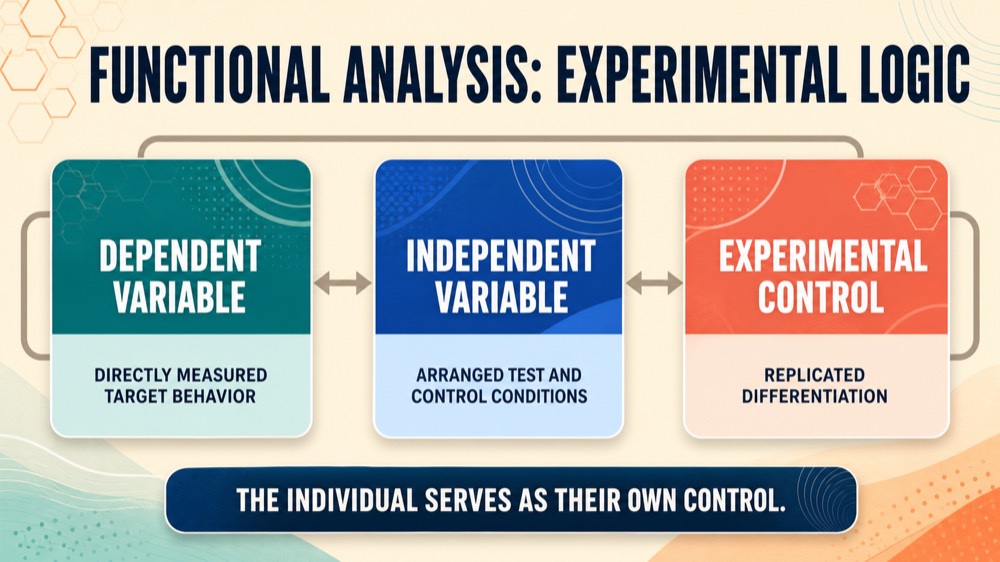
Functional analysis uses research design principles borrowed from single-case experimental designs, most commonly the multielement design. In a multielement FA, test and control conditions are rapidly alternated (e.g., across 5- to 10-minute sessions) in a counterbalanced or random order. Differential responding across conditions demonstrates experimental control when the behavior under each condition remains stable and separated from others. However, other designs are valid when multielement designs suffer from sequence effects, multiple treatment interference, or discrimination failure. A reversal design (ABAB) can be used, where a single test condition is compared to a control in consecutive phases. A pairwise design compares one test condition directly against a control in alternating sessions, and a sequential test-control design presents test and control conditions in blocks. Understanding that functional analysis uses research design in multiple ways helps behavior analysts select the most appropriate arrangement for the client, setting, and behavior. The classic Iwata et al. (1982/1994) study (PMC1297798) demonstrated the multielement approach with four standard conditions, but modern FAs may be brief, trial-based, or synthesized, reflecting the flexibility of the methodology. Experimental control in an FA means that changes in the DV are reliably associated with manipulation of the IV rather than a plausible extraneous variable. This is evaluated through differentiated responding across repeated test-control comparisons. For example, consistently higher responding in an escape test condition than in the control and other relevant conditions may support an escape function. A single elevated data point, isolated visual difference, or highest mean is insufficient by itself. There is no universal minimum number of observations that proves experimental control; interpretation depends on replication, differentiation, stability or predictable patterning, measurement quality, design integrity, and the extent to which alternative explanations have been addressed.
Common Traps in Interpreting Functional Analysis Data: Use the points below as a quick study guide.
- Claiming a function based on the highest single session: functional analysis uses research design logic requires replication of differences across multiple sessions. A single spike may be due to an extraneous event.
- Mistaking correlational ABC patterns for experimental evidence: descriptive observations can support a hypothesis, whereas an FA systematically manipulates variables to test that hypothesis.
- Treating the multielement design as the only valid FA arrangement: functional analysis uses research design broadly; reversal, pairwise, and sequential designs are also appropriate.
- Interpreting undifferentiated data as no function: undifferentiated results may indicate automatic reinforcement, multiple functions, or that the design is insensitive. Further analysis is needed.
- Confusing functional analysis with assessment procedures that lack systematic manipulation: interviews and rating scales are not experimental; they only suggest hypotheses.
Contrasting Functional Analysis with Indirect and Descriptive Assessments
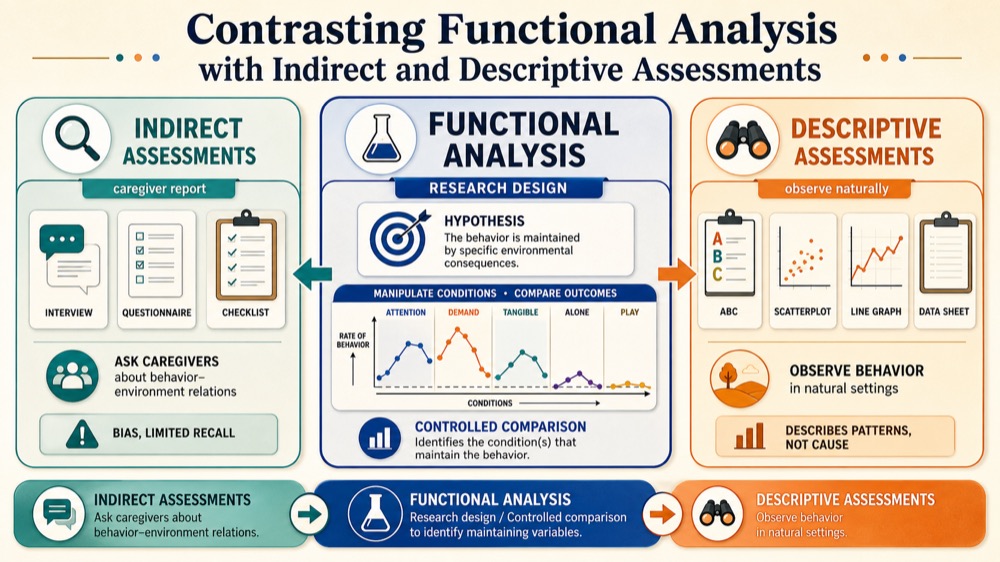
Indirect assessments (e.g., interviews, questionnaires) ask caregivers about behavior-environment relations. They are prone to bias and limited recall. Descriptive assessments (e.g., ABC continuous recording, scatterplots) observe naturally occurring antecedents and consequences but do not control them. Both can generate hypotheses, but neither demonstrates a functional relation. Among the indirect, descriptive, and experimental assessment approaches compared here, functional analysis is the one that systematically manipulates variables and can provide experimental evidence of a functional relation when adequate control is demonstrated. For example, an ABC observation may show that aggression often occurs after a demand is presented and is followed by removal of the demand. This suggests negative reinforcement, but it could also be that the demand was removed because the teacher needed to attend to another student. An FA would systematically test escape versus attention conditions to confirm which variable maintains the behavior. While descriptive assessments are less intrusive and may inform hypothesis development, they lack the internal validity of an FA. As discussed in the literature (PMC1284431), descriptive assessment can reveal naturally occurring patterns and inform hypotheses, but it does not establish the same experimental control as a well-designed FA. The decision to conduct an FA must balance ethical considerations, including informed consent, risk assessment, and availability of protective procedures, with the need for accurate function identification. The current BACB test content outline (BACB outline) includes FA as a key assessment method.
Variants of Functional Analysis: Multielement, Pairwise, Reversal, and More
While the multielement design is efficient and common, it is not mandatory. Functional analysis uses research design flexibly. Key variants include:
- Brief FA: Conducted in a single session or short series, often in outpatient settings. Useful when time is limited but may lack experimental control if data are unstable.
- Trial-based FA: Embedded in natural routines; each trial consists of a test and control comparison. Useful when extended sessions are impractical or unsafe.
- Pairwise design: Alternates one test condition with a matched control condition, which can reduce interaction and discrimination problems that arise when many conditions are rapidly alternated. It is conceptually distinct from a phase-based reversal design.
- Synthesized FA: Combines multiple suspected variables (e.g., attention + escape) into one test condition. Increases ecological validity but can make it harder to isolate which variable maintains behavior.
Each variant has strengths and limitations. The key is systematic comparison under a design capable of answering the assessment question. Selection must consider competence, client characteristics, safety, behavior severity, treatment relevance, setting, discrimination, possible interaction effects, and practical constraints. No format is automatically safer or more appropriate solely because it is brief or trial based. For dangerous behavior, a qualified team may consider individualized safeguards and design modifications, such as latency measures or predetermined session-termination criteria, only after a case-specific risk-benefit analysis. Research on FA methodology (PMC2846577) discusses considerations for selecting and adapting arrangements.
Ethical and Practical Considerations
Conducting an FA requires competence in single-case design, measurement, behavioral assessment, and risk management. Relevant professional obligations include obtaining informed consent when required, selecting assessments on the basis of evidence and client context, and minimizing risk of harm. A case-specific risk assessment, appropriate protective procedures, clear stopping criteria, and treatment relevance are essential safeguards; their exact form depends on the client, behavior, setting, and applicable requirements. Functional analysis uses research design to answer questions about function, but it should not be implemented as an intervention. This article does not provide instructions for provoking dangerous behavior; the focus is on experimental logic, not hands-on protocols. Behavior analysts must also consider the client’s right to effective treatment and the least restrictive assessment. If an FA cannot be safely conducted, alternative strategies such as a latency-based FA or a descriptive assessment may be considered, while acknowledging the reduced experimental rigor. Ongoing data review ensures that the assessment remains safe and that conditions are adjusted if the behavior becomes dangerous. Remember, functional analysis uses research design to benefit the client, not to satisfy academic curiosity.
Study Checklist: Understanding How Functional Analysis Uses Research Design
- Define functional analysis as an experimental methodology that uses single-case design logic.
- Identify the dependent variable (behavior) and independent variables (test and control conditions).
- Explain how repeated measurement and systematic manipulation produce experimental control.
- Distinguish FA from indirect and descriptive assessments by noting the presence or absence of systematic manipulation.
- List three single-case designs used in FA: multielement, reversal, pairwise.
- Describe how differentiated responding across test and control conditions supports a functional relation.
- Recognize common pitfalls: interpreting a single session as evidence, confusing correlation with causation, assuming multielement is the only design.
- Apply ethical considerations including consent, risk assessment, and protective procedures.
- Review primary sources: Iwata et al. (1982/1994), Iwata et al. (2000), and relevant BACB ethics standards.
For more study resources, practice with our free BCBA mock exam (free BCBA mock exam) to test your understanding of assessment methods and single-case design.