

The Premack Principle represents a fundamental concept in applied behavior analysis that every BCBA candidate must master. Often called Grandma’s Rule, this principle provides a powerful tool for behavior change by leveraging natural preferences. Understanding how to apply the Premack Principle ABA approach effectively can make the difference between successful intervention and missed opportunities.
Table of Contents
- Premack Principle ABA: What is the Premack Principle? A Foundational Definition
- Applying the Premack Principle: Worked ABA Examples
- Premack on the BCBA Exam: Relevance and Common Traps
- Quick Checklist for Implementation and Exam Readiness
- Summary and Key Takeaways
This guide breaks down the principle into exam-ready components, provides practical examples, and highlights common test traps to avoid.
Premack Principle ABA: What is the Premack Principle? A Foundational Definition
The Premack Principle states that a high-probability behavior can reinforce a low-probability behavior when access to the former is made contingent upon completion of the latter. This means behaviors that occur frequently can serve as reinforcers for behaviors that occur less frequently.
David Premack’s original research demonstrated that organisms will engage in less preferred activities to gain access to more preferred activities. This principle moves beyond simple stimulus-based reinforcement to focus on behavioral contingencies.
The Core Concept: Grandma’s Rule in Behavioral Terms
The classic “eat your vegetables, then you can have dessert” example perfectly illustrates the Premack Principle. In behavioral terms, eating vegetables represents the low-probability behavior (something the child is less likely to do), while eating dessert represents the high-probability behavior (something the child is highly motivated to do).
What distinguishes this from simple positive reinforcement is that the reinforcer is not a tangible item but rather the opportunity to engage in a preferred behavior. This distinction is crucial for both clinical application and exam success.
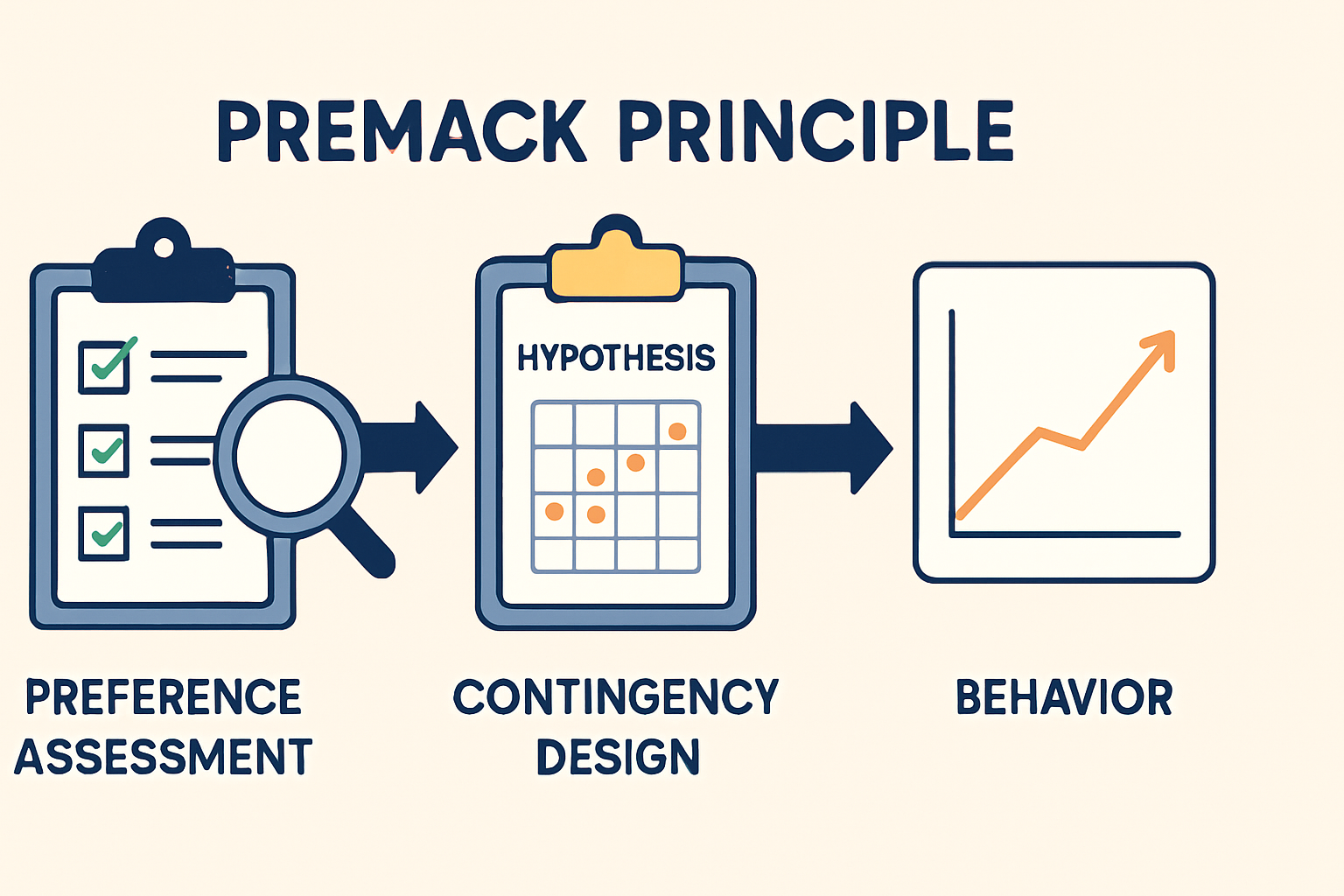
Applying the Premack Principle: Worked ABA Examples
Effective implementation requires careful preference assessment and contingency design. The principle works across various settings when properly applied with attention to individual preferences and behavioral functions.
Example 1: Increasing Academic Engagement in a School Setting
Consider a student who avoids math worksheets but eagerly engages with computer games. A behavior analyst might implement: “Complete five math problems, then you can have five minutes of computer time.”
The ABC data would show:
- Antecedent: Math worksheet presented with contingency statement
- Behavior: Student completes math problems
- Consequence: Access to computer time (high-probability behavior)
The hypothesized function is likely escape from academic demands, and the Premack Principle provides an alternative reinforcement pathway. This approach aligns with effective differential reinforcement strategies.
Example 2: Promoting Daily Living Skills at Home
A child resists toothbrushing but loves watching a specific television show. The contingency becomes: “Brush your teeth for two minutes, then you can watch ten minutes of your favorite show.”
This intervention addresses what might be maintained by automatic reinforcement or avoidance of the sensory experience. The high-probability behavior (watching TV) reinforces the low-probability behavior (toothbrushing).
Successful implementation requires accurate preference assessments to identify truly high-probability behaviors that will function as effective reinforcers.
Premack on the BCBA Exam: Relevance and Common Traps
The Premack Principle appears frequently on the BCBA exam, often disguised within scenario-based questions. Understanding its nuances can help you distinguish it from similar concepts.
How the Exam Tests This Concept
Exam questions typically present scenarios where you must identify which behavioral principle is being applied. They may describe a contingency where access to a preferred activity follows completion of a non-preferred task.
Key indicators include descriptions of behavioral contingencies rather than simple stimulus delivery. The exam might also test your ability to select Premack as an intervention based on preference assessment data.
Pitfalls to Avoid: Distinguishing Premack from Other Principles
Common mistakes include confusing the Premack Principle with simple positive reinforcement. Remember: Premack uses a behavior as reinforcement, while positive reinforcement uses a stimulus.
- Premack vs. Positive Reinforcement: Premack reinforces with access to behavior; positive reinforcement uses stimuli
- Premack vs. Negative Reinforcement: Premack adds access; negative reinforcement removes aversives
- Response Deprivation: Only applies when access to high-p behavior is restricted below baseline
Another trap is misapplying the principle without proper baseline data to establish what constitutes high and low probability behaviors for that individual.
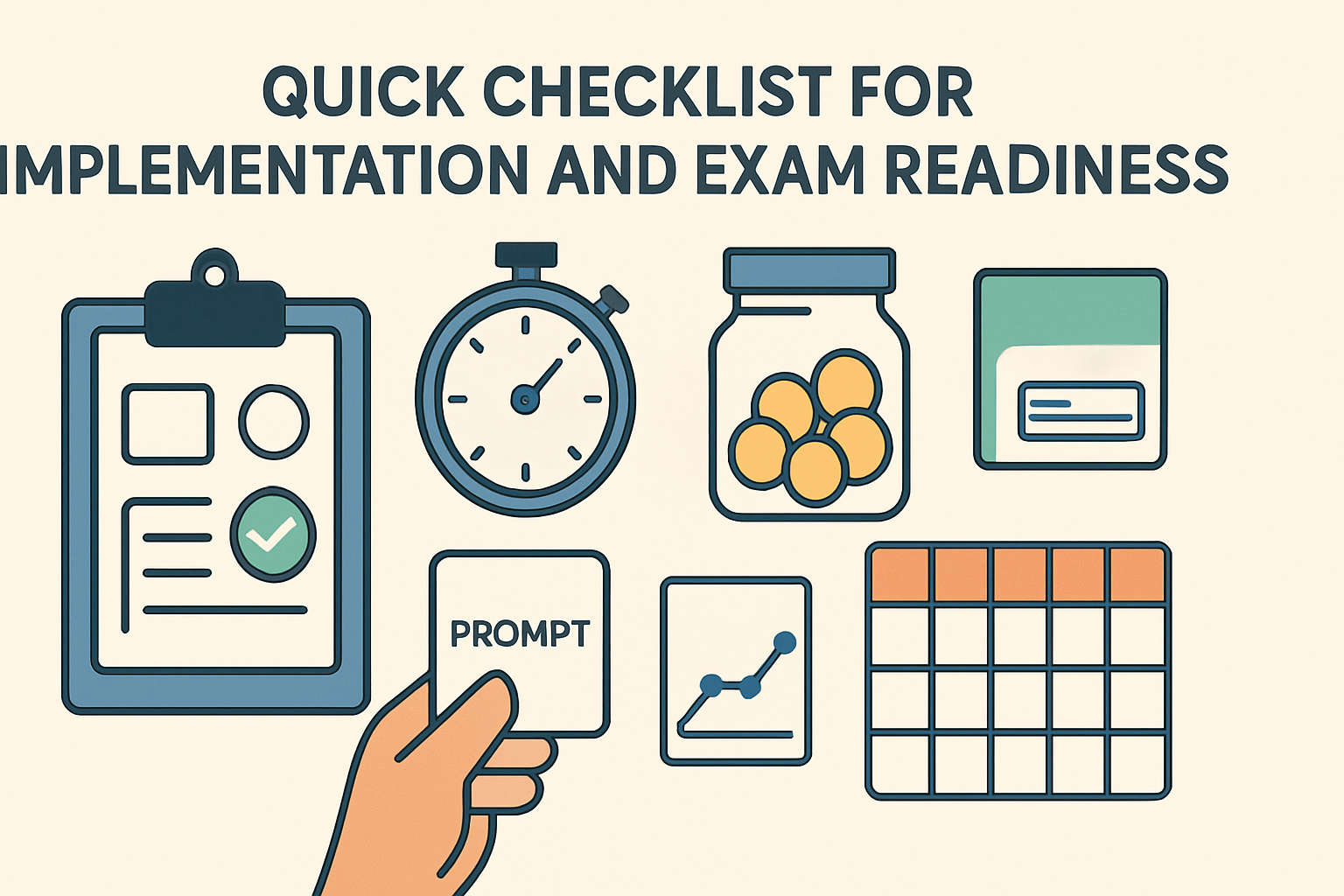
Quick Checklist for Implementation and Exam Readiness
Use this checklist to ensure proper application and exam preparation:
- Conduct thorough preference assessments to identify true high-probability behaviors
- Establish clear baseline measures for both target and reinforcing behaviors
- Design contingencies that make access to high-p behavior contingent upon low-p behavior completion
- Monitor for satiation effects that might reduce reinforcing value over time
- Remember that the reinforcer is the opportunity to engage in the behavior, not the behavior itself
- On the exam, look for scenarios describing behavioral access contingencies
For comprehensive exam preparation, consider our BCBA exam prep guide that covers all essential concepts.
Summary and Key Takeaways
The Premack Principle remains one of the most practical and frequently applied concepts in ABA. Its power lies in using naturally occurring preferences to build behavioral repertoires.
Key points to remember:
- The principle uses high-probability behaviors to reinforce low-probability behaviors
- It differs from simple reinforcement by using behavioral access as the consequence
- Effective implementation requires accurate preference assessment and contingency design
- On the exam, distinguish it from positive reinforcement and response deprivation
- Clinical success depends on individualizing based on reliable preference data
For further study, consult the BACB Task List and original research by David Premack to deepen your understanding of this foundational principle.
Next step for BCBA exam prep
Turn this topic into exam-day practice
Use this topic as a focused review, then test it in exam-style conditions with a free mock before deciding whether five full-length mocks are the right next step.
Start the Free BCBA Mock ExamContinue with Five Full-Length Mocks — $99
Review the included materials and access details before ordering. No pass guarantee is implied.



