
A BCBA-facing framework for private practice quality, coaching, and caregiver support If you are looking for the best private ABA practices for caregiver coaching and support, start with one important distinction: “best” should describe a repeatable service standard, not a marketing claim or a universal ranking of clinics. A strong private ABA practice helps caregivers use behavior-analytic strategies in ordinary routines while keeping goals measurable, responsibilities clear, and the child’s dignity and communication access at the center.
Table of Contents
- Best Private ABA Practices for Caregiver Coaching and Support: What Good Looks Like
- Start With Functional, Caregiver-Defined Goals
- Use a Teach–Practice–Feedback Loop
- Build the Practice System Around Quality
- A Private ABA Practice Comparison Table
- Measure Skill, Generalization, and Burden
- Questions Families and Supervisors Should Ask
- A Practical Next Step for BCBA Candidates
- Take the Free BCBA Mock Exam
This guide is written for BCBAs, supervisors, practice owners, and families comparing a private ABA provider. It focuses on what a practice should be able to explain and demonstrate: how caregiver goals are chosen, how coaching is taught, how progress is measured, how supervision protects quality, and what happens when a plan is not working. Requirements vary by state, payer, and client situation, so verify current rules with the relevant board, plan, and official documents. Scope note: This is an educational framework, not a provider ranking, treatment recommendation, or legal opinion. A private practice should adapt coaching to the learner, caregiver, culture, language, setting, consent, and clinical plan.
Best Private ABA Practices for Caregiver Coaching and Support: What Good Looks Like
Caregiver coaching is not a lecture delivered at the end of a therapy week. It is collaborative skill development: a qualified clinician helps a caregiver understand a target, practice a response, receive useful feedback, and use the skill in the setting where it matters. The caregiver should leave with a clear next action, a way to know whether it helped, and a route for asking questions. A private ABA practice is on stronger ground when it can answer five questions:
- What is the goal? The goal should describe a meaningful change in daily life, not simply “parent understands ABA.”
- What will the caregiver do? The steps should be observable, realistic, and written in language the family can use.
- How will coaching happen? A plan should include modeling, rehearsal, feedback, and adaptation rather than passive handouts alone.
- How will the team know it is helping? The practice should look at caregiver implementation, client outcomes, generalization, and burden.
- What happens when it does not fit? The team should revise the plan, seek assent and feedback, and escalate clinical concerns instead of blaming the caregiver.
These standards align with the broader ethical expectation that behavior-analytic services be individualized, respectful, competent, and documented. The BACB Ethics Code resources are a useful official starting point, but a code is not a substitute for clinical judgment or a state and payer review.
Start With Functional, Caregiver-Defined Goals
The best private ABA practices do not begin caregiver support by asking a family to memorize a long list of terms. They begin by identifying a routine that matters. Examples include getting ready for school, communicating a break, tolerating a transition, completing a hygiene step, or reducing a dangerous response during a specific activity. A useful goal has four parts:
- Routine and context: where and when the skill needs to occur.
- Caregiver action: the prompt, arrangement, reinforcement, or communication support the caregiver will try.
- Learner response: what observable behavior will show that the routine is moving in the intended direction.
- Mastery and maintenance: how the team will decide that the skill is stable enough to generalize or fade support.
For example, “caregiver will use a visual transition cue” is a teaching action, but it is incomplete by itself. A more useful plan identifies the transition, the cue, the learner response, the prompt-fading plan, and the data that will be reviewed. It also asks whether the cue is acceptable and usable for that family. A strategy that cannot survive the family’s actual schedule is not a high-quality coaching strategy simply because it looks precise on paper.
Use a Teach–Practice–Feedback Loop
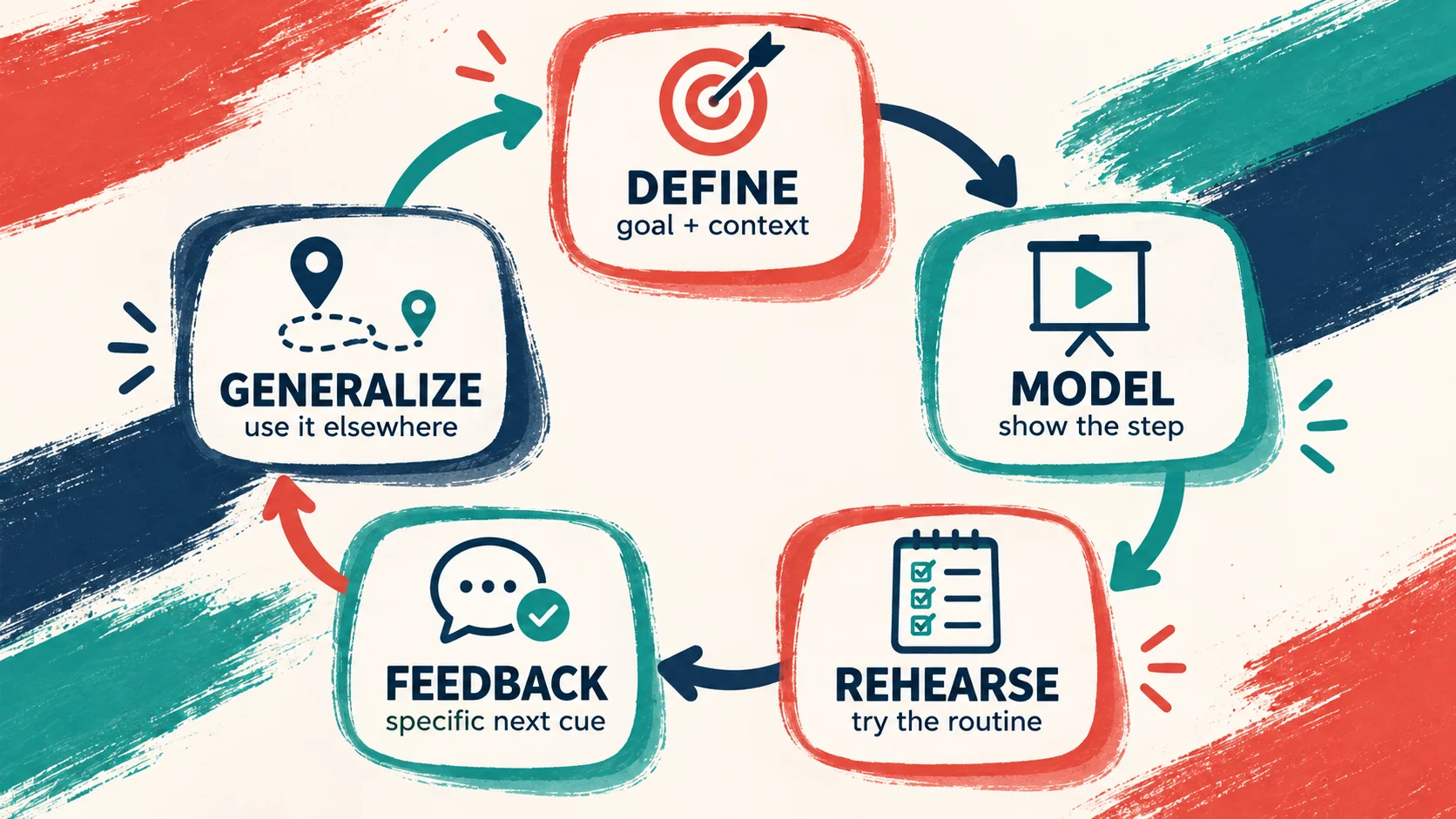
Caregiver coaching works best as a loop rather than a one-way explanation. The clinician explains the target in plain language, models the response, asks the caregiver to rehearse it, gives specific feedback, and plans how the skill will be used in another routine. The next session starts with what happened in real life and adjusts the plan.
The loop can be organized into five steps:
- Define: agree on the routine, the reason it matters, and the exact behavior to observe.
- Model: demonstrate the strategy while narrating only the information the caregiver needs to act.
- Rehearse: let the caregiver practice with a realistic example, role-play, or natural routine.
- Coach: provide immediate, respectful feedback and adjust the prompt, materials, or environment.
- Generalize: plan where the skill will be used next and what data or brief note will come back to the team.
Good feedback is concrete. “That was better” is encouraging but hard to repeat. “You gave the choice before the transition and waited five seconds before adding a prompt” tells the caregiver what to keep. Feedback should also include what to do when the strategy does not work, including when to pause and contact the BCBA.
Build the Practice System Around Quality
A single excellent coaching session cannot compensate for a weak delivery system. A private ABA practice should define who prepares the goal, who provides coaching, who reviews data, and how a caregiver can reach the responsible clinician. The process should be understandable even when staffing changes. At minimum, the practice should have a documented approach to:
- Consent and collaboration: explain the plan, invite questions, respect refusal or modification, and protect privacy during in-home and telehealth sessions.
- Supervision: make clear how the BCBA reviews the plan, observes implementation, and supports technicians or other team members.
- Language and access: arrange interpretation or accessible materials when needed; do not treat translation as a cosmetic add-on.
- Documentation: record the goal, coaching activity, caregiver response, data reviewed, barriers, and next step without turning notes into blame.
- Escalation: describe what happens when there is a safety concern, a sharp change in behavior, a mismatch between the plan and family priorities, or a need for another professional service.
- Continuity: explain coverage for cancellations, staff turnover, school breaks, caregiver absence, and transitions between settings.
A Private ABA Practice Comparison Table
Families and supervisors can use this table to compare what a practice says with what it can show. The point is not to reward the longest brochure. It is to identify whether the service has a clear feedback and accountability loop.
| Practice element | A strong standard | What to verify |
|---|---|---|
| Goals | Caregiver and learner goals are observable, meaningful, and linked to routines. | Can the team show the target, mastery rule, and reason it matters? |
| Coaching | Sessions include modeling, caregiver practice, specific feedback, and a next routine. | Will the caregiver actually rehearse, or only receive a handout? |
| Data | The team checks implementation, learner outcomes, generalization, and burden. | What is recorded, who reviews it, and how does it change the plan? |
| Support | Families know how to ask questions, report barriers, and raise safety concerns. | Is there a named contact and a realistic response process? |
Measure Skill, Generalization, and Burden
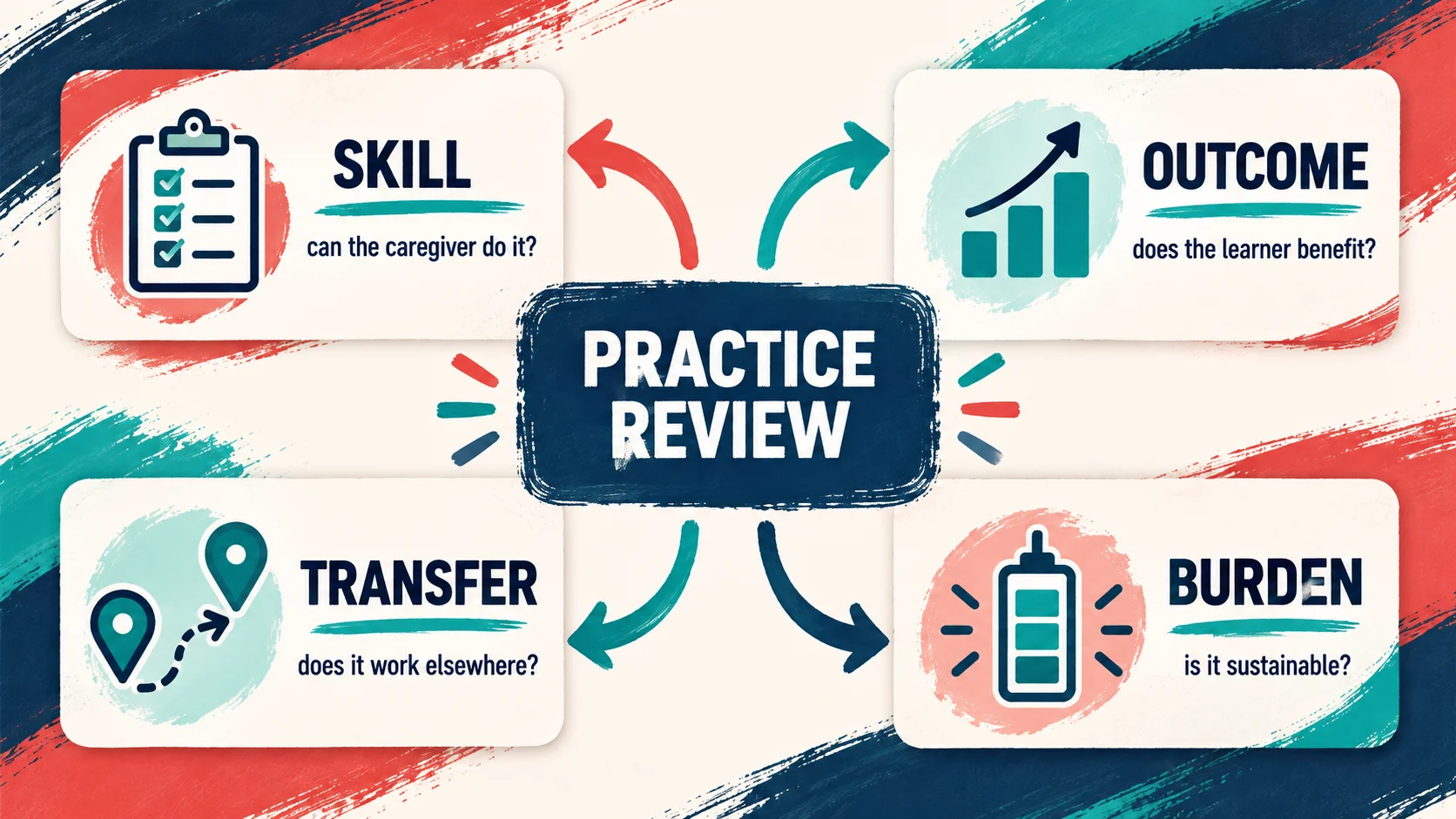
Caregiver support should be measured without turning the caregiver into the problem. A private ABA practice can track whether the caregiver performs the planned steps, whether the learner’s response changes, whether the skill occurs outside the coaching session, and whether the plan is practical enough to continue.
Useful measures might include a brief implementation checklist, opportunities to respond, latency to start a routine, frequency of a communication response, or a simple generalization probe. Choose the smallest measurement system that answers the clinical question. If the data collection takes so long that the family stops using the strategy, the measurement system needs revision.
Review the data in a problem-solving conversation:
- If caregiver implementation is low, check clarity, materials, time, language, reinforcement, and whether the goal was jointly chosen.
- If implementation is high but the learner response is unchanged, reassess the function, the measurement, the intervention components, and the need for another professional perspective.
- If the skill works only in sessions, plan deliberate generalization across people, materials, locations, and routines.
- If the plan creates excessive stress or conflict, treat burden as clinical information and adapt the plan rather than demanding perfect compliance.
A good practice can explain not only how it counts success, but also how it decides that a strategy should be changed. That is often more revealing than a polished promise about outcomes.
Questions Families and Supervisors Should Ask
Before starting with a private ABA practice, ask for specific answers rather than general assurances:
- How will you choose caregiver goals, and how can the family disagree or request a change?
- What does a coaching session look like from start to finish?
- How will you support communication access, language preference, assent, and privacy?
- What data will be collected, how often will it be reviewed, and who will explain it?
- How will the practice respond if a caregiver cannot use the plan as written?
- How are supervision, staff changes, missed sessions, and urgent concerns handled?
- Which statements are clinical guidance, and which depend on a payer, state board, or licensing rule?
For a BCBA supervisor, these questions can become an internal audit. Ask whether the team’s notes show the same sequence: goal, model, rehearsal, feedback, generalization, data review, and next decision. If the answer is no, the practice may need a clearer supervision and documentation routine.
A Practical Next Step for BCBA Candidates
Caregiver coaching questions often test more than a definition. They ask you to choose a function-based, ethical, measurable next action while accounting for context, consent, generalization, and treatment integrity. When reviewing a BCBA practice question, underline the learner’s target, the caregiver’s action, the consequence or environmental variable, and the evidence you are being asked to interpret.
If you are studying for the BCBA exam, use this topic as a decision-making exercise: can you distinguish a caregiver skill deficit from a poorly designed plan, an implementation barrier, a measurement problem, or a change in the learner’s needs? That distinction is more valuable than memorizing a list of “best practices.”
Bottom line: the best private ABA practices for caregiver coaching and support make goals functional, teach skills through practice and feedback, measure outcomes without blame, document supervision, and revise plans when real life exposes a mismatch. Compare practices by these visible systems—not by slogans—and use official state, payer, and BACB materials when a rule or credential is involved. When you want to test your own reasoning on applied ABA scenarios, try the Free BCBA Mock Exam and review each missed question by decision error, not just by answer letter. For targeted review, use our best private aba practices for caregiver coaching and support practice questions to apply the concept in exam-style scenarios.
Take the Free BCBA Mock Exam
A useful next step is to apply this idea in a fresh set of BCBA-style practice questions and review the feedback. Take the Free BCBA Mock Exam



