

A current Colorado roadmap for BACB certification, supervised fieldwork, the BCBA exam, and the state’s licensing transition If you are asking how to become a BCBA in Colorado, plan for two connected but separate systems. The Behavior Analyst Certification Board (BACB) controls the national BCBA credential, including education, supervised fieldwork, and the examination. Colorado also has its own practice-authority rules, and a law enacted in 2026 creates a behavior analyst licensing board with a general licensing requirement scheduled to apply on and after July 1, 2028, subject to the law’s exemptions.
Table of Contents
- How to Become a BCBA in Colorado: The Short Answer
- Choose a BACB Eligibility Pathway
- Complete Supervised Fieldwork
- Apply for and Pass the BCBA Exam
- Understand Colorado’s Licensing Timeline
- 2026–2028 Colorado BCBA Planning Table
- Choose Programs and Fieldwork Carefully
- Turn the Roadmap Into Exam Practice
- Take the Free BCBA Mock Exam
This means a Colorado candidate should not stop at “I passed the BCBA exam.” You need a dated plan for the BACB requirements that apply when you submit your application, a reliable fieldwork record, and a separate check of Colorado’s rules before you practice or accept work. The roadmap below is an educational planning guide, not legal advice or a promise of employment.
Important date note: BACB certification changes take effect January 1, 2027. Colorado’s enacted licensing timeline is a separate state issue. Recheck BACB and Colorado sources before filing, because future rules, forms, fees, and exemptions may change.
How to Become a BCBA in Colorado: The Short Answer
The national route is the same whether you study in Denver, Colorado Springs, Fort Collins, or online. You generally need to complete a qualifying graduate-level education and behavior-analytic coursework, accrue qualifying supervised fieldwork, apply through the BACB, and pass the BCBA examination. Your Colorado planning adds a state-law check before you practice.
- Confirm the BACB pathway that fits your education. Beginning January 1, 2027, the BACB describes Pathway 1 and Pathway 2 for new applicants.
- Arrange qualifying supervised fieldwork. The supervisor, percentage, activities, observations, and records must match the applicable BACB rules.
- Submit a complete BACB application. Follow the current handbook for transcripts, fieldwork verification, fees, and review steps.
- Pass the BCBA examination. The current examination is based on the BCBA 6th Edition Test Content Outline.
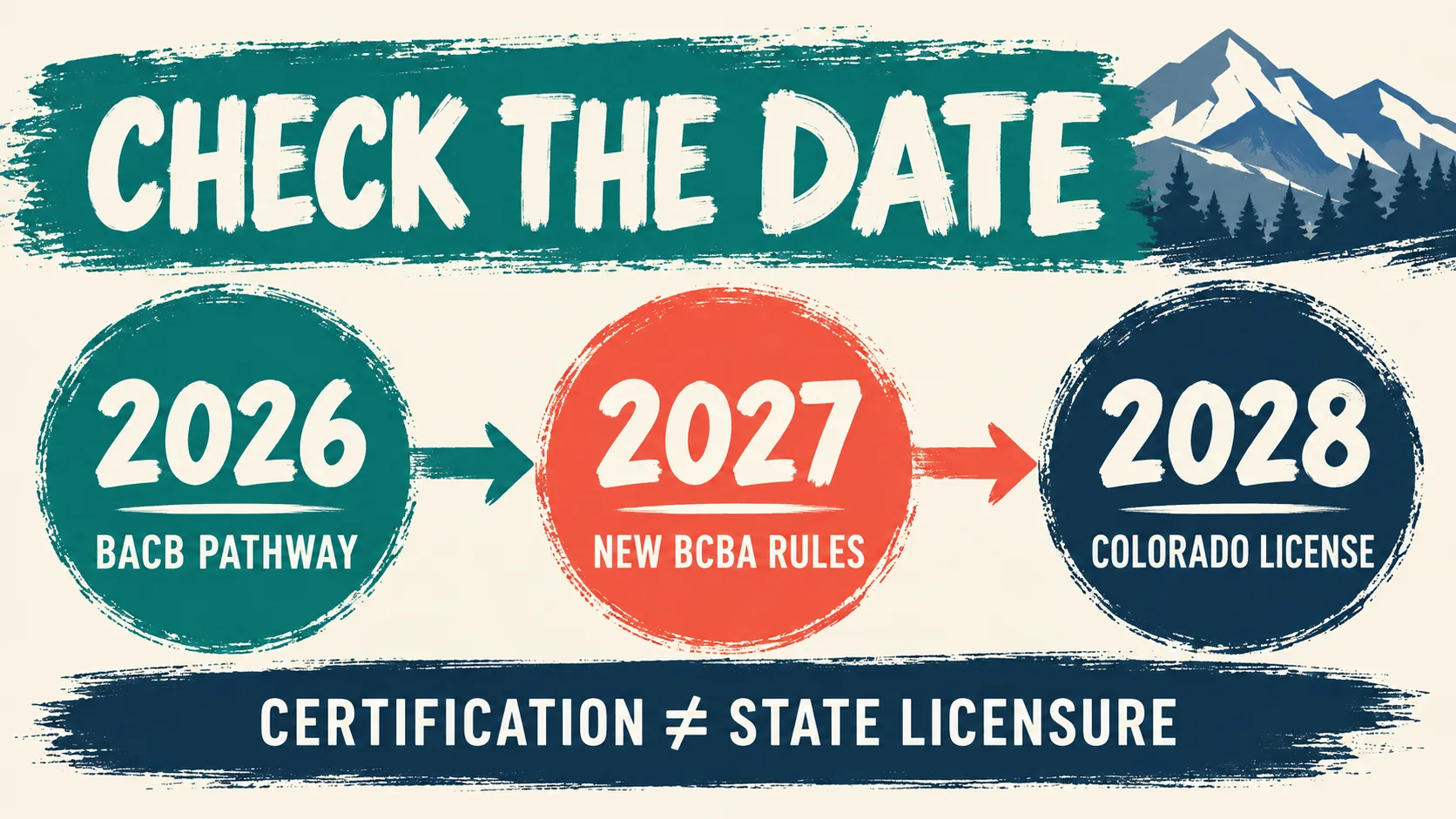
- Check Colorado practice authority. Certification and state licensure are not interchangeable, especially during the 2026–2028 transition.
Do not choose a graduate program only because its marketing says “BCBA track.” Ask which BACB pathway it supports, how fieldwork is arranged, who supervises it, and how the program is handling the 2027 transition.
Choose a BACB Eligibility Pathway
The BACB’s 2027 requirements describe two main routes. Pathway 1 uses a qualifying master’s or doctoral degree from an APBA-accredited program or an ABAI-accredited or recognized behavior-analysis program. Pathway 2 uses a qualifying graduate degree in any field plus behavior-analytic coursework that meets the BACB’s requirements. Both routes still require practical supervised fieldwork and a passing examination.
Timing matters. The BACB’s transition guidance says that applicants seeking review under the current requirements must submit a complete application, including payment and required documents, by December 31, 2026. If you will apply on or after January 1, 2027, use the new requirements and the current BCBA Handbook rather than relying on an older university page or an old study guide. Before enrolling, verify:
- Whether the program’s degree and coursework satisfy the pathway you plan to use.
- Who confirms coursework or sends official transcripts to the BACB.
- Whether supervised fieldwork is embedded, coordinated, or entirely your responsibility.
- How the program explains the 2027 coursework, form, and application changes.
Complete Supervised Fieldwork
Fieldwork is not simply time spent working in an ABA setting. It must be planned, supervised, documented, and connected to behavior-analytic practice in a way that meets BACB requirements. For the 2027 overview, the BACB lists 2,000 hours for supervised fieldwork or 1,500 hours for concentrated supervised fieldwork. The supervision percentages are different: 5% for supervised fieldwork and 7.5% for concentrated fieldwork.
The 2027 overview also includes limits and quality checks such as 20 to 160 fieldwork hours per supervisory period, a 60-minute cumulative client observation for supervised fieldwork or 90 minutes for concentrated fieldwork, at least 50% individual supervision, and at least 60% unrestricted activities. Your exact documentation must follow the current handbook and the forms that apply to your application date. A Colorado fieldwork plan should answer five practical questions:
- Is the supervisor currently qualified under the BACB requirements, and has the required supervision training been completed?
- What client-related activities will count as restricted or unrestricted work?
- How will monthly hours, individual and group supervision, observations, and signatures be reconciled?
- What happens if a supervisor changes jobs, a client leaves, or the organization cannot provide enough qualifying work?
- Which version of the monthly and final verification forms will be used for the application date?
Keep your own contemporaneous records and compare them with the supervisor’s records each period. A spreadsheet can help you organize evidence, but it is not a substitute for the official BACB forms or a signed supervision relationship.
Apply for and Pass the BCBA Exam
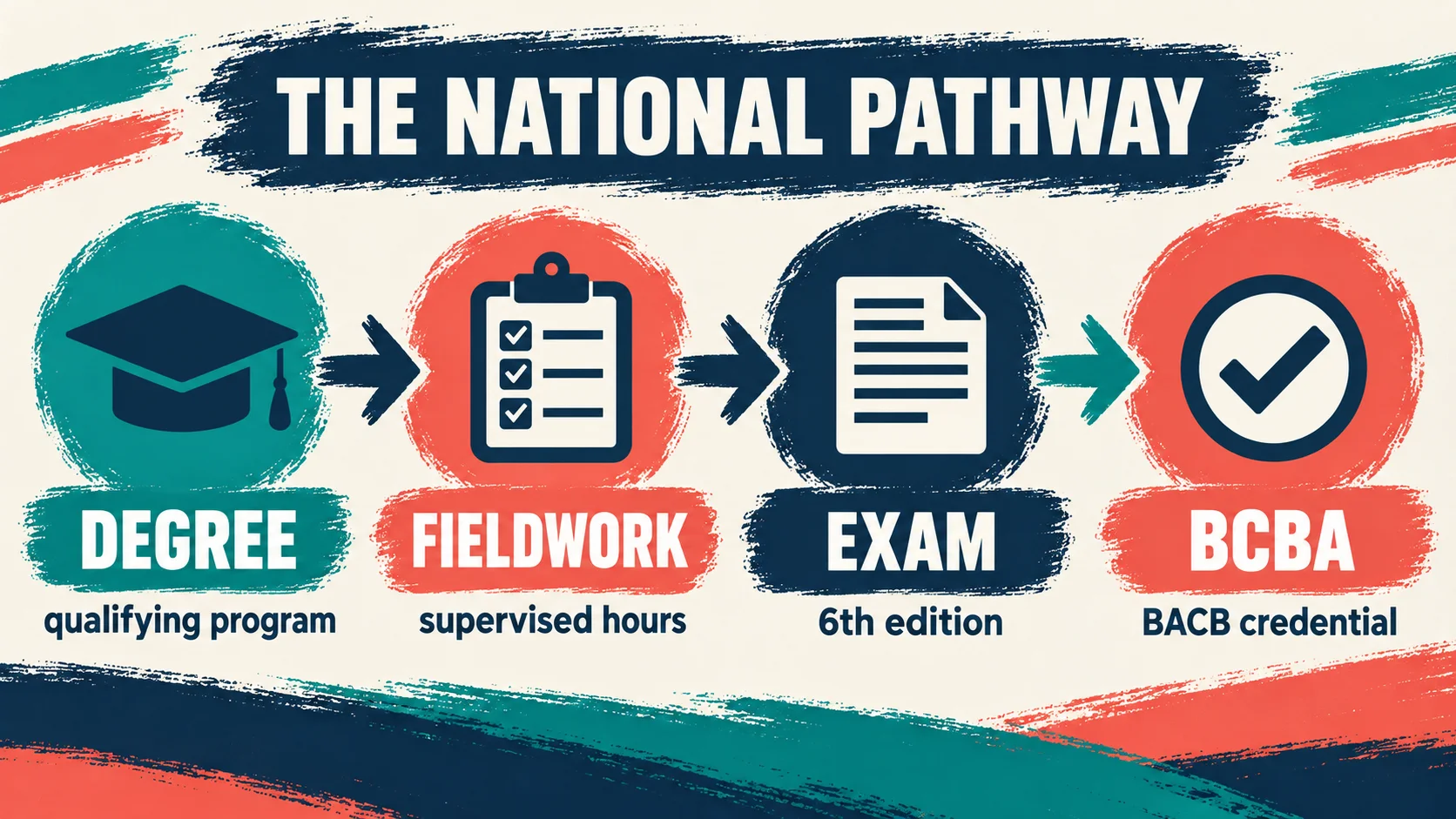
After education and fieldwork are in order, follow the BACB application process in the current handbook. Do not assume that a completed master’s degree automatically gives you permission to schedule the exam. The BACB reviews the application and supporting evidence, and the current exam is based on the 6th Edition Test Content Outline, which took effect January 1, 2025.
Use an application checklist that includes official transcripts, fieldwork verification, supervisor information, identity and payment details, and any action items returned by the BACB. If the application is incomplete, the delay can affect your study schedule and your planned Colorado employment date.
For exam preparation, study by decision rather than by label. When you miss a practice question, record whether the error involved measurement, function, ethics, assessment, intervention selection, supervision, or reading the “best” or “first” qualifier. That error pattern is more useful than a single overall percentage.
Understand Colorado’s Licensing Timeline
Colorado’s 2026 HB26-1425 is the state-specific issue many older “how to become a BCBA in Colorado” pages do not explain. The official bill summary says the act creates a Colorado behavior analyst licensing board under the Department of Regulatory Agencies. It states that, on and after July 1, 2028, a person generally may not engage in or offer applied behavior analysis practice unless licensed by the board or exempted by the law.
The same summary identifies requirements such as filing a license application, holding a valid certification in good standing, completing a fingerprint-based criminal-history check, and carrying professional liability insurance unless a public-employee exception applies. It also says the board may adopt rules. That last point matters: do not invent a future application fee, form, renewal cycle, or detailed exemption from a third-party summary. In practical terms, a BCBA candidate should treat the dates as separate checkpoints:
- 2026: confirm which BACB rules and transition documents apply to your intended application date, and monitor Colorado implementation.
- 2027: use the new BACB eligibility requirements and forms if you apply under the new rules.
- 2028: plan for Colorado’s scheduled licensing requirement before practicing after July 1, unless an exemption applies.
2026–2028 Colorado BCBA Planning Table
Use this table as a planning map, not as a replacement for the controlling documents. The dates answer different questions: national certification rules, transition management, and Colorado practice authority.
| Date | What to check | Your evidence |
|---|---|---|
| 2026 | Current BACB route, complete-application deadline, fieldwork records, and Colorado implementation updates | Current handbook, signed forms, official transcripts, and dated state source |
| Jan. 1, 2027 | New BACB eligibility pathways, coursework, fieldwork, and verification forms | The 2027 BACB requirements and current BCBA Handbook |
| July 1, 2028 | Colorado’s scheduled behavior-analyst licensing requirement, exemptions, and board rules | Colorado application, license, fingerprint, insurance, and rule documents when published |
Choose Programs and Fieldwork Carefully
Colorado has universities, online programs, employers, and private practices that may describe their support differently. Compare the actual evidence instead of choosing from a listicle alone:
- Ask for the exact BACB pathway the program is designed to support.
- Ask who is responsible for finding and verifying a qualified supervisor.
- Ask whether the schedule can produce enough qualifying unrestricted work and observations.
- Ask how the program will communicate 2027 form and coursework changes.
- Ask what Colorado licensing information is known, what is still pending, and where the official update will appear.
Common mistakes include counting unverified work as fieldwork, confusing a school’s certificate with BACB certification, treating a BCBA credential as a permanent substitute for state rules, and studying from a fifth-edition resource after the 6th Edition exam has taken effect. A dated document trail helps prevent each mistake.
Turn the Roadmap Into Exam Practice
The Colorado pathway is a useful BCBA exam practice scenario because it requires you to separate national credentialing, supervised fieldwork, ethics, documentation, and state law. When you study a question, identify the governing authority first: is the stem asking about BACB eligibility, a fieldwork record, an exam decision, or a state practice requirement?
If you are ready to test that reasoning, try the Free BCBA Mock Exam. Use the result as a study diagnostic, then review missed questions by decision error and return to the relevant domain—not as a promise that one score guarantees a passing result.
Bottom line: to become a BCBA in Colorado, complete a qualifying BACB route, document supervised fieldwork, apply and pass the current BCBA exam, then keep Colorado’s separate licensing timeline in view. Recheck the official BACB and Colorado sources at every transition point, especially before practicing after July 1, 2028.
Take the Free BCBA Mock Exam
A useful next step is to apply this idea in a fresh set of BCBA-style practice questions and review the feedback. Take the Free BCBA Mock Exam



